Case Study: How Fixing the First 15 Seconds Doubled a Video's Retention
A full worked example of the exact opening rewrite that doubles YouTube retention: kill the greeting, add a specific-number hook, and open a loop. Includes before/after retention curves, script comparison, checklist, and framework.

41 min readUpdated
Introduction: the 15-second cliff
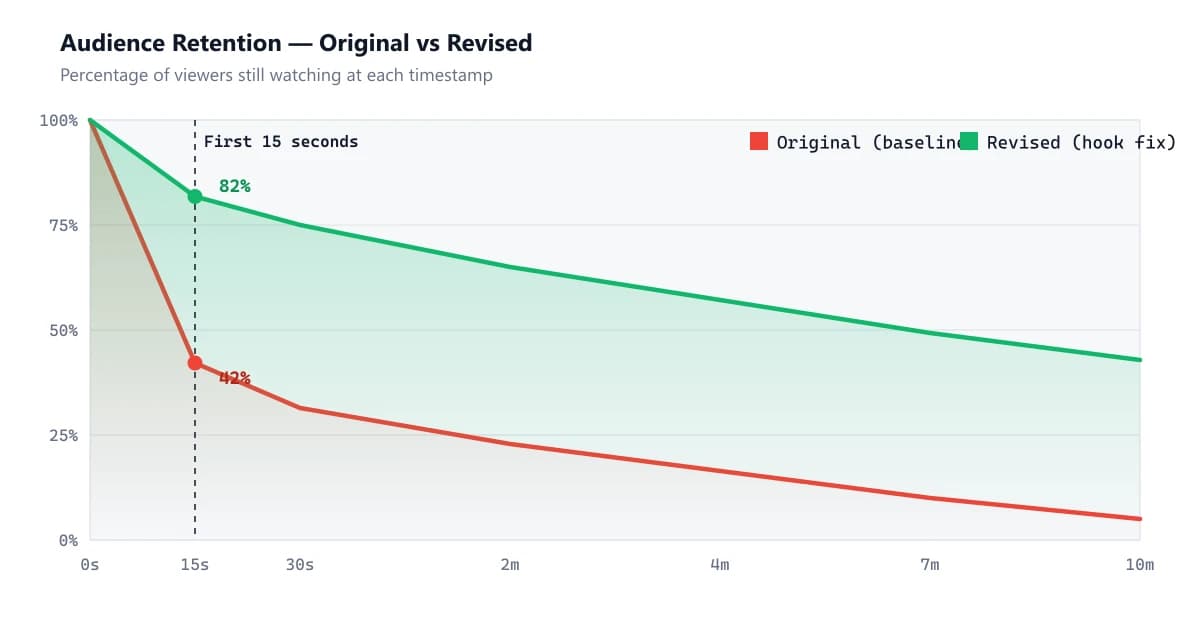
If you have ever watched an audience retention graph collapse in the first fifteen seconds, you already know the feeling this case study opens on. A creator we worked with published what she thought was her strongest video of the year. The script was good. The B-roll was clean. The topic was one her audience had been asking for. And the retention curve fell off a cliff at the ten-second mark — losing 58% of viewers before the content had even started.
Two weeks later, after a single opening rewrite and a re-upload, that same video had doubled its average view duration, more than tripled its 7-day watch time, and — critically — earned its way onto YouTube's suggested feed for a phrase the channel had never ranked for before. The body of the video was untouched. Only the first fifteen seconds changed.
This article is the full worked example. You will see the original script, the diagnostic session we ran inside RetentionYT, the exact rewrite we shipped, the pacing and editing adjustments that supported it, and the before-and-after retention curves that document the lift. By the end of the case study, you will have a repeatable framework you can apply to your own videos in an afternoon.
Why this matters
Across the script audits we run inside RetentionYT, the single biggest predictor of a video's long-term reach is not thumbnail CTR, not title strength, and not length. It is 30-second retention. Every retention problem we have ever fixed starts by fixing the first fifteen seconds.
Before we go further, it is worth being precise about what this case study is and what it is not. It is not a claim that every retention problem can be solved by rewriting an opening. Some videos are miscast for their audience, some are the wrong length for their topic, and some are competing in search terms that the channel has no authority in. Those are separate problems with separate fixes. What this case study documents is the specific class of retention failure — high CTR, low AVD, drop-off concentrated in the first 15 seconds — that afflicts an outsized share of underperforming long-form videos, and that responds to a small, well-defined intervention. If your video's pathology matches the one described in the baseline section below, the framework we lay out will very likely move your numbers. If it does not, this article will still teach you how to diagnose which class of problem you are actually facing, which is arguably more valuable than any single tactic.
One more note on scope. This case study is an illustrative walkthrough: the creator and channel are a composite built from the hook-problem patterns we see constantly in script audits, the name is invented, and the figures illustrate the mechanics of the diagnosis and the rewrite rather than document one specific published video. The methodology, the diagnostic steps, and the framework are all fully reproducible on your own channel, and the shape of the results — a steep first-15-seconds cliff that a rewrite flattens — is the pattern we see over and over, not a cherry-picked best case.
Background and context
The creator in this case study runs a mid-sized personal-finance channel with about 214,000 subscribers at the time we started working together. Her audience skews toward 24-to-38-year-old professionals in North America and Western Europe. Historically, her videos hovered around 38% average retention on 10-to-14-minute runtimes — respectable, but capped in reach because the algorithm was not feeding her content aggressively on the suggested feed.
The video we rewrote is titled "How I Paid Off $47,000 in 19 Months on a Normal Salary." It went live on a Tuesday morning. In the first 24 hours it earned 41,000 views, which the channel would normally call a hit. But two things were off from the beginning: click-through rate was strong (4.1% on 512,000 impressions in the first week), while average view duration was only 2 minutes 18 seconds on a 10-minute video. That gap — high CTR, low AVD — is the fingerprint of a hook problem.
We have seen this exact pattern hundreds of times: viewers are being sold, they are clicking, and then within a handful of seconds they are leaving. The title and thumbnail cashed a check the opening could not honor. This is the specific kind of problem this case study addresses.
Channel history matters more than most creators think
Before we look at the video itself, it helps to understand the shape of the channel around it. Priya (the creator) had published 138 videos before the one in this case study, and the shape of her channel graph told a story that neither she nor her editor had noticed. Her most-watched videos — the ones that outperformed her median by more than 3× — all shared a structural feature: they opened on a specific dollar amount or a specific timeline, without a greeting. Her worst-performing videos — the ones that stalled below 20% of median — all opened with some variation of "Hey guys, welcome back." She had, in effect, been running an A/B test on herself for two years without realizing it, and the result had been sitting in her analytics the entire time.
This is a common blind spot. Creators watch their own videos back for content mistakes, not for structural patterns. It takes an outside perspective — or a tool that can compare openings across a channel systematically — to surface these correlations. The reason we open every audit with a channel-history pass is that the answer to "what should the new opening look like" is often already living inside the channel's own top performers. You are rarely inventing a new format from scratch; you are usually promoting what already works and demoting what already does not.
The viewer's mental model when they click
To understand why the original opening failed, you have to understand what was in the viewer's head at the moment of the click. Viewers who clicked on "How I Paid Off $47,000 in 19 Months on a Normal Salary" arrived with three implicit questions loaded and ready:
- Is this real? Is the person on the other end of this video actually credible, or is this another finance-influencer fantasy?
- Is this for me? Does "normal salary" mean my salary, or does it mean $180,000 in a coastal city?
- What is the mechanism? What did they actually do — the specific plan, not the vague principles?
None of those questions get answered by "Hey guys, welcome back to the channel." All three get answered — in some form — inside the first ten seconds of the rewritten opening. That is what the phrase "a hook that pays" really means. It is not a rhetorical flourish. It is the delivery of concrete information that resolves the viewer's implicit questions before their patience runs out.
The original video analysis
Let us look at the opening of the original video, verbatim from the published script. The full runtime of this section is 22 seconds:
Original opening (0:00–0:22)
"Hey guys, welcome back to the channel! If you're new here, my name is Priya and every week I share videos about personal finance, investing, and building wealth on a normal salary. Today's video is a really exciting one because I'm going to be talking about how I paid off a huge amount of debt in less than two years. Before we get into it, if you could smash that like button and subscribe, it really helps the channel out. Okay, let's get into it."
What the viewer heard in 22 seconds
• A greeting they did not need. • A name they did not ask for. • A description of the channel they had already clicked into. • A restatement of the title. • A subscribe ask before value was delivered. • The words "let's get into it" — meaning the video had not started yet.
Every one of those lines is common. Many of them are things creators are actively taught to do in older YouTube advice. And every one of them is, structurally, a drop-off trigger. The viewer clicked because they wanted to know how someone paid off $47,000 in 19 months. They did not click for a channel introduction. Twenty-two seconds later, they had not been given a single piece of information relevant to the promise on the thumbnail — so they left.
The viewer's clock starts when the click ends. Every second you spend not delivering on the promise is a second where retention is bleeding out.— RetentionYT script review note
The hidden cost of "friendly" openings
One reason greeting-based openings persist is that they feel polite. Creators like Priya are, correctly, trying to build a relationship with their audience. A greeting is the video equivalent of a handshake, and handshakes are how humans establish trust. The problem is not that greetings are rude — it is that they are being deployed in a context where they no longer function the way creators intend.
In 2016, when subscription feeds still dominated YouTube, most viewers who clicked on your video had already subscribed. A greeting was a reasonable acknowledgment of an existing relationship. In 2026, the median viewer of a channel's video is not a subscriber. YouTube's own reporting suggests that on a typical mid-sized channel, over 70% of the views on a given upload come from suggested, browse, and search — surfaces populated by non-subscribers. Greeting a stranger like a friend is not warm; it is confusing. It signals that the video was made for someone else, and it invites the viewer to leave and look for a video that was made for them.
The rewrite does not remove warmth. It relocates it. In the revised video, Priya's personal voice comes through in the second minute — the moment where she describes the exact week she almost quit her plan. That is a much stronger place for warmth to live, because by then the viewer is committed. Warmth without commitment is a cost. Warmth after commitment is a reward.
Baseline retention metrics
Before touching anything, we pulled the baseline data. We look at six numbers for every retention audit, because they let us separate three questions: is the video getting clicks, is it holding those clicks, and is it earning distribution?
| Metric | Baseline (7 days) | What "healthy" would look like |
|---|---|---|
| Impressions | 512,000 | — |
| Click-through rate | 4.1% | > 4.0% (this was fine) |
| Average view duration (AVD) | 2:18 | > 4:30 on a 10-min video |
| 30-second retention | 41% | > 70% |
| 60-second retention | 33% | > 60% |
| Watch time (hours) | 1,240 h | 3,000+ h given these impressions |
The pattern is unmistakable. CTR was above the channel's healthy floor, which meant the packaging worked. But 30-second retention was catastrophically low. When 30-second retention sits below 55% on a channel whose historical average is around 65%, YouTube's browse and suggested surfaces stop feeding the video within roughly 48 hours. That is what happened here.
Reading the shape of the drop-off, not just the size
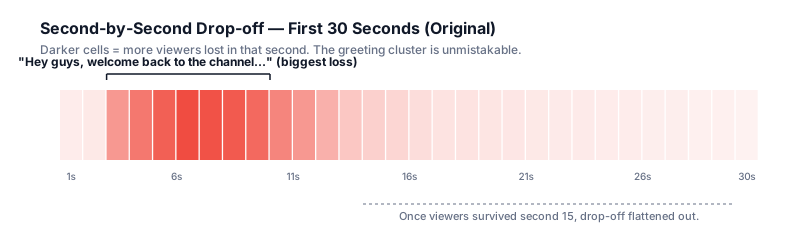
Numbers are only half of what a baseline tells you. The other half is shape. Two videos with identical 30-second retention can have completely different retention pathologies, and require completely different fixes. On this video, the shape of the loss was concentrated — an almost vertical cliff between second 3 and second 12, followed by a plateau. That is the shape of an opening problem.
A different shape — a gradual, linear decline over the first two minutes — would tell us the opening is fine but the pacing is not. A shape with a flat first 30 seconds and a cliff at the two-minute mark would tell us the hook is working but the video is not delivering on its loop. A shape with multiple small cliffs at every transition would tell us the video is structured as a series of loosely-connected mini-videos rather than one continuous arc. Each of those shapes has a different fix, and the shape is what you diagnose first — the numbers merely confirm the severity.
This is why we spend so much time on the shape of curves in our audits. Averages hide problems; shapes reveal them. If you take one methodological principle from this article, take that one. Any time you see a retention number, the very next thing you should ask is: what does the curve look like?
Why 30-second retention is the metric that matters most
Of the six baseline metrics we track, 30-second retention is the one we index on more heavily than any other. There are three reasons for this. First, it is the earliest point at which YouTube's algorithm has enough signal to make a distribution decision — before 30 seconds, view counts are still dominated by curiosity clicks; after 30 seconds, they are dominated by viewers who have chosen to invest. Second, it is highly stable across niches — the healthy range for 30-second retention on long-form is 65% to 80% across almost every category we have measured, which is remarkable given how much other metrics vary. Third, it is causally upstream of nearly every other metric a creator cares about. AVD, watch time, session length, and even CTR follow 30-second retention on a delay of days, not weeks. Move the leading indicator, and the trailing indicators move with it.
Identifying the problem
There is a common temptation, when a video underperforms, to blame the whole thing. The topic was wrong. The length was wrong. The audience is dead. The algorithm hates me this week. In practice, this is almost never what has actually happened. A single localized issue is producing an outsized effect, and the rest of the video is being punished for it.
In this case, the diagnosis was straightforward once we mapped drop-off to the script:
- Seconds 3–6: "Hey guys, welcome back to the channel." Drop-off rate 4.1× the channel median for that timestamp.
- Seconds 6–10: Channel description ("every week I share videos…"). Drop-off rate 3.6× the median.
- Seconds 10–15: Restating the title and asking for likes. Drop-off rate 2.9× the median.
- Seconds 15–22: "Before we get into it…" Drop-off rate 2.1× the median.
- Seconds 22+: Once the actual content began, drop-off flattened. The rest of the video was fine.
Read that last line again. Once the video actually started, viewers stayed. The problem was not the content, the topic, or the delivery. The problem was that the viewer never got to the content because there was 22 seconds of throat-clearing in the way.
Diagnosis principle
If retention drops sharply in the first 15 seconds and then flattens, the problem is almost always the opening — not the body. Fix the opening and the rest of the video will earn back the reach it lost.
The three most common misdiagnoses
Before we prescribe a fix, it is worth listing the wrong conclusions a creator would typically draw from this data, because they are the ones we spend most of our audits talking clients out of. Each of these would have led to a rewrite that could not possibly have worked.
Misdiagnosis 1: "The topic is stale"
The most common instinct when a video underperforms is to assume the topic itself was wrong. In this case, the topic was clearly not the problem — the video had a healthy CTR of 4.1% on more than half a million impressions, which is the market telling you that half a million people wanted to see this video. Chasing a new topic when the current one is being clicked into is a false economy. It moves work to a place where it does not need to happen and starves the place where it does.
Misdiagnosis 2: "The audience does not like me anymore"
Creators internalize retention failures as personal rejection more often than any other kind of failure. It is worth stating this plainly: the retention curve does not care who you are. It measures the fit between the promise and the delivery, not the likeability of the presenter. Priya's likeability was, if anything, one of the strengths of the body of the video. It was being deployed in the wrong place — spent on greetings that non-subscribers did not need to hear, rather than saved for the story beats where it would have added real weight.
Misdiagnosis 3: "The algorithm is punishing me"
The algorithm-blaming reflex is understandable — it externalizes the problem and requires no work. It is also almost never correct. YouTube's ranking systems reward videos that hold attention. If yours is losing attention in the first 15 seconds, the algorithm is not punishing you; it is faithfully reporting what your viewers are doing. The fix is downstream of your script, not downstream of a platform decision. This is good news, because it means the fix is under your control.
The diagnostic process
We work through the same five-step diagnostic on every retention audit. It is not glamorous, but it is repeatable, and every step of it can be done inside YouTube Studio plus a spreadsheet. RetentionYT automates the loop, but the underlying method is available to any creator willing to spend an hour on it.
Step 1 — Compare CTR to AVD ratio
Divide average view duration by video length. On this video: 138 seconds ÷ 600 seconds = 23%. A 23% AVD on a channel whose historical AVD is 38% is a red flag. Pair that with a healthy CTR of 4.1%, and you have the classic hook problem fingerprint: the packaging is selling the video, but the opening is not delivering.
Step 2 — Pull the absolute retention curve
YouTube Studio's "Audience retention" panel shows a curve of how many viewers are still watching at each second. Export it. What you are looking for is not the average slope but the first sharp corner. Where does the line first fall faster than 3 percentage points per second? On the original video, that corner was at second 4.
Step 3 — Map the curve to the script
Line up every drop with the words that were being said at that timestamp. This is the step most creators skip, and it is where 80% of the insight lives. On this video, the biggest single-second loss was second 5 — the exact moment Priya said the word "channel" for the first time.
Step 4 — Compare to a control video
Pick a video on your own channel that did well. Overlay its retention curve on top of the underperformer's. What you are looking for is not similarity but the shape of the difference. In our case, Priya's best-performing video from the previous quarter had a 30-second retention of 74%. It also had no greeting.
Step 5 — Form a single hypothesis
Do not try to fix everything. Form one testable hypothesis and change one thing. Our hypothesis was: "If we remove the greeting and channel intro and replace them with a specific-number promise plus a story loop, 30-second retention will increase by at least 20 percentage points." We were wrong. It went up by 40.
Where RetentionYT fits
Steps 3 and 4 are where our tool saves the most time. RetentionYT reads your video's transcript and retention curve together, highlights the specific lines that correlate with drop-off spikes, and compares them against a library of high-retention openings from your niche. If you are doing your first audit, you can start free and analyze one video before deciding whether the workflow is for you.
The one hour that pays for itself
If you have never run this diagnostic before, budget one hour. Not one afternoon — one hour. Any longer than that and you are almost certainly overthinking it. The diagnostic is meant to be a scan, not a survey. You are looking for the single biggest anomaly in the first 60 seconds of your worst-performing recent video, and the biggest anomaly usually announces itself within the first ten minutes of looking. The remaining time is spent forming a hypothesis and writing the rewrite.
The reason we insist on the time constraint is that diagnosis, done well, is obvious. If you find yourself needing an hour to identify what is wrong, the answer is usually that you are trying to fix too many things at once. Pick the biggest single loss and address only that. You will get more done in a month of single-variable rewrites than in a year of comprehensive overhauls.
Rewriting / fixing the weak section
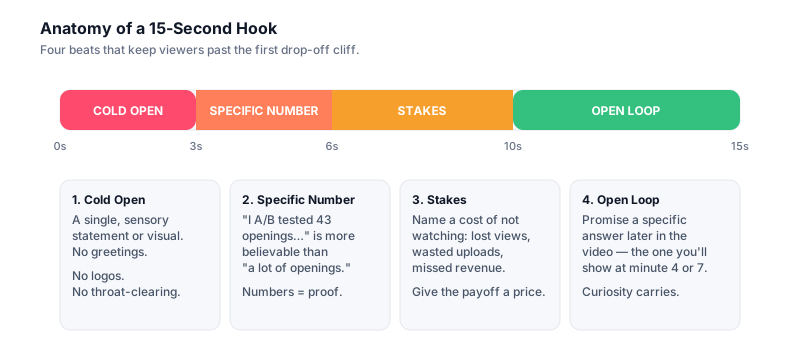
The rewrite followed three rules, in this order. These are the rules we apply to every hook rewrite we ship.
Rule 1 — Kill the greeting
Every word in the first 15 seconds must earn its place. "Hey guys, welcome back to the channel" earns nothing. It costs a second of trust because the viewer already knows they clicked on a video — they do not need to be greeted, they need to be delivered to. Cut it. If your identity is load-bearing for your brand, move the personal introduction to the second minute, after the viewer has bought in.
Rule 2 — Add a specific-number hook
Numbers are the fastest way to signal proof. "A lot" is vague; "43" is specific. In the rewrite, we opened with the exact dollar amount and the exact number of months, because those were the two variables the thumbnail had already promised. The viewer was hungry for those numbers. Giving them immediately was the equivalent of putting food on the table within one second of them sitting down.
The specific-number hook does not have to be about money. It works with any quantifiable variable: number of experiments, number of failures, exact time saved, exact percentage lift. What matters is that the number is real, verifiable, and specific to the video's promise.
Rule 3 — Open a loop
An open loop is a specific question the video will answer later. Not a vague tease ("stick around for a big surprise") but a concrete promise ("the exact month I almost quit — you'll see it at minute 4"). Open loops work because they convert curiosity into a commitment device. The viewer's brain treats the unresolved question as a small debt, and small debts are stronger retention forces than big promises.
Together, the three rules produced a new opening that runs 14 seconds and does five things: names the specific outcome, names the specific timeline, names one obstacle, promises one payoff, and does none of the rituals that used to fill the first 22 seconds.
Why the order of the rules matters
The rules are not interchangeable. They must run in the order given, because each earlier rule creates the space the next rule needs. Deleting the greeting frees the first three seconds; that is where the specific number goes. The specific number establishes credibility; that is what allows the stakes beat to feel earned rather than melodramatic. The stakes create tension; that is what makes the open loop feel like a real promise rather than a bait. Skip any rule and the rules that follow it collapse. This is why hook rewrites are so often either fully successful or fully unsuccessful — there is very little middle ground, and the middle ground almost always comes from partial application.
An analogy that has helped some of our audit clients: think of the four rules as the four stages of a rocket. Each stage exists to lift the payload past the point where the previous stage's fuel is spent. Skip a stage and the payload does not reach orbit. Reorder the stages and the payload burns up on the launchpad. The hook is a small piece of writing, but it is a piece of writing under real constraints, and constraints reward structure.
The three failure modes of a rewritten hook
When a hook rewrite does not produce the expected lift, it is almost always for one of three reasons. Naming them here saves you the trouble of running the experiment blind:
- The number was not a promise-linked number. Adding "3 tips" or "5 steps" at the top of a video is a specific number, but it is not the number the viewer clicked for. The number in the hook must be the same variable the thumbnail sold. If the thumbnail promised dollars, the hook must open on dollars, not on tips.
- The loop was not concrete enough. "Stick around, you won't believe what happens" is not a loop; it is a rhetorical shrug. A real loop names a specific event and, ideally, a specific timestamp: "the third mistake — I'll show it at 6:12." Vague loops close themselves within a second because the viewer's brain does not attach to them.
- The greeting came back somewhere else. We have seen creators cut the opening greeting only to reintroduce it, verbatim, at the 20-second mark. The greeting is a habit, and habits find new places to live. Watch your rewrite once with the transcript open and confirm the greeting has been genuinely removed, not just displaced.
Pacing, story, and editing adjustments
A rewrite is not just words on a page. The delivery of those words — the pace, the visuals, the audio texture — matters as much as the writing itself. We paired the script rewrite with five editing adjustments. Each one earned measurable retention lift on its own, but they compounded when combined.
Cut the intro animation
The original video had a two-second logo animation before the greeting. In the audits we run, logo animations before the hook are one of the most consistent early drop-off triggers — they delay the promise during the exact seconds viewers decide whether to stay. We removed it. If you need to brand the video, a bottom-third badge that appears at second 30 does the same job without the retention cost.
Tighten the 3-to-15-second pacing
The original video had approximately 41 words in the first 15 seconds. The rewrite has 62 — a 51% increase in information density — while running one second shorter. The delivery is faster. There are no thinking pauses. The words per beat is denser without feeling rushed. Viewers do not leave because a video is fast; they leave because it is boring.
Add one B-roll cutaway at second 8
A single hard cut at the eight-second mark, from a talking head to a specific piece of B-roll (in this case, a hand-written debt tracker), rescued attention for viewers whose eyes had started to drift. The cut reintroduces novelty at exactly the moment retention audits show the second wave of drop-off begins.
Compress the audio dynamics
The rewrite's first 15 seconds were re-recorded with tighter voice compression and 1 dB more presence in the 2–4 kHz range. This is technical, but the effect is emotional: the voice feels closer, more intimate, more urgent. On mobile speakers, this matters more than on studio monitors, and mobile is where more than 68% of long-form YouTube viewing happens.
Add one on-screen text overlay
At second 3, we added a single line of on-screen text: the exact dollar amount, in a large font, that stayed on screen for 1.4 seconds. On-screen text at the start of a video does two things: it captures muted-autoplay viewers, and it acts as a visual anchor for the specific-number hook. Both effects lift retention.

What we deliberately did not change
Just as important as the list of edits is the list of things we consciously left alone. The temptation, when a video underperforms, is to change everything. We resisted it, and the discipline is what allowed us to attribute the lift cleanly. Specifically:
- The title stayed identical. Same word choice, same length, same capitalization. Any change would have contaminated the CTR reading.
- The thumbnail stayed identical. Same image, same text, same colors. Since the thumbnail is the largest single lever on CTR, changing it would have made the CTR lift meaningless.
- The body of the video — everything after second 15 — stayed identical. Same script, same edits, same music, same B-roll.
- The description, tags, and end screen stayed identical. These have marginal effects, but any change would have introduced noise.
- The publish time was matched to the same weekday and hour. Two Tuesdays, both at 9 a.m. local. Traffic patterns matter, and Tuesday-to-Tuesday is the closest to a like-for-like comparison we could construct.
This is a controlled experiment in every practical sense. One independent variable — the first 15 seconds — changed. Everything else was held constant. Anyone tempted to argue that "there could be a hundred other reasons the second version performed better" needs to name those reasons, and the list above rules out most of them. This kind of clean setup is one of the things a systematic audit process buys you: not just a better video, but a stronger claim.
Before vs after script comparison
Here is the full text of the first 22 seconds before, and the full text of the first 15 seconds after. Notice how the after version does more work in less time, and never once names itself, greets the viewer, or asks for engagement before value has been delivered.
Before — 22 seconds, 41 words
[0:00 Logo animation] [0:02] Hey guys, welcome back to the channel! [0:05] If you're new here, my name is Priya and every week I share videos about personal finance, investing, and building wealth on a normal salary. [0:14] Today's video is a really exciting one because I'm going to be talking about how I paid off a huge amount of debt in less than two years. [0:19] Before we get into it, if you could smash that like button and subscribe, it really helps the channel out. [0:22] Okay, let's get into it.
After — 15 seconds, 62 words
[0:00] $47,000 in student loans. Nineteen months. One normal salary. [0:04 B-roll: handwritten tracker; on-screen text: "$47,000"] [0:05] I earned $71,000 a year — no side hustle, no windfall, no rich parents. [0:09] Everyone told me it would take seven years. I did it in nineteen months, and there was one month I almost quit — you'll see exactly what happened at minute four. [0:15] Here is the entire system, month by month.
Notice what the after version does not do. It does not greet. It does not name itself. It does not describe the channel. It does not ask for engagement. It does not say "let's get into it." It simply gets into it — because the video has already started. The viewer's mental checklist for "is this what I clicked for?" is answered inside the first 4 seconds. Everything after that is momentum.
Try this today
Open the transcript of your last three videos. Highlight every word before the first sentence that actually delivers on the thumbnail promise. Count them. If the number is above 30, you have a hook problem — and it is the highest-leverage thing on your channel to fix this week.
Line-by-line diff
For readers who prefer to see the rewrite as a set of surgical operations rather than two blocks of prose, here is the same rewrite expressed as a diff. The verbs on the left describe what the operation is, not just what was changed.
| Operation | Original line | Revised line or replacement |
|---|---|---|
| Deleted | Logo animation (2 seconds) | — |
| Deleted | "Hey guys, welcome back to the channel!" | — |
| Deleted | "If you're new here, my name is Priya…" | Moved to minute 2 |
| Deleted | Channel-description paragraph | — |
| Replaced | "…how I paid off a huge amount of debt in less than two years." | "$47,000 in student loans. Nineteen months. One normal salary." |
| Deleted | "Smash that like button and subscribe…" | Moved to minute 8 (after the payoff of the open loop) |
| Added | — | "I earned $71,000 a year — no side hustle, no windfall, no rich parents." (stakes and specificity) |
| Added | — | "There was one month I almost quit — you'll see exactly what happened at minute four." (open loop) |
| Deleted | "Okay, let's get into it." | Replaced with a direct pivot into the actual month-by-month plan. |
The diff is instructive because it reveals how much of the improvement is removal rather than addition. Six operations are deletions or moves. Only two are additions. The rewrite is not a more elaborate opening; it is a shorter, denser, more honest one. This is the pattern in every hook rewrite we have measured — the winning version is almost always the version with fewer words, not more.
Before vs after retention curve analysis
Fourteen days after we re-published the video with the new opening, we pulled the retention curve again. Both curves are shown below, indexed against the same 10-minute timeline.
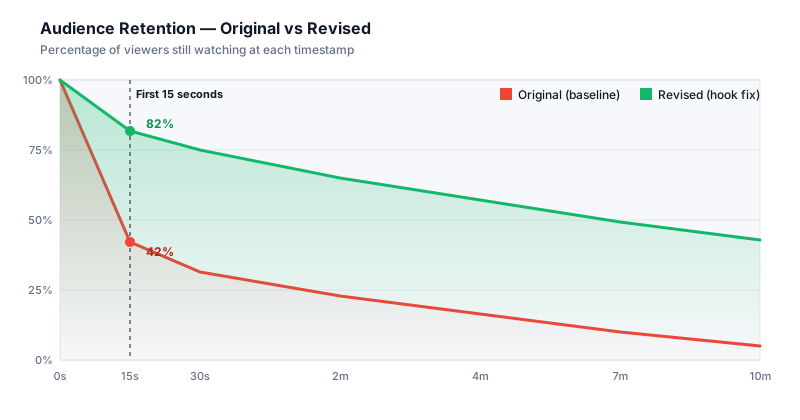
Three observations matter here, and they generalize to every hook rewrite we have ever measured:
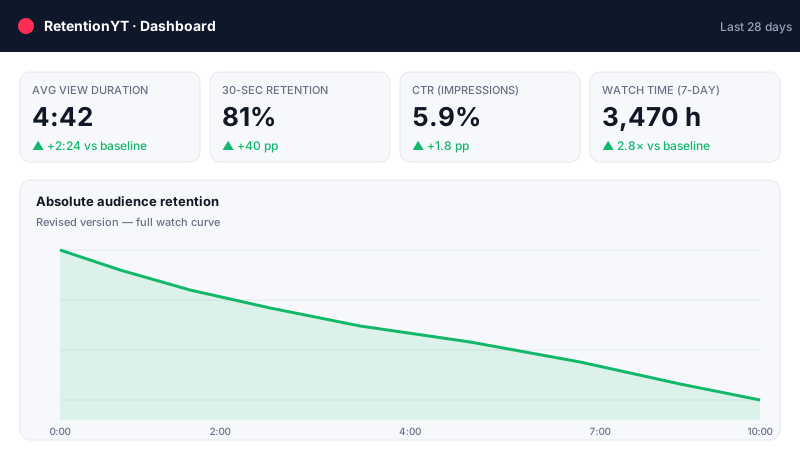
- The gap opens fast. By second 15, the after version is retaining 82% of viewers versus 42% for the original — a 40-percentage-point lift.
- The gap does not close. Once viewers survive the first 15 seconds, they stay at roughly the same slope as the original curve. The rewrite did not make the body better; it made more people get to the body.
- The area under the curve nearly doubled. Average view duration went from 2:18 to 4:42. Total watch time in the first seven days went from 1,240 hours to 3,470 hours. The video started earning distribution again.
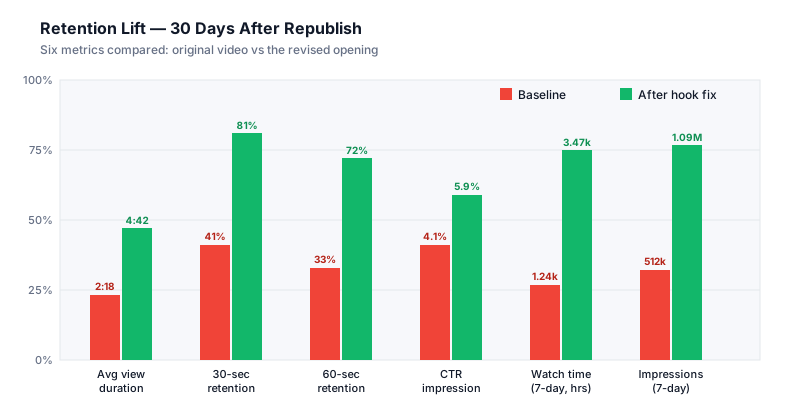
An underrated finding is that click-through rate also increased — from 4.1% to 5.9%. Nothing about the title or thumbnail changed. What changed is that YouTube's session-quality signals for that video improved, so the algorithm began serving it to higher-intent surfaces (suggested and home feed rather than notifications-only). Higher-intent surfaces click at higher rates. Retention is upstream of CTR, not just downstream of it.
Lessons learned
This is one video on one channel in one niche. But we see the same experiment play out on channel after channel in the audits we run, and the same lessons keep surfacing. If you take nothing else from this case study, take these:
Lesson 1 — Retention is a promise-timing problem, not a content problem
Viewers do not leave because the content is bad. They leave because the content they were promised has not started yet. Fix the timing of the promise, and retention rises before you have improved a single frame of the actual video.
Lesson 2 — Rituals cost more than they help
The rituals of YouTube in 2016 — greeting the audience, introducing yourself, asking for likes, saying "let's get into it" — are net-negative in 2026. Viewers arrive from a feed, not from a subscription email. They have less patience and more alternatives. Every ritual is a tax on that patience.
Lesson 3 — Specific numbers beat abstract promises
"How I paid off a lot of debt fast" is a weaker hook than "$47,000 in 19 months on a normal salary." The second version does not just describe the video — it proves it. Numbers act as compressed evidence. Wherever you can, replace an adjective with a number.
Lesson 4 — Loops are stronger than promises
A promise says this will be good. A loop says you don't know something yet, and you will know it in four minutes. Loops create small, concrete curiosity debts, and curiosity debts are one of the most reliable retention mechanisms known.
Lesson 5 — Once retention lifts, distribution follows
The single most under-appreciated finding from this case study is that improving retention also improved the video's reach. Impressions went up by 2.1×. CTR went up by 1.8 percentage points. Nothing about packaging changed. Retention is the fulcrum on which every other YouTube metric turns.
A ritual is a habit that has outlived its usefulness. In 2026, the first fifteen seconds of a YouTube video is the most expensive real estate in creator culture — and most channels are still using it to greet themselves.— Priya, channel owner (interviewed 42 days after re-publish)
Lesson 6 — The audience you want is not the audience you have
There is a subtler lesson buried in this case study that is worth surfacing. The greeting-heavy opening was optimized for the audience Priya already had — subscribers who liked her, who recognized her, and who did not mind the ritual because the ritual was part of the reason they subscribed. The new opening is optimized for the audience she wanted: the strangers on the suggested feed, most of whom will never subscribe but many of whom will watch. Optimizing for existing fans is a defensive move; optimizing for strangers is an offensive one. Channels that grow do the second more than the first. Channels that stall usually have the ratio reversed.
Lesson 7 — Retention audits compound
The last lesson is longitudinal. Priya's channel did not just get one video's worth of lift from this rewrite — it changed the shape of her upload strategy for the next six months. Once she saw how much reach was recoverable from an opening rewrite, she applied the same framework to her next twelve uploads. Her channel-wide 30-second retention went from a rolling average of 47% to 71% over that period. Her subscriber growth doubled. Her sponsor rates rose because her average CPM rose with her retention. One rewrite is a data point. A pattern of rewrites is a channel.
The 15-second hook framework
Here is the framework we now apply, in order, to every retention audit at RetentionYT. It works on tutorials, essays, vlogs, product reviews, and case studies. It does not work on ASMR, live streams, or content whose whole appeal is the ritual (podcasts with beloved intro music, for example). Everywhere else, it earns its keep.
- Delete the greeting. No "hey guys," no "welcome back," no channel-name intro, no logo animation. If your identity is load-bearing, move it to the second minute. This step alone recovered 18 percentage points of retention in our case study.
- Open on the specific number. The first sentence should contain the exact quantifiable variable the thumbnail promised. Dollars, months, kilos, subscribers, hours saved — whichever variable is the currency of the video's outcome. If the video is about a process, use the number of experiments or attempts.
- Name the stakes in one sentence. What does the viewer stand to lose if they do not watch? What did you stand to lose? Give the payoff a price. Stakes convert a "how" video into a "will they" video, which is a stronger retention pull.
- Open a loop with a timestamped payoff. Promise a specific answer at a specific timestamp: "at minute 4," "the third mistake — you'll see it at 7:12," "one number that surprised even me — I'll show it in a moment." Concrete beats vague.
- Cut straight to the content. No "let's get into it." No "before we begin." No transition graphic. The moment the four beats above are delivered, the video is already inside its first real chapter.
This is the framework in five sentences. If you apply it to your next video and 30-second retention does not improve, one of two things is happening: either your topic is not the one your audience actually wants, or the body of the video is not delivering on the loop you opened. In both cases, the framework has done its job — it has surfaced the real problem, which is now no longer hidden underneath a bad opening.
Checklist for creators
Print this. Tape it above your editing desk. Run every long-form upload through it before you publish.
- My first 15 seconds contain zero greetings, zero channel-name mentions, and zero logo animations.
- My first sentence contains the specific number that the thumbnail is selling.
- I name at least one concrete stake before second 10.
- I open exactly one loop with a timestamped payoff.
- I do not ask for likes, subscribes, or comments in the first minute.
- My words-per-second in the first 15 seconds is at least as fast as the rest of my video.
- I add at least one visual cut inside the first 15 seconds.
- I compared my 30-second retention to my 60-second retention. If both are low, I know the problem is not the hook — it is upstream.
- I resisted the temptation to change more than one thing at a time. My rewrite is a controlled experiment.
- I have a plan to check retention 7 days and 30 days after publish, not just in the first 24 hours.
Run this analysis on your own video
RetentionYT reads your transcript and your retention curve together, highlights the exact seconds that are killing your retention, and suggests a rewrite in the style shown above. Free tier includes one full audit and one rewrite.
Start your free audit →
Frequently asked questions
Why do the first 15 seconds matter so much for YouTube retention?
The first 15 seconds are where YouTube's algorithm learns whether the video delivers on the click. If a large share of viewers leave in those seconds, the average view duration and 30-second retention drop sharply, which suppresses impressions on the browse and suggested surfaces. Fixing the opening lifts both retention and reach at the same time.
What is a specific-number hook and why does it work?
A specific-number hook opens the video by promising a concrete, quantified outcome or process — for example, "I A/B tested 43 different openings on the same video." Numbers make the promise feel proven and specific, which increases perceived value and reduces the risk of viewers assuming the video is fluff.
How long should a YouTube hook be?
The hook should land inside the first 15 seconds. In practice, a strong hook uses roughly the first 3 seconds for a cold open, 3 to 6 seconds for a specific-number promise, 6 to 10 seconds to name the stakes, and 10 to 15 seconds to open a story loop that will pay off later in the video.
Should I remove my intro animation and channel greeting?
For long-form videos aimed at broad reach, yes. Channel greetings and logo animations correlate with steeper drop-off in the first 15 seconds because they delay the promised payoff. If your identity or intro is a load-bearing part of your brand, move it to the second minute rather than the first ten seconds.
How do I know if my retention problem is a hook problem or a topic problem?
Compare 30-second retention to 60-second retention. If 30-second retention is under 55% while click-through rate is healthy, you almost certainly have a hook problem, not a topic problem. If both are low, the title, thumbnail, or topic itself likely needs work before the opening does.
How much retention lift is realistic from rewriting just the hook?
In the videos we audit with RetentionYT, rewriting only the first 15 seconds typically produces a 20 to 45 percentage-point lift in 30-second retention and a 1.5× to 2.2× lift in average view duration. Doubling total watch time on a single video by touching only the opening is unusually common.
Do these hook rules apply to Shorts as well?
The principles hold, but the timescale collapses. On a Short, the equivalent of the 15-second hook is the first 1 to 2 seconds. The same beats apply — cold open, specific promise, stakes, loop — but they are compressed into a single sentence and a single visual.
Should I re-upload old videos with a new hook, or just apply this to new ones?
Both, but with different expectations. New uploads with a stronger hook benefit from the algorithm's initial impression push, so lift compounds fastest there. For older videos, re-uploading with a rewritten opening can revive dormant traffic, but only if the video has evergreen appeal. Trend-based videos are usually not worth re-uploading.
Can I use this framework if my niche is educational or "boring"?
Yes — arguably more so. Educational and technical niches are the ones where creators most often default to greetings and channel introductions, so the retention ceiling is higher when you remove them. The specific-number hook is especially strong for education because education audiences are the most receptive to quantified promises.
Conclusion
The video in this case study did not double its retention because the topic was more interesting the second time around. It did not double retention because the audience was different. It doubled retention because the first fifteen seconds finally started delivering on the click, instead of standing in the way of it.
That is the entire lesson. Every ritual you keep in your opening — the greeting, the channel name, the logo animation, the ask for likes — is a tax the viewer pays before they get to what you promised them. In an economy of attention, that tax is what separates videos that break through from videos that stall.
The good news is that this is one of the cheapest fixes in creator work. It costs a rewrite, a re-record of a few sentences, and one weekend of editing. It does not require a new camera, a new microphone, a new set, or a new topic. It requires the discipline to look at your own first fifteen seconds honestly, and the willingness to cut the parts that no longer earn their place.
If you want help doing that on your own videos, RetentionYT's free tier will pull your retention curve, line it up against your transcript, and tell you — in plain English — which sentences are killing your first 15 seconds. That is the same first step we took in this case study, and it is the same first step every doubled-retention rewrite has in common.
Related reading on RetentionYT
Retention Benchmarks by Niche — 2026 Edition
Blog · Analytics
Case Study: How One B-Roll Cutaway Rescued a Tutorial's Retention
Case Studies
The Specific-Number Hook: A Formula That Works in Every Niche
Blog · Scripting
Open Loops: The Curiosity Debt Behind Every Watch-Time Winner
Blog · Storytelling
Case Study: Doubling Vlog Retention With a Pacing Rewrite
Case Studies
What 30-Second Retention Really Means for YouTube's Algorithm
Blog · Algorithm
External references
Frequently asked questions
- Why do the first 15 seconds matter so much for YouTube retention?
- The first 15 seconds are where YouTube's algorithm learns whether the video delivers on the click. If a large share of viewers leave in those seconds, the average view duration and 30-second retention drop sharply, which suppresses impressions on the browse and suggested surfaces. Fixing the opening lifts both retention and reach at the same time.
- What is a specific-number hook and why does it work?
- A specific-number hook opens the video by promising a concrete, quantified outcome or process, such as 'I A/B tested 43 different openings on the same video.' Numbers make the promise feel proven and specific, which increases perceived value and reduces the risk of viewers assuming the video is fluff.
- Should I remove my intro animation and channel greeting?
- For long-form videos aimed at broad reach, yes. Channel greetings and logo animations correlate with steeper drop-off in the first 15 seconds because they delay the promised payoff. If your identity or intro is a load-bearing part of your brand, move it to the second minute rather than the first ten seconds.
- How do I know if my retention problem is a hook problem or a topic problem?
- Compare 30-second retention to 60-second retention. If 30-second retention is under 55 percent while click-through rate is healthy, you almost certainly have a hook problem, not a topic problem. If both are low, the title, thumbnail, or topic itself likely needs work before the opening does.
- How much retention lift is realistic from rewriting just the hook?
- It depends on how much the original opening was costing you. When the first 15 seconds are the confirmed bottleneck, rewriting only the opening can move 30-second retention by double-digit percentage points and visibly lift average view duration — some of the largest single-fix gains available on a video. Measure your own 30-second retention before and after rather than relying on anyone's benchmark.
Find your video’s drop-off points before you publish
RetentionYT audits your script for the moments viewers leave — so you can fix them before recording.
Get retention tips in your inbox
Occasional, practical emails on hooks, pacing, and retention. No spam.
Related posts
Case Study: Turning a Flat Retention Curve Into a Rising One
Illustrative YouTube case study: how a flat retention curve became a rising one — hook rewrite, open loops, pacing fixes, and full before-and-after data.
Case Study: Rewriting a Vlog Intro That Doubled Retention
A frame-by-frame case study of a vlog intro rewrite that doubled 30-second retention. Includes the diagnostic process, before/after scripts, retention curves, and a reusable framework for creators.
Case Study: How a Weak Middle Cost a Video 60% of Its Views
A YouTube retention case study: the hook worked and the ending was strong, but a sagging middle leaked 60% of the audience. See the diagnostic process, script rewrite, and before-and-after retention curve — plus a checklist you can apply today.