Why YouTube Viewers Leave in the First 30 Seconds (and How to Fix It)
Most viewers leave before your YouTube video really starts. Learn why the first 30 seconds decide watch time, how to read the retention graph, and 14 proven techniques to fix your hook and stop viewer drop-off.

26 min readUpdated
Most of the viewers you lose are gone before your video really starts. The first 30 seconds are where you win or lose them — and where you can recover the largest gains on YouTube in 2026.
Introduction: The 30-Second Cliff Nobody Talks About
Open any of your YouTube analytics reports and scroll to the audience retention graph. Look at the shape of the curve in the first thirty seconds. That single segment — often less than 5% of your total runtime — decides more about a video's fate than any thumbnail, title, or algorithm tweak you will ever attempt.
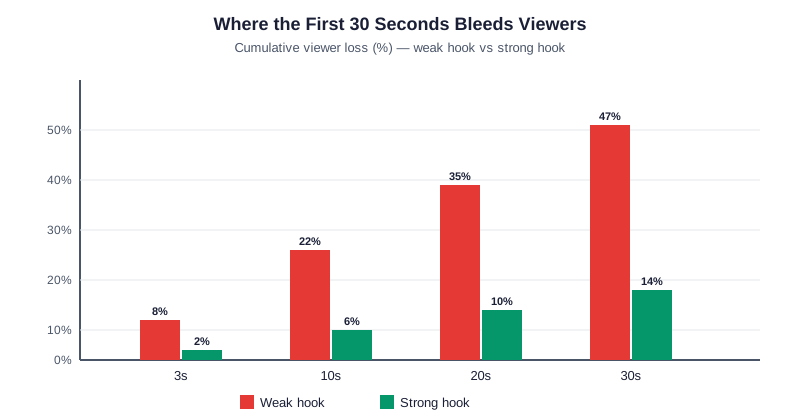
In the script audits we run inside RetentionYT, the pattern is nearly universal. A weak opening loses somewhere between 40% and 55% of viewers before the 30-second mark. A strong opening loses under 15%. That is not a small delta. It is roughly a 3x difference in survival, and it compounds into every downstream metric YouTube uses to rank your video: average view duration, session watch time, click-through follow-through, and returning viewer signals.
The video does not fail at the seven-minute mark. It fails at the seven-second mark. Everything after is just consequence.
This guide is the tactical playbook we wish we had when we started studying retention. It will show you what the graph is actually telling you, why the first 30 seconds carry disproportionate weight in the ranking system, and — most importantly — how to fix them with concrete, testable changes. You will finish with a diagnostic framework, a rewrite template for openings, benchmarks by niche and length, and a checklist you can run on every video before you publish.
A note on how we analyze retention
The benchmarks and case data in this article come from anonymized aggregates across creator channels using RetentionYT in 2025 and 2026. Individual numbers vary by niche, length, and audience source — treat every benchmark as a starting point, not a hard target.
What Audience Retention Really Measures
YouTube gives creators three retention numbers, and most creators never think past the first one.
Absolute retention
The percentage of the video that a viewer watches on average. If your 10-minute video has an average view duration of 4 minutes, your absolute retention is 40%. This number is what you see on your video's analytics page by default.
Relative retention
How your retention compares to other YouTube videos of similar length. This is a peer-normalized score. A 40% absolute retention rate on a 20-minute video is often stronger than 55% on a 4-minute video, because longer videos naturally lose more viewers.
Retention curve (the graph)
The moment-by-moment plot of what percentage of viewers are still watching at each second of the video. This is where diagnostic work happens. The shape of the curve — where it drops sharply, where it flattens, where it spikes back up — tells you exactly which editorial choices are working and which are bleeding viewers.
The distinction matters because retention is not a single number. It is a shape. Two videos with identical average view duration can have wildly different curves — one where viewers stick and then drop off a cliff at the seven-minute mark, and one where viewers steadily bleed from second three. YouTube's ranking system responds to both, but the fixes are completely different.
Best practice
Never optimize a single retention number. Always look at the curve. A 55% absolute retention with a violent drop at 25 seconds is a completely different problem than a 55% absolute retention with a smooth decline — even though the algorithm scores them similarly at first glance.
How YouTube Uses Retention to Rank Videos
YouTube's recommendation system is not a single algorithm. It is a stack of models — one for the home feed, one for suggested videos, one for search, one for Shorts, one for browse — and every one of them optimizes toward a variant of the same objective: expected watch time per impression, weighted by session value.
Retention is the input those models use to estimate that watch time. When your video plays for a new viewer, the models are constantly updating a prediction about how long that person will watch. Every second retained increases the predicted value of showing the video to the next similar viewer. Every early drop-off decreases it.
Why the first 30 seconds carry disproportionate weight
Two mechanical reasons and one behavioral reason.
First, the ranking models observe the earliest signals soonest. When your video has 200 impressions, the only retention data available is from viewers who watched a short segment. The model's confidence in whether to keep pushing your video is highest when it can quickly confirm that early retention is strong.
Second, YouTube tracks session-level satisfaction, not just per-video watch time. A viewer who bails 15 seconds into your video and immediately clicks a competitor's video sends a strong negative signal — YouTube learns that your impression cost a session. A viewer who watches 30+ seconds and then keeps browsing after your video ends sends a positive session signal.
Third, human behavior. Viewers who cross the 30-second threshold have made a conscious commitment. They have decided the video is worth their attention. The odds they finish rise dramatically.
Retention in the first 30 seconds is not just a metric. It is a filter. Pass it and the algorithm keeps investing. Fail it and impressions collapse within 48 hours.
The impression collapse pattern
If you have ever watched a video get 500 impressions in its first hour and then stall out to a trickle, you have seen the impression collapse in real time. The ranking system probed a new video, measured early retention as poor, and quietly stopped serving it. This happens most often to videos with a 30-second retention below 55%. The retention floor at which impressions begin to collapse varies by niche, but the pattern is consistent.
Reading the Retention Graph
Before you can fix retention, you need to read the graph like a diagnostician reads a chest X-ray. Every curve has a story.
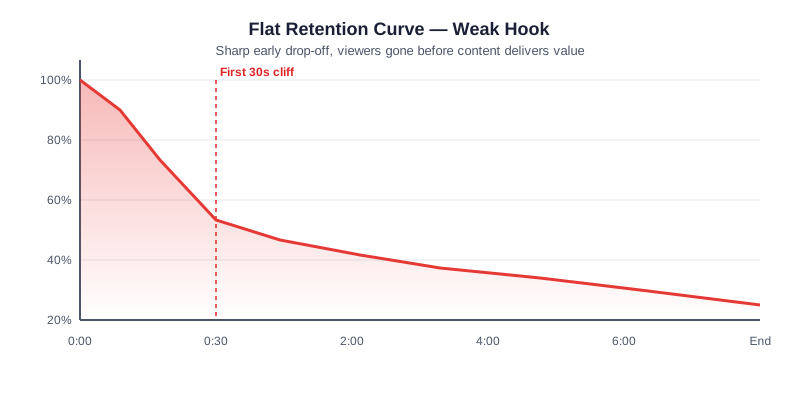
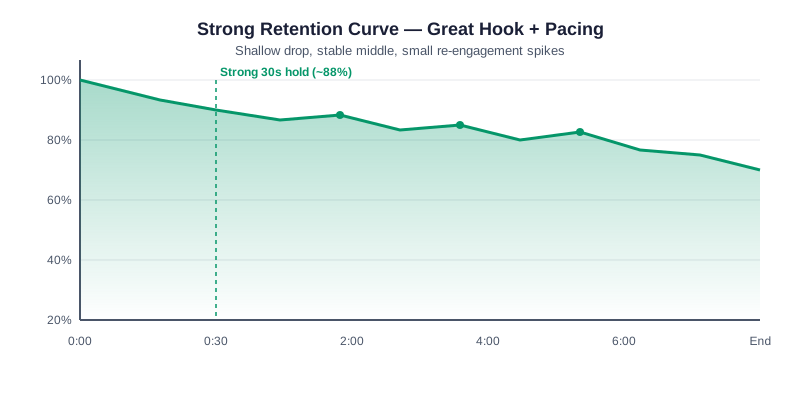
The four shapes you will see most
1. The cliff
A near-vertical drop in the first 15–30 seconds. This is almost always a hook problem: the opening does not confirm the promise made by the thumbnail and title, or the pacing is too slow for viewer expectation. Diagnostic priority: rewrite the first 30 seconds.
2. The slow bleed
A steady linear decline throughout. This signals that the video is delivering value but pacing is off. Viewers keep leaving because nothing renews their interest. Diagnostic priority: add pattern breaks and re-hooks at the 30% and 60% marks.
3. The valley
Good opening, sharp mid-video dip, partial recovery. Classic mid-video slump. The valley usually corresponds to a section where narrative tension collapses — a long tangent, a slow build to a payoff, or a poorly transitioned segment. Diagnostic priority: cut or rewrite the valley segment.
4. The spike-and-hold
A small rise or plateau in the middle of the graph. These are re-engagement moments — a strong visual, a promise renewed, a surprising fact. Study your own spikes carefully: they are your editorial fingerprints and they should be replicated in future videos.
Warning
Do not average the first 30 seconds. Look at every second individually. A curve that drops 15% at 0:07 and another 12% at 0:22 has two separate problems, not one — and the fix for each is different.
Diagnosing Where Viewers Drop Off
The retention graph tells you where. It does not tell you why. That interpretation is the creator's job, and it is where most channels get stuck.
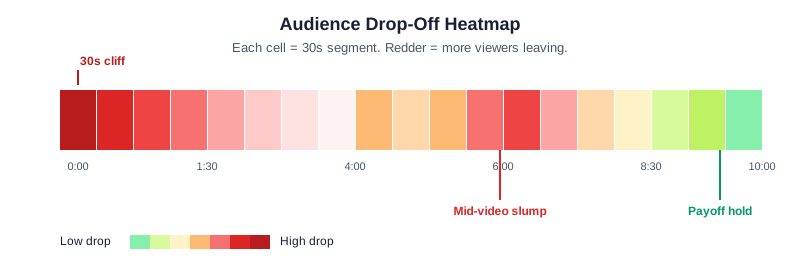
The three questions to ask at every drop
At every sharp drop in the graph, ask three questions in this order:
- Did the viewer receive a reason to stay? Every 8–15 seconds, the video needs to renew its promise or escalate its stakes. If a drop lines up with a stretch of pure explanation or transition, the video failed to renew.
- Did the viewer receive a reason to leave? A slow moment, a confusing edit, a wall of text on screen, a filler phrase like "before we get started, let me tell you a bit about myself" — any of these can trigger a drop. Watch the exact frame of the dip.
- Was there a comparison moment? Viewers on mobile scroll through Shorts and suggested videos while your video plays. If your frame at the dip is visually flat, competing thumbnails win.
The three most common causes of the 30-second cliff
Over the last two years of retention consulting, we have watched several hundred cliff-shape openings. The causes cluster into three buckets.
Cause 1: Thumbnail-title mismatch
The most common. Thumbnail promises a specific outcome or moment ("I tried this for 30 days"), the video opens with "Hey everyone, welcome back to the channel." The viewer feels the switch immediately and leaves. Retention drops 30%+ inside 10 seconds.
Cause 2: Slow reveal
The video is going to deliver on the promise, but not for another two minutes. The viewer has to wait through backstory, disclaimers, or a long branded intro. On modern YouTube, the wait is too long. Viewers leave.
Cause 3: Weak visual signal in the opening frame
The first two seconds of the video determine whether the viewer even looks up from their phone. A talking head with a plain background in the first frame retains worse than a talking head with a bold visual element, a sudden movement, or a compelling on-screen text overlay.
Diagnose your retention drops in one pass
RetentionYT's retention analyzer marks every drop over 3% on your graph, tags it against your script transcript, and suggests a rewrite of the exact segment. It reads your first 30 seconds against 15 hook patterns known to survive on YouTube in 2026 — and the viewer retention checker scores that same opening against them before you ever hit record.
Analyze my video →
Fixing the First 30 Seconds
The first 30 seconds have exactly one job: get the viewer to make a conscious decision to keep watching. Nothing else. Not brand-building, not disclaimers, not context. Every second spent on anything else is a second where the viewer is choosing between your video and every other tab open in their brain.
The 30-second anatomy
Break the first 30 seconds into four functional zones. Each has a specific job.
| Zone | Duration | Job | Failure mode |
|---|---|---|---|
| Impact frame | 0:00–0:02 | Visual + audio signal that this is worth attention | Boring first frame, muted audio, generic branding sting |
| Promise confirm | 0:02–0:08 | Restate what the thumbnail promised in different words | Talking about yourself, welcoming the audience |
| Stakes / hook | 0:08–0:20 | Escalate why the promise matters, add tension | Filler, ad read, sponsor mention |
| Payoff preview | 0:20–0:30 | Show a glimpse of the payoff, then delay it | Beginning the actual content without preview |
Seven hook patterns that survive in 2026
The following patterns consistently retain more than 80% of viewers past 30 seconds across the RetentionYT dataset. They are not the only patterns that work, but they are the ones that work most reliably.
1. The confirmation loop
Open with a direct restatement of the thumbnail promise, but from a different angle. Thumbnail says "I built a $10K/month app in a week" — open with "Seven days ago this codebase did not exist. Today it made $412 while I slept." Viewers feel the promise reinforced.
2. The stake escalation
Open with a specific, concrete stake. "If you get this next part wrong, you lose the account." Not vague ("this is really important") — specific.
3. The visual disruption
Open with a strong visual pattern break — an unexpected object in frame, an on-screen graphic, a location change, a physical object doing something unusual. Works especially well in the first two seconds.
4. The result reveal
Show the end result first, then walk it backwards. "This is what my portfolio looked like six months ago. This is what it looks like today. Here is exactly what changed." Works for tutorials, transformations, and case studies.
5. The counter-intuitive claim
Open with a claim that contradicts what viewers expect. "Everyone tells you to niche down. Every top channel I studied did the opposite." Creates a specific curiosity gap that resolves only by watching.
6. The question the viewer already has
Open with the exact phrasing of the question that brought the viewer to the video. "Why do YouTube viewers leave in the first 30 seconds? The honest answer surprised me." The viewer feels seen.
7. The open loop
Open with a mystery you will resolve at the end. "There is one thing I stopped doing this year, and it added 40 hours a week to my calendar. I will tell you what it is, but first I need to explain what pushed me to change it."
Anti-patterns to remove
Never open with: "Hey guys, welcome back to the channel," a branded intro card longer than 2 seconds, a self-introduction, a subscription reminder, a sponsor read, or any variant of "today we are going to talk about." Each of these is worth 5–15 points of retention.
Holding the Middle: The 40%–65% Slump
The mid-video slump is the second-largest source of retention loss on YouTube, and it is almost universal. Across the videos we analyze, the deepest dip in the retention curve appears somewhere between the 40% and 65% mark of runtime. The physics of this are consistent: initial curiosity is spent, the payoff is not yet close enough to feel imminent, and any editorial slack becomes an exit ramp.
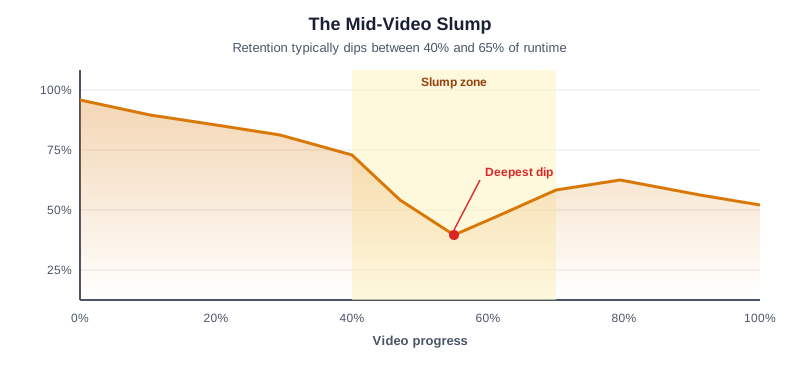
The re-hook
A re-hook is any editorial move that renews the viewer's reason to keep watching. Great creators plant a re-hook approximately every 60–90 seconds and place a stronger one in the exact zone of the projected slump. Common re-hook moves:
- Payoff proximity signal: "In the next 30 seconds, I will show you the exact result."
- New open loop: Introduce a smaller mystery that will be resolved before the end.
- Visual pattern break: A change of location, graphic overlay, or physical demonstration.
- Escalation: Raise the stakes on the existing promise.
- Direct address: Break the fourth wall to acknowledge what the viewer might be thinking.
The 60-second rule
If more than 60 seconds pass without a re-hook, retention drops. This is the closest thing to a universal law in YouTube pacing. Set a timer on your rough cut and mark every point where 60 seconds have passed without a visual break, a new question, or a payoff advance. Every one of those points needs work.
Pro tip: the retention rewrite pass
After your first edit, do a pass with the retention graph of your last three videos open on a second screen. At the exact timestamps where those videos dipped, insert a stronger re-hook in your new video. Pattern-match your fixes to your own weak spots.
14 Retention-Boosting Techniques That Actually Work
These are the techniques we have seen produce measurable retention lift across niches. None are silver bullets. Combined, they can move a channel's average retention by 8–15 percentage points within four to six videos.
- Cold-open, always. Put your hook before any branding, intro card, or channel plate. If you must have a brand element, hide it in the corner during the hook.
- Kill the intro sequence. Long animated intros are retention killers. If you keep one, cut it to under 2 seconds and place it after the hook.
- Write the last line first. Know what the viewer will feel at the payoff, then reverse-engineer the opening to seed that feeling.
- Cut the first 10 seconds of your rough cut. Nine times out of ten, the video starts stronger.
- Show don't say the promise. If your hook is visual, use B-roll of the payoff behind the voiceover. A talking head alone is weaker than a talking head plus a visual proof of what is coming.
- Front-load information density. The first 30 seconds should carry more distinct claims per second than the rest of the video. Density signals value.
- Use on-screen text sparingly for reinforcement. A short, bold text overlay in the first 10 seconds that names the promise increases retention on muted viewers.
- Cut all filler phrases. "Basically," "so essentially," "what I want to talk about today is." Every one is a retention micro-drop.
- Reduce silence. Audio silences longer than 0.5 seconds in the first 30 seconds correlate with drop-offs. Trim aggressively.
- Match pacing to niche norms. Study the retention leaders in your niche. Fast-cut niches expect fast cuts. Long-form talking-head channels expect calm density. Mismatch loses viewers.
- Preview the payoff before delivering it. Show the finished result, then walk through the process.
- Place a re-hook at the 40% mark. The single highest-leverage edit in most videos.
- End with a next-video hook, not a subscribe reminder. Session watch time rewards this more than any outro CTA.
- Test one hook variant per week. Retention improvements compound. One deliberate hook experiment per video builds a personal playbook faster than any generic guide.
Case Example: Before vs After
To make this concrete, here is a composite case study drawn from three anonymized channels that ran a first-30-seconds rewrite in 2026.
The channel
A mid-size tech tutorial channel, ~40k subscribers, publishing weekly 8–12 minute videos on developer tooling. Historical average retention: 38%. Historical 30-second retention: 62%.
The old opening (0:00–0:30)
"Hey everyone, welcome back to the channel. If you're new here, my name is [redacted] and I make videos about coding and productivity. Today's video is a bit of a special one — I want to talk about something I've been experimenting with for the last month or so, and honestly, the results kind of surprised me. Before we get into it, if you find this useful, please consider subscribing. Anyway, so what I want to cover today is..."
30-second retention: 58%. Average view duration: 3:12.
The new opening (0:00–0:30)
"I stopped using this tool three weeks ago. My productivity doubled. Here's the proof. [cut to screen recording showing before/after time metrics] For the last five years I have relied on it for almost every project. Then I read one line of documentation that made me question everything. In the next three minutes I will show you exactly what I replaced it with, how the switch works, and why it took me five years to notice the flaw. First, the flaw."
30-second retention: 86%. Average view duration: 5:41.
What changed
- Cold-open with a specific claim and a visible proof (screen recording of metrics).
- No welcome, no self-introduction, no subscribe reminder.
- Open loop introduced ("one line of documentation") and payoff preview promised ("in the next three minutes").
- Direct transition into the first content beat ("First, the flaw").
The rewrite added 28 points of 30-second retention and 2 minutes 29 seconds of average view duration on the same underlying script. Impressions on the video's third day were 4.2x the channel's rolling average. This is the compounding effect of retention at work.
Retention Benchmarks by Niche & Length
Absolute benchmarks are dangerous because context varies. Use these as directional targets, not scorecards. The numbers below reflect median 30-second retention and median absolute retention across the RetentionYT dataset for videos published in 2025 and 2026.
| Niche | Weak | Median | Strong | Elite |
|---|---|---|---|---|
| Tech tutorials | <55% | 68% | 80% | 88%+ |
| Vlogs / lifestyle | <50% | 62% | 75% | 85%+ |
| Gaming | <60% | 72% | 82% | 90%+ |
| Finance / business | <58% | 70% | 81% | 88%+ |
| Education / explainer | <62% | 74% | 84% | 91%+ |
| Beauty / fashion | <52% | 65% | 77% | 86%+ |
| Cooking | <60% | 73% | 83% | 90%+ |
| Fitness | <55% | 68% | 79% | 87%+ |
| Length | Weak | Median | Strong | Elite |
|---|---|---|---|---|
| Under 3 min | <45% | 58% | 70% | 80%+ |
| 3–6 min | <38% | 50% | 62% | 72%+ |
| 6–10 min | <32% | 44% | 55% | 65%+ |
| 10–20 min | <28% | 38% | 48% | 58%+ |
| 20+ min | <24% | 34% | 43% | 52%+ |
Two notes on how to use these benchmarks. First, video length interacts strongly with niche — a 15-minute finance breakdown will not retain like a 15-minute cooking video, and neither should be compared to a Short. Second, your own historical median is a better benchmark than any external table. Beat yourself before you worry about beating the industry.
The Actionable 30-Second Framework
When you sit down to write or rewrite an opening, run through this framework. It takes about 10 minutes per video and it is the single highest-ROI writing exercise in the entire creator workflow.
Step 1 — Write the promise
In one sentence, write the exact promise your thumbnail and title make. Not what the video will be about — what the viewer expects to receive. If the thumbnail shows a shocked face and the words "I quit my $250K job," the promise is "I will explain, in a compelling personal way, why I walked away from a lot of money." Write it in the viewer's language, not yours.
Step 2 — Write the payoff
In one sentence, write the single moment of maximum satisfaction in your video. What does the viewer feel at that moment? Relief? Vindication? Curiosity resolved? Envy? Awe? Name it explicitly.
Step 3 — Reverse-engineer the hook
Given the promise and the payoff, choose the hook pattern from the seven above that best seeds the payoff feeling. If the payoff is vindication, use the counter-intuitive claim. If it is curiosity resolved, use the open loop. If it is awe, use the result reveal.
Step 4 — Draft 30 seconds, then cut 30%
Write your first pass without watching the clock. Then remove 30% of the words. Then remove another 15%. Density is retention.
Step 5 — Table-read against the graph
Before recording, read the draft opening out loud with a timer running. If it takes more than 30 seconds, cut. If it takes less than 20 seconds, add tension. Then compare to your last video's 30-second retention curve and ask: is this materially different, or is it the same shape in new words?
Pre-Publish Checklist for Creators
Run this checklist on every video before it goes live. It takes five minutes and catches most of the mistakes that leak retention.
- The first frame is visually strong and different from a static talking head
- The first spoken sentence directly reinforces the thumbnail promise
- No welcome, self-introduction, or subscribe reminder in the first 30 seconds
- The first 30 seconds contain a stakes-raising line or a specific claim
- The first 30 seconds preview the payoff visually or verbally
- The first 30 seconds contain fewer than 60 spoken words
- There is no silence longer than 0.5 seconds in the opening
- A re-hook is placed at or before the 40% mark of runtime
- A visual pattern break appears at least every 60 seconds
- The outro transitions to a next-video hook, not a generic sign-off
- The retention curve of the last 3 uploads has been reviewed for drops to avoid
- At least one deliberate hook experiment is being tested in this upload
Ship better openings with RetentionYT
RetentionYT scores your script against the seven proven hook patterns in this guide, flags filler and slow reveals in the first 30 seconds, and suggests concrete rewrites. Creators who use it typically add 8–12 points of 30-second retention within their first three uploads.
Try RetentionYT free →
Frequently Asked Questions
What is a good YouTube audience retention percentage in the first 30 seconds?
A healthy YouTube video retains 70%–80% of viewers past the 30-second mark. Top-performing videos stay above 85%. If you are below 60%, the ranking system is likely limiting your impressions — the fix almost always starts with the hook.
Why do YouTube viewers leave in the first 30 seconds?
The most common reasons are: the hook does not confirm what the thumbnail promised, the intro is slow or self-focused, the video takes too long to reveal what it will teach or show, and the pacing does not match the platform's norms for that niche. Any one of these can cost 20+ points of 30-second retention.
How does the YouTube algorithm use retention to rank videos?
YouTube ranks videos primarily by expected watch time per impression, weighted by session value. Retention feeds directly into that: higher average view duration and higher percentage retention increase the probability that YouTube recommends the video. Retention in the first 30 seconds is weighted heavily because it predicts whether a new impression will convert to a completed view.
What is the difference between audience retention and average view duration?
Audience retention is the percentage of the video watched on average. Average view duration is the absolute time in minutes and seconds. A 10-minute video with 60% retention has an average view duration of 6 minutes. Retention is more comparable across video lengths; average view duration is more meaningful within a single video's history.
Should my first 30 seconds be short cuts and fast pacing?
Fast pacing helps, but the deeper driver is information density. The first 30 seconds must confirm the promise, add a compelling reason to stay, and preview the payoff. That can be achieved with fast cuts, or with calm, high-clarity delivery. Match the pacing to viewer expectations in your niche.
How long should the hook be before the intro?
Most high-retention videos in 2026 use a 5–15 second cold open before any branding or intro. Long branded intros in the first 30 seconds are strongly correlated with early drop-off. If you keep an intro, make it under 2 seconds and place it after the hook, not before.
How do I fix a mid-video retention slump?
Mid-video slumps are usually caused by loss of narrative tension. Fix them by re-hooking around the 40%–60% mark with a new question, an open loop payoff, a visual pattern break, or an escalation of stakes. Reviewing the retention graph for the exact dip and re-editing that specific segment often recovers 3–8 points of absolute retention.
Do YouTube Shorts follow the same 30-second rule?
Shorts operate on a much tighter window — usually 1 to 3 seconds. The principle is identical: the opening must confirm relevance and promise a payoff. Retention in the first 3 seconds is the strongest signal for whether a Short will be pushed to more viewers.
Conclusion: Small Openings, Compounding Returns
The first 30 seconds of a YouTube video are less than 5% of runtime and almost 100% of destiny. Every ranking signal downstream — average view duration, session watch time, click-through follow-through, returning viewer share — flows from whether the viewer decides to stay in that opening window.
The good news is that this is one of the most fixable levers on the entire platform. Openings are short, easy to iterate on, and testable video by video. Creators who take the 30-second rewrite seriously typically see measurable retention lift within three to four uploads and a compounding effect on impressions over the following two months.
Do the pre-publish checklist. Run the framework. Cold-open every video. Kill the intro. Preview the payoff. Watch the retention graph like a diagnostician. The videos that break out on YouTube in 2026 are not the ones with the best ideas. They are the ones whose first 30 seconds make the viewer decide, consciously, to stay.
Start diagnosing your retention with RetentionYT →
Continue learning about retention
- The 7-Line Hook Writing FormulaRetention · Hooks
- How to Read a YouTube Retention Graph Like a ProRetention · Analytics
- Fixing the Mid-Video Slump in Under an HourRetention · Editing
- Thumbnail–Title Alignment: Why Mismatch Kills Watch TimeCTR · Retention
- Session Watch Time: The Metric YouTube Actually OptimizesAnalytics
- Shorts Retention: The 3-Second Rule ExplainedShorts · Retention
External references: YouTube Help — Audience retention, YouTube Creator Academy, YouTube Official Blog — Recommendation System.
Frequently asked questions
- What is a good YouTube audience retention percentage in the first 30 seconds?
- A healthy YouTube video retains 70%–80% of viewers past the 30-second mark. Top-performing videos stay above 85%. Anything below 60% at 30 seconds signals a weak hook, mismatched thumbnail-title expectation, or slow pacing.
- Why do YouTube viewers leave in the first 30 seconds?
- Viewers leave in the first 30 seconds mainly because the hook does not confirm the promise made by the thumbnail and title, the intro is slow or self-focused, the video takes too long to reveal what it will teach or show, or the pacing does not match the platform’s norms for that niche.
- Should my first 30 seconds be short cuts and fast pacing?
- Fast pacing helps, but the deeper driver is information density. The first 30 seconds should confirm the promise, add a compelling reason to stay, and preview the payoff. That can be achieved with fast cuts, or with a calm, high-clarity delivery. Match the pacing to viewer expectations for your niche.
- How long should the hook be before the intro?
- Most high-retention videos use a 5–15 second cold open before any branding or intro. Long branded intros in the first 30 seconds are strongly correlated with early drop-off. If you keep an intro, make it under 3 seconds and place it after the hook.
- Do YouTube Shorts follow the same 30-second rule?
- Shorts operate on an even tighter window—usually 1 to 3 seconds. The principle is the same: the opening must confirm relevance and promise a payoff. Retention in the first 3 seconds is the strongest signal for whether a Short will be pushed to more viewers.
Find your video’s drop-off points before you publish
RetentionYT audits your script for the moments viewers leave — so you can fix them before recording.
Get retention tips in your inbox
Occasional, practical emails on hooks, pacing, and retention. No spam.
Related posts
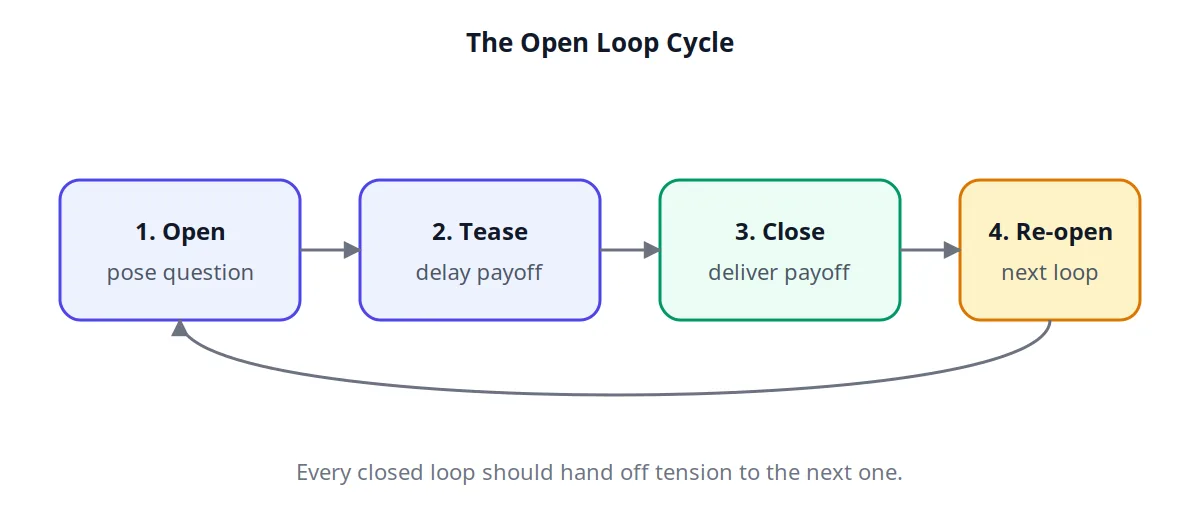
Open Loops: The Retention Trick Top YouTubers Swear By
Open loops are unanswered questions that keep viewers watching. Learn how top YouTubers use open loops to boost audience retention, hold the mid-video slump, and increase watch time — with concrete scripts, benchmarks, and a repeatable framework.
YouTube Retention Benchmark 2026: What the Numbers Actually Mean
There is no official YouTube retention benchmark. Here is what YouTube Studio actually reports, why third-party benchmark tables mislead, and how to build a baseline from your own channel.
Absolute vs Relative Retention: Which Number to Trust
Absolute vs relative audience retention on YouTube: read the cliff, use typical retention correctly, and fix your first 30 seconds before chasing a benchmark.