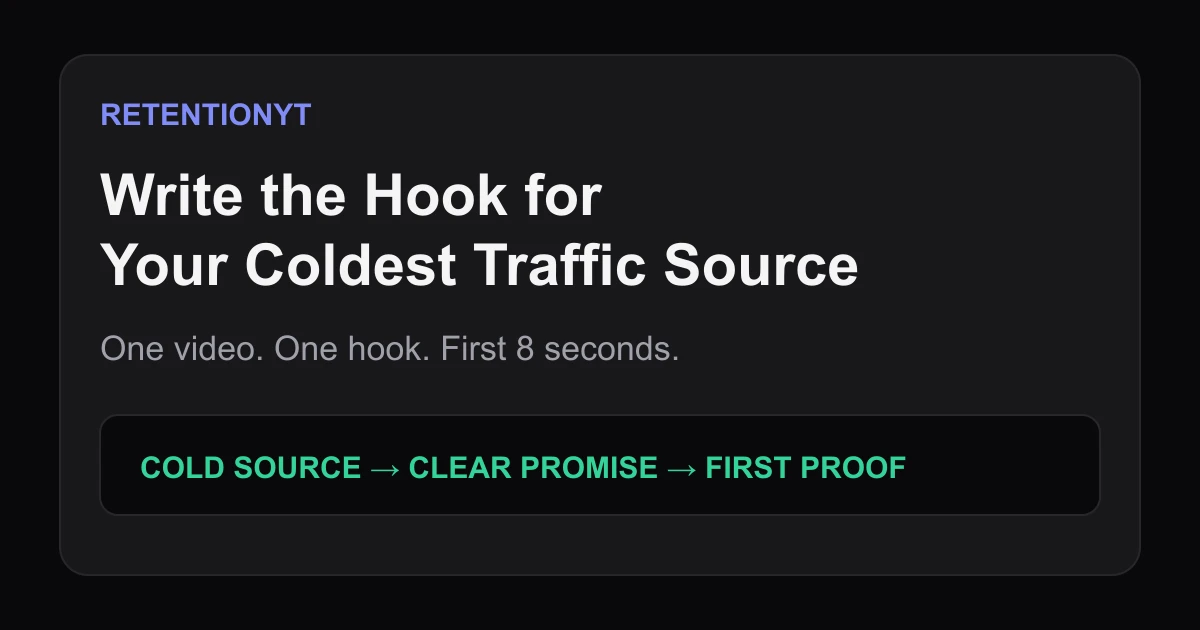
Write the Hook for Your Coldest Traffic Source
Write one YouTube hook for the coldest traffic source your video earns, then test the first 8 seconds against the promise your thumbnail and title made.

11 min readUpdated
In this guide
If search viewers arrive with a question, they may tolerate more setup than a viewer who sees your video beside something else. Start with one hook and one number: the first 8 seconds. Write that opening for the traffic source in your own data that needs the most help understanding the promise, then let warmer viewers enjoy the surplus context.
What Write the Hook for Your Coldest Traffic Source actually is (and what it is not)
Write the hook for your coldest traffic source is a decision rule for the opening, not a new YouTube setting. You look at where your impressions and views come from, decide which source gives the opening the least benefit of the doubt, and make the first lines understandable there. The rule protects you from writing a clever intro that only makes sense to people who already know the channel.
The phrase coldest traffic source means the source whose viewer needs the most immediate orientation before the video’s promise becomes clear. That is a practical editorial label, not an official YouTube metric. YouTube’s own reporting names sources such as browse features, suggested videos, and YouTube search, but the locked documentation does not say that one source is always warmer or colder than another. Treat the temperature as a hypothesis you test against your own graph.
| Term | What it means here | What you should do |
|---|---|---|
| Browse | A viewer encountering the video through a browsing surface | Make the promise legible without assuming prior intent |
| Suggested | A viewer seeing the video beside or after other videos | Match the opening to the title and thumbnail quickly |
| Search | A viewer arriving with a query or topic in mind | Give the answer path early, without over-explaining the setup |
| Coldest source | Your own source with the most practical opening friction | Write one hook that removes that friction |
Treat source temperature as a working hypothesis, not a universal ranking. Record the assumption and label every invented number illustrative.

Why this shows up in YouTube Studio
YouTube Studio connects the opening with how viewers found the video. SOURCE 1 shows this computer path: sign in, select Content, open the selected video’s Analytics, and choose Reach. It says the traffic-source types report shows how viewers found content within YouTube and external sources. Read SOURCE 1, Audience retention, August 2026 before copying the path into your notes.
The source report answers where the viewer came from; retention answers what the viewer did after arriving. SOURCE 2 describes the Content tab as an overview of how viewers find, watch, and interact with content. It lists browse, suggested, search, external, and channel-page routes, and defines average view duration and average percentage viewed as measures among viewers who stayed to watch. Read SOURCE 2, Understand your YouTube content performance, August 2026 for current report context, including SEE MORE or ADVANCED MODE for specific data, comparisons, and exports.
Read the graph without overclaiming
Mark the first clear drop, the sentence spoken there, and the first visual change. If source detail is unavailable, mark the finding unverified instead of building a story around a missing view.

Ask, “Which source exposes the cost of my current opening?” If the promise is late, simplify the first sentence; if the answer is buried, state it sooner; if the visual does not match the package, connect the first shot to the thumbnail.
Worked example 1: the failure
A creator has one tutorial with an opening that begins, “There are many different ways to think about this topic, and before we get into the details, it helps to understand where the idea came from.” The video may eventually deliver a useful answer, but the first sentence asks a viewer to wait without saying what will be gained. No fake channel name is needed; the failure is in the opening itself.
The creator sees three source labels and guesses that search viewers are patient while browse viewers are impatient. They write, “Stop scrolling because this secret method will change everything.” It is louder, but it does not say what will happen or why the title is credible. The temperature is guessed, the hook is intensified, and the curve is treated as platform proof instead of an upload-specific clue.
| Checkpoint | Illustrative reading | Failure interpretation |
|---|---|---|
| 0:00 | Illustrative 100% | The package earned the start, not the explanation |
| 0:08 | Illustrative 62% | The opening still has not made the payoff concrete |
| 0:30 | Illustrative 48% | Setup is consuming the time meant for proof |
| End | Illustrative 19% | A curve alone cannot explain source temperature |
These numbers are illustrative, not YouTube benchmarks. Record the time marker, sentence, and source context together; never paste them into a client report as YouTube data. The vague preface hides whether the friction is topic, packaging, or delayed promise, so isolate the opening job: confirm, prove, and create the next beat.
Worked example 2: the fix
Keep the same subject and write for the source that needs the clearest orientation. Replace the preface with: “Your first eight seconds should prove what the thumbnail promised. I’ll show you the exact sentence to cut, the visual to put beside it, and the retention check to run after you publish.”
This version gives a subject, time boundary, proof plan, and next step without channel backstory. In your notes, write “the opening delayed the promise; rewrite for a viewer with no prior context,” not “browse is bad.” Compare the same early window on a comparable upload and record what changed.
The practical formula is:
Cold-source hook = clear promise + first proof + next beat, inside the first 8 seconds.
The “cold source” part comes from your editorial diagnosis. The rest is a writing constraint: show the smallest useful proof before history, and let the first visual confirm the thumbnail’s result instead of opening on a logo or greeting.

If the proof cannot fit in eight seconds, do not cram. Shorten the claim, move proof to the first visual, or choose a promise the video can satisfy quickly.
How to check this in YouTube Studio (step by step)
1. Choose the video and date window
Open the upload and record its title, publish date, format, and date range. Keep the comparison deliberate.
2. Find the source labels
Open YouTube Studio and use the Reach or Content report exposed by your account. Copy the labels for browse features, suggested videos, YouTube search, and other routes exactly as shown.
3. Mark the practical coldest source
Choose the source with the most actionable opening problem: a sharp early drop, meaningful volume, or a mismatch between package and first sentence. State the rule. If the data cannot separate it, write “unverified.”
4. Transcribe the first 8 seconds
Write the words and describe the simultaneous frame. Either can contradict the title or thumbnail.
5. Rewrite one opening
Use one sentence for the promise and one for proof or the next beat. Delete greetings, channel history, broad declarations, and context that can wait.
6. Keep the payoff honest
The first proof must be real and the next beat must move toward the title’s answer. A sharp opening cannot repair a video that changes subjects.
7. Review the next comparable upload
Record source mix, opening sentence, first drop, and first visual again. Compare like with like; a non-reproducible result is a clue, not a rule.
Where RetentionYT fits
Manual method works alone. Product shortens the loop. Use RetentionYT when you want another pass over the wording before you record, but do not treat a tool score as a replacement for checking the source and the actual opening.
The documentation locates reports; it does not supply a universal “cold” ranking. Keep the video, date, report path, source label, first-eight-second transcript, and rewrite in the handoff.
The trap
The trap is writing for an average viewer who does not exist. “This works for browse,” “search viewers always stay longer,” and “suggested needs energy” can hide packaging, visual, or topic problems. Use them only as hypotheses: a source label is a route, not a permanent personality, and louder delivery cannot repair a missing promise.
The trap
The move

When a finding conflicts with intuition, record both the hypothesis and what the locked source says. Publish only the supported claim or label the editorial rule of thumb.
What to do in the next upload
Use the next upload as a focused writing test. You are not trying to prove a universal traffic-source theory; you are trying to remove one identifiable opening problem and leave enough evidence to learn from the result.

- Record the exact video, publish date, and report date.
- Copy the source labels shown in your current YouTube Studio.
- Choose the coldest practical source and state the reason.
- Transcribe the original first 8 seconds word for word.
- Identify the first sentence or visual that delays the promise.
- Rewrite the hook as promise, first proof, and next beat.
- Read it aloud and cut any setup that can wait.
- Check that the title and thumbnail promise still match the words.
- Mark every invented number as illustrative or remove it.
- After publishing, compare the same early window on a comparable upload.
For another manual reference, use 9 YouTube Hook Formulas and How to Write a YouTube Hook That Actually Works for structures, not evidence of a fixed source temperature. You can also run the draft through the YouTube script analyzer as a prompt to inspect a sentence, not as a benchmark.
A good cold-source hook respects limited context: state the promise, put credible proof in reach, and make the next beat obvious. If your account does not expose the source detail you need, mark that boundary. If the video lacks comparable traffic, keep the conclusion provisional.
Frequently asked questions
- Why is my search retention better than browse?
- Search viewers may arrive with a specific question already in mind, while browse viewers may be deciding quickly whether your packaging matches their interest. Treat that contrast as a working hypothesis, not a YouTube rule. Check your own traffic-source reports and compare the opening before changing the whole video.
- Should I write different videos for search vs suggested?
- No. Start with one video and one hook. Write the opening so a viewer who does not know you can understand the promise immediately, then let viewers who arrived from a specific search enjoy the extra context. Separate videos only when the audience and promise are genuinely different.
- What is the coldest traffic source?
- The coldest traffic source is the source in your own report whose viewers need the most context before they understand why the video is for them. It is not automatically browse, search, or suggested. Compare early retention by source when the data is available, then choose the source with the steepest practical opening problem.
- Can I change the hook by traffic source?
- You normally cannot ship three different openings for one published video. You can change the opening on the next upload, or make separate versions when the audience promise truly differs. Use the source report to choose the problem to solve, then write one hook that makes the title and thumbnail legible to the coldest viewer.
- How do I see retention by traffic source?
- Open the video in YouTube Studio, select Analytics, and inspect the Reach or related performance reports available to your account. Look for the traffic-source breakdown and compare it with the opening retention. Exact report availability can vary, so use the labels shown in your current Studio rather than assuming every view has the same drill-down.
- How do I apply “Write the Hook for Your Coldest Traffic Source” on my next upload?
- Before recording, identify the traffic source that needs the most help, write the first two sentences for that viewer, and make the title promise concrete in the first 8 seconds. Read the hook aloud, remove setup that delays the payoff, and keep a note of what changed so your next review compares like with like.
- Where in YouTube Studio do I check “Write the Hook for Your Coldest Traffic Source”?
- There is no single Studio button named after this method. Use the analytics area for the selected video or the channel Content reports, then inspect traffic-source and audience-retention information that your account exposes. The method is a writing decision built from those reports, not a native YouTube feature or setting.
- What is the most common mistake with “Write the Hook for Your Coldest Traffic Source”?
- The common mistake is treating a guessed audience temperature as a fact, then writing a vague hook for everyone. Use your own report, label illustrative numbers as illustrative, and choose one concrete opening problem. A cold-viewer hook should clarify the promise quickly without making the rest of the video feel like an unrelated lecture.
Give your next script a second look
Paste a script into RetentionYT for suggestions on your hook, pacing, and structure. Choose the edits that serve your video, then check audience behavior in YouTube Analytics after publishing.
Get retention tips in your inbox
Occasional, practical emails on hooks, pacing, and retention. No spam.
Related posts
How to Write a Hook When the Title Is a How-To
YouTube how-to title hook that is not boring: turn one title noun into a result-first first line, a visible object, and a proof cue your viewer can follow.
Free YouTube Hook Checker: How to Test Your Intro Before You Film
Test a YouTube hook before you record: a 150-word paste test, a 15-second phone clip, and a structural audit — so you fix the first 8 seconds on paper, not in the edit.
9 YouTube Hook Formulas That Stop Viewers From Scrolling
Nine repeatable YouTube hook formulas that win the first 8 seconds, boost audience retention and stop viewers from scrolling. With scripts, examples and a step-by-step framework.