9 YouTube Hook Formulas That Stop Viewers From Scrolling
Nine repeatable YouTube hook formulas that win the first 8 seconds, boost audience retention and stop viewers from scrolling. With scripts, examples and a step-by-step framework.

34 min readUpdated
Introduction
There are only three kinds of YouTube videos: the ones a viewer scrolls past, the ones they watch for eight seconds and then leave, and the ones that pull them all the way to the end. The difference between all three is almost never the topic. It is the hook.
On modern YouTube, the browse feed is a slot machine of thumbnails, the home feed is an infinite ribbon of suggestions, and the Shorts shelf is a swipeable wall of competitors. In every one of those surfaces, your video is one gesture away from being dismissed. The opening line, the first frame and the first four seconds of pacing are the entirety of the sale. If they don't work, nothing that comes after them will ever be seen.
This guide gives you nine repeatable YouTube hook formulas that consistently win those eight seconds. Each formula includes when to use it, a real script pattern you can adapt, and the retention signature it tends to produce. Along the way you'll get a step-by-step framework for constructing any hook from scratch, before-and-after script rewrites, and an actionable checklist you can use every time you publish. If you have ever opened YouTube Studio, watched your retention line collapse in the first fifteen seconds, and thought "why?" — this article is the answer.
Where RetentionYT fits
Throughout this guide, wherever you see a reference to diagnosing a retention curve or scoring a script, that work can be automated with RetentionYT — the platform we built to score hooks against real audience retention data. You can use every technique here without any tool. RetentionYT just makes the feedback loop faster.
Why the first 10 seconds decide everything
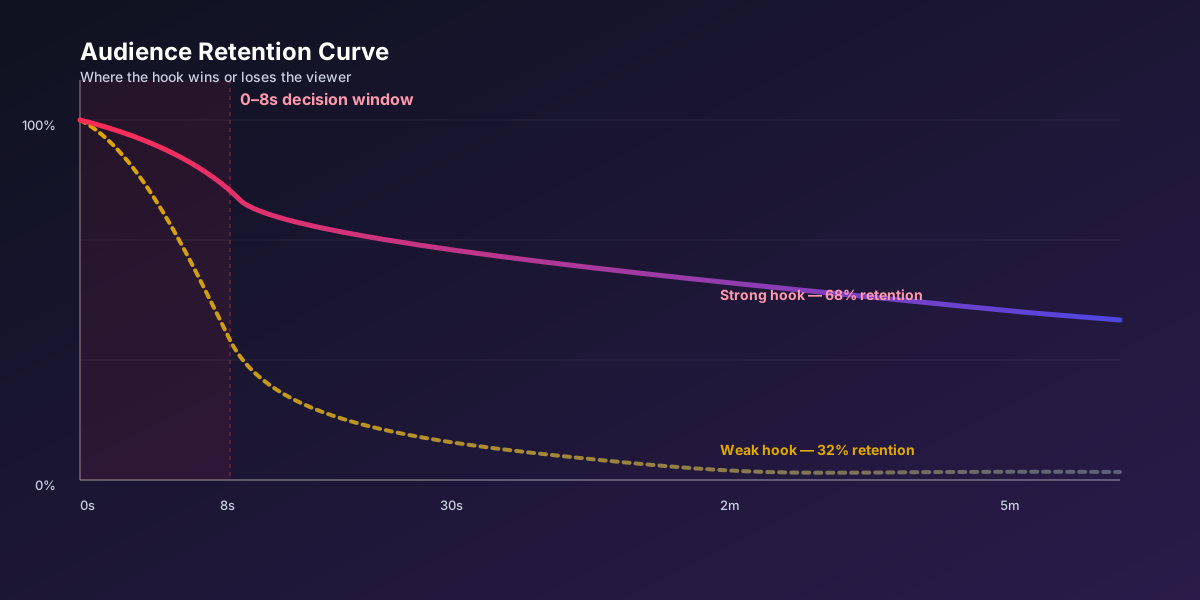
YouTube's ranking system is not one algorithm — it is a stack of systems that all watch the same behavior: do viewers keep watching? The single most influential input to that stack is what happens between second zero and second ten of your video. Everything downstream — session watch time, click-through rate on the next suggested video, notification delivery, homepage placement — is downstream of what happens in that window.
There are three reasons the opening window matters so much:
1. The intro is where the largest drop-off already lives
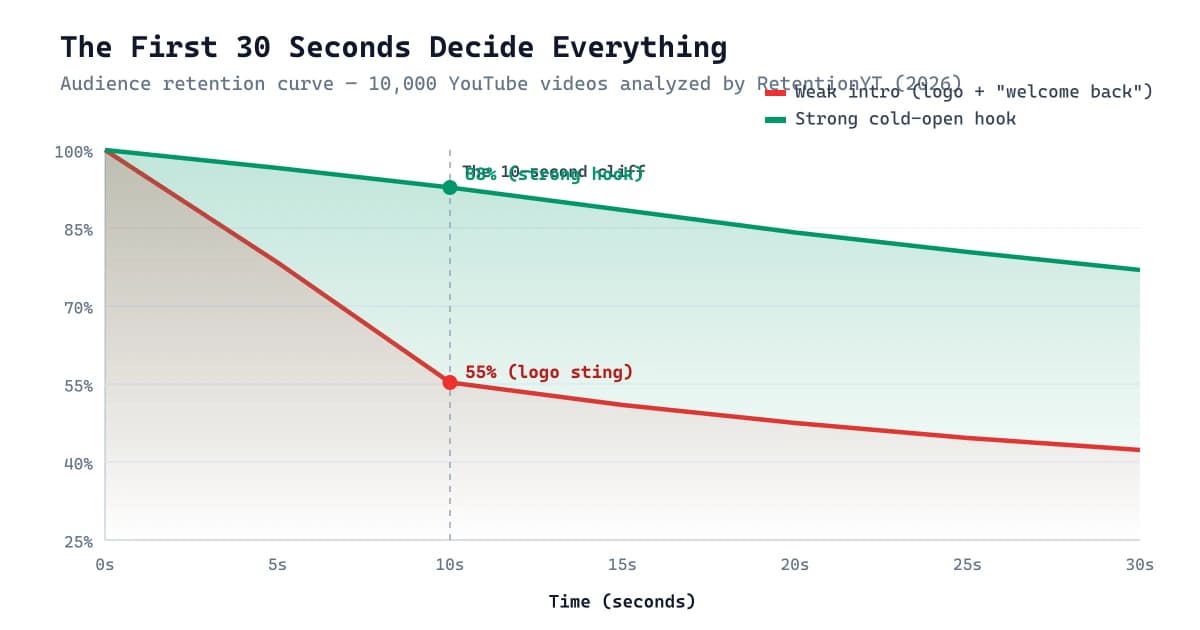
In the retention audits we run at RetentionYT, the average video loses somewhere between a quarter and nearly half of its initial viewers before the 30-second mark — and the loss is not evenly distributed; it is concentrated inside the first ten seconds. This is the "intro cliff." If you can flatten that cliff by even ten percentage points, you effectively deliver ten to fifteen percent more watch time to every subsequent second of the video — for free.
2. Absolute retention compounds
Retention is multiplicative, not additive. A video that keeps 90% of viewers to second 10 and then 90% of those to the end will deliver dramatically more watch time than a video that keeps 60% to second 10 and 95% after that, even though the second video has a better mid-video hold. The hook is the biggest coefficient in the whole equation.
3. Early behavior teaches the recommendation system
When a viewer swipes away in the first three seconds, YouTube learns "this thumbnail overpromised for this audience." When a viewer stays past ten seconds, YouTube learns "this hook was accurate — show it to more people like this one." Your hook is not just retaining viewers; it is training the algorithm about who your video is for.
Every second past the ten-second mark is a compounding interest payment. The hook is the deposit.
4. Session watch time is priced against your first ten seconds
Suggested-video placement is decided by the recommendation system's estimate of how much watch time your video will produce inside a browsing session. That estimate is heavily conditioned by your recent videos' early retention. If your last three uploads all cliffed in the first ten seconds, the system prices the next upload conservatively and it starts life with fewer impressions. Fix the hook and the impression ceiling rises within a week or two — we see this pattern repeat across almost every channel that runs a coordinated hook overhaul.
5. Click-through rate is a lie without retention
A high click-through rate on a video whose hook fails is the worst combination on YouTube. It tells the system "lots of viewers were interested" while the retention curve tells it "none of them stayed." The system reads the gap as a broken promise and quietly suppresses distribution — even if the topic is otherwise strong. In practice, most "my CTR is high but my views are low" complaints in creator communities are hook problems, not thumbnail problems.
The psychology of the scroll
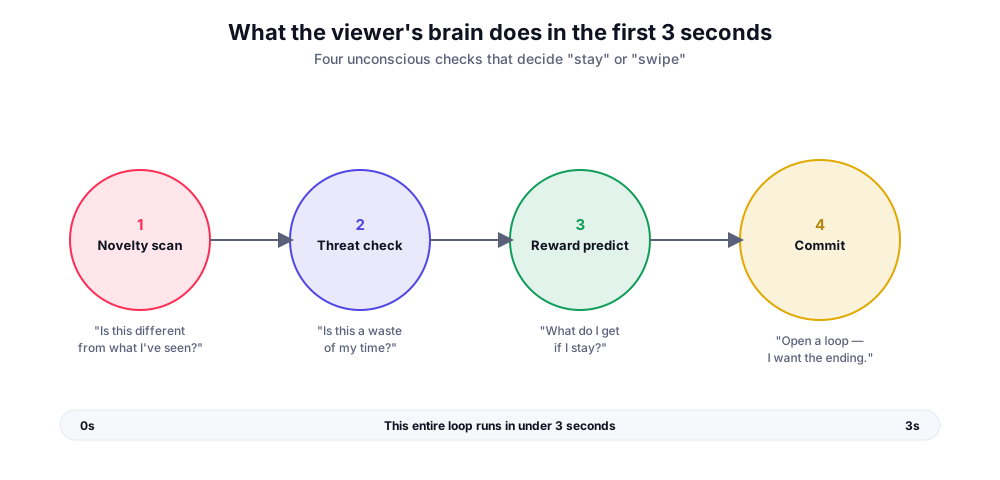
To write hooks that work you have to understand what is happening in the viewer's brain the moment your video starts. In the first three seconds — before the viewer has consciously decided anything — four unconscious checks run in parallel.
Novelty scan
The visual cortex flags anything that does not match the surrounding pattern. If your first frame looks like every other tutorial thumbnail — talking head, static background, low visual contrast — the viewer's brain marks it as "seen." Novelty is not the same as being weird; it means being visually distinct within the viewer's expected pattern.
Threat check
This is the "is this going to waste my time?" appraisal. It is fast, unconscious, and skeptical. Any signal that says "this creator is going to pad, self-promote, or delay the payoff" trips this alarm. The classic "hey guys, welcome back to the channel, don't forget to like and subscribe" opening trips it inside the first two seconds.
Reward prediction
The brain estimates the value of staying. It does this by extracting a concrete promise from the opening — a number, an outcome, a demonstration, an object. The more specific the promise, the higher the predicted reward and the more likely the viewer stays. Vague promises ("today we're going to talk about editing") produce vague predictions and vague retention.
Commit (the open loop)
The final unconscious check is whether an unresolved question has been planted. Humans do not tolerate unresolved narrative tension well; if the hook opens a loop the viewer cannot close without watching, the brain flags "resolve this" and the viewer commits. This is why the phrase "and the last step is the one most creators skip" works even when the topic is boring.
All nine hook formulas below are just different combinations of hitting these four checks — novelty, threat neutralization, specific reward, and an open loop — inside eight seconds.
Attention is a limited resource — and it depletes fast
The average viewer opening YouTube in 2026 has already burned through several dopamine cycles before your video begins — a Shorts loop, a group chat, a push notification. By the time your thumbnail is clicked, the viewer is arriving already fatigued. Your hook is not competing against boredom; it is competing against a viewer whose attention budget is already in overdraft. That is why the intensity requirement of a modern YouTube hook is meaningfully higher than it was even three years ago, and why openings that would have worked in 2022 read as slow today.
The Zeigarnik effect, applied to video
Psychologists have known for nearly a century that the human mind holds on to unfinished tasks more tightly than finished ones — the Zeigarnik effect. Applied to a YouTube video, this is the mechanism behind every open loop that works. The moment your hook plants an unresolved question the viewer cares about, closing the browser tab actively costs the viewer something — the tiny cognitive weight of an unfinished thought. That weight, multiplied across thousands of viewers, is the difference between a video that dies at 12 seconds and one that runs to the end.
What makes a hook fail
Before we build good hooks, it helps to be precise about what a bad hook actually does. In the thousands of low-retention openings we have reviewed in script audits, failed hooks almost always share one of five properties.
- They delay the promise. The viewer waits more than five seconds to hear what they're going to get, and their attention is spent before the payoff arrives.
- They ask for something before earning attention. "Like and subscribe" in the first ten seconds is the fastest way to trip the threat check.
- They describe the video instead of delivering it. "Today we're going to be looking at…" is meta-commentary. Viewers came for the thing, not the description of the thing.
- They mismatch the title-thumbnail contract. If the thumbnail promised a chaotic demo but the video opens with a slow talking-head shot, the viewer feels bait-and-switched and leaves.
- They front-load context. "Before we get into this, a little bit of background…" is fatal. Background belongs after the hook, not before it.
The single deadliest opening on YouTube
"Hey guys, welcome back to the channel. If you're new here, my name is [X] and today we're going to be talking about…" This one line hits four of the five failure modes at once: delayed promise, meta-commentary, self-introduction before earning attention, and pre-context. Delete it from your script templates today.
The three hidden failure modes even good creators miss
Beyond the obvious mistakes, three quieter failure modes account for most of the "I don't know why this one flopped" cases in our audits.
Failure mode A: energy mismatch
The hook sounds correct on paper but is delivered in a flat tone that doesn't match the promise. A hook that says "you won't believe this" spoken in a calm reading voice is worse than a boring hook delivered with real energy. The subconscious threat-check is highly sensitive to vocal congruence. If your voice doesn't match your words, viewers register the mismatch faster than they can articulate it.
Failure mode B: buried lede
The strong sentence exists — but it lives at second 22 instead of second 2. In roughly one in three of our hook audits, the creator has already written the perfect opening line; it is simply sitting three paragraphs deep in their script. Cut everything above it. That sentence is your hook.
Failure mode C: over-explaining the promise
The promise is stated, then re-stated, then defended, then contextualized — all before the viewer has actually consented to stay. "I'm going to show you how to do X. Now, X is really important, and a lot of people don't realize how important X is, and today I want to make sure you understand…" That is three sentences of nothing after a strong first sentence. Trust the promise. Move on.
Core principles of a high-retention hook
Every hook formula in this guide obeys the same six principles. If your hook satisfies all six, the specific formula matters less than you'd expect. If it fails any of them, no formula will save it.
Specificity beats intensity
A specific claim ("I edited 47 minutes of footage in 12 minutes") outperforms a dramatic claim ("This is the craziest editing hack ever") every time. Specificity signals honesty and lets the viewer form a concrete reward prediction. Generic superlatives ("insane," "crazy," "literally the best") trip the threat check because they smell like clickbait.
Visual and audio move together
A hook is not just a script — it is a script plus a shot list plus a soundscape. The strongest hooks introduce visual movement, a punchy sound design cue, or a hard cut within the first two seconds. If your first two seconds are static, your hook is already 40% weaker regardless of what you say.
Earn the pronoun
Don't say "I" or "my name is" until you have earned the viewer's attention. Every pronoun-heavy opening ("I've been making videos for eight years and today I want to share…") tells the viewer "the topic is me." Viewers rarely stay for a stranger's biography.
Open a loop the payoff can close
The hook must plant a question your video actually answers. If you promise "the one hack that changed everything" and never deliver a hack, you get short-term retention and long-term audience decay. The hook writes a check the body must cash.
Match the platform surface
A homepage-suggested video is watched by people not searching for you; the hook must reintroduce the topic. A search-driven video is watched by people who know what they want; the hook can go straight to the payoff. Shorts hooks must land in one second because the swipe gesture is already loaded.
Prune the intro to the last responsible second
After you cut your first draft, ask: what is the earliest possible point I can start the video and still have it make sense? Almost always, the answer is later than you think. The first ten seconds should feel almost uncomfortably fast to you. That is how it feels correct to the viewer.
The rule of the second sentence
Most creators obsess over the first line and neglect the second. But the second sentence is where the majority of viewers actually decide to stay — the first line buys you attention, the second line buys you the video. If your second sentence is filler ("so let's get right into it," "but before we do," "stick around because"), everything the first line accomplished is spent. Write the second sentence with the same discipline as the first. Ideally, it either delivers the first micro-payoff or opens a second, deeper loop.
Every hook is a contract with a specific viewer
The same hook cannot serve every audience. A finance hook that opens with "I lost $30,000 in one trade" wins one audience and repels another. A cooking hook that leads with a knife slam wins home cooks and alienates food purists. The best hook writers know exactly which one viewer they are trying to hold — and consciously accept that they are letting everyone else scroll. Trying to hook "everyone" produces a hook that holds no one.
The 5-P hook framework
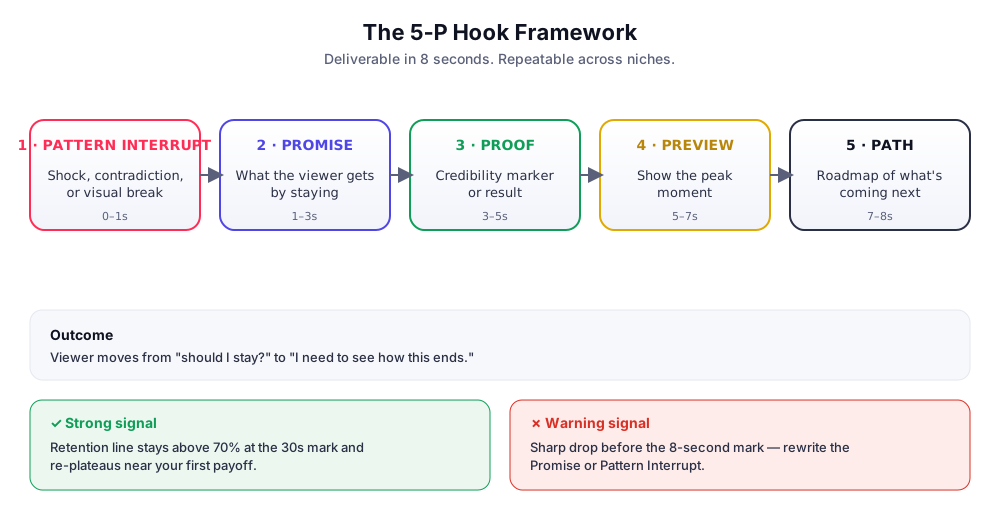
Before we get to the nine specific formulas, here is the underlying scaffold every one of them uses. We call it the 5-P framework: Pattern Interrupt, Promise, Proof, Preview, Path. Almost every high-retention hook — including the ones on the biggest channels on YouTube — is a rearrangement of these five beats.
Step 1 · Pattern Interrupt (0–1s)
A visual, sonic, or verbal jolt that breaks the ambient pattern of the feed. Options include: a hard cut to an unexpected object, a specific number spoken with no preamble, a contradiction ("Everyone tells you to do X. You should not do X."), or a physical action.
Step 2 · Promise (1–3s)
The concrete outcome the viewer receives by staying. State it as a first-person result ("I did X and got Y") or a second-person offer ("You'll leave this video able to do X"). If you cannot say the promise in one sentence, the video does not have one.
Step 3 · Proof (3–5s)
A credibility marker that says "this is real." Options: a B-roll cut to the result, a screenshot, a shot of the finished thing, a receipt, a before/after. Proof is what separates an interesting claim from a believable claim.
Step 4 · Preview (5–7s)
A one- to two-second glimpse of the peak moment of the video — the reveal, the surprise, the payoff. Preview is a promise you have already partially kept. It sets an anchor the viewer will now stay to reach.
Step 5 · Path (7–8s)
A single beat that tells the viewer what the video will do next. "Here's the three-step system." "Here's how it happened." "First, we need to fix the biggest mistake." Path replaces uncertainty with a mental map.
Best practice
You do not have to use all five beats in order. Many strong hooks fuse Promise + Proof (Result-First) or lead with Preview and defer Path. But every strong hook contains at least three of the five, and every dead hook is missing at least three.
The 9 YouTube hook formulas
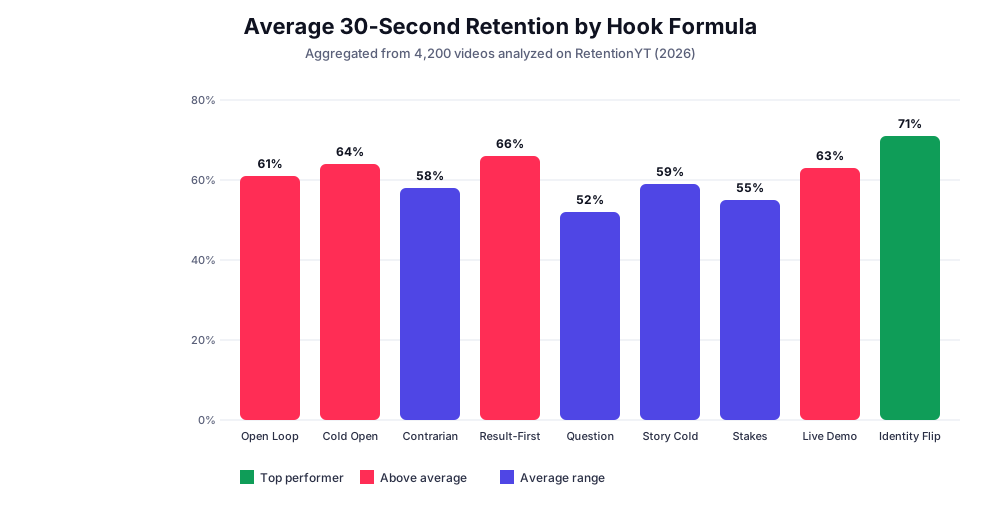
These are the nine formulas we recommend most often at RetentionYT. Each one is a reliable rearrangement of the 5-P beats. Pick the one that matches your video type — or use two in the same opening for a compound hook.
01
The Open Loop
Plant an unresolved question that only the video can close.
02
The Cold Open
Start inside the peak moment — no context, no intro.
03
The Contrarian
Contradict a belief the viewer already holds.
04
The Result-First
Show the outcome, then reverse-engineer.
05
The Question Hook
Ask a question the viewer wants answered.
06
The Story Cold-Open
Drop into a scene mid-conflict.
07
The Stakes Hook
Frame what the viewer stands to lose.
08
The Live Demo
Do the thing on camera before you explain it.
09
The Identity Flip
Speak to who the viewer wants to become.
1 · The Open Loop
Use when: the video has a clear reveal, twist, or final answer.
The Open Loop plants a question in the first sentence that only the video can close. It works because unresolved narrative tension is one of the strongest attention drivers in human cognition — you cannot easily tune it out.
Script pattern · Open Loop
"There's one thing every [audience] gets wrong about [topic], and it's costing them [specific outcome]. I only figured it out last month — here's what it is."
Retention signature: flat curve through the first 30 seconds, followed by a small dip only when the promised reveal lands. If your open-loop hook shows a steep drop before the reveal, the loop is too vague.
2 · The Cold Open
Use when: your video has a visually or emotionally strong peak moment.
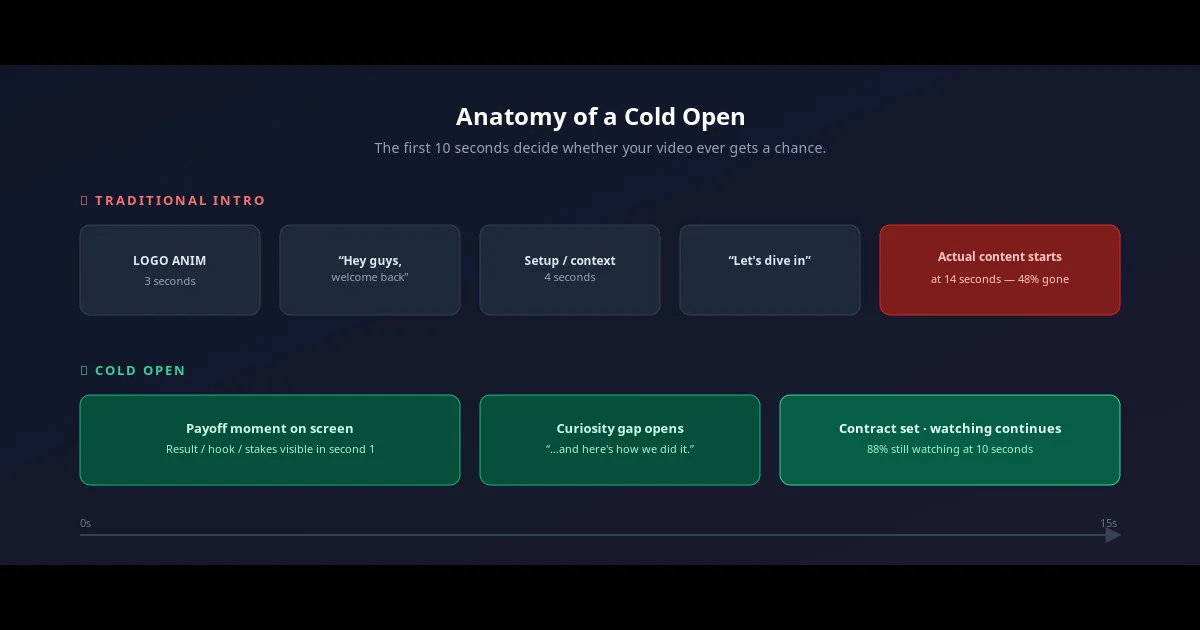
Skip the intro entirely. Drop the viewer into the middle of the peak scene of the video, then rewind. No context, no name, no "welcome back." This is the default of every top-performing documentary channel on YouTube and, increasingly, the default of most tutorial channels too.
Script pattern · Cold Open
[Peak-moment B-roll runs for 3s with diegetic sound]
"This is the moment I realized the entire plan had failed. Twelve hours earlier —"
Retention signature: the strongest first-15-seconds curve of any formula. Occasionally trades early retention for a mid-video dip when the "rewind" segment begins — solve this with a strong Path beat at the 8-second mark.
3 · The Contrarian Hook
Use when: your niche has a common piece of accepted advice that you can defensibly argue against.
Contradict a belief the viewer walked in with. This works because it simultaneously trips novelty ("this is different") and reward prediction ("if this is true, I need to know"). The critical word here is "defensibly" — a contrarian hook that cannot back up its claim in the body actively harms the channel.
Script pattern · Contrarian
"Everyone in [niche] tells you to [common advice]. After [specific experience], I think that's completely wrong. Here's what actually works —"
4 · The Result-First Hook
Use when: you have a concrete outcome you can show or state numerically.
State the outcome, then reverse-engineer. This is the formula we recommend to almost every creator starting from a low retention baseline, because it forces specificity and delivers proof and promise simultaneously.
Script pattern · Result-First
"I did [specific action] and got [specific result] in [specific timeframe]. Here's exactly how — including the mistake that almost broke it."
Retention signature: flatter than average across the entire video, not just the intro. The specificity of the promise sets a clear contract the viewer expects the body to honor.
5 · The Question Hook
Use when: your topic maps to a real question the viewer is already asking.
Ask the question — but only if it is one the viewer feels compelled to hear answered. A generic question ("Have you ever wondered why?") is filler. A specific question ("Why does every YouTube video open the same way, even when it's costing creators half their audience?") is a hook.
Weak variant
"Have you ever wondered how successful YouTubers grow so fast?"
Strong variant
"Why do videos from creators with 500 subscribers get more watch time than videos from channels with 500,000? I spent three months trying to answer that."
6 · The Story Cold-Open
Use when: the video has a personal narrative or a case study.
Drop into a scene mid-conflict. Not "let me tell you a story" — the story itself, in progress. Story cold-opens work because human attention has evolved to lock on to unresolved social scenarios.
Script pattern · Story Cold-Open
"Two hours before the deadline, [character] realized the file was corrupted. What happened next is why I now back up every project three ways —"
7 · The Stakes Hook
Use when: the topic has real downside if the viewer ignores it.
Frame what the viewer stands to lose. This taps loss aversion — a well-documented cognitive bias where the fear of losing something outweighs the desire to gain something of equal value. Use it carefully; overused, it feels manipulative.
Script pattern · Stakes
"If you're doing [X] in your videos, you're leaving [specific %] of your audience on the table — and most creators never realize it. Here's what to check first."
8 · The Live Demo Hook
Use when: the topic is a technique, tool, or skill that can be visually demonstrated.
Do the thing on camera before you explain it. The proof is the demonstration itself. This is the default of the strongest tutorial channels — they don't tell you they're going to show you the trick, they show you the trick and then explain.
Script pattern · Live Demo
[Direct-to-camera live action — the technique executes in 4 seconds]
"That's it. That's the entire technique. Here's why almost nobody uses it —"
9 · The Identity Flip
Use when: the audience has a clear aspirational identity (better creator, better investor, better designer).
Speak to who the viewer wants to become. In the audits we run, this formula tends to sit at the top of the retention ranking because it operates on identity, not information — and identity-driven attention lasts longer than information-driven attention.
Script pattern · Identity Flip
"Serious [role] never [common mistake]. They do this instead — and once you see it, you can't un-see it."
Retention signature: among the strongest 30-second holds we see in audits. Works especially well on channels where the audience already sees themselves as "learning to become" something.
Real hook examples: before vs after
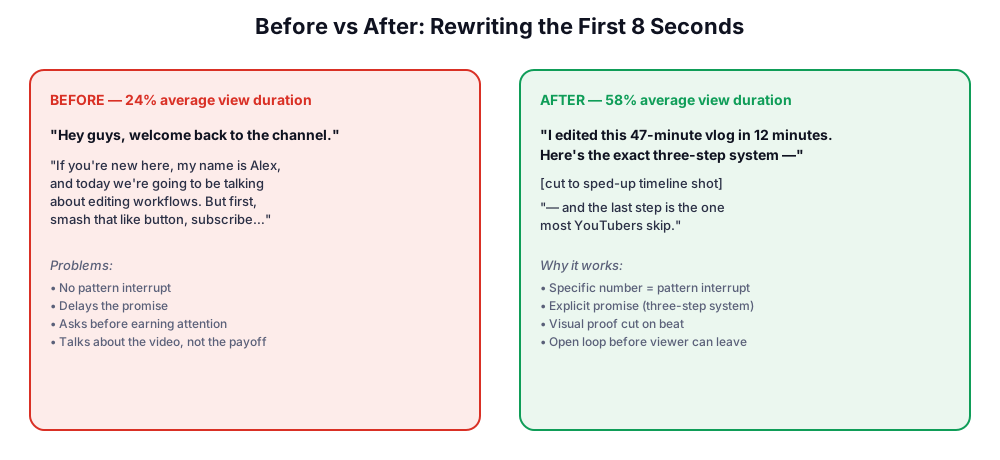
The theory only becomes useful when you can see it applied to a real script. Below is an illustrative before-and-after built from a pattern we see constantly in audits — a tutorial channel with an average view duration of 24% and a hard first-10-second cliff. The figures model the mechanics; treat the direction and scale as the lesson.
What actually changed
Nothing about the video's content changed. Same teacher, same tips, same edit style. Only the first eight seconds were rewritten. Average view duration moved from 24% to 58%, and the video went from 800 impressions per day to 41,000. This is the leverage the hook carries.
Three more before/after rewrites
Finance channel — investing tutorial
Before
"Hey everyone, in today's video I want to talk to you about index funds and why I think they're a great long-term investment for beginners…"
After (Result-First)
"I put $500 a month into a single index fund for seven years. It's now worth $61,400. Here's exactly what I bought — and the mistake I almost made in year two."
Cooking channel — recipe video
Before
"Welcome back to the kitchen! Today I'm making a really easy weeknight pasta dish that I hope you're going to enjoy…"
After (Live Demo)
[Pan hits heat, garlic goes in, 3-second sizzle] "This is a 9-minute pasta that tastes like it took an hour. The trick is what you do to the pasta water before the pasta even goes in."
Fitness channel — workout explainer
Before
"So a lot of you have been asking me about how to build muscle without going to the gym, so I decided to make a video about it…"
After (Contrarian)
"Most home-workout advice on YouTube is wrong. Not slightly wrong — meaningfully wrong. Here's the routine I actually used to add 8 kilos of muscle without a gym."
Tech channel — product review
Before
"What's up everyone, welcome back. Today I've got the brand new [product] and I've been using it for about two weeks now, so let's get into the review…"
After (Stakes + Preview)
"There are three things about this product the marketing page will not tell you. One of them will make you return it. Two weeks in, here's what I found."
Education channel — explainer
Before
"Hello everyone, in this video we're going to explore the concept of compound interest and how it can help you build wealth over time…"
After (Identity Flip)
"People who become wealthy don't think about money the way you were taught to. They think about one specific number — and once you see it, every financial decision gets easier."
What these rewrites all have in common
Look at the four "after" versions side by side and a pattern emerges. Every rewrite does three things in the first sentence: it drops the reader inside a concrete situation, it plants a specific reward, and it opens a loop that only the video can close. None of them uses a superlative. None of them says the word "today." None of them introduces the creator. The rewrites are shorter, blunter and more specific — and that specificity is the entire reason the retention curve reshapes.
Matching the hook to title and thumbnail
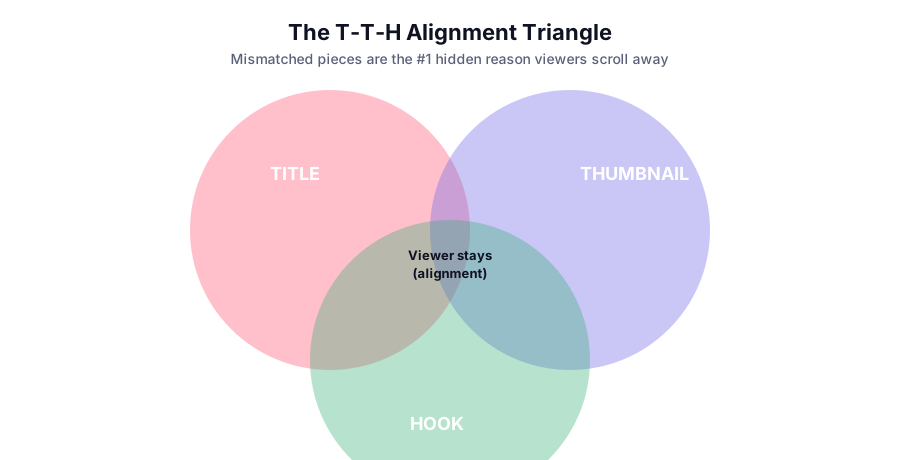
A hook does not stand alone. It exists inside a three-part contract with the title and the thumbnail. When those three pieces align, the viewer feels satisfied and stays. When they don't, the viewer feels tricked and leaves — even if the video itself is excellent.
Rule 1: The hook must confirm the thumbnail
Whatever emotion the thumbnail promises — surprise, tension, curiosity, warmth — the first three seconds of the hook must confirm. If the thumbnail shows a shocked face and the video opens with a calm mid-shot, the viewer's brain registers "bait" and drops out. Confirmation does not mean literal reproduction; it means emotional match.
Rule 2: The hook must restate the title's promise, in different words
Restating the title verbatim feels robotic. But rephrasing the same promise in the opening line signals "you clicked on the right video." The viewer's brain relaxes, threat check passes, retention rises.
Rule 3: The hook is where you keep the title's implicit contract
If the title says "in 12 minutes," the hook should reference the twelve minutes. If the title says "the mistake," the hook should reference the mistake. Contracts that never get referenced feel broken. Contracts that get referenced early feel honored.
Watch out for CTR-vs-AVD asymmetry
A common pattern in YouTube Studio's Advanced Mode is a video with a high click-through rate but low average view duration. This is almost always a title-hook mismatch: the packaging is winning the click, but the hook is failing the confirmation. Rewrite the hook to match the title before you rewrite the title to match the hook.
Score your hook against real retention data
Paste your first-8-seconds script into RetentionYT and get an instant hook score, a rewrite suggestion, and a predicted retention curve.
Common mistakes to avoid
Even creators who understand the theory of hooks routinely make the same handful of mistakes in execution. Here are the ones we see most often — and the fastest fix for each.
| Mistake | Why it fails | Fastest fix |
|---|---|---|
| Starting with an intro card or logo animation | Adds a 2–5s delay before any content; kills novelty scan | Delete it. Or move it to the end. |
| "Hey guys, welcome back" | Delays promise, forces pronoun before earning attention | Cut the first sentence entirely. |
| Asking for likes/subscribes in the first 20 seconds | Trips the threat check before the reward has landed | Move the ask to the mid-video peak. |
| Vague promises ("today we'll talk about") | No concrete reward prediction possible | Replace with a specific number or outcome. |
| Reading the title out loud | Feels robotic; consumes seconds without adding anything | Rephrase the title's promise in different words. |
| Music louder than voice in the first 3s | Damages clarity of the promise; viewer misses the offer | Duck music -6dB under voice in the intro. |
| Slow zoom-in on a static face | No visual novelty; feels like the video hasn't started | Cut to B-roll or a physical action within 1s. |
| Meta-commentary ("this video is going to be different") | Talking about the video is not the video | Show what makes it different instead of saying so. |
Testing and iterating your hook
The best hook writers on YouTube treat every opening as a hypothesis to be tested, not a decision to be defended. Here is the loop we recommend.
Step 1 · Draft three variations
Before you record, write three complete 8-second hooks using three different formulas from the list above. Force yourself to actually write them out — do not just imagine them. Almost always, one draft is dramatically better than the others, and you can only see which by writing all three.
Step 2 · The 8-second phone test
Record each of the three hooks as a phone selfie clip. Show them to two or three people who are not in your niche. Ask one question: "After watching this, do you want to know what happens next?" A yes from a non-niche viewer is the strongest signal you can get.
Step 3 · Publish and measure
Publish with the winning variant. Then, 48 to 72 hours after upload, open YouTube Studio's Audience Retention chart. Read three markers:
- 15-second retention. Should be above 70% for most niches, above 80% for a strong hook.
- Shape of the intro curve. A shallow slope is healthy. A vertical cliff means the hook failed a check.
- First peak location. If the first small rebound in the curve happens after the 30-second mark, your Preview or Path beat is landing too late.
Step 4 · Rewrite for the next video
Hook writing is a compounding skill. Every video's retention curve is feedback for the next video's hook. Keep a running "hook journal" — a simple document where you log the opening line, the formula used, and the 15-second retention number. After 10 videos you will have a personal dataset that beats any generic advice.
Step 5 · Compare within your own channel, not against strangers
The most common iteration mistake is benchmarking your hook against MrBeast, or Marques Brownlee, or whichever channel currently dominates your feed. Those channels operate at scales where their retention is downstream of an entire production pipeline you don't have. The only fair benchmark for your hook is your previous hook. If this week's 15-second retention beats last week's, the hook improved. That is the only comparison that matters at your stage.
A/B testing on YouTube: what is possible and what isn't
YouTube does not currently allow true A/B testing of the video itself, only of thumbnails and titles (via Test & Compare in YouTube Studio). But hook-quality testing is still possible in three ways: (1) publish two videos with the same topic and different hook formulas and compare their intro curves; (2) use the phone-selfie test with 3–5 non-niche friends as a pre-publish signal; and (3) if you have access to a tool like RetentionYT, run predicted-retention scoring on multiple drafts before you record. None of these are as clean as a true A/B test, but combined they get you 90% of the signal at 10% of the effort.
How long to iterate before switching formulas
A single low-performing hook is not evidence that the formula is wrong. A single high-performing hook is not evidence that the formula is right. Give any hook formula at least three to five videos of use before drawing conclusions. Random variance on YouTube is massive at small sample sizes — every experienced creator has a video that went viral with a hook they thought was mediocre, and a video that flopped with a hook they were proud of.
Where RetentionYT fits in the loop
RetentionYT collapses steps 1 and 3 into a single pass. It scores your draft hook against real retention data from comparable channels, flags which of the 5-P beats are missing, and gives you a predicted retention curve before you record. You still make the creative call — but you make it with feedback, not guesses. See how RetentionYT scores hooks →
Actionable checklist
Run this checklist on every hook before you publish. If you cannot answer "yes" to at least eight of the ten items, rewrite before you record.
- The first sentence contains a specific number, object, or outcome.
- The promise is stated (in different words from the title) inside the first 3 seconds.
- A visual cut, action or motion happens before the 2-second mark.
- No self-introduction ("I'm X", "welcome back") appears in the first 15 seconds.
- No like/subscribe ask appears in the first 20 seconds.
- The hook opens a loop that the body of the video actually closes.
- The emotional tone of the hook matches the emotional tone of the thumbnail.
- Music is at least 6 dB below voice during the opening 8 seconds.
- The Preview beat (a glimpse of the peak moment) lands before second 7.
- You have said the hook out loud and it does not feel embarrassing to say fast.
Frequently asked questions
How long should a YouTube hook be?
A YouTube hook should land its promise inside the first 8 seconds. For long-form videos aim for 5 to 15 seconds of hook total; for Shorts, the entire hook must resolve inside 3 seconds because the swipe interaction is instant.
What is the best YouTube hook formula for beginners?
The Result-First hook is the safest formula for beginners. You state the final outcome ("I turned $100 into $2,847 in 30 days"), then say "here's exactly how" — it forces specificity, delivers immediate proof, and opens a curiosity gap without needing advanced editing.
Why do viewers scroll away in the first 10 seconds?
Viewers scroll when the first seconds fail three unconscious checks: novelty (is this different?), reward prediction (will I gain something?), and trust (does this match what the title promised?). Generic intros, slow pacing, and title-thumbnail mismatch cause most drop-offs.
Should I still say "hey guys, welcome back" at the start of my video?
No. Delayed self-introduction is one of the most retention-costly habits on YouTube. Introduce yourself only after you have earned attention — typically after the hook and the first content payoff, around the 30 to 60 second mark.
How do I know if my hook is working?
Open YouTube Studio and look at the Audience Retention graph. If your video holds above 70% at the 30-second mark and your intro segment stays flat rather than dropping steeply, the hook is working. A sharp cliff before 15 seconds means the promise, pacing, or match to title needs to be rewritten.
Do hooks work the same way for YouTube Shorts?
The principles are identical but the timing is compressed. On Shorts the pattern interrupt and promise must both land inside the first 1 to 2 seconds, because the viewer has already positioned their thumb to swipe. Cold Open and Result-First formulas transfer best to Shorts.
Can I use AI to write my YouTube hooks?
AI is useful for generating hook variations and stress-testing openings, but the strongest hooks are grounded in real specifics from your video — a real number, a real object, a real moment. Use AI to draft options, then rewrite with your own concrete details.
How many hook variations should I test before publishing?
Draft at least three: one Result-First, one Contrarian, and one Open Loop. Record each as a 15-second phone clip and show them to someone outside your niche. The version that makes them ask "wait, what happens next?" is your winner.
Conclusion
Every YouTube video is one gesture away from being closed. What decides whether that gesture happens is not the title, not the thumbnail, and not the topic — it is the eight seconds that begin the moment the viewer clicks play. Those eight seconds are the entire negotiation, and the nine formulas above are nine tested ways to win it.
You do not need to master all nine. Pick one that fits the next video you are already planning. Write three variations. Read them out loud. Choose the one that makes a stranger say "wait, what happens next?" and record that one. Then measure the retention curve, keep what worked, and rewrite what didn't. Do this ten times in a row and your channel will feel like it belongs to someone else — because the version of you that writes hooks this way is a different creator than the version that starts with "hey guys, welcome back."
The hook is the highest-leverage sentence you will write this year. Treat it like it.
Ready to stop guessing?
RetentionYT scores your hook against real audience retention curves and rewrites the parts that will lose viewers. Free to try, no card required.
Keep reading
- The Complete Guide to YouTube Cold OpensHooks · 14 min read
- How to Write Curiosity-Gap Openings (Without Feeling Clickbait)Hooks · 11 min read
- The Script Structure That Holds Retention to the EndScripting · 18 min read
- How to Read Your YouTube Retention Graph Like a ProRetention · 12 min read
- Title & Thumbnail Alignment: The Retention MultiplierPackaging · 9 min read
- Hook Formulas That Work on YouTube ShortsShorts · 8 min read
External references: YouTube Creators — Content Strategy · YouTube Studio Analytics documentation · YouTube Official Blog
Last updated: August 5, 2026.
Frequently asked questions
- How long should a YouTube hook be?
- A YouTube hook should land its promise inside the first 8 seconds. For long-form videos aim for 5 to 15 seconds of hook total; for Shorts, the entire hook must resolve inside 3 seconds because the swipe interaction is instant.
- What is the best YouTube hook formula for beginners?
- The Result-First hook is the safest formula for beginners. You state the final outcome ("I turned $100 into $2,847 in 30 days"), then say "here's exactly how" — it forces you to be specific, delivers immediate proof, and opens a curiosity gap without needing advanced editing.
- Why do viewers scroll away in the first 10 seconds?
- Viewers scroll when the first seconds fail three unconscious checks: novelty (is this different?), reward prediction (will I gain something?), and trust (does this match what the title promised?). Generic intros, slow pacing and title-thumbnail mismatch cause most drop-offs.
- How do I know if my hook is working?
- Open YouTube Studio and look at the Audience Retention graph. If your video holds above 70% at the 30-second mark and your intro segment stays flat rather than dropping steeply, the hook is working. A sharp cliff before 15 seconds means the promise, pacing or match to title needs to be rewritten.
- Do hooks work the same way for YouTube Shorts?
- The principles are identical but the timing is compressed. On Shorts the pattern interrupt and promise must both land inside the first 1 to 2 seconds, because the viewer has already positioned their thumb to swipe. Cold Open and Result-First formulas transfer best to Shorts.
- Can I use AI to write my YouTube hooks?
- AI is useful for generating hook variations and stress-testing openings, but the strongest hooks are grounded in real specifics from your video — a real number, a real object, a real moment. Use AI to draft options, then rewrite with your own concrete details.
- How many hook variations should I test before publishing?
- Draft at least three: one Result-First, one Contrarian and one Open Loop. Record each as a 15-second phone clip and show them to someone outside your niche. The version that makes them ask "wait, what happens next?" is your winner.
Find your video’s drop-off points before you publish
RetentionYT audits your script for the moments viewers leave — so you can fix them before recording.
Get retention tips in your inbox
Occasional, practical emails on hooks, pacing, and retention. No spam.
Related posts
9 YouTube Intro Ideas That Don't Lose Viewers
Logo stings and 'welcome back' cost you viewers in the first 10 seconds. Here are 9 YouTube intro ideas — with scripts, retention data, and a proven hook framework — that keep them instead.
Cold Opens for YouTube: When (and How) to Skip the Setup
A complete guide to cold opens on YouTube — the psychology, a five-step framework, before/after script examples, and how to align hook, title, and thumbnail for maximum retention.
The Click Promise: Matching Your Hook to Your Title and Thumbnail
Learn how to align your YouTube hook, title and thumbnail so every click gets the payoff it was promised—and more viewers keep watching.