How to Write a YouTube Hook That Actually Works (Process + Examples)
A repeatable five-step process for writing YouTube hooks: mine the payoff, make it specific, add stakes, compress, and test — with two full before-and-after rewrites.

12 min read
Most videos are lost in the first ten seconds, and most creators write their hook as the last thing, at midnight, tired, in one take. That's backwards. The hook is the highest-leverage 35 words in the entire script — it deserves to be written first, rewritten hardest, and tested before anything gets recorded.
A strong hook is not luck or charisma. It is a structure you can reuse across every video you publish, and this post is the process for building it: five steps, two full rewrites, and the mistakes that quietly undo otherwise good openings. If you want a library of plug-in formulas instead of a process, the companion piece is 9 YouTube Hook Formulas That Stop Viewers From Scrolling; this one is about how to generate hooks from your own material, on demand.
What a hook has to do
A viewer who clicks arrives with a question — the one your title and thumbnail planted. In the first seconds they run three checks, fast and mostly unconsciously:
- Confirm the click. "Is this actually the video I thought it was?" The hook must echo the title's promise immediately — one shared noun usually does it. Any delay reads as bait.
- Open a gap. "Do I still need to watch?" If the hook answers the title completely, the video is over before it starts. State the outcome, withhold the mechanism.
- Price the wait. "How long until I get it?" A time-boxed promise — "in the next two minutes," "by the end of this" — tells the viewer the wait is bounded. Unbounded waits are what swipes are for.
Miss any one of the three and attention leaks: no confirmation means instant exit, no gap means satisfied departure, no price means impatient departure. For a data-side view of exactly where these failures show up on the retention graph, see Why YouTube Viewers Leave in the First 30 Seconds.
One rule sits above all three: the hook is a promise you must keep. Everything below is about making the promise sharp, not making it big.
The five-step hook-writing process
Run these in order. The order matters — each step feeds the next.
Step 1: Write the payoff sentence first
Before writing any opening, finish this sentence somewhere in your notes: "By the end of this video, the viewer will have ______." Be concrete: not "learned about color grading" but "a three-step grading workflow they can run tonight." That sentence is the raw material of your hook. If you can't complete it, the problem isn't the hook — it's that the video doesn't have a defined payoff yet, and no opening line survives that.
Step 2: Make it specific
Take the payoff sentence and replace every abstraction with an artifact: a number, a named object, a moment, or a contradiction. "Faster" becomes "six hours down to eleven minutes." "A budget trip" becomes "nine days in Portugal." Specificity does two jobs at once — it proves you actually did the thing, and it gives the viewer's brain a picture to hold while you set up. Generic hooks fail this check constantly: "I found a better way to edit" is invisible; "I deleted 40% of my editing workflow" is not.
Step 3: Add stakes
Answer the viewer's unasked question: why now, and what does not-knowing cost? Loss framing works well here — "if you're still doing X, you're paying for it in Y." Stakes can also be time ("this changes in September"), money ("the mistake nearly cost us $400"), or status ("this is the thing that separates channels that grow from channels that stall"). One stake is enough. Two starts to sound like an infomercial.
Step 4: Compress to two sentences
Now write the hook as two sentences — roughly 35 words, landing inside 15 seconds at a sprint pace. The deletion pass is the whole step: remove the greeting, the "today we're going to talk about," the "I've been thinking about making this video," the disclaimer, the energy warm-up. The test is brutal and simple: the first sentence must contain a noun from your title, and both sentences must survive the "would a viewer repeat this to a friend?" filter. If a sentence is setup rather than promise, it goes.
Step 5: Read it aloud and write variants
Read the hook out loud, at performance energy. If it sounds like a warm-up — rising inflection, throat-clearing rhythm — rewrite it. Then write two more variants of the same hook: one that leads with the result, one that leads with the problem. Say all three aloud back to back; the one that sounds like you mid-story, not at the start of a presentation, is usually right. This is also the step where an outside perspective earns its keep — the testing method in the FAQ below takes about ten minutes and costs nothing.
Two worked rewrites
The process is easiest to trust when you watch it transform a real opening. Both examples are typical of the drafts we see in audits — decent videos, soft openings.
Rewrite 1: the tutorial hook
Before — 41 words, promise never confirmed
Hey everyone, welcome back to the channel. Today I want to talk about something I've been experimenting with lately, which is color grading, and specifically how I grade my photos in Lightroom. Before we get into it, real quick — if you're new here, I do photography and editing videos every week.
Applying the steps: the payoff sentence is "a three-step grading workflow you can run tonight" (step 1). The artifact is the time saved, so we need real numbers (step 2). The stakes: everyone wastes hours re-grading from scratch (step 3). Then compress to two sentences and cut everything that is setup (step 4):
After — 48 words, 15 seconds at sprint pace
This photo took me six hours to grade last year. This one took eleven minutes — same camera, same room, same light — and the difference is a three-step Lightroom workflow you can copy tonight. If you're still grading from scratch every time, you're paying for it in hours.
What changed: the first sentence confirms a title noun ("grade") and states a specific contrast. The numbers are real artifacts, not decoration. The stakes arrive by sentence three, and the mechanism stays withheld — the viewer knows that it works, not how, which is the entire reason to keep watching. The self-introduction moved to after the first payoff, where it costs nothing.
Rewrite 2: the vlog / story hook
Before — 52 words, story starts before it starts
So a few months ago we decided we were going to try to plan this trip, and there was a lot of back and forth about it. I know a lot of you ask how we travel so cheaply, so I thought it would be fun to kind of walk you through the whole process of how we did it.
This one isn't lazy — it's friendly and the video behind it is good. But it spends its 15 seconds on meta-commentary about the decision to make the video. The payoff ("how we travel cheaply") is buried at the end, with no specifics and no stakes. Running the steps:
After — 44 words, result first, open loop planted
We spent nine days in Portugal for less than most people spend on four. The flights were the easy part — it was the one booking mistake on the way home that nearly cost us 400 dollars, and it's the mistake I see everyone make. Here's the whole system.
What changed: the result leads. The money claim is the specific artifact. The booking mistake plants an open loop that pays off mid-video, and "here's the whole system" prices the wait — the viewer knows structure is coming. Note that nothing here over-promises: the video really does contain the system and the mistake, which is what keeps the retention graph honest after the hook does its job.
How long a hook runs, and where everything else goes
The hook itself is short. What surrounds it is where creators lose the next 30 seconds:
- The hook: two sentences, roughly 35 words, inside the first 15 seconds.
- The roadmap: comes after the hook — one line previewing the route. Never before.
- Your name and channel pitch: after the first small payoff, typically past the 30-second mark — or not at all. Regulars don't need it; newcomers didn't come for it.
- The setup and context: whatever survives belongs in the first section, not in the hook's 15 seconds.
If your format can skip setup entirely and open inside the story, that's a cold open — a related technique with its own tradeoffs, covered in Cold Opens for YouTube: When (and How) to Skip the Setup.
Common hook mistakes
- The meta-opening. "I've been wanting to make this video for a while" — the video's production history is not the viewer's problem.
- The buried lede. The payoff exists, but it's the fourth sentence, and nothing before it would survive deletion.
- Repeating the title verbatim. Confirmation needs one noun, not the whole string — spend the rest of the two seconds going one level more specific.
- Front-loading credentials. "As someone who's been editing for ten years..." — show the artifact instead; the proof is the number, not the resume.
- Asking permission. "Stick around if you want to learn..." gives the viewer a decision point at the exact moment you want momentum.
- Energy mismatch. A quiet, apologetic delivery under a high-intensity thumbnail reads as a broken promise before the sentence even finishes.
- Over-promising. The most common self-inflicted wound: a hook the video can't cash. It buys clicks and pays them back with a bleed.
The pre-record hook checklist
- The first sentence contains a noun from the title
- The hook states a real number, object, or named moment
- The mechanism is withheld — the outcome is stated, not explained
- Stakes answer "why does this matter to me?"
- Total length is two sentences, roughly 35 words, under 15 seconds
- No greeting, no meta-commentary, no credentials before the promise
- You read it aloud and it does not sound like a warm-up
- The promise is one the video actually keeps
Frequently asked questions
What's the difference between a YouTube hook and an intro?
The hook is the first one or two sentences — it confirms the title's promise and opens the question the video answers. The intro is everything that comes after: your name, the channel pitch, the roadmap, the setup. The hook is mandatory and comes first; the intro is optional and comes later — usually only after the first small payoff, if you keep it at all.
How do I test a hook before recording the whole video?
Record each candidate hook as a 15-second phone clip, exactly as you'd deliver it, and show two or three of them to someone outside your niche. Ask them only one question: "what do you think this video is about?" If their answer doesn't match your title, the hook failed — no opinion about quality needed. You can also paste the script into the YouTube script review tool and read the hook score before you film anything.
Should my hook repeat the exact words in my title?
Not word for word — one shared noun is enough. The hook's job is to confirm the click, and echoing a key word from the title does that instantly. But repeating the full title verbatim wastes the two seconds where you could be adding the specific detail the title couldn't hold. Say the keyword, then immediately go one level more specific than the title.
Can a strong hook still hurt retention?
Yes — when it over-promises. A hook that inflates the payoff pulls in viewers the video can't satisfy, and the retention graph shows it: a decent first 30 seconds, then a fast bleed once viewers realize the promised thing isn't coming. A hook should be the most exciting true sentence about the video, not the most exciting sentence possible.
Score the hook before you record it
The cruel part of hook-writing is that you can't hear your own opening the way a first-time viewer does — read it twenty times and it all starts to sound fine. RetentionYT gives you the outside read before filming: paste the script and you get a hook score, title–opening alignment (does the first stretch actually deliver the title's promise), and deterministic hook variations generated from your own script, free, so you can compare rewrites of your hook rather than generic templates. Paid features add AI rewrites that preserve your voice, and the free tier's two audits a month at 5,000 words is enough to test the hook and opening of your next two scripts. The scores are structural estimates of how the opening is built — not YouTube Analytics data — so the retention graph after publish remains the final judge.
Continue reading in Hooks
- 9 YouTube Hook Formulas That Stop Viewers From Scrolling
- The Click Promise: Matching Your Hook to Your Title and Thumbnail
- Cold Opens for YouTube: When (and How) to Skip the Setup
- 9 YouTube Intro Ideas That Don't Lose Viewers
Further reading (external authority references): YouTube's Help Center on audience retention in YouTube Analytics — for verifying a hook against the real curve after publish; YouTube on how its recommendation system weighs satisfaction; and the Creator Insider channel for the YouTube team's own creator guidance.
Frequently asked questions
- What's the difference between a YouTube hook and an intro?
- The hook is the first one or two sentences — it confirms the title's promise and opens the question the video answers. The intro is everything that comes after: your name, the channel pitch, the roadmap, the setup. The hook is mandatory and comes first; the intro is optional and comes later — usually only after the first small payoff, if you keep it at all.
- How do I test a hook before recording the whole video?
- Record each candidate hook as a 15-second phone clip, exactly as you'd deliver it, and show two or three of them to someone outside your niche. Ask them only one question: 'what do you think this video is about?' If their answer doesn't match your title, the hook failed — no opinion about quality needed. You can also paste the script into RetentionYT and read the hook score before you film anything.
- Should my hook repeat the exact words in my title?
- Not word for word — one shared noun is enough. The hook's job is to confirm the click, and echoing a key word from the title does that instantly. But repeating the full title verbatim wastes the two seconds where you could be adding the specific detail the title couldn't hold. Say the keyword, then immediately go one level more specific than the title.
- Can a strong hook still hurt retention?
- Yes — when it over-promises. A hook that inflates the payoff pulls in viewers the video can't satisfy, and the retention graph shows it: a decent first 30 seconds, then a fast bleed once viewers realize the promised thing isn't coming. A hook should be the most exciting true sentence about the video, not the most exciting sentence possible.
Find your video’s drop-off points before you publish
RetentionYT audits your script for the moments viewers leave — so you can fix them before recording.
Get retention tips in your inbox
Occasional, practical emails on hooks, pacing, and retention. No spam.
Related posts
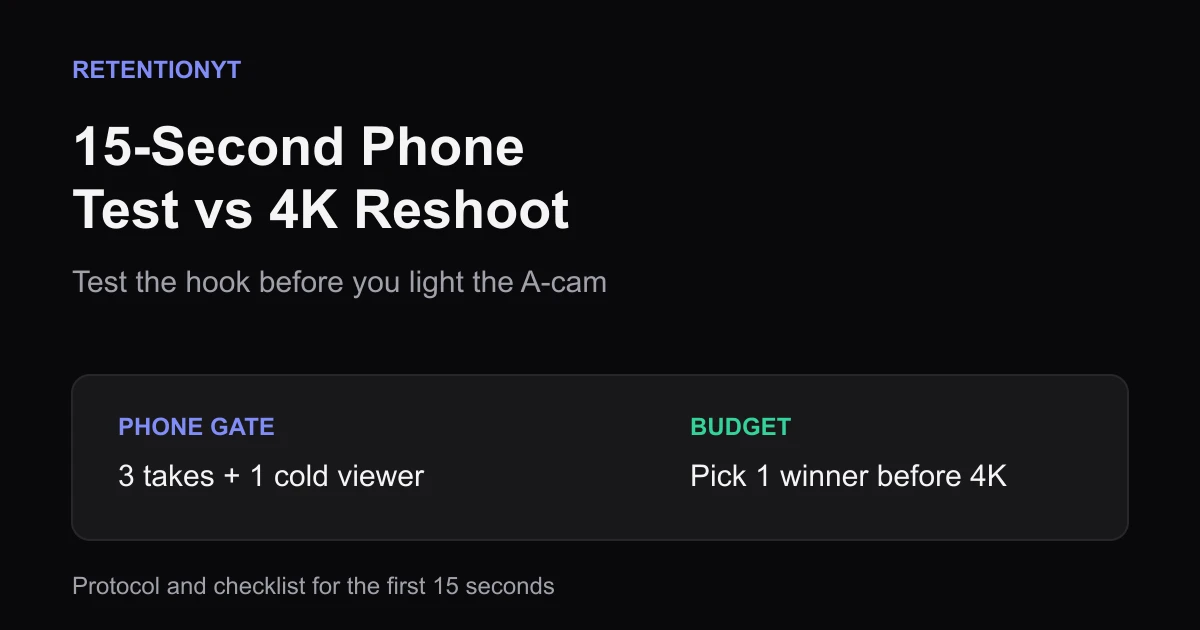
A 15-Second Phone Test Beats a 4K Reshoot
Before you light the A-cam, test three 15-second hooks on a phone in bad light with one cold viewer, then spend the 4K budget only on the winner.
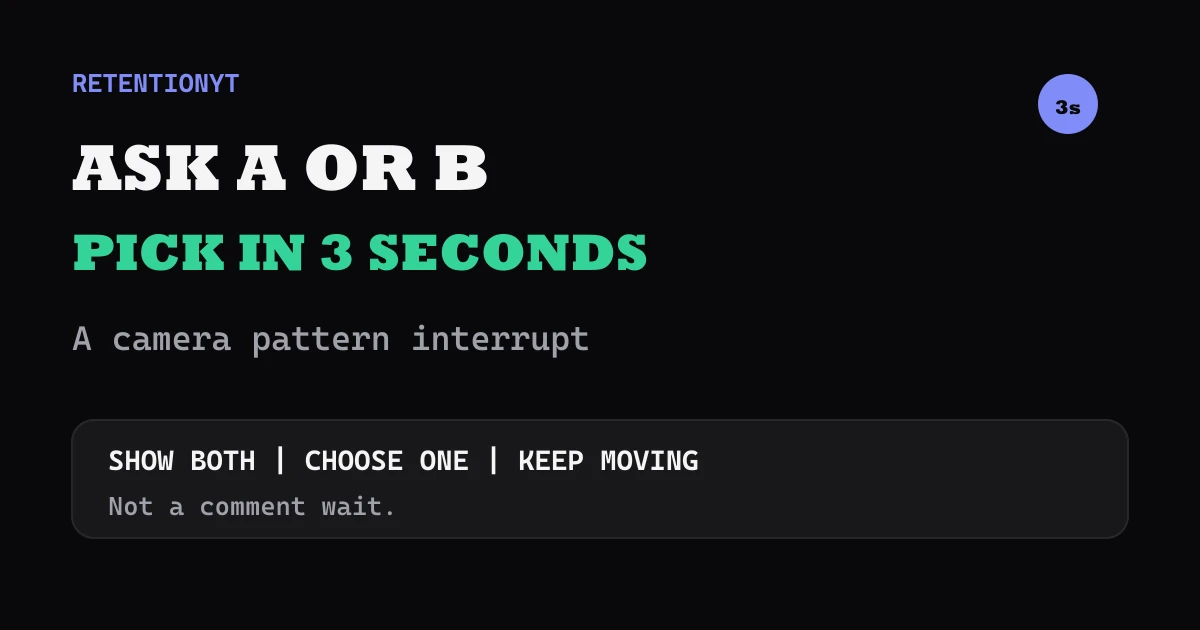
Binary Choice to Camera as a Pattern Interrupt
Use a three-second A or B question to reset a YouTube video: put both choices on screen, pick one on camera, and keep the comment prompt out of the critical beat.
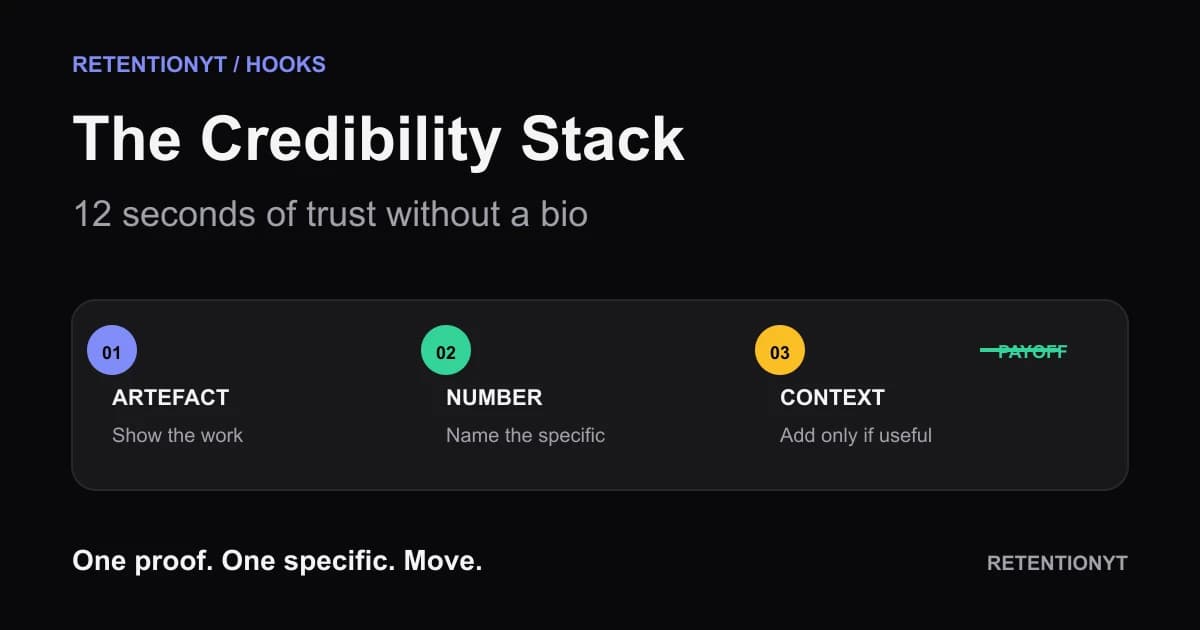
The Credibility Stack: 12 Seconds of Trust Without a Bio
Build credibility in a YouTube intro without a bio: stack one proof artefact, one defensible number, and one short credential inside the first 12 seconds.