Free YouTube Hook Checker: How to Test Your Intro Before You Film
Test a YouTube hook before you record: a 150-word paste test, a 15-second phone clip, and a structural audit — so you fix the first 8 seconds on paper, not in the edit.

6 min read
In this guide
Most YouTube intros fail before the camera turns on. The title promised a specific payoff. The first 20 seconds delivered a greeting, a channel pitch, and a roadmap. Viewers did not wait for the part you actually made the video for.
A hook checker exists to catch that mismatch on the page, not in the retention graph two days later. You do not need a published video. You need the opening lines, 15 seconds of honesty, and a pass/fail rule.
This is the free workflow we use before any RetentionYT audit goes to camera: paste the hook, test it out loud, then run a structural check. Nothing here is a guaranteed retention number. It is a pre-record filter so weak openings never get filmed.
What a hook checker actually checks
A useful checker answers three questions. If any answer is no, rewrite before you record.
- Does sentence one confirm the title? If the title is "I audited 50 finance scripts," the first line cannot be "Hey guys, welcome back." The viewer already chose the video. Confirm the promise.
- Is there a stake in the first 8 seconds? Why this, why now, what happens if they leave. Stakes can be small: wasted film time, a wrong edit, a claim that will be proven in a minute.
- Has the first payoff started? Not the whole video. A fragment: a number, a failed example, a clip of the problem. If the first payoff is still "coming up," the hook is an advertisement for itself.
Those three checks are structural. They do not require a million-subscriber channel. They require you to look at the words you were about to say.
For the writing process behind those sentences, use How to Write a YouTube Hook That Actually Works. For ready-made shapes, see 9 YouTube Hook Formulas. This post stays on testing, not inventing, the opening.
The 150-word paste test (do this first)
Open a notes app. Paste only the first 150 words of the script — roughly 60 seconds spoken, which is more than enough to see whether the hook exists.
Read it once without stopping. Mark:
- The first sentence that a stranger could match to your title. If that sentence is not in the first two lines, the hook is late.
- Any line that could be cut without changing what the video is about (welcome, subscribe, "before we start," your name). Those belong after a first payoff, if they belong at all.
- The first concrete thing: a number, a named mistake, a before/after. If there is none in 150 words, you wrote setup, not a hook.
Pass rule: title match in the first two sentences, and one concrete thing before word 80. Fail means rewrite the opening, not "add energy in the edit."
You can run the same 150-word clip through RetentionYT's free hook test on the homepage. It is a structural estimate, not a YouTube prediction. Use it as a second pair of eyes on the same paste.
The 15-second outsider test
Tools cannot hear delivery. People can.
Record the hook on your phone exactly as you would on camera: same words, same pace, no "I'll fix it in post." Show it to one person who does not make videos in your niche. Ask one question:
What do you think this video is about?
If they paraphrase your title, the hook passed. If they say "a vlog" or "you talking about your channel," it failed. Do not ask "did you like it?" Like/dislike is taste. Title match is the only signal that matters before you spend a day filming.
Two or three candidate hooks, same test. Keep the one that matches. This takes ten minutes and saves a reshoot.
A three-pass rewrite when the checker fails
When a hook fails, do not start over from a blank page. Run three passes on the same draft:
Pass 1 — Payoff first. Move the sentence that actually delivers the title to position one. Greetings drop below it or go away.
Pass 2 — Specific. Replace "a lot of creators" with a countable thing you can defend: "the first 12 seconds," "this cold open," "this paragraph." Invented statistics fail this pass. If you do not have a real number, use a named example instead.
Pass 3 — Cut. Read out loud at conversation speed. If you breathe before the title is confirmed, the sentence is too long. Aim for one breath per sentence in the first 8 seconds.
Then paste the new 150 words and run the outsider clip again. Two cycles is enough for most scripts. A third cycle usually means the title is the problem, not the hook — fix the title against title–thumbnail promise before you write another opening.
Where a tool helps (and where it does not)
A pre-record auditor is useful when you want the whole script checked, not just the first paragraph: pacing density, late payoffs, visual-cue gaps, a verdict of record / fix first / rewrite. That is what RetentionYT is for, and it is also what the YouTube script analyzer landing describes without overclaiming.
It is not useful as a fake retention percentage. No checker, including ours, can promise "your AVD will be 58%." The honest output is: this opening is structurally weak, here is a rewrite to test, re-run the audit after you change the words.
If you only have 10 minutes, do the paste test and the 15-second clip. If you have 20, paste the full script into an auditor and fix the top finding before you film. Either path beats publishing a greeting and hoping the graph is kind.
A 10-minute checklist before you hit record
- Title written as a promise a stranger can repeat
- First two spoken sentences confirm that promise
- One concrete thing before ~80 words
- No subscribe / "welcome back" before the first payoff
- 15-second phone clip: outsider can name the topic
- Optional: full-script audit, one fix applied, re-checked
If six boxes are ticked, you are allowed to film. If the first three fail, you are not "almost ready." You are still in the outline.
For the timed skeleton around the hook, use the YouTube script outline template. For what happens after the opening 30 seconds, see The first 30 seconds of a YouTube video.
What to do with the result
A pass is permission to record, not a forecast. After you publish, compare the real retention graph at 0:00–0:15 with the hook you tested. If the graph still cliffs, the problem may be packaging (title/thumbnail over-promised) or the second sentence, not the tool. Log that and bring it into the next outline.
A fail is cheaper on paper. Rewrite, re-test, then shoot. That is the entire point of a free YouTube hook checker: you find out the intro does not work while the cost of changing it is still zero.
Frequently asked questions
- What is a YouTube hook checker?
- A hook checker is any process that tests the first 8–15 seconds of a script before you film. It can be a paste-into-a-tool audit, a 15-second phone clip shown to one outsider, or both. The point is the same: catch a weak opening while changing it still costs nothing.
- How many words should a YouTube hook be?
- Most spoken hooks land in 20–40 words (about 8–15 seconds at ~150 words per minute). If your opening is over ~80 words before the first payoff, you are writing an intro, not a hook. Cut until the title's promise is confirmed in the first two sentences.
- Can I test a hook without publishing a video?
- Yes. Record the hook as a 15-second clip on your phone and ask one person outside your niche: 'What do you think this video is about?' If their answer does not match your title, the hook failed. You can also paste the script into a pre-record auditor such as RetentionYT and read the hook score before you shoot.
- Does a high hook score guarantee retention?
- No. A checker can only judge structure: whether the opening confirms the title, names a stake, and starts the first payoff. It cannot predict the real YouTube retention graph. Treat the score as a pre-flight check, then verify with the published analytics after upload.
Give your next script a second look
Paste a script into RetentionYT for suggestions on your hook, pacing, and structure. Choose the edits that serve your video, then check audience behavior in YouTube Analytics after publishing.
Get retention tips in your inbox
Occasional, practical emails on hooks, pacing, and retention. No spam.
Related posts
9 YouTube Hook Formulas That Stop Viewers From Scrolling
Nine repeatable YouTube hook formulas that win the first 8 seconds, boost audience retention and stop viewers from scrolling. With scripts, examples and a step-by-step framework.
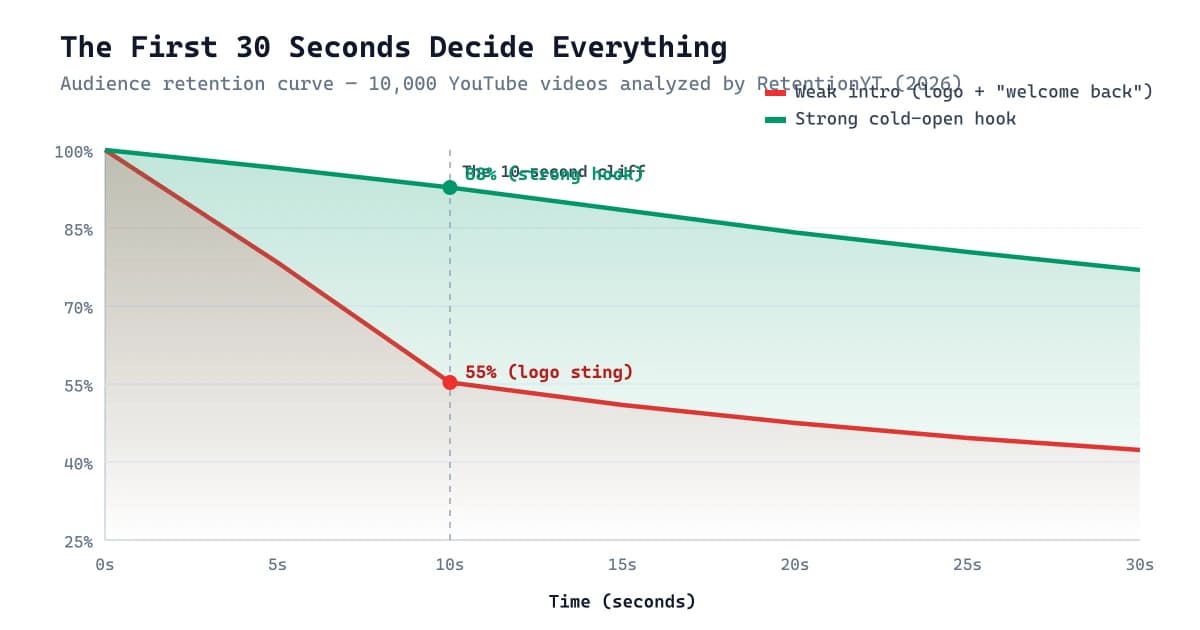
9 YouTube Intro Ideas That Don't Lose Viewers
Logo stings and 'welcome back' cost you viewers in the first 10 seconds. Here are 9 YouTube intro ideas — with scripts, retention data, and a proven hook framework — that keep them instead.
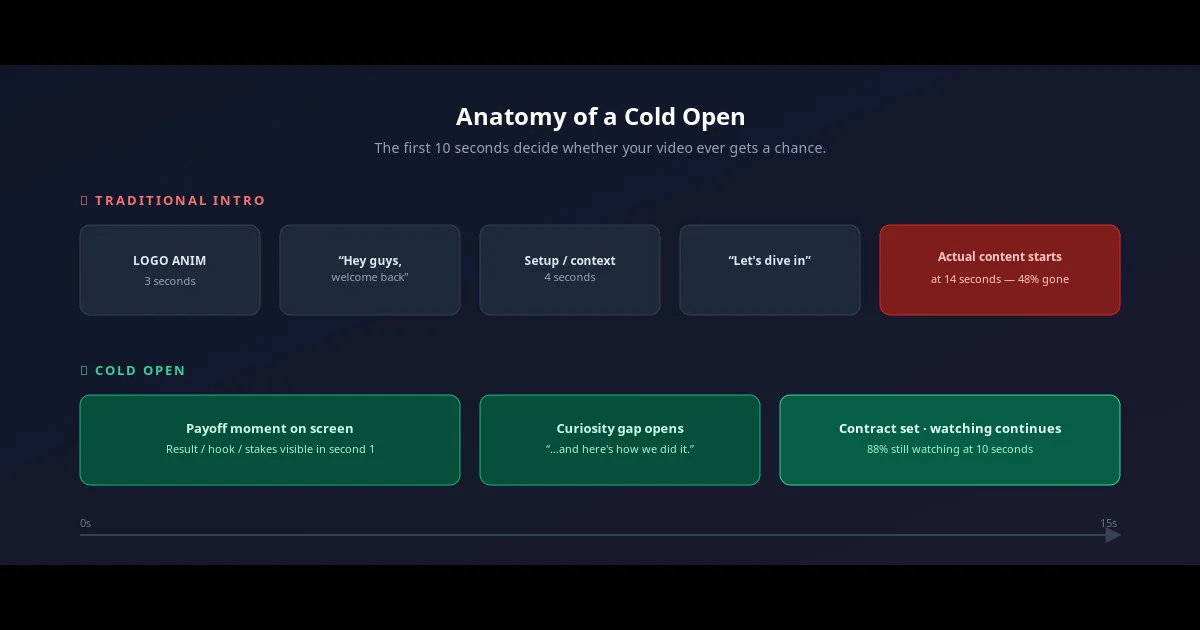
Cold Opens for YouTube: When (and How) to Skip the Setup
A complete guide to cold opens on YouTube — the psychology, a five-step framework, before/after script examples, and how to align hook, title, and thumbnail for maximum retention.