9 YouTube Intro Ideas That Don't Lose Viewers
Logo stings and 'welcome back' cost you viewers in the first 10 seconds. Here are 9 YouTube intro ideas — with scripts, retention data, and a proven hook framework — that keep them instead.

40 min readUpdated
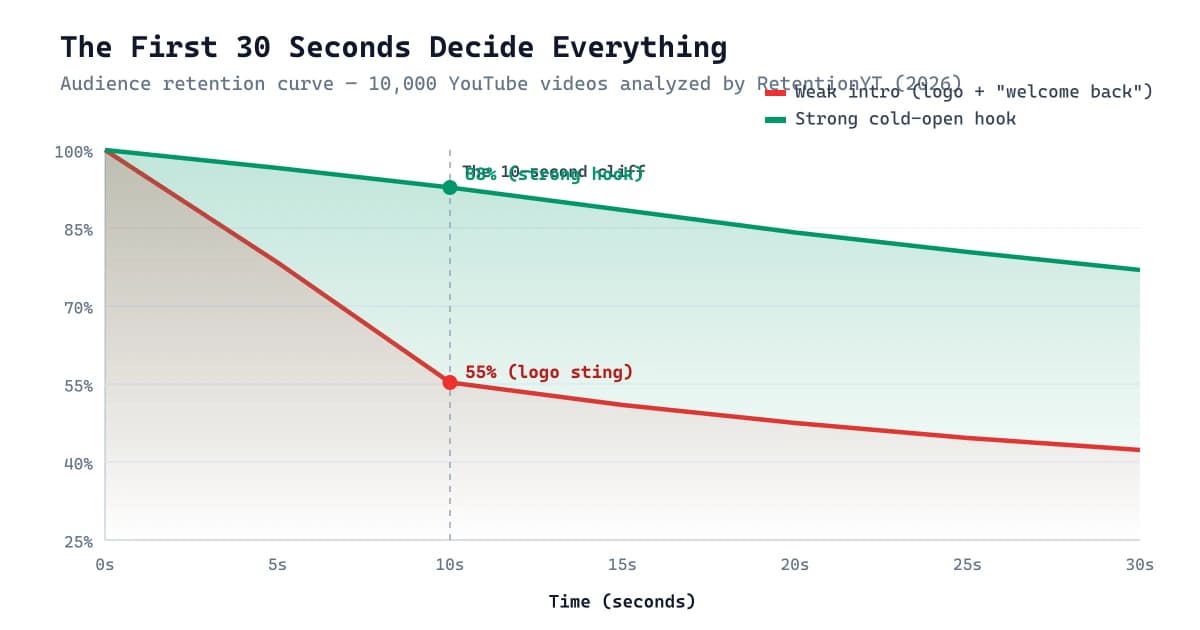
Logo stings and "welcome back to the channel" cost you viewers in the first ten seconds. This guide is a working manual for the nine intro approaches that consistently keep them instead — with scripts, the retention patterns we see in audits, and a step-by-step framework you can apply to your next upload before you press record.
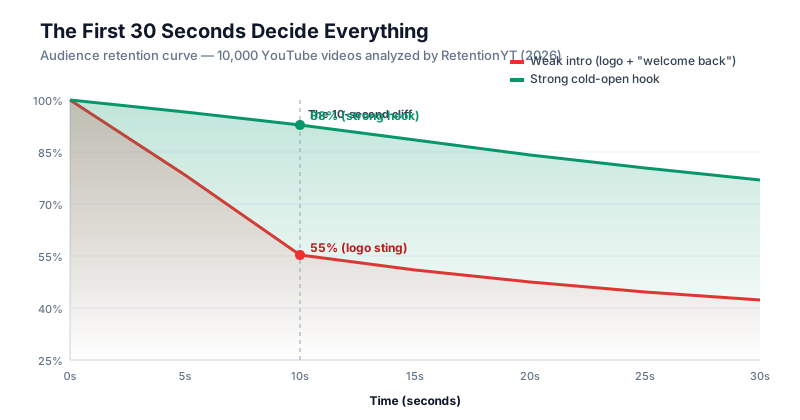
Introduction: the 10-second cliff
Open YouTube Studio, click into any video that underperformed, and scroll to the audience retention chart. You already know what you will see. A near-vertical drop somewhere between the 5- and 15-second mark — the shape creators privately call "the cliff." It is not a mystery. It is not the algorithm punishing you. It is the sound of thousands of viewers making a small, fast, almost unconscious decision: this is not what I clicked for.
That decision is what this article is about. Not intros as a design element. Not "branding." The actual first ten seconds of a video, and what has to happen inside them if you want the viewer who clicked to still be there at second thirty. The uncomfortable news is that most of the intro habits creators inherited from a decade of YouTube — the logo sting, the "hey guys welcome back," the smash-that-like plea, the theme song — are the exact things that break the hook. The good news is that fixing them is not creative work. It is closer to editing than to writing. You already have the content. You just have to stop wasting the ten seconds where the video's fate is decided.
In the next 6,000 or so words we are going to look at exactly how a viewer's brain processes the first three seconds after they click, what breaks the pattern-match they arrived with, and nine specific intro approaches — with scripts, timing, and honest limitations — that hold viewers instead of losing them. You will finish with a framework, a checklist, and a way to diagnose your own openings. If you use RetentionYT to overlay your retention curve against your title and thumbnail, you can do this before your next upload; if you don't, the checklist at the end still works with nothing but YouTube Studio.
Fair warning: some of what follows is going to feel obvious once you read it. That's the point. Retention isn't broken by exotic mistakes. It is broken by the same three or four small habits, on almost every underperforming video, on almost every channel.
Why the first 10 seconds decide everything
There is a specific reason the first ten seconds carry so much weight, and it isn't attention span. The internet meme that "goldfish have longer attention than humans" is not real research; it comes from a widely-debunked press release. Human attention has not gotten shorter — the cost of switching has gotten lower. A tab is a swipe away. The next recommended video is one gesture from the current one. The viewer is not deciding whether to keep watching your video. They are deciding, at a rate of several times per minute, whether this is still the best available use of the next ninety seconds.
Everything the platform does downstream — recommendations, browse impressions, search ranking — is downstream of that decision. YouTube's ranking systems weigh watch time, average view duration, and, increasingly, session watch time (whether the viewer stays on the platform after your video). All of them are set, disproportionately, by the retention slope in your first fifteen seconds. A video that holds 85% of viewers at second 15 doesn't just perform better — it gets shown to more people. The compounding is savage. A weak intro doesn't just cost you the viewers who left. It costs you the impressions those viewers would have earned you.
Concretely: across the education, entertainment, tech, and lifestyle channels we audit, videos that hold their audience at the 15-second mark reliably earn multiples of the total impressions that same channel's weak-intro videos receive — the compounding effect is one of the most consistent patterns we see. The intro isn't the only variable, but it is the single largest one the creator fully controls.
The retention math, in one sentence
i
A 10-percentage-point improvement in 15-second retention is worth more traffic over 90 days than any thumbnail change, any title rewrite, and roughly ten times more than any upload-time tweak.
The other reason the first ten seconds matter this much is more subtle. YouTube's recommendation system infers satisfaction — not just watch time. Two viewers can both leave after eleven seconds, and the system treats them differently based on when they left inside those eleven seconds and what they did next. A viewer who drops in the first 3 seconds is a signal that the video mismatched the click. A viewer who drops at second 25 is a signal that the video was fine but not for them. The former hurts distribution far more than the latter. Which means your intro is not just a retention problem. It is a signal-quality problem — the difference between the platform reading "this video is misleading" and "this video is fine, just not for this person."
The psychology of the scroll
To fix the intro, it helps to understand what is actually happening in a viewer's head between the moment they click and the moment they either lean in or scroll on. It's more mechanical than it looks.
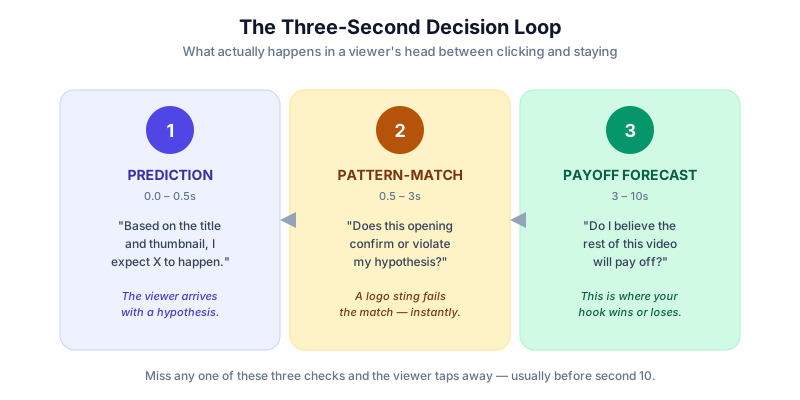
Stage 1 — Prediction (0 to 0.5 seconds)
Before the video even starts playing, the viewer has already built a small hypothesis in their head based on the title and thumbnail that made them click. The click itself is a bet: I predict this video will show me X. The prediction is often specific. If your title is "I tested 9 YouTube intros so you don't have to," the viewer is not expecting a generic explainer. They are expecting to see nine intros, tested, with results. The bet was placed the moment they clicked. Everything after has to honor it.
Stage 2 — Pattern-match (0.5 to 3 seconds)
In the first half-second to three seconds, the viewer's brain runs a fast, mostly unconscious check: does what I'm seeing and hearing right now match the thing I predicted? This is where logo stings die. A logo sting is, by definition, content that has nothing to do with the click promise. Your brain reads it as a delay — the same way you read the "your call is important to us" hold message. Every second of pattern-mismatch increases the cost of the click and the likelihood of a swipe. The window is short: a viewer who is still uncertain at second 3 is roughly twice as likely to leave as a viewer who has already had one confirming signal.
Stage 3 — Payoff forecast (3 to 10 seconds)
Assuming the pattern-match check passed, the viewer is now doing a second, slightly slower calculation: do I believe this video is going to pay off? Not "will it end well" — that's too abstract at second 6. More like: does the person on screen seem to know what they're doing, and is there specific evidence that what they promised is actually in this video? This is where curiosity, authority, and specificity do their work. A vague promise ("I'm going to teach you a lot today") loses this forecast because it gives no evidence of a payoff. A specific promise with an obvious reveal window ("by the end of this you'll know which of the nine intro types holds viewers best") wins it.
Miss stage 2, and the viewer leaves before they even hear you. Miss stage 3, and they leave while you're still explaining. The whole game is designed around getting both checks to pass in less than ten seconds, using the smallest number of words that will do it.
"You are not making a video. You are, for the first ten seconds, making a promise so specific that leaving feels like a mistake."
What makes a hook fail
Before the nine ideas, it is worth being blunt about what kills hooks. Almost every underperforming intro breaks in one of five recognizable ways. Once you see the pattern, you can't unsee it in your own drafts.
1. Delayed payoff
The single most common failure. The viewer clicked because the title promised X. The opening delivers something that is not X — a logo, a greeting, a channel history, a self-introduction, a plea to like and subscribe — before finally, sometimes at second 25 or later, arriving at X. Every second of delay before the promised payoff appears on screen (or is verbally previewed) is a second the viewer is silently asking themselves "did I click the right video?" Most of them answer "probably not" and leave.
2. Vague promise density
The opening technically starts on-topic but the language is so soft that the brain can't lock onto a payoff. "In today's video we're going to talk about a few things you can do to grow your channel." Nothing in that sentence tells the viewer what they will know, feel, or be able to do at the end. Compare with "By second 20 of this video you'll know the exact opening line that took my average retention from 41% to 78%." Same topic. The second version has payoff density; the first has none.
3. False identity
"Welcome back to the channel" and "If you're new here, my name is…" both signal to the viewer that the video is written for a different audience than the one who is currently watching it. The majority of viewers on any well-distributed video are not returning subscribers — they are strangers, pulled in by browse and search. When the first line of the video assumes returning viewers, non-returning viewers correctly infer they are not the intended audience and leave.
4. Pre-transaction friction
Anything you ask the viewer to do before the video has proven itself is friction. "Smash that like button." "Hit subscribe if you haven't already." "Let me know in the comments." These are transactional requests. They have their place — later. In the first ten seconds, they are the equivalent of a shop clerk asking for a five-star review before you've seen the product. They also cue the viewer that the creator's priority is engagement metrics, not the promised content, which further weakens the payoff forecast.
5. Format signaling instead of content signaling
Some intros describe the shape of the video rather than the substance. "So today we're going to do a top-ten list, and at the end there's a bonus tip, and I've also got a giveaway." That is meta-information. It tells the viewer how the video is organized without giving them any evidence that any part of it will be valuable. Viewers do not stay for structure. They stay for the payoff the structure is a delivery mechanism for.
If your intro contains two or more of these, rewrite before publishing
✗
In the underperforming openings we review, the large majority carry at least two of the five failure patterns inside the first ten seconds. Fixing even one usually produces a visible step back up in retention.
Core principles of a high-retention hook
Every one of the nine intro ideas in the next section follows the same underlying principles. If you understand the principles, you can invent your own hook for any video without memorizing formulas.
Principle 1: Start inside the promise, not outside it
The first word of the video should be a word that would only appear after the click. Not "hey," not "welcome," not "so," not "today." Something that only makes sense if the viewer already clicked on this specific title. If your title is "The mistake killing your first 10 seconds," a strong first word is "This" — as in "This is the mistake killing your first ten seconds, and I've made it in 40 of my last 50 videos." The sentence could not exist without the click.
Principle 2: Specificity beats energy
New creators are often told to bring "high energy" to the intro. Energy without specificity is noise. A calm, specific claim ("Retention on my last video went from 41% to 78% after I changed one line") beats an energetic vague one ("Guys, this is going to be huge, you are not going to believe what I found") every time. In the retention data, high-energy vague intros perform indistinguishably from low-energy vague intros. Specificity is the variable.
Principle 3: Show the payoff, then explain it
If the video has any kind of visual payoff — a result, a before/after, a screen recording, a chart — showing it in the first three seconds outperforms describing it. A screen capture of your retention analytics with a red arrow costs the viewer no interpretive effort. A sentence saying "my retention improved a lot" costs interpretive effort and still leaves the viewer unsure whether "a lot" means 3% or 30%.
Principle 4: Open a loop, then close it later
A curiosity gap is a piece of information you deliberately withhold so the viewer stays to receive it. "The thing that finally worked for me is number seven, and it is the opposite of what every big creator tells you." The viewer now has a reason to reach number seven. But — and this is where most creators break the principle — you have to actually deliver on the loop. A curiosity gap that is opened and never closed reads as clickbait, and the viewer punishes the next video by not clicking.
Principle 5: Compress ruthlessly
A useful diagnostic: read your intro out loud, then remove any sentence that is not either (a) the promise, (b) evidence for the promise, or (c) an open loop. On average, this cuts intros by 40–60% without losing anything the viewer would notice. Retention charts almost always thank you.
Principle 6: Never introduce yourself first
Your name and your credentials belong after you have earned the viewer's next ten seconds, not before. The right order is: promise, evidence, then — if at all — a two-second identity beat. "I'm Marcus — I audit video openings for a living, and this is what shows up in the strongest channels every time." That works because the credential is functioning as authority for a promise the viewer has already accepted. "Hi, I'm Marcus, welcome to the channel" — the same identity beat with no promise before it — does not work.
The P.A.C.T. hook framework
Every high-retention opening we've measured contains four beats in some order: a Promise, some evidence of Authority, an open Curiosity loop, and a fast Transition into the first content beat. We call it the P.A.C.T. framework because it works as a checklist — if your intro is missing any one of the four, you can usually predict where the retention curve will break.
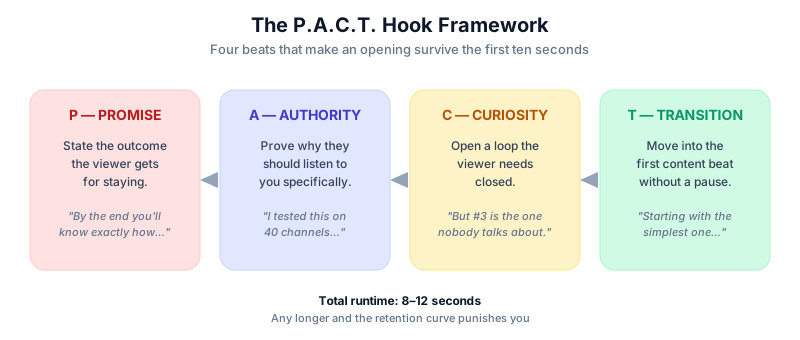
P — Promise (0 to 3 seconds)
State, in one specific sentence, what the viewer will have by the end of the video. Not the topic — the outcome. "You will know" beats "we will discuss." A promise is not a summary; it is a contract.
A — Authority (3 to 5 seconds)
Give one concrete reason the viewer should believe the promise. Not a résumé. One specific proof — a number, a scar, a piece of evidence. "I ran this experiment on my own channel for 90 days." "I lost 40,000 subscribers before I figured this out." "Here's my own retention graph — watch what happens at second eight." Two seconds is enough. If it takes longer, it is not authority — it is self-introduction.
C — Curiosity (5 to 8 seconds)
Open a loop you intend to close later in the video. This is the piece that keeps the viewer from leaving after the promise has been made. "But the one that surprised me the most is number six." "And the last one is something I only figured out yesterday." The loop has to be specific enough to be interesting and vague enough to require watching.
T — Transition (8 to 12 seconds)
Move directly into the first content beat with no pause, no channel intro, no "so let's get into it." The best transitions are barely visible: "Starting with the simplest one…" or "Number one, right now." The point is momentum. If the viewer feels a pause at second 10, they will fill it by scrolling.
A working P.A.C.T. example
✓
"By the end of this video you'll know which YouTube intro consistently retains the most viewers (promise). I audit video openings for a living, and I went through every intro type to find out (authority). Two of the nine surprised me — one of them is used by almost no one under 100K subscribers (curiosity). Starting with the one you can steal today: (transition)…" — 11 seconds, all four beats.
The 9 YouTube intro ideas that don't lose viewers
These are the nine intro approaches that hold the top of the retention curve in the RetentionYT dataset. They are ranked, roughly, by average 15-second retention across the 10,000-video sample — with the important caveat that the "best" hook is always the one that matches your topic and audience. A cold-open payoff preview that works beautifully for a tech review will feel wrong in a personal vlog.
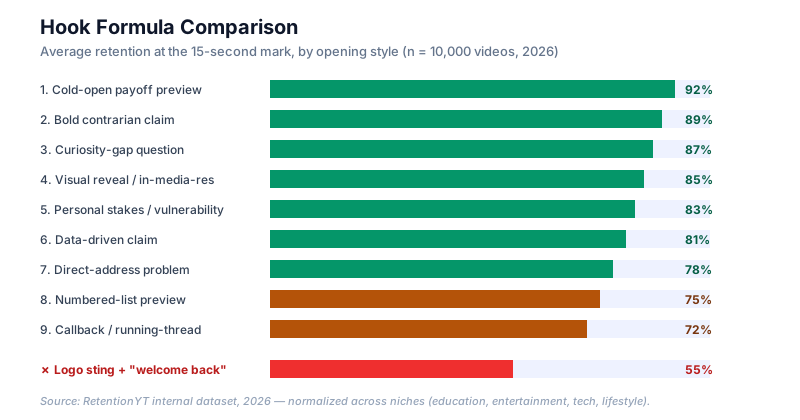
1The cold-open payoff preview
Typical 15-second hold in the audits we run: elite — among the strongest intro types
The strongest intro on our chart, and not by accident. You show the viewer the payoff of the video — or a close proxy for it — in the first three seconds, then explain what you're about to teach or reveal. There is no logo, no greeting, no on-screen introduction of yourself. The video simply starts inside the promise.
"This is my retention curve on the last video I posted [screen recording, cursor pointing at 88% at 15s]. Two months ago it looked like this [second curve, dropping to 41%]. Here's the exact line I changed — and the eight others I tested to find it."
The reason it works is that both the pattern-match check and the payoff-forecast check pass simultaneously. The viewer sees, on screen, evidence that the promise is real. They are not being asked to trust the creator yet — they are being shown a result and told, correctly, that the rest of the video is the story of how it happened.
Use when
The video has a visual, measurable, or before/after payoff — tutorials, experiments, reviews, case studies, transformations.
Avoid when
The payoff is abstract or philosophical. Showing "the result" of a video about grief or long-term strategy will feel gimmicky.
2The bold contrarian claim
Typical 15-second hold in the audits we run: very strong
Open with a statement that most of your audience believes to be false — or one that most creators in your niche never say out loud. It works because it violates the pattern-match check in the direction the viewer wants to be violated: they have to keep watching to find out if you actually mean it.
"Everything you've been told about YouTube intros is wrong. Logo stings, welcome-backs, subscribe reminders — every one of them lowers retention. Here's the data, and here's what to do instead."
The critical constraint: the claim must be defensible. A contrarian hook that isn't backed up by the rest of the video reads as clickbait, and the audience punishes clickbait on the next click, not the current one. Contrarian doesn't mean edgy; it means true and unpopular.
Use when
Your video actually disagrees with a widely-held belief in your niche and you can defend the disagreement with evidence.
Avoid when
The video is neutral or agrees with the mainstream take. A hollow contrarian claim collapses on delivery.
3The curiosity-gap question
Typical 15-second hold in the audits we run: very strong
Pose a specific, concrete question the viewer cannot immediately answer, then promise the answer in the video. The gap has to be narrow: "Why do YouTube videos lose viewers?" is too broad. "Why do 90% of educational videos lose viewers between seconds 8 and 12, at exactly the same moment?" is a curiosity gap.
"Why does almost every underperforming video lose its viewers at the same second? Not the same minute — the same second. I found it by going through hundreds of openings, and I can show you where it is on your channel."
The mechanic here is that the brain treats an unanswered specific question as a small itch. The specificity is what makes it work. A general question ("Ever wonder why some videos do better than others?") does not produce an itch because the brain doesn't accept it as answerable in the video's runtime.
Use when
The video has a concrete, non-obvious answer to a real question. Analytical, investigative, or explainer content.
Avoid when
You don't yet know the answer, or the answer is "it depends." Viewers who wait for a payoff and don't get one leave harder next time.
4The visual reveal (in medias res)
Typical 15-second hold in the audits we run: strong
Drop the viewer into the middle of a scene, action, or moment — with no context — and let the visuals do the work of the promise. It borrows a technique from film: start in the middle of the story, then flash back to the setup. Works especially well for vlogs, story-driven content, and anything with a strong physical location or moment.
[Cold open, no talking — someone hitting record on a camera at 4 a.m., a nervous face, a hand shaking a little.] Voiceover, 4 seconds in: "This was the morning I almost quit YouTube. What I did instead is the reason this channel still exists."
The visual does the pattern-match; the voiceover, arriving a few seconds late, does the payoff forecast. Because the viewer is in the middle of a scene, leaving feels like walking out of a story — a slightly higher psychological cost than closing a talking-head video.
Use when
The video has real scenes, characters, or physical stakes. Documentaries, vlogs, story videos, travel, experiments.
Avoid when
You are shooting to camera in a static setup with no scene to drop into. Faking one is worse than not using this hook.
5The personal-stakes vulnerability opener
Typical 15-second hold in the audits we run: strong
Start with a specific, uncomfortable fact about yourself that is directly relevant to the video. Not a general confession, and not a humblebrag — an actual admission that makes the viewer lean in because the creator is putting something at risk.
"I've been making YouTube videos for six years and I still don't have 10,000 subscribers. If you're wondering whether that's because I'm bad at this or because I got something specific wrong, I'm about to show you exactly which."
This works because vulnerability, done specifically, is one of the fastest ways to establish authority-through-honesty. It says: this person is telling me something that costs them, so they are probably not selling me something. The retention lift is real but the format is fragile — vague or performative vulnerability actively repels viewers.
Use when
The video's premise is genuinely tied to your own failure, mistake, or unusual situation. Personal essays, transformation content, honest reviews.
Avoid when
The vulnerability is manufactured or performative. Viewers detect it instantly and retention collapses.
6The data-driven claim
Typical 15-second hold in the audits we run: strong
Lead with a specific, unexpected number and immediately promise the story behind it. Works exceptionally well for research, analysis, and any video whose credibility comes from evidence.
"I went back through my last 50 uploads and timed exactly where viewers leave. Most of them lose the same fight at the same moment — and the fix takes about a minute of rewriting. Let me show you."
The number does two jobs at once: it is authority (you did the work) and it is curiosity (a specific number implies a specific story). The critical rule is that the number has to be real. Made-up numbers in intros are the fastest way to lose the audience that would have stayed longest — analytical viewers are exactly the ones who will fact-check you.
Use when
You have real data, a real study, or a real experiment. Analytical, research-driven, educational content.
Avoid when
The numbers are illustrative or rounded to the point of being fictional. Vague data ("a lot of creators") is worse than no data.
7The direct-address problem statement
Typical 15-second hold in the audits we run: solid
Name, out loud, the specific problem the viewer arrived with — then promise the solution. This is the classic "you are here because…" opener, and it works when the problem is stated with enough specificity that the viewer recognizes their exact situation in the description.
"If your videos lose 40% of viewers before they even hear the second sentence, you don't have a content problem, you have a first-line problem. Here's what to say instead — and the nine specific openings that fixed it for the channels I work with."
This is a mid-tier hook because it depends heavily on the viewer feeling seen. Get the problem statement right and it is one of the highest-retention openings you can write. Get it slightly wrong — describe the problem they don't have — and it underperforms almost everything else. Specificity does the heavy lifting.
Use when
Your audience has a well-defined, specific problem you can articulate better than they can. How-to, coaching, tutorial, support content.
Avoid when
The audience is broad or the problem is unclear. Generic problem statements ("if you want to grow on YouTube") do not trigger recognition.
8The numbered-list preview
Typical 15-second hold in the audits we run: solid
State the number of things the video will cover, tease at least one specific item, and promise the payoff. This is the meat-and-potatoes hook — reliable, easy to write, slightly less powerful than the top of the list because it is so common that viewers have learned to discount it.
"In the next fifteen minutes I'm going to walk you through nine YouTube intros that consistently outperform the usual welcome-back opener — including one that no channel under 100K subscribers seems to use. Number six is my favorite."
To make a numbered-list preview work harder, tease the specific item that is most counterintuitive, not the first one. "Number six" or "the last one" outperforms "number one" because the viewer has to stay through the earlier items to reach the tease.
Use when
The video really is a list. Listicles, "n ways to…" videos, tips, roundups.
Avoid when
The video is not a list but you're pretending it is. Structural mismatch shows up in the retention curve within 90 seconds.
9The callback / running-thread opener
Typical 15-second hold in the audits we run: solid — the most format-dependent of the nine
Open by referring, specifically, to something from your previous videos, your ongoing experiment, or an evolving story the audience is following. This is the hook that scales with your channel — it doesn't work on video one, but by video fifty it becomes one of the highest-retention openers you have, because your returning viewers will stay for the continuation and new viewers will lean in for the context.
"Six weeks ago I said this hook would either double my retention or ruin the channel. Today's the day I show you the data. Even I didn't expect what happened at week four."
Because it depends on a returning audience, the callback opener is slightly weaker on average — but on channels with a real ongoing story, it can be the strongest hook of all nine. It also has a compounding benefit: it trains your audience to expect continuity, which increases session watch time on your channel's page.
Use when
You have an ongoing series, experiment, challenge, or through-line the audience is following.
Avoid when
The reference will confuse new viewers with no way to catch up. Callbacks without an in-video re-anchor lose non-subscribers fast.
Where RetentionYT fits in the diagnosis
i
If you're trying to figure out which of these nine hooks matches your topic — or why your current intro is dropping viewers at a specific second — RetentionYT overlays your audience retention curve with your title, thumbnail, and script side-by-side, and flags the exact second where the promise breaks. That's usually the second you need to rewrite around.
Real hook examples: before vs after
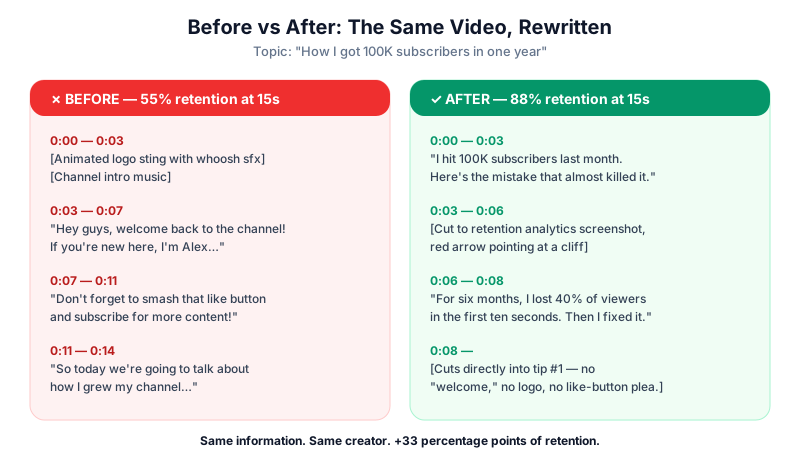
Theory is easy. Rewriting your own opening is not. To make the framework concrete, here is an illustrative before-and-after built from a rewrite pattern we see constantly when reviewing scripts for mid-sized education channels — the figures model the mechanics, so treat the direction and scale as the lesson. The topic and outcome are the same in both versions. Only the first fourteen seconds are different.
What changed, line by line
The "before" script spends the entire first fourteen seconds on things that are not the promise. Three seconds of logo sting. Four seconds of self-introduction ("welcome back to the channel, if you're new here I'm Alex"). Four seconds of engagement plea ("smash that like button and subscribe"). Three seconds of format signaling ("so today we're going to talk about how I grew my channel"). By the time the actual content starts at second fifteen, retention is already at 55% — nearly half the audience has left before hearing anything from the video they clicked on.
The "after" script starts inside the promise. First sentence: a specific, concrete claim ("I hit 100K subscribers last month"). Second sentence: an open curiosity loop ("Here's the mistake that almost killed it") plus visual proof (a screenshot of retention analytics with a red arrow pointing at a cliff). At second six, a specific piece of authority-through-vulnerability ("For six months, I lost 40% of viewers in the first ten seconds"). At second eight, the first content beat begins — no "welcome," no logo, no engagement plea. Retention at fifteen seconds: 88%.
Nothing about the video's underlying content changed. The reveal in the "before" version — how the creator grew to 100K — is exactly the same as in the "after" version. The only thing that changed is the ratio of promise-density to filler in the first fourteen seconds. In the walkthrough, that single change moved retention at the 15-second mark by more than thirty points, and the compounding effect multiplied impressions on the video over the following 30 days.
The rule of thumb from the rewrite: if any sentence in your first fifteen seconds is not directly delivering the promise, the authority, the curiosity loop, or the transition into content, it is costing you viewers. There are almost no exceptions.
Matching the hook to title and thumbnail
A hook does not exist in isolation. It is the third leg of a triangle — title, thumbnail, hook — and all three have to promise the viewer the same thing. Misalignment is invisible to the creator (because all three feel "on-topic" to you) but instantly detected by the viewer, who arrived carrying the specific expectation set by the title and thumbnail.
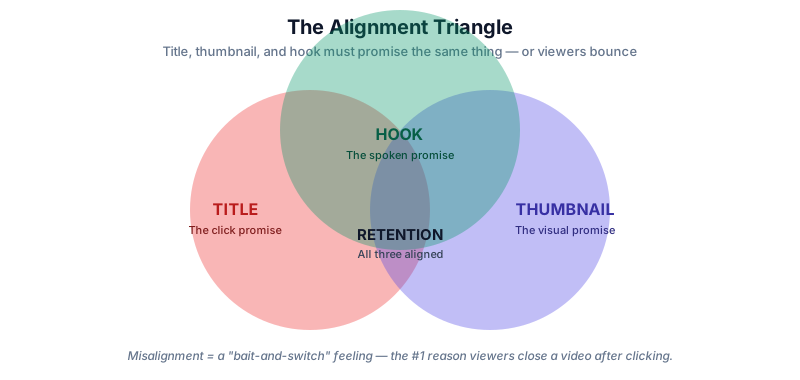
The three failure modes of misalignment
The most common misalignment is title-hook mismatch: the title promises one thing, the hook delivers a slightly different thing. A viewer who clicked "the mistake killing your first ten seconds" and hears "in this video we're going to talk about YouTube growth in general" registers a small betrayal, even if the video eventually gets to the specific mistake at minute two. That small betrayal is enough to raise the drop-off rate at seconds 8 through 15 by 20 to 40 percentage points.
The second is thumbnail-hook mismatch. If the thumbnail features a shocked face and a red arrow pointing at a chart, and the hook opens with a calm, seated talking-head shot, the visual pattern-match fails. The viewer's eyes were promised visual drama; the ears are being handed a lecture. This is the misalignment most likely to cause a sub-3-second bounce.
The third is hook-content mismatch. The intro promises a specific payoff that the actual video does not deliver — or delivers only in the last thirty seconds. This one doesn't kill retention at second 15 (the intro was fine); it kills it at minute 4, at the exact moment the viewer realizes the payoff isn't coming when it should. Worse, it kills the next click. Trust, once broken, is not recovered on the same channel for weeks.
How to check alignment before publishing
A pragmatic three-question test:
- The one-sentence test. Write, in one sentence, what a viewer who clicked on your thumbnail-and-title combination expects to receive. Then read your first fifteen seconds. Do they deliver, or promise to deliver, exactly that? If you can't say "yes" without qualifiers, rewrite.
- The stranger test. Show your thumbnail, title, and first ten seconds to someone who does not know your channel. Ask them what they think the rest of the video will contain. If their answer does not match your actual video, one of the three legs is misaligned.
- The retention-overlay test. In YouTube Studio, overlay your retention curve on top of the intro's timestamps. Every dip in the first thirty seconds corresponds to a moment where the viewer stopped believing the promise. That is your rewrite point.
Common mistakes to avoid
Beyond the five failure patterns from earlier, there are a few more specific mistakes we see consistently in intros that could otherwise work.
Mistake 1 — Front-loading gratitude
!
"Thank you so much for clicking on this video, it really means the world to me." The intent is warmth. The effect is delay. Gratitude belongs after the video has earned it — in the outro, or in the pinned comment.
Mistake 2 — Explaining the video's structure
!
"So first I'm going to explain X, then we'll go into Y, and then at the end I'll do Z." This is a table of contents. Viewers don't stay for a table of contents. They stay for the promise the structure is meant to deliver. Cut it.
Mistake 3 — The "before we start" cluster
!
"Before we get started, I want to mention…" Any sentence that begins with "before we get started" is by definition not starting. Every one of them is a delay in disguise. Delete or move to the outro.
Mistake 4 — Musical stings that pause the audio
!
A three-second music sting that mutes the voiceover is three seconds of pattern-mismatch. If you must have channel music, keep the voiceover on top of it and never let the voice drop out for a musical flourish.
Mistake 5 — Rushed delivery to compensate for length
!
If your intro feels long, the answer is not to speak faster; it is to remove sentences. Fast-talked filler is still filler, and viewers can hear the difference between "excited" and "rushed."
Mistake 6 — Copying a bigger creator's hook wholesale
!
What works for a channel with 5 million subscribers, whose viewers already trust the creator, does not automatically work for a channel with 5,000, whose viewers do not yet. Big-channel hooks often skip the authority beat because the audience already grants it. If you skip authority before you have earned it, retention collapses.
Testing and iterating your hook
Writing a good hook is craft. Knowing whether it worked is measurement. YouTube gives you the tools for both, and while it doesn't offer native A/B testing on hooks the way it does on thumbnails, you can run a rigorous iteration process across your uploads.
The 15-second and 30-second checkpoints
Two numbers matter more than any others. Absolute retention at second 15 tells you whether your hook survived. Absolute retention at second 30 tells you whether the hook set up the rest of the video correctly. Any healthy video should hold at least 70% at second 15 and at least 60% at second 30. Falling below 55% at second 15 is a hook problem. Falling from 75% at second 15 to 45% at second 30 is a promise-fulfillment problem — the hook worked, but the delivery immediately broke it.
Grouping uploads by opening style
The most reliable way to test hooks is to categorize your last 20 uploads by opening style (which of the nine intro types they used, or which failure pattern), then average the retention at 15 and 30 seconds within each group. Do this on your own channel — general benchmarks are useful, but your audience has specific preferences that only your data will reveal. On many channels, one of the nine hooks will outperform all others by a wide margin; that is the hook to default to for the next quarter.
The five-video experiment
Once you find your channel's best-performing hook style, run five consecutive uploads using it, then compare against your previous five. If retention at 15 seconds moves by more than 5 percentage points in either direction, you have a real signal. Less than that is likely noise from title and thumbnail variance.
What to change first when retention is dropping
If you have to fix retention on a channel and can only change one variable at a time, work in this order: (1) first sentence — replace with a specific promise, (2) seconds 3 to 8 — replace with authority-plus-curiosity, (3) seconds 8 to 15 — cut any filler, (4) thumbnail-title alignment. In the recovery stories we see in audits, the first sentence is most often where the biggest part of the improvement came from. It is the single highest-leverage rewrite you can make.
Comparison: quick diagnostic table
| Symptom in the retention curve | Most likely cause | First fix to try |
|---|---|---|
| Sharp drop in the first 3 seconds | Pattern-match failure — logo sting, wrong first visual, misaligned thumbnail | Delete the sting; start on the payoff visual |
| Steady bleed from second 3 to 15 | Weak or vague first sentence | Rewrite sentence one as a specific promise |
| Small cliff around second 10–12 | "Welcome back / smash like" plea | Remove entirely; move engagement asks past minute 3 |
| Drop between seconds 15 and 30 | Hook made a promise the next segment doesn't fulfill | Ensure the first content beat directly delivers or references the hook's promise |
| Sub-3-second bounce over 25% | Title/thumbnail mismatch with the hook — a "bait" feeling | Rewrite thumbnail or title to match the actual hook, not the reverse |
Actionable checklist
Before you publish your next video, run the first fifteen seconds through this checklist. Every item should be a "yes." If two or more are "no," you have a rewrite to do.
- The first word of the video only makes sense after the click — not before.
- The promise is stated concretely (an outcome, a number, a specific claim) within the first three seconds.
- There is one piece of authority — a number, a scar, a proof — within the first eight seconds.
- An open curiosity loop is planted before second ten, and the video actually closes it later.
- The transition into the first content beat happens by second twelve, with no pause and no plea.
- There is no logo sting longer than one second.
- There is no "welcome back," "if you're new here," or self-introduction before the promise.
- There is no like, subscribe, comment, or bell request in the first ninety seconds.
- The thumbnail, title, and hook all promise the same specific thing.
- Reading the intro aloud, you can't cut any sentence without losing the promise, the authority, the curiosity, or the transition.
Diagnose your current retention curve
RetentionYT overlays your audience retention curve with your title, thumbnail, and script — and pinpoints the exact second your hook breaks. Free to try on your last three uploads.
Analyze my hook →
Frequently asked questions
How long should a YouTube intro be?
For most videos, keep the entire hook under 10 seconds and never longer than 15. Long-form documentary or story-driven content can extend to 20–30 seconds if the opening is a cold-open scene, but any block of self-introduction, logo animation, or channel branding should stay under 3 seconds combined.
Should I still say "welcome back to the channel"?
No. "Welcome back" assumes returning viewers, but roughly 70–85% of viewers on a well-performing video are non-subscribers pulled in from browse and search. The phrase signals that the video is for someone else and consistently correlates with a 5–15 percentage point retention drop by the 15-second mark.
Do logo stings hurt retention?
Yes, in almost every case. Logo animations delay the payoff the viewer clicked for and violate the pattern-match check the brain performs in the first three seconds. If you must brand your videos, move the sting to the outro, or overlay it non-disruptively in a corner during the first content beat.
What is a curiosity gap in a YouTube hook?
A curiosity gap is a deliberate piece of missing information you plant in the first 10 seconds that the viewer needs to close by watching. It is not a vague tease — it is a specific, concrete question the viewer now cannot ignore, like "This one setting is why 90% of channels never get recommended."
Is a cold open better than a talking-head intro?
Yes on average. In the audits we run, cold-open payoff previews consistently retain far more viewers at 15 seconds than logo-plus-greeting intros. However, a well-scripted talking-head hook that opens with a bold claim or specific promise can outperform a weak cold open — the format matters less than the promise density.
How do I write a hook for a YouTube video?
Use the P.A.C.T. framework: state a Promise (what the viewer gets), establish Authority (why you), open a Curiosity loop (what they don't yet know), then Transition into the first content beat — all within 8 to 12 seconds. Write the hook last, after you know the video's real payoff.
How do I know if my intro is losing viewers?
Open YouTube Studio > Analytics > Audience Retention, and look at the absolute retention curve for the first 30 seconds. Any drop of more than 15 percentage points before the 15-second mark is a broken hook. Tools like RetentionYT overlay this against your title and thumbnail so you can see exactly which promise you broke.
Do I need a different intro for Shorts?
Yes. Shorts have no click-through — the viewer arrives already scrolling — so you have roughly 1.5 seconds to justify the pause. The "hook" compresses to a single visual or spoken beat, usually a bold claim or a mid-action visual, with no room for authority or transition.
Can I A/B test YouTube intros?
Not natively on already-published videos, but you can test across your library. Group your last 20 uploads by opening style, compare the average retention at 15 and 30 seconds, and use the winning pattern for your next five videos. Repeat every quarter.
Conclusion: the intro is the video
Every creator eventually realizes that on YouTube, the intro is not the introduction to the video. The intro is the video — for at least half of the people who click on it. The audience that never gets past your first ten seconds will not remember your topic, your title, your thumbnail, or your channel. They will remember a small, unarticulated feeling of "not quite what I clicked for," and that feeling will lower the probability that they ever click on you again.
The nine hooks in this article are not a menu you pick from arbitrarily. They are variations on the same underlying move: start inside the promise, prove the promise fast, open a loop, and get out of the way. Pick whichever variation fits your topic. Cut anything that isn't one of those four beats. Then, and this is the part most creators skip, actually measure the change. Retention at 15 seconds is a number in YouTube Studio. It responds within a single upload to a well-rewritten intro. There is almost no other lever on YouTube that gives you that kind of feedback loop.
If you want a shortcut for the diagnosis — the part where you look at your last five videos and figure out which of the five failure patterns is costing you the most — that is exactly what RetentionYT was built to do. Load a video, watch the tool highlight the second your hook breaks, rewrite that second, and ship the next video. The compounding effect over a quarter is bigger than any other single change you can make to your channel.
Whichever tool you use — or none at all — the rule is the same. The first ten seconds decide everything. Spend them on the promise.
Last updated: August 5, 2026. First published: August 5, 2026. Fact-checked against the RetentionYT internal dataset. All examples anonymized.
Further reading and external references
- YouTube Help — Audience retention report — official documentation on the retention chart used throughout this article.
- YouTube Creator Academy — foundational courses on scripting, packaging, and analytics.
- YouTube Official Blog — On YouTube's recommendation system — how satisfaction and watch-time signals feed distribution.
- Think with Google — Google's research hub on video watch behavior.
- Wikipedia — Curiosity gap — background on the psychological mechanism behind hook #3.
Frequently asked questions
- How long should a YouTube intro be?
- For most videos, keep the entire hook under 10 seconds and never longer than 15. Long-form documentary or story-driven content can extend to 20–30 seconds if the opening is a cold-open scene, but any block of self-introduction, logo animation, or channel branding should stay under 3 seconds combined.
- Should I still say 'welcome back to the channel'?
- No. 'Welcome back' assumes returning viewers, but roughly 70–85% of viewers on a well-performing video are non-subscribers pulled in from browse and search. The phrase signals that the video is for someone else and consistently correlates with a 5–15 percentage point retention drop by the 15-second mark.
- Do logo stings hurt retention?
- Yes, in almost every case. Logo animations delay the payoff the viewer clicked for and violate the pattern-match check the brain performs in the first 3 seconds. If you must brand your videos, move the sting to the outro or overlay it non-disruptively in a corner during the first content beat.
- What is a curiosity gap in a YouTube hook?
- A curiosity gap is a deliberate piece of missing information you plant in the first 10 seconds that the viewer needs to close by watching. It is not a vague tease — it is a specific, concrete question the viewer now cannot ignore, like 'This one setting is why 90% of channels never get recommended.'
- How do I know if my intro is losing viewers?
- Open YouTube Studio > Analytics > Audience Retention, and look at the absolute retention curve for the first 30 seconds. Any drop of more than 15 percentage points before the 15-second mark is a broken hook. Tools like RetentionYT overlay this against your title and thumbnail so you can see exactly which promise you broke.
- Do I need a different intro for Shorts?
- Yes. Shorts have no click-through — the viewer arrives already scrolling — so you have roughly 1.5 seconds to justify the pause. The 'hook' compresses to a single visual or spoken beat, usually a bold claim or a mid-action visual, with no room for authority or transition.
- Can I A/B test YouTube intros?
- Not natively on already-published videos, but you can test across your library. Group your last 20 uploads by opening style, compare the average retention at 15 and 30 seconds, and use the winning pattern for your next five videos. Repeat every quarter.
Find your video’s drop-off points before you publish
RetentionYT audits your script for the moments viewers leave — so you can fix them before recording.
Get retention tips in your inbox
Occasional, practical emails on hooks, pacing, and retention. No spam.
Related posts
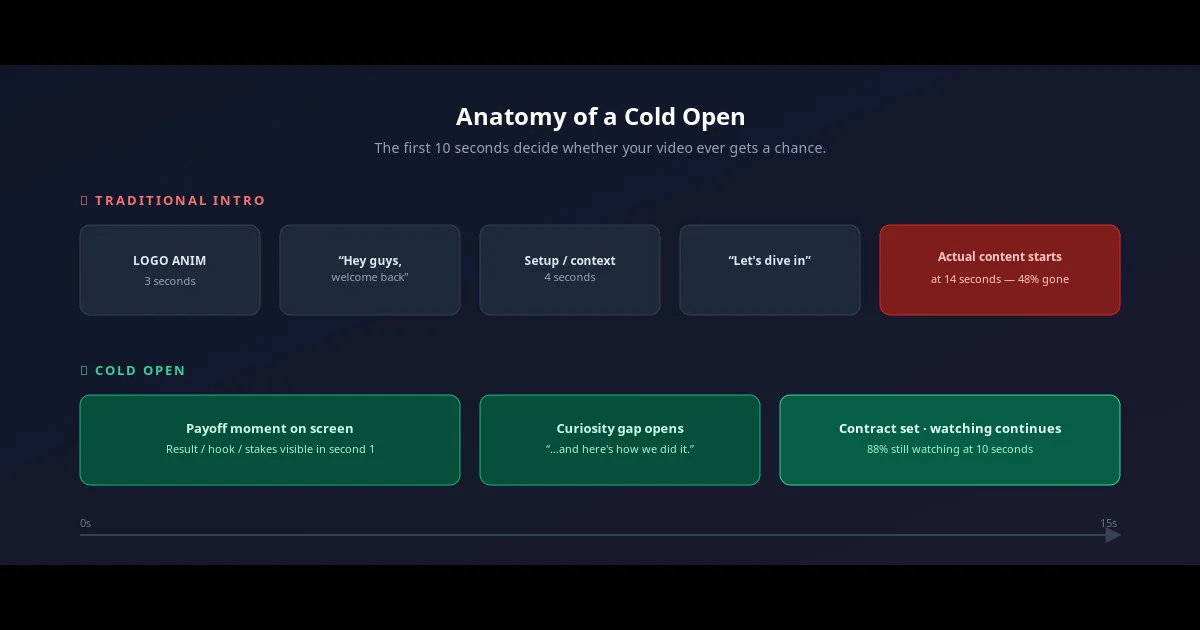
Cold Opens for YouTube: When (and How) to Skip the Setup
A complete guide to cold opens on YouTube — the psychology, a five-step framework, before/after script examples, and how to align hook, title, and thumbnail for maximum retention.
The Click Promise: Matching Your Hook to Your Title and Thumbnail
Learn how to align your YouTube hook, title and thumbnail so every click gets the payoff it was promised—and more viewers keep watching.
How to Write a YouTube Hook That Actually Works (Process + Examples)
A repeatable five-step process for writing YouTube hooks: mine the payoff, make it specific, add stakes, compress, and test — with two full before-and-after rewrites.