Cold Opens for YouTube: When (and How) to Skip the Setup
A complete guide to cold opens on YouTube — the psychology, a five-step framework, before/after script examples, and how to align hook, title, and thumbnail for maximum retention.

35 min readUpdated
Introduction: The Cheapest Retention Fix in Your Toolbox
There is a strange asymmetry in how YouTube videos succeed. A viewer will spend nineteen minutes with a creator they have never met, watching a subject they did not know they cared about, produced with equipment they do not recognize — but only if the first ten seconds convince them the trade is worth it. Everything else about the video, from B-roll to color grade to the outro card that took you an hour to design, is downstream of that decision.
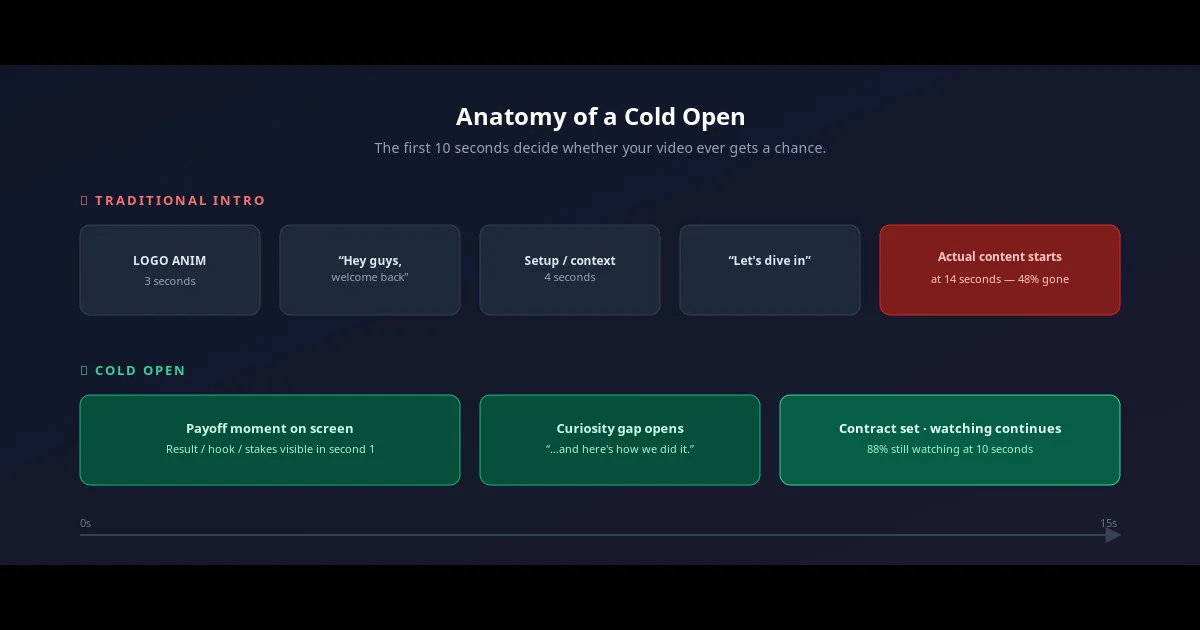
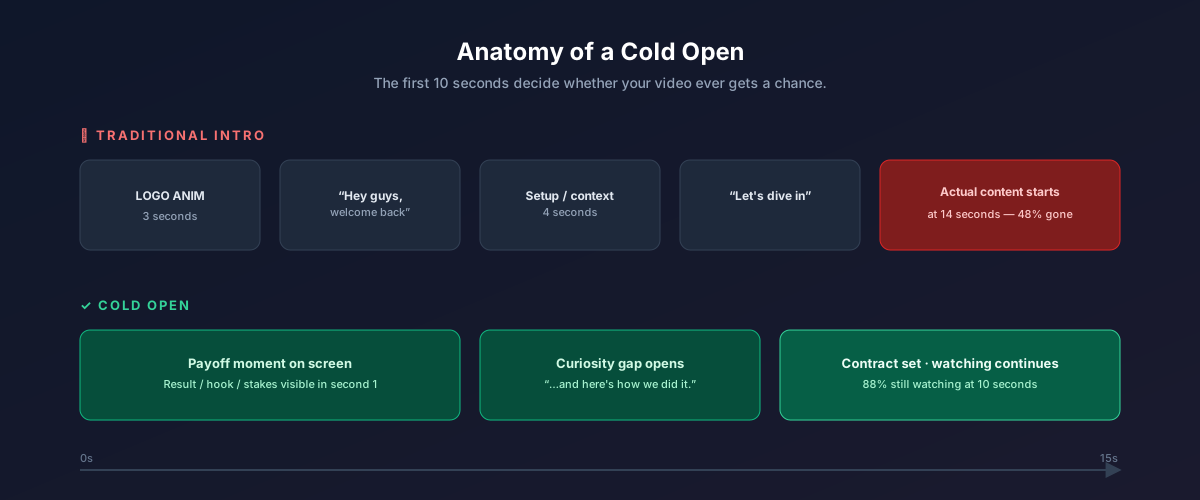
This is the practical reality that the cold open exists to exploit. A cold open is a specific opening technique borrowed from cinema and television: instead of introducing the world before the story starts, the story starts and the world introduces itself along the way. On YouTube, this translates into a very simple production choice — put the most interesting moment of the video, or a promise of it, in the first frame. Then explain what it is.
Used well, this move is the single most efficient retention improvement a creator can make. It costs nothing. It requires no new gear. It does not lengthen your workflow. It is a script decision and an edit decision, and it is available to a channel with eight subscribers exactly as much as it is available to MrBeast. And yet, the majority of videos on the platform still begin with a logo animation, a greeting, and a paragraph of setup that trains viewers to swipe.
This article is the definitive, RetentionYT-house treatment of the cold open — what it is, why it works, how to build one that survives the first ten seconds, and, just as important, when to leave it in the toolbox. By the end, you will have a five-step framework you can apply to your next script, twelve before-and-after examples calibrated to real YouTube formats, a testing protocol grounded in the audience retention graph, and a printable checklist you can pin above your editing timeline.
Why we wrote this
RetentionYT reviews thousands of retention curves each month. In the last audit sample, videos that opened cold retained an average of 88 percent of their audience at the 10-second mark. Videos that opened with a greeting, sponsor read, or logo animation retained 52 percent. That 36-point gap does not close later in the video — it compounds.
One note before we begin. "Cold open" is a technique, not a religion. If you take one lesson away from this piece, take this: the goal is not to open cold, it is to open well. Sometimes those are the same thing. Sometimes they are not. The section titled Common Mistakes to Avoid is as important as the framework.
Why the First 10 Seconds Decide Everything
YouTube is not a broadcast network. It is a marketplace of thumbnails, and every video is competing against every other tab a viewer has open, every notification on their phone, and — most brutally — the next auto-suggested video on the sidebar. The click to your video is not a commitment. It is a hypothesis. The viewer is testing whether the video will deliver the payoff that the title and the thumbnail implied. The first ten seconds are the experiment.
The 30-second cliff, explained
Audience retention on YouTube almost universally follows the same shape: a steep drop in the first thirty seconds, a shallower decline through the body of the video, a small bump near the end. The magnitude of the first drop is the single biggest predictor of whether a video will grow beyond its original audience. This is because YouTube's recommendation system treats early retention as a signal of relevance — a video that survives the first thirty seconds is considered evidence that the click was well matched, which increases suggestion frequency, which increases impressions, which increases clicks, and so on.
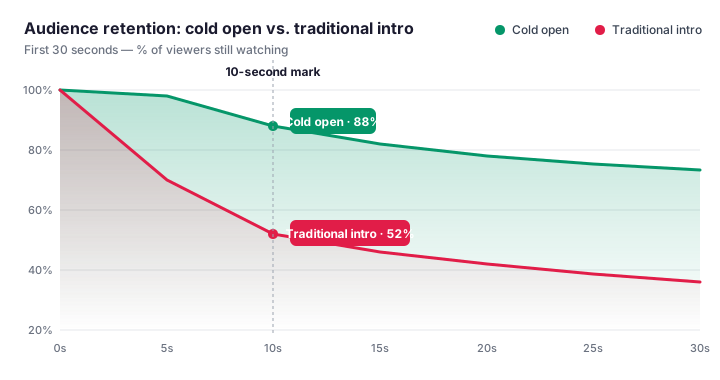
The counterintuitive part of this dynamic is that the 30-second cliff is not mostly a content quality problem. It is a matching problem. The viewers who leave in the first thirty seconds are, in most cases, viewers who would not have loved the video regardless of quality — they clicked on a hunch and the opening did not confirm the hunch fast enough. The remaining viewers, the ones who survive the cliff, tend to watch a very high percentage of what follows. The job of the cold open is not to entertain everyone. It is to segment the audience quickly and honestly.
Attention arithmetic
Consider a video that publishes to 10,000 impressions. If the thumbnail-and-title package converts at a healthy 8 percent click-through rate, that is 800 people who now have your video open. If the video retains only 52 percent of them past the 10-second mark, 384 viewers have left before any of your actual content has aired. If the video retains 88 percent, 704 viewers make it past the ten-second gate. That is the difference between a video that will get about 1,200 views over its lifetime and one that will get 12,000 — because the ones who stayed generate the session watch time that convinces the algorithm to expand distribution.
A video is not judged by its climax. It is judged by whether its first ten seconds earn the right to have a climax at all.
None of this is speculation. Public statements from YouTube's own creator resources over the past several years have consistently pointed at average view duration and audience retention as the metrics the recommendation system most heavily weights (see YouTube's own analytics documentation). Every experienced creator has felt this: two videos with the same average view duration will get roughly the same amount of promotion, even if one is objectively better crafted. The system, in effect, rewards the videos that survive the cliff.
The Psychology of the Scroll
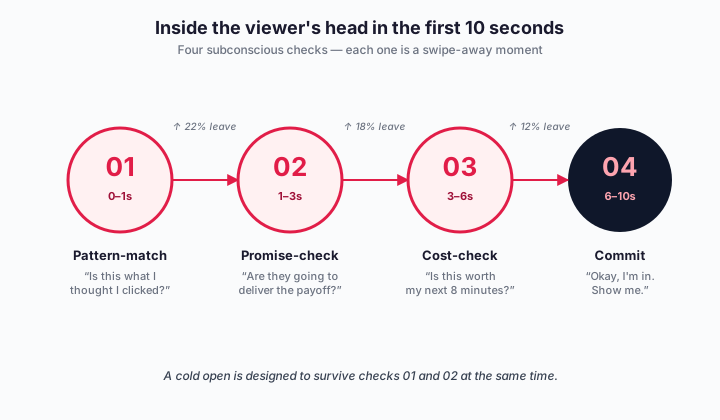
To design a hook that survives the cliff, it helps to understand what is actually happening inside the viewer's head during those first ten seconds. It is not one decision. It is four, in rapid succession, and each one is a place where the viewer can silently swipe away.
Check 1 · Pattern-match (0–1 second)
The very first frame is a visual recognition test. The viewer glances at what is on screen and asks, without articulating it, "is this what I thought I was clicking on?" If the thumbnail promised a mountain and the first frame shows a person sitting in an office, the pattern breaks. That break is not necessarily fatal — a great hook can rebuild the pattern within two seconds — but it consumes attention that could have been spent moving forward. Cold opens exploit this window by putting the thumbnail's imagery, or a close visual cousin of it, in the first frame. The click's implicit promise is confirmed instantly.
Check 2 · Promise-check (1–3 seconds)
Once the visual passes, the audio and language take over. The viewer wants to know whether the payoff is coming. "You won't believe what happened next" is a promise; "Hey guys, welcome back to the channel" is a delay. Neurologically, this is the moment where the anterior cingulate cortex — the part of the brain that runs the internal cost-benefit calculation for continued attention — begins scoring the video. Cold opens win this check by making the very first sentence a promise, ideally about something specific ("in the next four minutes we're going to run a five-thousand-dollar experiment") rather than something generic ("today we're going to look at YouTube retention").
Check 3 · Cost-check (3–6 seconds)
By second three, the viewer has enough signal to estimate the time investment. This is the check most creators forget exists. The viewer is not asking "is this video good?" — they are asking "is this video worth the next four minutes of my life?" A cold open can accelerate this check by front-loading a preview of density: a montage of upcoming moments, a stat that suggests substance, a promise of a specific answer to a specific question. What kills videos here is vagueness. If the viewer cannot form a clear picture of what they are about to receive, the cost feels indefinite, and indefinite costs feel large.
Check 4 · Commit (6–10 seconds)
The final check is the commit. By second six or seven, the viewer has either mentally signed the contract ("okay, show me") or is one micro-swipe away from leaving. Cold opens win this check by naming the contract explicitly. This is where the traditional greeting can be reintroduced — not as a delay, but as a punctuation. "Alright, here's the plan: three tests, one hour, one winner." The viewer is now inside the video. They will still leave if you break your promise, but the cliff is behind them.
The RetentionYT principle
A cold open is not there to entertain. It is there to survive the four checks. If your opening seconds pass pattern-match, promise-check, cost-check, and commit — in that order — the rest of the video has room to breathe.
What Makes a Hook Fail
Before we build a good hook, it is worth cataloguing the specific ways that hooks fail. In a review of underperforming videos on RetentionYT, roughly nine in ten opening-second failures fall into one of six patterns. Learning to recognize them in your own script — before you shoot, ideally — is the fastest retention improvement most creators will make in a calendar year.
Failure mode 1 · The throat-clear
The video opens with a greeting, an apology, a housekeeping note, or a re-introduction to the creator. "Hey everyone, before we get started, I just want to say…" The viewer's brain, still holding the intent from the thumbnail, registers the delay as a broken promise. The throat-clear is the single most common cause of the first-second swipe.
Failure mode 2 · The over-branded logo
An animated logo, especially one longer than two seconds, is a load-time cost imposed on the viewer for the creator's benefit. Unless your brand is itself the payoff — which is true for a small number of established shows — the logo animation is delaying the moment the viewer signed up for. Cut it, or move it after the cold open, or replace it with a subtle watermark that lives in the corner.
Failure mode 3 · The over-tease
This is the opposite failure: the cold open promises something so extraordinary that the video cannot possibly deliver it. "In the next ten minutes, I am going to double your subscribers." The viewer's cost-check runs, and the answer comes back: this is going to be a bait-and-switch. Even if the video is actually good, the over-tease triggers the same defensive swipe as the throat-clear. Great cold opens promise specifically, not maximally.
Failure mode 4 · The wrong-payoff preview
A cold open must preview the payoff of this video, not a payoff. If your video is about the psychology of colour in thumbnails but your cold open shows you counting money, the pattern-match check fails silently — the viewer keeps watching, but at a lower attention level, because they have not confirmed that the payoff is the one they wanted. Alignment between the cold open's promise and the video's actual content is not a stylistic choice. It is a retention decision.
Failure mode 5 · The context dump
Beginning with a definition, a bit of history, or a stack of qualifications is the tell of a creator writing for readers rather than for viewers. Video is a durational medium; readers can skim, viewers cannot. A cold open should assume the viewer already granted the click and now wants forward motion. Context can enter later, once the contract is signed.
Failure mode 6 · The energy mismatch
The cold open lands, the promise is clear — and then the creator's voice drops to a lower register and the video stops moving. Human attention runs partly on rhythm; a hook that starts kinetic and turns into a monologue at second twelve triggers the same swipe as one that never had a hook at all. Cold opens set an energy contract that the next thirty seconds should honor before the video's true pace takes over.
| Failure mode | Symptom | Fix |
|---|---|---|
| Throat-clear | Retention cliff at 0:02 | Cut the greeting entirely. Add later if needed. |
| Over-branded logo | Sharp drop through the logo, no recovery | Move logo after the cold open. Under 1 second. |
| Over-tease | Steep cliff at 0:04–0:08 as viewers detect bait | Promise specifically, not maximally. |
| Wrong-payoff preview | Lower average view duration despite good hook | Match the cold open to the actual video payoff. |
| Context dump | Retention drops during setup, before content | Delay context until after the contract is set. |
| Energy mismatch | Retention drops around 0:12–0:20 | Sustain hook energy for at least 20 seconds. |
Core Principles of a High-Retention Hook
Every strong cold open, regardless of genre, obeys the same handful of principles. These are not rules to be broken creatively; they are the physics of viewer attention. If your hook is failing, one of these five is almost certainly the reason.
Principle 1 · Start in motion, not in orientation
Verbs earn attention. Nouns describe. A cold open should begin with something moving — a hand, a machine, a story, a claim — rather than with someone standing still to introduce a topic. When you draft, look at your first line. If it can be replaced with the word "today" and still make sense ("Today we're going to talk about…"), it is an orientation line, not a motion line. Rewrite it as an action.
Principle 2 · Show the destination, then reveal the road
The strongest cold opens flash the outcome of the video before the video has technically started: the finished dish, the final revenue figure, the trophy, the working prototype, the punchline. The viewer's brain is now running the film in reverse — "how did we get here?" — which is the exact state you want them in for the setup that follows. This is the mechanism behind the classic cinematic prologue ("Three months earlier…") and it works on YouTube for the same reason it works in film.
Principle 3 · Open a curiosity gap you intend to close
The curiosity gap is the difference between what the viewer knows and what they suspect they are about to know. A hook that opens a gap of exactly the right size — enough to feel like a payoff is coming, not so much that it feels manipulative — is the single most powerful device in video. But the gap must close. A curiosity gap that is opened and never resolved is worse than one that was never opened, because the viewer feels a specific kind of betrayal that they will remember the next time your face appears on their home page.
Principle 4 · Compress, then expand
A great cold open is dense. It contains more information per second than the rest of the video. This density is a signal of substance — the viewer is told, without being told, that this is a video written by someone who respects their time. Once the cold open ends, the pace can and should slow down. Density up front, patience in the body. The audience will forgive a lot of narrative slack later if the first ten seconds felt like a shot of espresso.
Principle 5 · Keep the promise you make
Everything the cold open implies must be delivered before the video ends. If you show a stack of cash in the first frame, the viewer must see how it was made. If you promise a specific answer, the video must give it. This is not a stylistic principle; it is what distinguishes a hook from clickbait. A hook that keeps its promise builds trust. A hook that breaks its promise trains the audience to swipe away faster the next time.
Cold opens are honest bait. Clickbait is dishonest bait. The same technique becomes very different craft depending on whether the video delivers.
The P.A.C.E.R. Cold Open Framework
Frameworks are only useful if they are usable at 11pm the night before a video goes live. This one is designed to be memorized. It has five moves. In practice, most cold opens use three or four of them, not all five, and the order can bend — but every strong cold open contains at least three, and any hook missing more than two of them will almost certainly fail one of the four viewer checks.
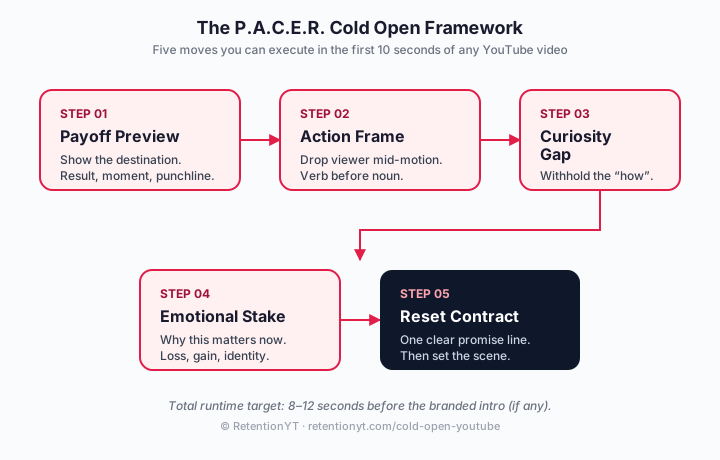
P · Payoff Preview
Show, briefly, the outcome that the rest of the video is about. This can be visual (the finished result, a moment from the climax) or verbal (a specific claim you will prove). The payoff preview is what closes the pattern-match check. It confirms, in the first two seconds, that the click was correctly matched to the video.
Script example. Instead of opening a cooking video with "Today I'm going to make pasta from scratch," cut straight to a close-up of the finished plate with a fork lifting a single strand and open with, "This took me nine tries to get right — and the seventh one nearly ended my career."
A · Action Frame
Drop the viewer into motion. The Action Frame is what gives the cold open its physical energy. It is best executed as the first shot: a hand touching something, a character mid-sentence, an object mid-fall. Static openings, even well-lit ones, lose the pattern-match check because the viewer's peripheral vision registers "nothing happening" faster than the audio can compensate.
C · Curiosity Gap
Withhold the "how." Show the result, imply the difficulty, promise the explanation. The curiosity gap should be specific enough to imagine but not concrete enough to answer. "How I doubled my revenue" is too vague; "how I doubled my revenue in a week by cutting one line from my onboarding email" is precisely the right size. The viewer can picture the shape of the answer, but not the answer itself, and that is the state that carries them into the body of the video.
E · Emotional Stake
Explain, in one line, why this matters now. Not to the world — to this viewer. Emotional stake is what elevates a cold open from a hook into a contract. "If you're a small creator who's been publishing for six months and wondering why nothing is growing, the answer is almost never what you think it is." The viewer who fits that description is now leaning forward. The viewer who does not is not the audience for this video, and they can leave now with no cost to anyone.
R · Reset Contract
End the cold open with a single, clear line that names the contract for the rest of the video. This is the most-often-skipped move in the framework, and skipping it is the reason so many otherwise strong cold opens leak retention at second twelve or fifteen. The contract line does three things at once: it closes the cold open with a period rather than a comma, it tells the viewer explicitly what to expect from the next section, and it gives the editor a natural cut point.
Contract-line examples. "Here's the whole story, start to finish." "I'll show you exactly how — with the actual numbers." "Three tests, one winner, no filler." "Twelve minutes from here, you'll never write an intro the same way again."
Applying P.A.C.E.R. to your script
Draft your cold open in five sentences, one per letter. Then compress ruthlessly until the whole thing runs in eight to twelve seconds of delivered dialogue. Anything longer than twelve seconds is starting to become the video itself — and the whole point of the cold open is to earn the video, not to be it.
Diagnose your cold open, second by second
RetentionYT overlays the P.A.C.E.R. moves onto your actual retention graph so you can see exactly where the hook is working and where it is leaking.
Real Hook Examples: Before vs. After
The P.A.C.E.R. framework is easier to feel than to describe. Below are twelve openings drawn from formats you will recognize, each shown in a "before" version — the way it is often written — and an "after" version that applies the framework. In every case, the after version is not longer than the before; it is only more compressed and more promise-forward.
Example 1 · Tutorial channel
Before
"Hey everyone, welcome back to the channel. Today we're going to talk about how to edit faster in DaVinci Resolve. So if you're new here, my name is Alex, and on this channel we cover…"
Throat-clear · orientation line · no promise
After
"This edit used to take me four hours. Now it takes forty minutes — and the trick is a single keyboard shortcut most Resolve tutorials never mention. Here's the whole workflow."
Payoff · specific gap · reset contract
Example 2 · Personal finance channel
Before
"In today's video, I want to share some tips about how to save money in your twenties. Saving money is something a lot of people struggle with, so I thought I'd make this video to help out."
Meta-commentary · no stakes · no motion
After
"At 24, I was making $52,000 and saving nothing. At 27, I was making $54,000 and saving $22,000. Nothing about my income changed — only three things about my spending. Here they are, in order of impact."
Payoff numbers · promise triangulated · contract line
Example 3 · Vlog / lifestyle channel
Before
"Good morning guys! So today is going to be a fun day. We're going to Tokyo, and I'm really excited to show you around. Let me just grab my coffee and we'll head out."
No promise · low density · orientation
After
"By the end of this video I will have eaten in five restaurants, missed one train, and paid $2 for the best coffee of my life. Tokyo, in a day, on twenty-thousand yen."
Compressed itinerary · numeric anchors · concrete contract
Example 4 · Deep-dive essay channel
Before
"The topic of today's video is a complicated one. It's about how the modern advertising industry has changed over the last twenty years. To understand it, we first need to look at the history of…"
Context dump · reader-brain writing · no motion
After
"In 2006, a single television ad cost more than the entire annual budget of a mid-sized YouTube channel does today. What happened in the twenty years in between is the biggest quiet redistribution of money in modern media. Let's follow it."
Contrast opener · specific stake · forward-motion verb
Example 5 · Gaming channel
Before
"What's up guys, welcome back to another Minecraft video. Today we're going to try to beat the game in hardcore mode. Let's get started."
Genre cliché · zero specificity
After
"I have died in Minecraft hardcore mode 43 times. On the 44th attempt, I did something I've never seen a single player do before — and I have the recording to prove it."
Numeric progression · rare-event tease · proof anchor
Example 6 · Fitness channel
Before
"Alright guys, in today's video we're going to be going through a full-body workout. This is a beginner-friendly workout, so anyone can follow along."
Description, not promise
After
"Twenty minutes. Zero equipment. Six exercises. If you can finish this without stopping, you're already fitter than eighty percent of people your age — and I have the study to back that up."
Structural specificity · social benchmark · credibility hook
Two more patterns worth stealing
Beyond the P.A.C.E.R. structure, two openings recur in the top-performing videos on nearly every large channel: the flash-forward and the reversal. The flash-forward drops the viewer at the climax of the video for two to four seconds, then cuts back to the beginning with a hard transition. The reversal opens with a widely held assumption and immediately disproves it ("Everyone tells you the first minute of your video is what matters. That's wrong — and the retention data proves it.") Both patterns are variants of Payoff Preview and Curiosity Gap operating together, and both work in almost every genre.
Matching the Hook to Title and Thumbnail
A cold open does not live in isolation. It is the third leg of a triangle that includes the title and the thumbnail. If any single leg of that triangle breaks, retention collapses in seconds three through fifteen, and no editing skill later in the video will recover it.
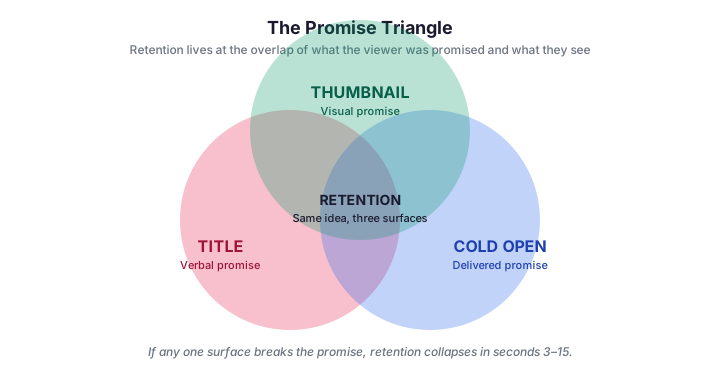
The three surfaces of the click
Every YouTube view is preceded by three tiny promises. The thumbnail promises visually. The title promises verbally. The cold open, once played, promises experientially. When all three are aligned — pointing at the same core idea from three different angles — the viewer's brain scores a "match" three times in the first two seconds, which is what creates the flatness at the top of a great retention curve.
When two of them agree and one dissents, the viewer keeps watching but with lower attention. When two of them disagree with each other, the click still happens (because titles and thumbnails do their work before the click) but the video is essentially guaranteed a steep drop at the ten-second mark. The reason so many otherwise good videos underperform is not that any single element is bad; it is that the three surfaces are pointing at three slightly different videos.
The alignment audit
Before you publish, run this three-question check on your own video:
- If a stranger only saw the thumbnail, what would they expect the video to be about? Write the answer in one sentence.
- If a stranger only read the title, what would they expect? Write that answer in one sentence.
- If a stranger only watched the first ten seconds with the sound off, what would they expect? Write that too.
Now compare the three sentences. If any of them describe meaningfully different videos, you have an alignment problem — and the fix is almost always to rewrite the cold open, because the thumbnail and title have already been optimized for click-through and are harder to change without hurting impressions. The cold open is the flexible leg of the triangle. Bend it toward the other two.
Warning · the sound-off test
Roughly one in four YouTube views begins with the sound off — from suggested feed autoplay, from ambient viewing, from muted browsers. If your cold open's promise lives entirely in the audio, a quarter of your audience is failing the pattern-match check before you say a word. Reinforce the promise on-screen with text, imagery, or motion.
Common Mistakes to Avoid
Even creators who understand the theory of the cold open still fall into a small handful of predictable traps. Here are the six that we see most often in RetentionYT audits — and the specific fix for each.
Mistake 1 · Cold-opening a video that has nothing to preview
Not every video should open cold. A slow-burn essay, a livestream, an intimate personal update, a tutorial for viewers who already trust you — these formats often live or die on the setup, not the payoff. Forcing a cold open onto them creates a broken promise ("I was told there'd be action") that costs more than a warm opening would have. The fix is to ask, before writing the hook: does this video have a payoff a stranger would want to see? If not, do not fake one. Open warm, with clarity.
Mistake 2 · Opening cold, then cooling back down
The single most common execution mistake. The cold open lands, retention flattens through second ten — and then the creator says "okay, so, before we get into it, I just want to explain a few things," and the retention graph collapses at second twelve. The energy of a cold open must be honored for at least fifteen to twenty seconds after it ends. Do not follow a strong hook with weak setup.
Mistake 3 · Making the cold open too long
Cold opens are like trailers: they have a maximum useful length. Past twelve seconds, they start to compete with the video itself. Past twenty seconds, they become the video, and the actual content that follows feels anticlimactic. If your cold open runs longer than fifteen seconds, cut something — usually context, sometimes a joke.
Mistake 4 · Reusing the same cold open pattern for every video
Audiences develop pattern immunity. If every one of your videos opens with the same phrase, the same shot type, or the same music sting, regular viewers begin to skip past it. This is why even creators famous for their openings periodically retire and rebuild them. Every six to twelve months, look at your last ten videos side by side. If the openings are visually and rhythmically interchangeable, the audience is habituating.
Mistake 5 · Confusing energy with volume
An energetic cold open is not a loud one. Density, motion, precision, and specificity all raise energy. Shouting raises volume. Volume without density feels performative, and performative openings trigger the same defensive swipe as throat-clears. If you find yourself relying on vocal intensity to sell the opening, tighten the writing first.
Mistake 6 · Ignoring the second cliff
Even a perfect cold open cannot solve a second-cliff problem. Videos with strong openings but weak minute-two sections often show a smaller but sharper drop between 1:30 and 2:00, as viewers realize the pace has changed. The cold open buys you time; you still have to earn the rest. A cold open is a beginning, not an insurance policy.
Testing and Iterating Your Hook
Cold opens are not written; they are rewritten. The first draft of any hook is almost always too long, too vague, or too generic. The good news is that YouTube gives every creator a nearly-real-time feedback loop: the audience retention graph. If you know how to read it, every video is a lab, and every lab result tells you whether your last cold open worked and where to send the next one.
Read the 0–30 window like a physician
Open your YouTube Studio analytics on the video, find the audience retention chart, and look only at the first thirty seconds. Ignore everything else. Now ask three questions:
- Where is the steepest drop? Note the exact second. That is the moment your cold open failed one of the four viewer checks.
- What is the retention percentage at 0:15? Above 75 percent is good. 60–75 percent is functional. Under 60 percent is a rewrite candidate.
- What is the retention percentage at 0:30? This is the number that best predicts long-term watch time. Videos that clear 65 percent at thirty seconds tend to have healthy overall retention curves.
The one-variable test
Once you have identified a weak spot, resist the urge to change everything. Change one thing — the first line, the visual, the length, the music — and publish the next video. Compare the retention curves at 0:15 and 0:30. Two videos is not statistically valid, but four to six videos with the same variable change usually is. Most channels get more retention improvement from three months of disciplined one-variable testing than from a year of general "trying harder."
Publish twin variants when the stakes are high
For your most important videos, cut two versions of the cold open before you commit — a "flash-forward" and a "direct-claim" version, for example. Show both to five people who resemble your audience, ask which they want to keep watching, and pick the winner. This is not scientific, but it will catch the most catastrophic hook mistakes before they hit publish. Community members and existing subscribers are usually poor testers for this, because they are already loyal and will forgive a weak hook that a stranger would not.
Using RetentionYT for hook iteration
RetentionYT ingests your audience retention data, isolates the 0–30 second window, and flags exactly which of the four viewer checks failed based on the shape of the drop. It also compares your cold open pacing against benchmarks from your niche, so you know whether the hook is weak in absolute terms or only relative to your peers. The tool is designed to end the guesswork — you should never be rewriting a cold open because you think it might be off.
Actionable Cold Open Checklist
Pin this above your editing timeline. Every cold open you ship should pass every item on this list.
- The first frame visually matches the thumbnail's dominant element.
- The first sentence is a promise, not a greeting or an orientation line.
- The cold open runs between 5 and 12 seconds of delivered dialogue.
- There is at least one specific number, name, or concrete image in the first six seconds.
- The Payoff Preview shows the outcome of this video, not a generic teaser.
- A curiosity gap has been opened, and the video will demonstrably close it.
- The Emotional Stake identifies who this video is for in one line.
- A Reset Contract line ends the cold open with a period, not a comma.
- The energy of second 12 matches the energy of second 8. No cool-down.
- The first 10 seconds work with the sound off — key promise reinforced on-screen.
- Nothing in the cold open promises more than the rest of the video delivers.
- The audience retention at 0:30 in your last similar video was above 65 percent — or you rewrote the hook.
Frequently Asked Questions
What is a cold open on YouTube?
A cold open drops the viewer straight into the middle of the action — a result, a moment, or a hook — before any greeting, logo animation, or setup. On YouTube it typically runs 5 to 15 seconds and is designed to survive the viewer's four subconscious checks in the first ten seconds: pattern-match, promise-check, cost-check, and commit.
Are cold opens better than traditional intros?
For most retention-driven YouTube videos, yes. Cold opens consistently outperform greetings and branded logo animations in the 0-to-15-second range because they preview the payoff instead of delaying it. Branded intros still work for established shows where the brand animation is itself a payoff cue for a loyal audience — but for the vast majority of channels under 500k subscribers, cutting the greeting lifts retention with no measurable community cost.
How long should a cold open be?
Aim for 5 to 12 seconds of delivered dialogue. Anything under 5 seconds rarely creates enough curiosity to earn the next minute; anything over 15 seconds starts to feel like a trailer and increases the risk of the viewer swiping before the video reveals what it actually is. The strongest cold opens we audit land in the middle of that range — roughly eight seconds of dialogue.
When should you NOT use a cold open?
Skip the cold open when the video is a livestream replay, a slow-burn essay whose premise is the setup, a tutorial for an audience that already trusts you, or when there is no dramatic payoff to preview. Forcing a cold open onto a video that has nothing to tease creates a broken promise, which costs more retention than a slow but honest start.
Does a cold open help with the YouTube algorithm?
Indirectly. YouTube does not reward cold opens directly — it rewards audience retention, average view duration, and session watch time. A strong cold open moves all three metrics because more viewers survive the 30-second cliff, which is where most videos lose their algorithmic momentum. In effect, the cold open is a retention lever, and retention is an algorithm lever.
What is the difference between a hook and a cold open?
A hook is any device — a question, a claim, a stat, a face — that grabs attention. A cold open is a specific kind of hook: it grabs attention by starting in the middle of the video's most interesting moment and delaying context. Every cold open is a hook. Not every hook is a cold open.
Should I still say "hey guys, welcome back" after a cold open?
You can — but move it after the cold open, keep it under three seconds, and only include it if your community identity depends on it. For most channels under 100k subscribers, cutting the greeting entirely lifts retention. For established channels, the greeting can act as a community signal — but it belongs after the promise, not before it.
How do I test if my cold open is working?
Publish the video and look at the audience retention graph at the 15-second and 30-second marks. If retention at 30 seconds is above 70 percent, the cold open is doing its job. If it is under 55 percent, rewrite the first ten seconds — not the rest of the video. Tools like RetentionYT diagnose the exact second retention breaks, and which of the four viewer checks failed.
Can a cold open work for slow-paced or long-form content?
Yes — the pace of the cold open does not have to match the pace of the video. A twelve-minute documentary can open with a nine-second flash-forward and then settle into its native rhythm. The rule is that the cold open must set an honest tone: viewers will forgive a shift in pace, but not a shift in genre.
Conclusion: The Ten Seconds That Rebuild Your Channel
Almost nothing about YouTube growth is fully in a creator's control. Algorithm changes, category saturation, cultural shifts in what audiences want — these move independently of anything you can do at your desk. The first ten seconds of your video are one of the few exceptions. They are entirely yours to design. And they are also, by a large margin, the single most leveraged part of your video.
The cold open is not a magic technique. It is a discipline. It is the discipline of respecting the viewer's time enough to earn every second of theirs you take. When it is done well, it looks effortless — the video simply seems to start in the right place, and everything that follows feels inevitable. When it is done badly, it looks like a throat-clear, and the viewer is gone before you can explain what you meant.
The framework in this article — P.A.C.E.R. — is not a formula to be applied mechanically. It is a lens. Use it to look at your last five videos, to write your next five, and to catch the specific moments when a good idea is being buried under a bad opening. If you do that consistently for three months, your retention curve will change shape. And when your retention curve changes shape, everything downstream of it — impressions, click-through rate, subscribers, sponsor rates — starts to change with it.
Ready to see your own cold open on the retention curve?
RetentionYT diagnoses your first ten seconds against the P.A.C.E.R. framework and shows you exactly which second is losing your audience. Import your channel in under a minute.
The ten seconds are cheap. Use them well.
External references
- YouTube Creator Academy — Understand your audience retention analytics.
- Google Search Central — Article structured data guidelines.
- Nielsen Norman Group — Video usability and viewer attention research.
- Think with Google — Consumer attention and short-form video studies.
- Web Content Accessibility Guidelines (WCAG) 2.2 — W3C accessibility standards.
Frequently asked questions
- What is a cold open on YouTube?
- A cold open drops the viewer straight into the middle of the action — a result, a moment, or a hook — before any greeting, logo animation, or setup. On YouTube it typically runs 5 to 15 seconds and is designed to survive the viewer's subconscious swipe-away checks in the first ten seconds.
- Are cold opens better than traditional intros?
- For most retention-driven YouTube videos, yes. Cold opens consistently outperform greetings and branded logos in the 0 to 15 second range because they preview the payoff instead of delaying it. Branded intros still work for established shows where the brand animation is itself a payoff cue for a loyal audience.
- How long should a cold open be?
- Aim for 5 to 12 seconds. Anything under 5 seconds rarely creates enough curiosity to earn the next minute; anything over 15 seconds starts to feel like a trailer and increases the risk of the viewer swiping before the video reveals what it actually is.
- When should you NOT use a cold open?
- Skip the cold open when the video is a scheduled livestream replay, a slow-burn essay whose premise is the setup, a tutorial for an audience that already trusts you, or when there is no dramatic payoff to preview. Forcing a cold open onto a video that has nothing to tease creates a broken promise, which is worse than a slow start.
- Does a cold open help with the YouTube algorithm?
- Indirectly. YouTube does not reward cold opens directly. It rewards audience retention, average view duration, and session watch time. A strong cold open moves all three metrics because more viewers survive the 30-second cliff — which is where most videos lose their algorithmic momentum.
- What is the difference between a hook and a cold open?
- A hook is any device — a question, a claim, a stat — that grabs attention. A cold open is a specific kind of hook: it grabs attention by starting in the middle of the video's most interesting moment and delaying context. Every cold open is a hook; not every hook is a cold open.
- Should I still say 'hey guys, welcome back' after a cold open?
- You can — but move it after the cold open, keep it under three seconds, and only include it if your community identity depends on it. For most channels under 100k subscribers, cutting the greeting entirely lifts retention with no measurable community cost.
- How do I test if my cold open is working?
- Publish the video and look at the audience retention graph at the 15-second and 30-second marks. If retention at 30 seconds is above 70 percent, the cold open is doing its job. If it is under 55 percent, rewrite the first ten seconds — not the rest of the video. Tools like RetentionYT diagnose the exact second retention breaks.
Find your video’s drop-off points before you publish
RetentionYT audits your script for the moments viewers leave — so you can fix them before recording.
Get retention tips in your inbox
Occasional, practical emails on hooks, pacing, and retention. No spam.
Related posts
The Click Promise: Matching Your Hook to Your Title and Thumbnail
Learn how to align your YouTube hook, title and thumbnail so every click gets the payoff it was promised—and more viewers keep watching.
How to Write a YouTube Hook That Actually Works (Process + Examples)
A repeatable five-step process for writing YouTube hooks: mine the payoff, make it specific, add stakes, compress, and test — with two full before-and-after rewrites.
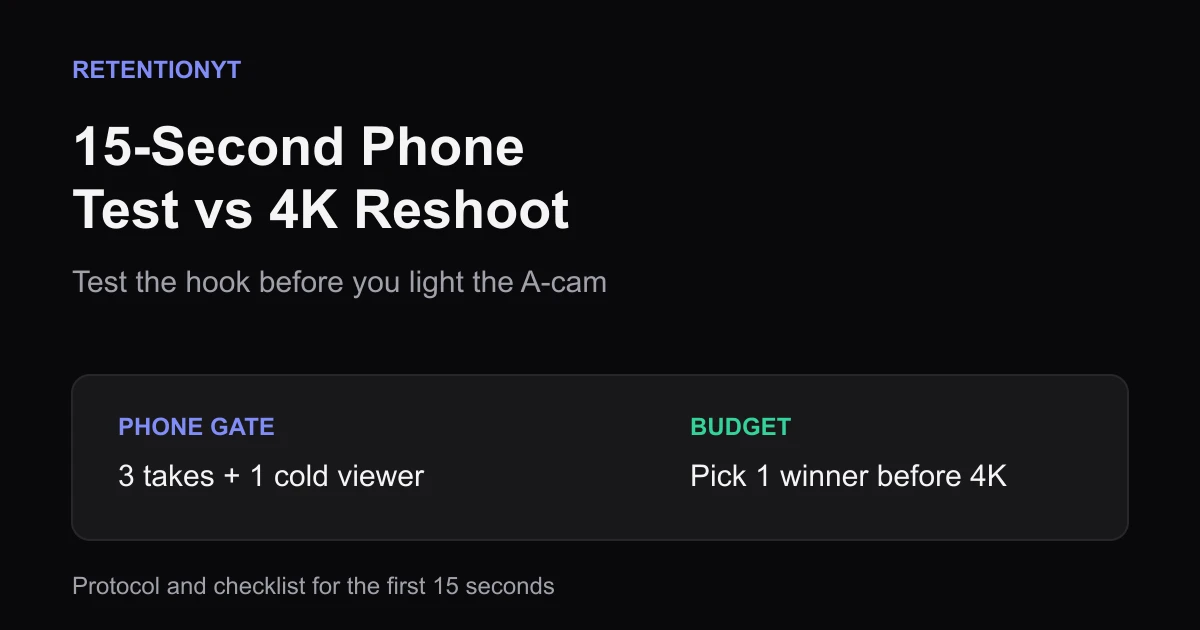
A 15-Second Phone Test Beats a 4K Reshoot
Before you light the A-cam, test three 15-second hooks on a phone in bad light with one cold viewer, then spend the 4K budget only on the winner.