Open Loops: The Retention Trick Top YouTubers Swear By
Open loops are unanswered questions that keep viewers watching. Learn how top YouTubers use open loops to boost audience retention, hold the mid-video slump, and increase watch time — with concrete scripts, benchmarks, and a repeatable framework.

37 min read
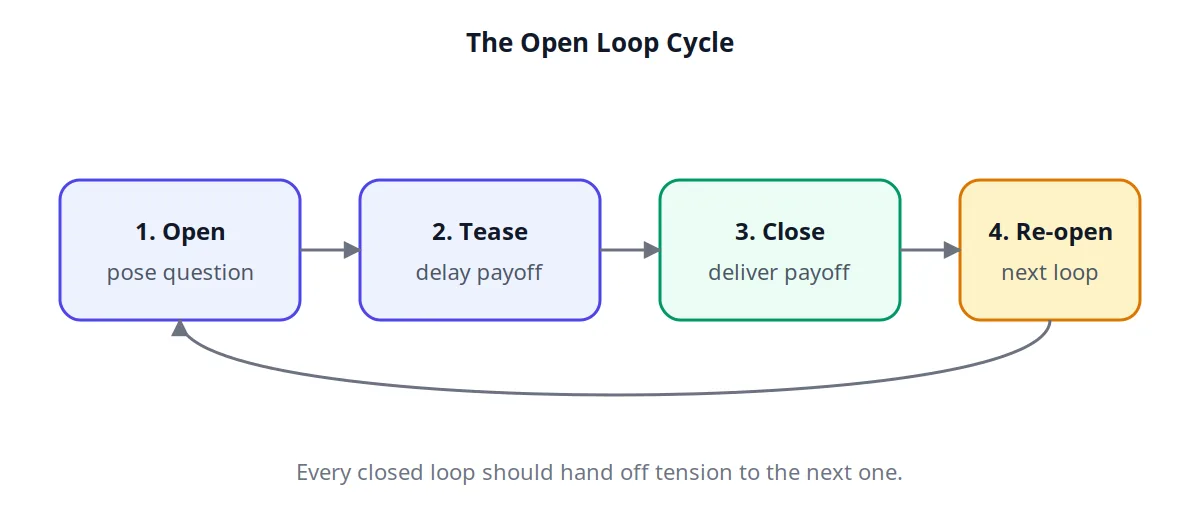
An open loop is an unanswered question that keeps viewers watching until you close it. Used well, it is the strongest pull in your script — the invisible thread that turns a casual viewer into someone who has to see how it ends.
Introduction: Why Open Loops Beat Every Other Retention Trick
Every YouTuber eventually learns the same painful lesson: it does not matter how good your information is if nobody stays long enough to hear it. You can shoot in 4K, edit like a Pixar animator, and write a title that could sell water to a river — and still watch the retention graph flatline three minutes in.
The creators who consistently hold viewers, the ones whose videos feel impossible to click away from, are not doing anything visually magical. They are doing something structural. They are opening loops.
An open loop is an unanswered question, unresolved promise, or unfinished piece of tension planted early in a video and paid off later. The moment your viewer accepts that loop, part of their attention becomes committed to seeing it close. It is the same mechanism that keeps you watching a mystery series at 1 a.m. when you know you have work in the morning. It is also the reason the best-performing YouTube channels — from MrBeast to Veritasium to Ali Abdaal — script their videos around loops rather than around information.
This guide is a working manual for that skill. You will learn what open loops actually are, how they interact with the YouTube algorithm, how to read a retention graph and diagnose where your loops break, and how to build videos that hold attention from the cold open to the outro. We will look at the first-30-seconds problem, the mid-video slump, retention benchmarks by niche, and a repeatable framework you can apply to your next script tonight.
If you are already using RetentionYT to analyze your retention graphs and stress-test your scripts, treat this article as the theory behind what the product is showing you. If you are new here, everything below stands on its own — and by the end, you will know exactly what to change in your next upload.
Quick answer
An open loop is an unanswered question or unresolved tension you plant in a YouTube video to keep viewers watching until it is closed. Well-constructed loops meaningfully increase audience retention and average view duration because the human brain tracks incomplete tasks and questions until they are resolved — the Zeigarnik effect.
Why the term "open loop" survived where other jargon died
The YouTube education economy churns through terminology faster than most creators change their thumbnail style. "Curiosity gap" had its year. "Pattern interrupt" had its year. "Retention edit" had its year. Open loops are still here because, unlike most of the vocabulary, the phrase describes a mechanism rather than a trend. A loop is either open or closed. There is no ambiguity, no gray zone, no room for a creator to convince themselves they did the thing when they did not. Either the viewer at the eight-minute mark is still holding an unanswered question from the intro, or they are not — and the retention graph will show which one is true.
That precision is what makes the concept survive across formats. It works in a two-minute short, a nine-minute explainer, and a thirty-minute video essay. It works whether you speak to camera, narrate over footage, or interview a guest. The scale of the loop changes; the mechanism does not. When you internalize that, you stop thinking about retention as something you "try to improve" and start thinking about it as the visible shape of a script decision you already made.
What Audience Retention Really Measures
Before we get to loops, it helps to be precise about what "retention" is, because the word gets used loosely and creators end up optimizing for the wrong number.
Audience retention on YouTube is the percentage of your video that the average viewer watches. It is expressed two main ways in YouTube Analytics: as a retention curve (a line chart showing what percentage of viewers are still watching at every moment in the video) and as an average view duration (the mean number of seconds watched per view).
The two numbers are related but not the same. A ten-minute video with an average view duration of six minutes has a retention rate of 60 percent. A three-minute Short with an average view duration of two minutes has a retention rate of 67 percent. Longer videos will almost always show lower percentage retention even when they generate more absolute watch time. This is why comparing your five-minute tutorial's retention to a twenty-minute deep dive is meaningless.
Several sub-metrics sit under the retention umbrella:
- Absolute audience retention: the percentage of viewers still watching at each moment, measured against 100 percent at the very start.
- Relative audience retention: how your video's retention compares to other YouTube videos of similar length that the same viewers watched.
- Average percentage viewed: the mean of all individual viewer retention percentages.
- Watch time: total minutes watched across all views — the metric YouTube actually monetizes and ranks by.
When YouTube talks about "retention", it usually cares about two things: whether people stay past the first 30 seconds, and whether your video generates more watch time per impression than competing videos. Everything a creator does to lift retention — hooks, pacing, cuts, and yes, open loops — is ultimately in service of those two outcomes.
Retention is not the same as engagement
One clarification worth burning in: retention and engagement are not synonyms. Engagement is likes, comments, shares, and end-screen clicks. Retention is time in seat. A video can be highly engaging in the last minute and still have terrible retention because most viewers never made it that far. Engagement without retention is a small, loyal audience clapping in a mostly empty room. Retention without engagement is a room that fills up and quietly empties out again. The videos that scale on YouTube do both — and open loops happen to serve both, because a well-closed loop is exactly the kind of moment that earns a comment.
What retention does not measure
Retention does not measure whether the viewer learned anything. It does not measure whether they liked you. It does not measure whether they will subscribe. It measures one thing very well: whether the next second of your video was worth staying for. Every open loop is a bet on that specific question, one second at a time.
Best practice
Do not chase retention percentage in isolation. Track it alongside average view duration and click-through rate. A video with 70 percent retention but a 2 percent CTR is invisible; a video with 45 percent retention and a strong CTR often outperforms it in total watch time.
How YouTube Uses Retention to Rank Videos
YouTube's recommendation system does not use one single "retention score". It uses retention as one of the strongest predictive signals for a broader question: if we show this video to a new viewer, will they keep watching YouTube longer as a result?
Three retention-adjacent signals drive most of what happens next after you hit publish:
- Absolute retention shape. Videos that hold a flatter, higher curve tend to get recommended more aggressively than videos that spike-and-fall, even at the same average duration.
- Session watch time. Does a viewer watch another YouTube video after yours, or do they leave the platform? Videos that end viewing sessions are quietly penalized. Videos that funnel viewers into their next click are quietly boosted.
- Early retention. The first 30 seconds are weighted heavily because that is when most of the drop-off happens and when YouTube gets the cleanest signal about whether the audience-video match is real.
None of this is controversial anymore — YouTube's own Creator Insider channel has said as much in different ways for years. What matters for us is the practical consequence: open loops directly influence all three signals. They flatten the retention shape by giving viewers a reason to keep watching past natural exit points; they extend session watch time by delaying resolution; and they earn the first 30 seconds by promising something specific and unresolved.
"You are not competing with other videos in your niche. You are competing with the viewer's next thumbnail click. Open loops keep their hand off the mouse."
— Common refrain among top YouTube retention coaches
The algorithm is not a person, but it behaves like one
It helps to stop thinking of the recommendation system as a set of rules to game and to start thinking of it as a bored friend on the couch next to you, holding the remote. This friend does not read your title. They do not care about your niche. They only care about one question: is this more interesting than what else I could be watching right now? Every second you fail to answer yes, their thumb moves closer to the next thumbnail. Every open loop, every re-hook, every callback is a small yes. The retention graph is the record of how many yeses you earned in a row.
Why session watch time may matter more than your video's retention
The metric YouTube most cares about — the one it will not tell you directly in the analytics dashboard — is what happens after your video ends. If viewers close the app, your video, no matter how well retained, has a hidden cost attached to it. If viewers click another video, especially another one of yours or one YouTube recommends off the back of yours, your video earns a hidden bonus. This is why the best-performing channels engineer their outros as loops that hand off to the next video rather than as summaries that give viewers permission to leave. An outro is not a closing statement. It is the last open loop of the session.
Reading the Retention Graph
The YouTube retention graph is the most honest feedback a creator gets. It does not care about your production budget, your subscriber count, or how clever your idea felt in the shower. It shows you, second by second, where people leave.
Four shapes cover almost every video you will ever upload:
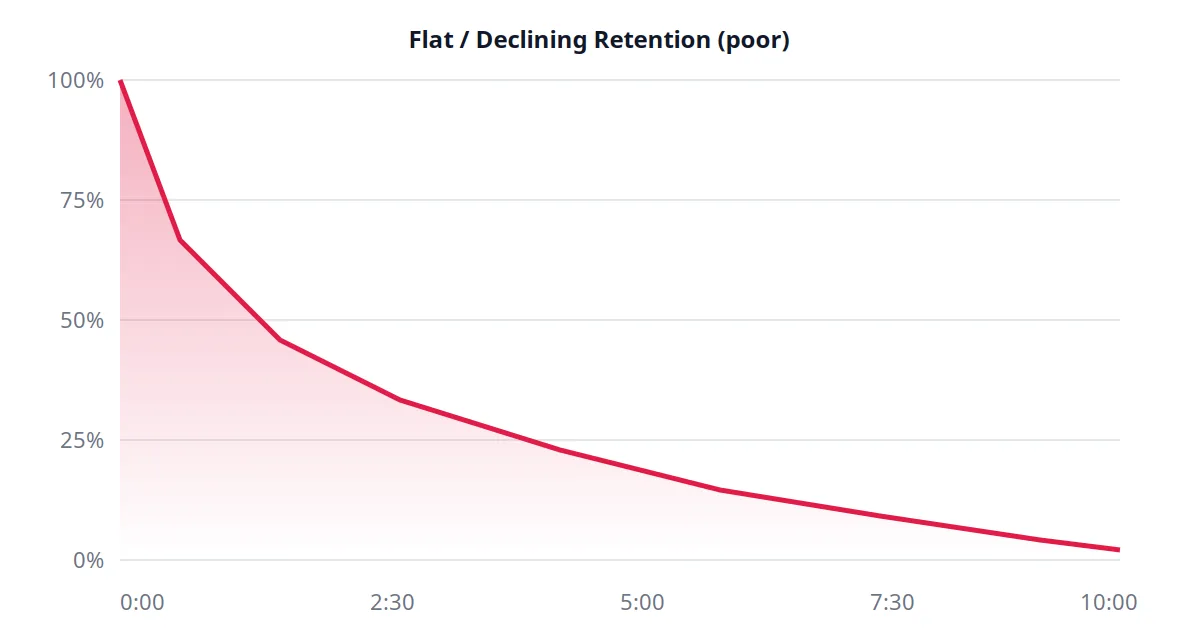
1. Steep decline. The curve drops fast in the first 30 seconds and keeps dropping. This is the most common failure mode. The intro did not promise anything specific, so viewers checked out early and never came back.
2. Cliff-and-plateau. Sharp early drop, then a relatively stable line. The people who survived the intro are your real audience. Your job is to raise the plateau, not to widen the cliff — you cannot save viewers who never bought in.
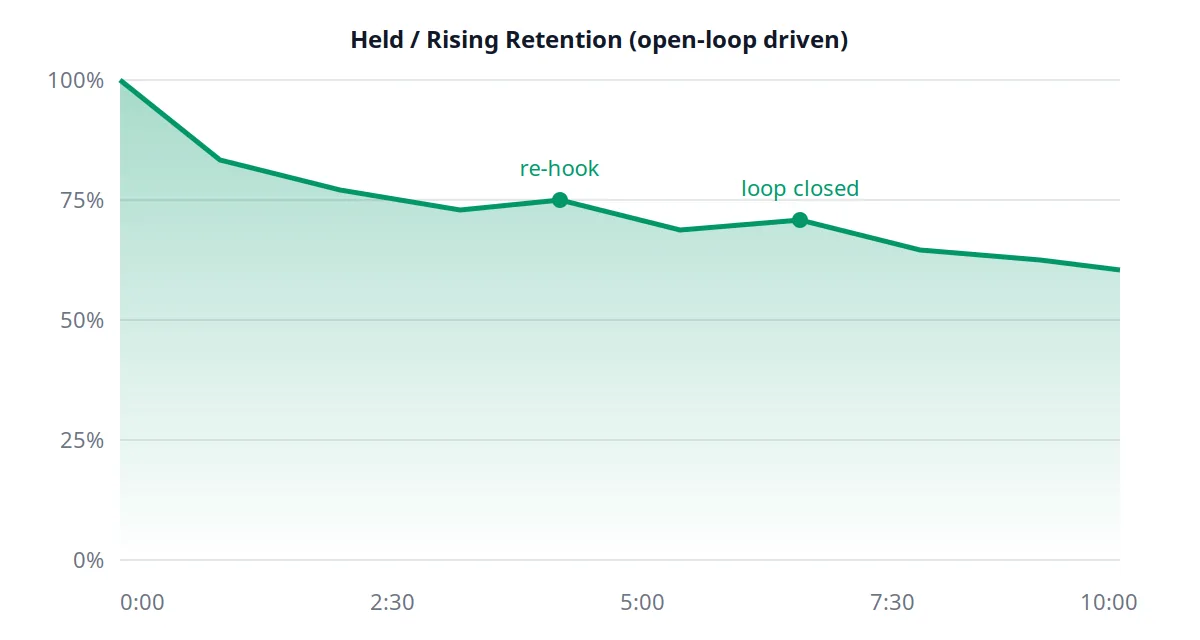
3. Held / gently rising. Small dips, followed by rises. Every rise is a moment where an open loop closed and pulled attention back. This is what you want.
4. Wave. The curve rises and falls repeatedly. Common in entertainment content. It usually means loops are opening and closing on a rhythm — good — but the closes are not always earning bigger rises.
When you look at your own graph, do not just note the average. Note the shape. Two videos with the same 48 percent retention can behave completely differently in the algorithm depending on whether the curve is a cliff-and-plateau or a smooth held decline.
What a healthy retention curve actually looks like
A healthy curve is not a straight line. Straight-line retention is a myth invented by course sellers. Real retention on a real video looks like a gently sloping downhill with small local dips where viewers scrub, small rises where they rewatch a moment, and a soft plateau near the end where only your most committed audience remains. The goal is not to eliminate the slope. The goal is to make the slope shallower and the rises more frequent — which is a very specific way of saying: keep loops open, keep loops closing, keep the next loop already started.
Relative retention: your real scoreboard
Absolute retention tells you how your video did against itself. Relative retention tells you how it did against other videos of the same length that the same viewers watched. Relative is the harder benchmark and, over time, the more honest one. A video with 42 percent absolute retention but above-average relative retention is a video the algorithm will happily push. A video with 55 percent absolute retention but below-average relative retention is a video the algorithm has quietly decided to leave alone. Track both, and when they diverge, trust relative.
Diagnosing Where Viewers Drop Off
Every drop is a message. The trick is reading them accurately instead of overreacting.
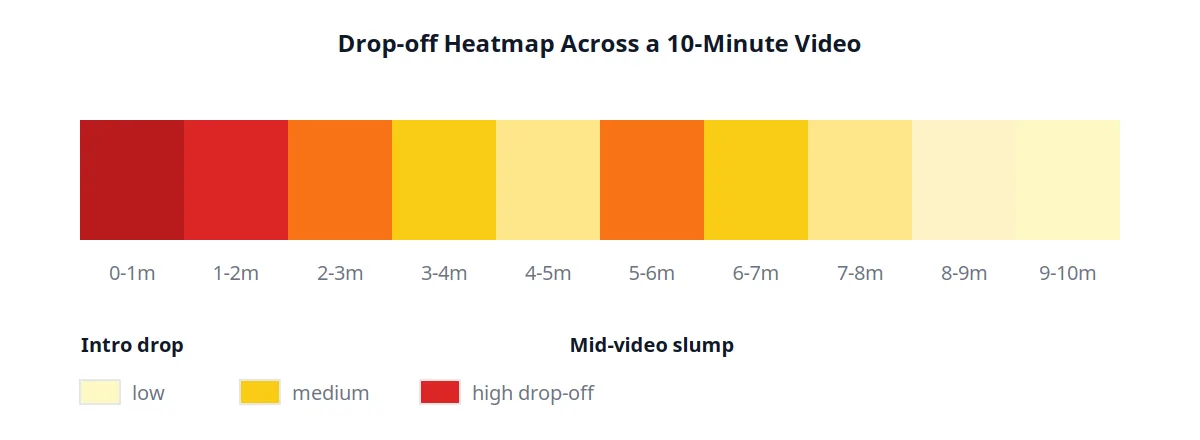
Vertical cliffs
A near-vertical drop means something in that specific second pushed viewers out. Common culprits: a jarring sponsor read, a promise that was clearly not going to be kept, a topic pivot without a bridge, or a piece of visual/audio friction (a loud sound effect, an ugly cut, a dead pause).
Long slow slides
A gradual downhill slope over a minute or more usually means pacing, not a single mistake. The video is not doing anything wrong per second — it is simply not giving people a reason to stay. This is where open loops are most needed and most absent.
Spikes upward
A rise in the curve almost always means viewers scrubbed back to rewatch a moment. That moment is a signal. Study it. It is telling you what your audience actually values, and you should be building more of it.
The plateau shift
Sometimes the curve holds steady for two minutes, then quietly drops five points to a new lower plateau. That step-down is a loop that closed without opening the next one. The viewer got their answer and had no reason to stay.
Warning
Do not chase every dip. Every video has natural drop-off. Focus on the three biggest cliffs and the longest slow slide — fixing those will move your average more than tweaking every second will.
This is where tooling starts to save real time. Watching your own retention graph in YouTube Studio and mapping every dip back to a script line is slow, and it gets slower the more videos you upload. Platforms like RetentionYT attach retention data directly to the script and mark the exact sentences that correspond to drop-offs, so you can see — in plain English — which lines are costing you viewers. Whether you use a tool or a spreadsheet, the discipline is the same: no unexplained dip.
Diagnosing by category, not by second
When you sit down to review a retention graph, resist the temptation to zoom in on every individual second. Instead, categorize each drop by one of five root causes: (1) promise mismatch — the video is not delivering what the thumbnail or title implied; (2) structural drift — the script wandered off the loop; (3) friction — a jarring cut, sponsor break, or dead air; (4) closure without continuation — a loop paid off but no new one was open; (5) fatigue — the pacing simply gave the viewer permission to leave. Almost every real drop-off falls into one of those five buckets. Once you can name the cause, you can name the fix. Without a name, you will just keep tweaking cuts and wondering why nothing moves.
The rewatch cluster is a gift
Pay disproportionate attention to any moment where the curve rises. Rises almost always mean viewers scrubbed backward to rewatch — the strongest positive signal in the entire graph. Whatever happened in those five seconds is what your audience actually values. It might be a joke, a specific phrase, a graphic, a data reveal, or a reaction. Whatever it is, that moment is a template. Do more of it. Most creators spend all their time trying to fix the drops and none of their time trying to replicate the rises, which is exactly backwards.
Fixing the First 30 Seconds
If you fix nothing else this month, fix the first 30 seconds. On most channels, 15 to 40 percent of the audience leaves in that window, and every viewer lost early is a viewer who cannot be recovered later. Your first 30 seconds is not the introduction to your video — it is the audition for your video.
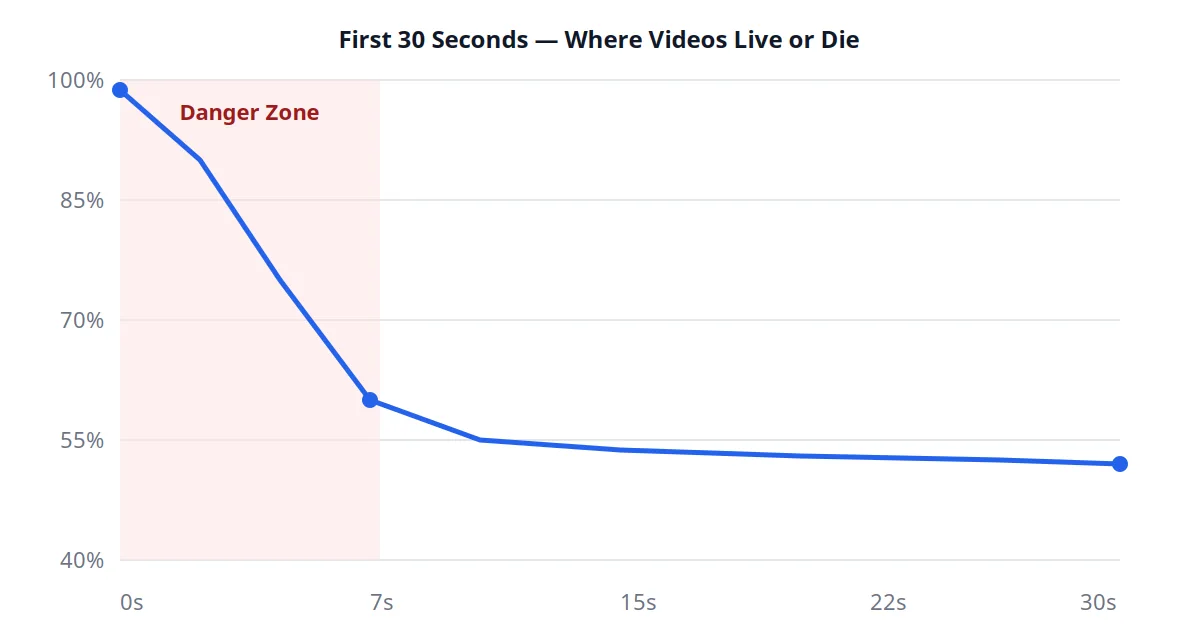
The three jobs of the cold open
A great first 30 seconds does three things, in this order:
- Confirm the promise of the thumbnail and title. The viewer clicked expecting a specific payoff. Confirm they are in the right video within the first sentence.
- Open a loop. Introduce an unanswered question or unresolved tension that the rest of the video will pay off.
- Show the stakes. Give the viewer a reason to care that the loop closes.
Notice what is missing from that list: your name, a slow "hey guys welcome back", a channel intro animation, and a preview montage. All of those can exist in your video. None of them belong in the first 15 seconds.
Cold-open patterns that open strong loops
Here are five patterns that consistently earn the first 30 seconds. Each opens a specific loop, not a vague one:
- Prediction + delay: "By the end of this video, one of these three thumbnails will be the reason I keep making them. I will tell you which one — and why the other two nearly cost me the channel."
- Contradiction: "Everyone says you need to hook viewers in the first five seconds. I stopped doing that a year ago and my retention went up. Here is what I do instead."
- Result-first: "This graph is what happened after I added one line to every script. I will show you the line — but only if you understand the mistake I was making first."
- Specific mystery: "Somewhere in this video I am going to lie to you on purpose. If you spot it, comment the timestamp. Now, let's start."
- Named list: "Three retention tricks that actually work. The third one is the one MrBeast uses on nearly every video, and almost no one else does. We are getting there."
Every one of these does two things: it opens a loop that cannot be answered without watching, and it makes the loop specific enough that the viewer can imagine the payoff. Vague loops — "stick around to learn a lot" — do not work because there is nothing concrete for the brain to hold open.
Pro tip
Write your first 30 seconds last. Once you know exactly what the middle and payoff of your video will deliver, you can open a loop that promises that exact payoff. Loops opened before you know your payoff are almost always too vague.
The five seconds most creators waste
Between seconds three and seven, most creators do the same thing: they take a small breath, deliver a channel greeting, and thank people for coming back. Those five seconds are the single most expensive real estate on YouTube, and they are being spent on a habit that no viewer has ever asked for. If you replaced those five seconds with a single specific sentence that opens a loop, you would raise the 30-second retention of your channel by five to ten points on average. That is not a rounded estimate — it is what tends to happen when a creator finally cuts the greeting. There is no ceremony to the beginning of a great YouTube video. The ceremony is what you build across the middle of it.
Cold-open pacing: what to cut ruthlessly
Beyond the greeting, three specific patterns cost creators the first 30 seconds more than any others. First, the preview montage — a two-second flash of every moment in the video before the loop is even opened, which tells the viewer nothing but signals that the payoff has already happened somewhere. Second, the setup dump — thirty seconds of context the viewer does not yet care about, delivered because the creator has not learned to trust that context can be sprinkled later. Third, the disclaimer — "before we get into it, I just want to say…" — which is almost always a signal that the loop the video needs has not been written yet, and the creator is stalling.
Reading the first 30 seconds from the outside
When you finish a rough cut, watch the first 30 seconds with the sound off. If, based purely on visuals, you cannot tell within 10 seconds what specific question the video is answering, a viewer with the sound on will not be able to either — because the audio is doing what the visuals should be doing, and audio requires more attention than visuals do. Fix the visuals of the first 30 seconds until they alone open the loop.
Holding the Middle: The Mid-Video Slump
The middle of your video is the graveyard of good ideas. You survived the hook, delivered the setup, and then… you kept explaining. The energy dropped. The pacing slowed. The viewer, whose brain had been holding your opening loop open, felt it quietly close on its own — and left.
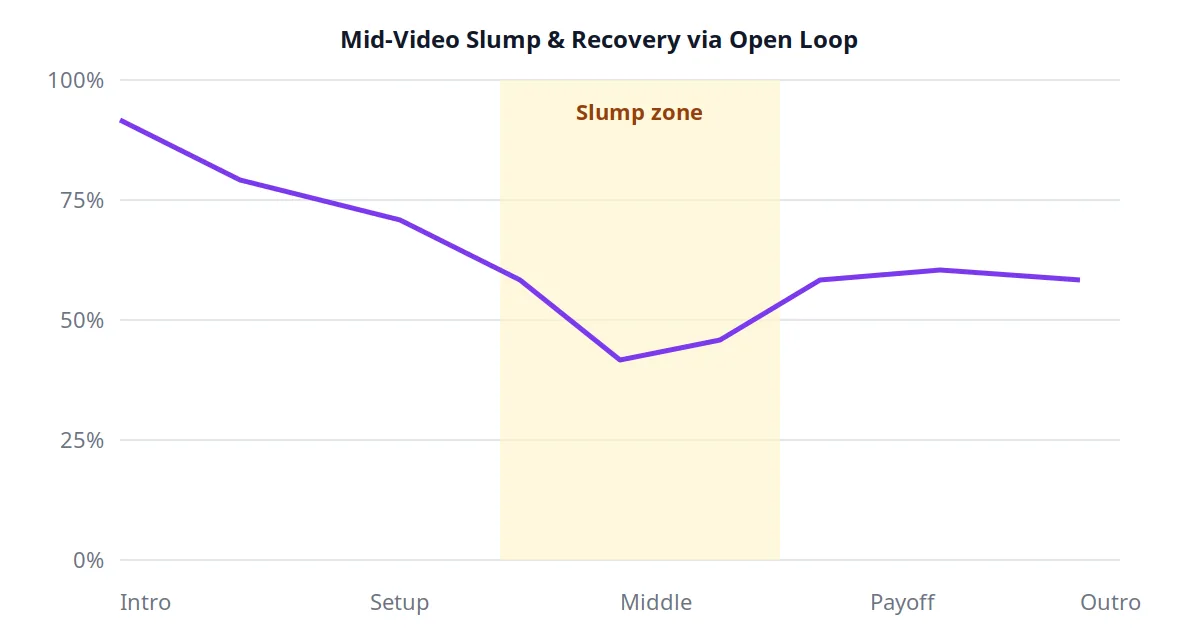
The mid-video slump has a single root cause: the loops you opened at the start have gone stale. Either the viewer forgot about them, or they got a partial answer and no new loop replaced it. The fix is not to add more energy — it is to add more loops.
The overlapping-loop principle
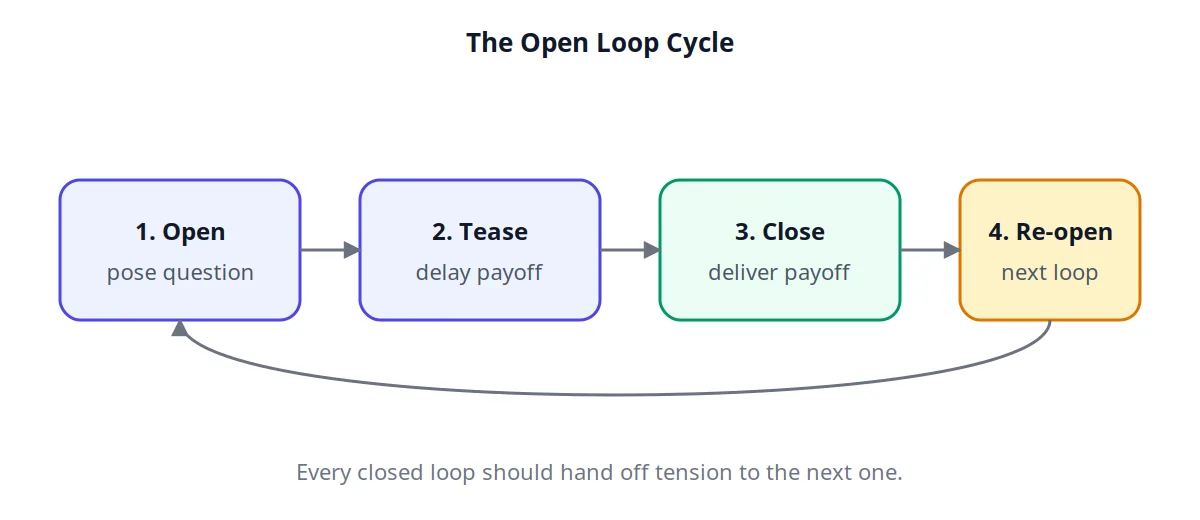
The most retention-durable videos do not run one long loop from start to finish. They run overlapping loops. As one loop closes, the next is already open. The viewer never reaches a moment where every question is answered.
Techniques for holding the middle
- Restate the loop. Around the 40 to 60 percent mark, remind the viewer of the original question. Not by repeating the exact words — by rephrasing it now that they have new context. "So back to what I said at the start — the reason none of this works if you skip the first step…"
- Escalate the stakes. Reveal something in the middle that makes the original loop bigger. If your video is about a technique, reveal that the technique changed something surprising. If it is a story, reveal a new obstacle.
- Introduce a mini-loop. Open a smaller, faster loop that will pay off within 60 to 90 seconds. Mini-loops carry the viewer across the flat parts of the main loop.
- Change modality. Cut to B-roll, an on-screen graphic, a location change, or a different framing. The viewer's brain treats a modality change as a reset — it re-engages before it decides whether to stay.
- Ask a direct question. Sometimes the cleanest re-hook is: "Before I show you what happened next, what would you have done?" This works because it makes the viewer participate in the loop instead of passively holding it.
The 60-second rule for middles
A workable rule that most high-retention creators follow, whether they articulate it or not, is this: no more than 60 seconds should pass without something changing. A loop opens, a loop closes, a graphic appears, a location shifts, a voice enters, a stake escalates. The change does not have to be dramatic. It has to be noticeable. Sixty seconds is roughly the outer edge of how long an average YouTube viewer will tolerate visual and structural sameness before the small voice in their head starts to ask whether they should still be watching. The best answer to that question is to never let it be asked.
The middle is where you earn subscribers, not the payoff
Creators often assume subscribers are earned at the end of the video, when they finally deliver the promised payoff. The data disagrees. Subscribers are disproportionately earned in the middle third — the moment when a viewer thinks, "I could have left five seconds ago, and I did not, because this person is still giving me something." That is the moment the loop is doing its job. Payoffs earn respect. Middles earn loyalty.
Retention-Boosting Techniques That Work
Open loops are the engine. Everything else in this section is a delivery system for them. Individually, each technique below is worth a few points of retention. Stacked, they compound.
1. Micro-loops within long explanations
Long explanations lose viewers because they close every loop as they open it. Fix this by chunking explanations into micro-loops. Instead of "here are five reasons X is true", say "there are five reasons X is true — the fifth one is the one almost nobody talks about. First…". You have now made the entire list an open loop with a payoff at the end.
2. Pattern interrupts
Every six to twelve seconds, something should change. A cut, a graphic, a zoom, a location shift, a change in music, or a shift in framing. Pattern interrupts do not increase retention on their own — they buy you time to keep the loop alive when it would otherwise flatten.
3. The "what I learned" pivot
Halfway through many videos, creators pivot from what they did to what they learned. This is a natural loop-close point that many creators mishandle. Instead of announcing the pivot ("so what did I learn from all this?"), plant a new loop inside the pivot itself: "the thing I learned surprised me — because it contradicts what I said at the start of this video."
4. Callback structure
Reference something you said earlier and reveal that it meant more than the viewer realized. Callbacks are loops the viewer did not know were loops. They generate the strongest retention spikes in the data because they reward the viewers who paid attention.
5. Anti-payoff (used sparingly)
Occasionally, close a loop with an outcome the viewer did not expect — including "this did not work". Honest anti-payoffs build trust. But use them rarely, and never as a substitute for a real payoff. Anti-payoff on every loop feels like being lied to.
6. The visible countdown
For list videos, showing where the viewer is (2 of 7, 3 of 7…) sounds like it would shorten retention by making the length obvious. In practice, it lengthens retention because it turns the whole list into a loop. Viewers stay because they want to reach the end of the count.
7. Delayed labeling
Show something interesting before you name it. "This is what one of the highest-retaining creators on YouTube does on every single upload. It has a name, and I will get to it — but first watch what he does." The viewer wants the label, which is now the loop.
Do not do this
Do not open a loop you cannot close. "Wait until the end for the secret" only works if the secret is real, specific, and worth the wait. Vague-promise loops train your audience to leave early on your next video.
If you run a channel with more than a handful of videos, mapping which of these techniques your retention data actually rewards is where a script analysis tool starts to pay for itself. Inside RetentionYT, you can tag scripts with the techniques you used and see which ones correlate with your channel's biggest retention gains — which is often not the same as what generic advice suggests.
Stacking, not swapping
None of these techniques is meant to replace another. Micro-loops belong inside a longer master loop. Pattern interrupts serve callbacks. Delayed labeling holds a mini-loop open while a bigger loop plays out in the background. Creators tend to fall in love with one technique and lean on it until it is exhausted; the ones with durable retention learn to stack. A single video should have at least three techniques in play at any given moment. That is not overkill — that is what a well-structured script feels like from the inside.
The unspoken eighth technique: honesty
The technique nobody sells because it is not sellable: keep your promises. Everything in this article assumes that when you open a loop, you actually intend to close it, and that when you close it, you actually intend to deliver what you promised. Every trick in the retention playbook works on the assumption of trust. Break trust once, and the tricks stop working — not because the algorithm punished you, but because the specific viewers who noticed remember. Retention is compounding trust more than it is compounding technique.
Case Example: Before vs After
To make this concrete, here is a composite example based on retention teardowns from mid-sized channels in the education niche. The numbers are realistic; the script is a redraw so you can see the mechanism cleanly.
Before: a well-produced but loop-less video
The video is a nine-minute explainer on how compound interest actually works. Cold open: "Hey everyone, welcome back to the channel. Today I want to talk about compound interest — one of the most powerful concepts in finance. Let's dive in."
The rest of the video is a clean, accurate walk-through. Formula, examples, a graph, a summary. No open loops. Retention numbers:
- Average view duration: 3:42 of 9:15 (40 percent)
- Retention at 30 seconds: 62 percent
- Retention at 4 minutes: 41 percent
- Retention at 8 minutes: 22 percent
The curve is a classic cliff-and-slide. The information is good; the video is not.
After: the same information, restructured around loops
Same nine minutes, same explanations, same graphics. Restructured cold open: "There is a mistake in the standard compound interest formula that almost every finance channel repeats. If you use the version they teach, and you invest for 30 years, you can be off by more than sixty thousand dollars. I will show you the mistake, why it happens, and the two-word correction — but you have to see the math first."
That single change opens three overlapping loops: what the mistake is, why it happens, and what the correction is. Each loop closes at a different point in the video, and each one hands off to a smaller mini-loop inside its section. The middle now contains a callback ("remember the mistake I mentioned — this is where it shows up") that raises the retention curve at exactly the point where the original version sagged. Retention numbers on the rewrite:
- Average view duration: 5:38 of 9:15 (61 percent)
- Retention at 30 seconds: 78 percent
- Retention at 4 minutes: 62 percent
- Retention at 8 minutes: 44 percent
Same information. Same host. Same production. Twenty-one percentage points of retention, roughly two additional minutes of watch time per view. Multiplied across an audience, that is often the difference between a video that gets shown and one that gets buried.
Takeaway
You almost never need to make a "better" video. You need to restructure the same video around loops. The information is rarely the problem — the sequence in which you reveal it is.
What the case example is really showing
The instinct, looking at the numbers above, is to assume the rewrite worked because the cold open was better. It was — but the cold open is only the visible tip of the change. What actually happened is that the entire video was reorganized around a single specific promise ("a mistake in the standard formula, worth sixty thousand dollars"), and then every graphic, every explanation, every example was re-sequenced so that it served the closure of that promise. The information did not change. The order did. That is what restructuring means in practice, and it is why most retention improvements do not require new footage. They require a new outline.
Where creators most often get case examples wrong
The most common mistake is to look at a video like the rewrite above and copy the surface — "there is a mistake in the standard formula" becomes "there is a mistake in almost every diet" — without doing the underlying work of finding a real, specific, defensible claim. Loops built on borrowed structures without real content collapse fast. Viewers can tell within 45 seconds whether the promise in your cold open is real. When it is not, retention crashes harder than a video with no loop at all, because the disappointment is baked in from the first second.
Retention Benchmarks by Niche and Length
"Good retention" is contextual. What counts as excellent for a 20-minute video essay would be catastrophic for a 90-second Short. Below are practical benchmarks based on what mid-sized channels (10k to 500k subs) typically see. Treat them as calibration, not commandments.
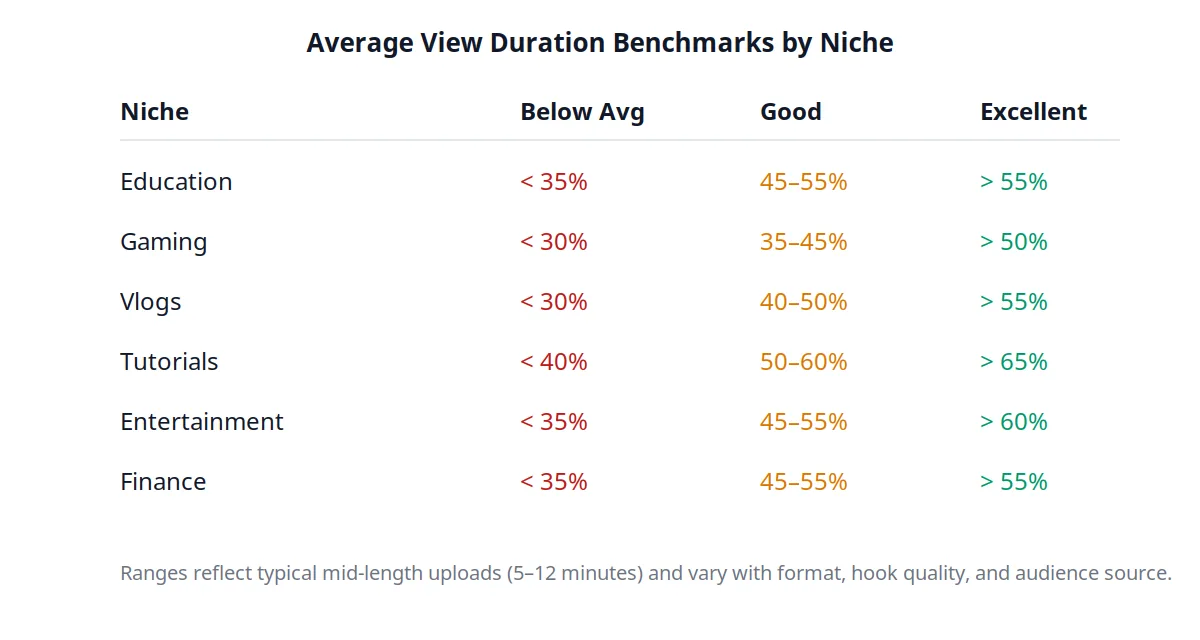
| Niche | Below average | Good | Excellent |
|---|---|---|---|
| Education / explainers | < 35% | 45–55% | > 55% |
| Long-form gaming | < 30% | 35–45% | > 50% |
| Vlogs | < 30% | 40–50% | > 55% |
| Tutorials / how-to | < 40% | 50–60% | > 65% |
| Entertainment / comedy | < 35% | 45–55% | > 60% |
| Finance / business | < 35% | 45–55% | > 55% |
| Reviews | < 35% | 45–55% | > 60% |
| Shorts (any niche) | < 60% | 70–85% | > 90% |
How length changes the target
As a rough working rule for long-form:
- Under 3 minutes: aim for 65 percent retention or better.
- 3 to 8 minutes: aim for 50 to 60 percent.
- 8 to 15 minutes: aim for 45 to 55 percent.
- 15 to 30 minutes: 40 to 50 percent is competitive.
- 30+ minutes: 35 to 45 percent is strong; anything above 50 is exceptional.
Notice that longer videos win on absolute watch time even at lower percentage retention. A 22-minute video at 42 percent generates more watch time than a 6-minute video at 60 percent. Choose your length based on the story, not the percentage.
Benchmarks are calibration, not target
Benchmarks are useful for one thing: telling you whether your current video is above, at, or below the median for its shape. They are actively harmful when they become the number you are chasing. A creator who fixes their retention at 55 percent and stops improving has capped their ceiling. A creator who ignores the benchmark and keeps refining loops finds themselves at 65 percent a year later, wondering when it happened. Use the numbers to know where you stand. Do not use them to know where to stop.
Actionable Framework: The L.O.O.P. Method
Everything above is easier to remember as a four-step framework you can apply to any script. Call it L.O.O.P.
L — Lead with a specific loop
Within the first 15 seconds, open a loop that is specific enough for the viewer to imagine the payoff. Not "you will learn a lot"; "you will learn the exact three words I now write on every thumbnail". If you cannot name the payoff, the loop is not specific enough yet.
O — Overlap loops in the body
Never let all loops close at the same time. As one closes, the next should already be open. Aim for at least three overlapping loops in a video longer than five minutes.
O — Optimize the mid-video re-hook
Around the 40 to 60 percent mark, restate or escalate the main loop. This is where most videos die and where a well-placed re-hook is worth ten points of retention.
P — Pay off with more than you promised
Close every loop with the answer the viewer expected, plus one thing they did not. Over-delivery on the payoff is what turns a viewer into a subscriber — and it is what makes them willing to accept your loops in the next video.
"The strongest signal a viewer can give you is not a like. It is that they still trust your loops enough to accept them again on your next upload."
Checklist for Creators
Run every script through this list before you record. If you cannot check off at least the first seven items, do not shoot yet — the retention has already been lost on the page.
- My first 15 seconds open a specific, named loop.
- The thumbnail and title promise is confirmed within the first sentence.
- I can point to at least three overlapping loops in the body of the video.
- There is a re-hook or loop restatement between the 40 and 60 percent mark.
- Every loop I open closes inside the same video.
- Every payoff delivers what was promised plus one extra surprise.
- There are no more than eight seconds of visual sameness anywhere in the cut.
- The final 10 percent of the video points toward the next click, not toward the exit.
- My end screen is visible before the audio ends, so viewers do not scrub away.
- I have watched my previous video's retention graph and used one lesson from it in this script.
Score your script in minutes, not weeks
RetentionYT reads your script, marks every open loop, flags the moments most likely to lose viewers, and predicts your retention curve before you record.
Frequently Asked Questions
What is an open loop on YouTube?
An open loop is an unanswered question, promise, or unresolved tension planted early in a video that keeps viewers watching until it is closed. It exploits the Zeigarnik effect — the brain's tendency to keep incomplete tasks and questions active in working memory — which meaningfully increases audience retention and average view duration.
How many open loops should a YouTube video have?
As a rule of thumb, open a new loop roughly every 60 to 90 seconds and close each one within two to four minutes. A typical 8 to 10 minute video will hold three to five overlapping loops. Longer explainers can carry one master loop that spans the whole video plus smaller loops inside each chapter.
Do open loops still work in 2026?
Yes. Open loops work because they rely on how attention functions, not on any specific YouTube algorithm feature. What has changed is viewer tolerance for empty teasing — modern audiences punish loops that are opened but never paid off, so every loop must resolve inside the video with real value delivered.
What is a good audience retention rate on YouTube?
For most niches, an average view duration of 45 to 55 percent of total video length is considered good, and above 55 percent is excellent. Tutorials and short explainers can exceed 60 percent, while long gaming and vlog uploads often perform well at 35 to 45 percent.
Where do most YouTube viewers drop off?
The largest drop-off almost always happens in the first 15 to 30 seconds, where uncertain viewers decide whether the video is worth their time. A second common drop-off appears in the middle third of the video — the mid-video slump — where pacing weakens and open loops have gone stale.
How is an open loop different from a cliffhanger?
A cliffhanger is an open loop that is intentionally left unresolved at the end of a segment to bridge to the next episode or video. An open loop inside a single video is opened and closed within that same video. Cliffhangers drive session watch time across multiple videos; internal open loops drive audience retention inside one.
Can open loops hurt retention if used incorrectly?
Yes. Loops that are vague, over-promised, or never closed feel manipulative and cause sharper drop-offs than a video with no loops at all. Every loop must be specific enough that the viewer can feel the resolution when it arrives — and every loop must actually resolve.
Conclusion
Open loops are not a trick, exactly. They are the acknowledgment that attention is not something you demand — it is something you keep by making the viewer's brain refuse to let go. Every YouTuber who consistently holds high retention has, whether they call it that or not, learned to structure videos as a chain of unanswered questions. The rest is delivery.
You now have the mechanism (the Zeigarnik effect and how YouTube reads the resulting retention shape), the diagnosis (how to read your own retention graph and identify what is actually broken), the fixes (the first 30 seconds, the mid-video slump, and seven concrete techniques), the framework (L.O.O.P.), and the numbers to calibrate against. What is left is the work.
Pick your next upload. Before you record it, open your script, and mark every open loop with a bracket. If you cannot find at least three, the video is not ready to shoot yet. Fix that, and everything else in your retention will start to fix itself.
And if you want that process to take minutes instead of hours, that is exactly what RetentionYT was built for — script-level retention analysis for creators who would rather ship than guess.
Keep reading on RetentionYT
- The First 30 Seconds: The Only Window That Matters
- Mid-Video Slump: Why Viewers Leave at the 4-Minute Mark
- How to Read a YouTube Retention Graph Like an Analyst
- 10 Hook Formulas That Consistently Earn the First 30 Seconds
- Pattern Interrupts: The Editing Secret That Buys You Attention
- Average View Duration vs Retention Rate: Which One Should You Optimize?
- Session Watch Time: The Hidden Metric YouTube Cares About Most
- Scripting for Retention: A Practical Playbook
External references
Frequently asked questions
- What is an open loop on YouTube?
- An open loop is an unanswered question, promise, or unresolved tension planted early in a video that keeps viewers watching until it is closed. It exploits the Zeigarnik effect — the brain's tendency to keep incomplete tasks and questions active in working memory — which meaningfully increases audience retention and average view duration.
- How many open loops should a YouTube video have?
- As a rule of thumb, open a new loop roughly every 60 to 90 seconds and close each one within two to four minutes. A typical 8 to 10 minute video will hold three to five overlapping loops. Longer explainers can carry one master loop that spans the whole video plus smaller loops inside each chapter.
- Do open loops still work in 2026?
- Yes. Open loops work because they rely on how attention functions, not on any specific YouTube algorithm feature. What has changed is viewer tolerance for empty teasing: modern audiences punish loops that are opened but never paid off, so every loop must resolve inside the video with real value delivered.
- Where do most YouTube viewers drop off?
- The largest drop-off almost always happens in the first 15 to 30 seconds, where uncertain viewers decide whether the video is worth their time. A second common drop-off appears in the middle third of the video, often called the mid-video slump, where pacing weakens and open loops have gone stale.
- How is an open loop different from a cliffhanger?
- A cliffhanger is an open loop that is intentionally left unresolved at the end of a segment to bridge to the next episode or video. An open loop inside a single video is opened and closed within that same video. Cliffhangers drive session watch time across multiple videos; internal open loops drive audience retention inside one.
- Can open loops hurt retention if used incorrectly?
- Yes. Open loops that are vague, over-promised, or never closed feel manipulative and cause sharper drop-offs than a video with no loops at all. Every loop must be specific enough that viewers can feel the resolution when it arrives, and every loop must actually resolve.
Find your video’s drop-off points before you publish
RetentionYT audits your script for the moments viewers leave — so you can fix them before recording.
Get retention tips in your inbox
Occasional, practical emails on hooks, pacing, and retention. No spam.
Related posts
YouTube Retention Benchmark 2026: What the Numbers Actually Mean
There is no official YouTube retention benchmark. Here is what YouTube Studio actually reports, why third-party benchmark tables mislead, and how to build a baseline from your own channel.
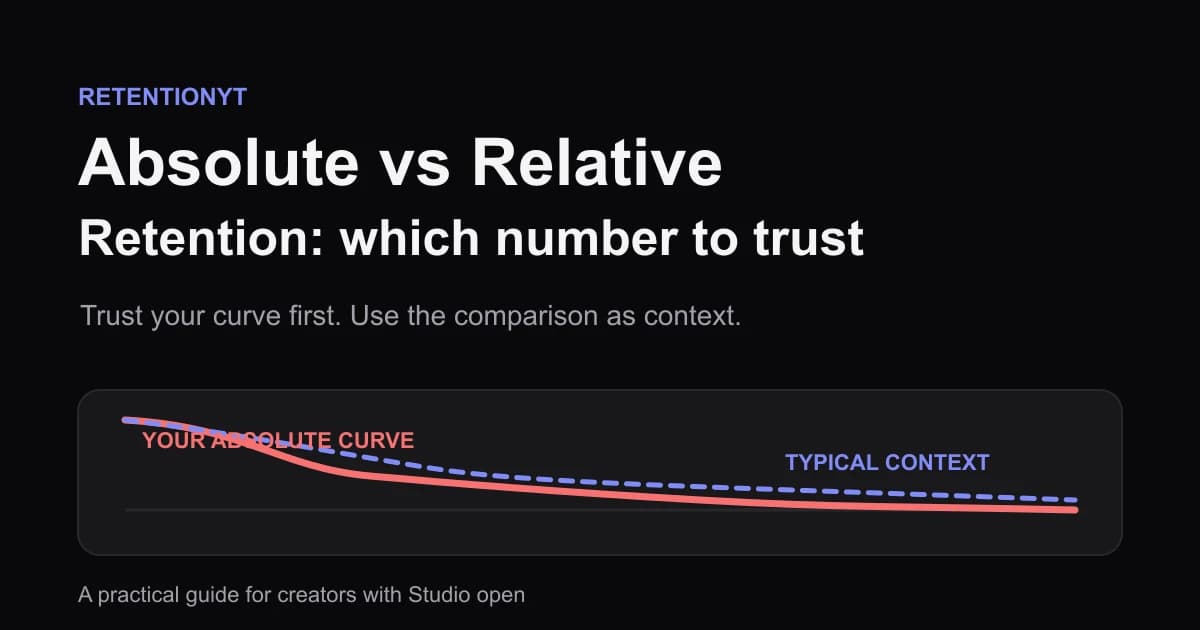
Absolute vs Relative Retention: Which Number to Trust
Absolute vs relative audience retention on YouTube: read the cliff, use typical retention correctly, and fix your first 30 seconds before chasing a benchmark.
How to Benchmark Retention Against Your Own Length Band
A YouTube retention benchmark by video length should start with your own channel: compare the last 8 videos in a similar length band, not a global chart.