The Click Promise: Matching Your Hook to Your Title and Thumbnail
Learn how to align your YouTube hook, title and thumbnail so every click gets the payoff it was promised—and more viewers keep watching.

24 min read
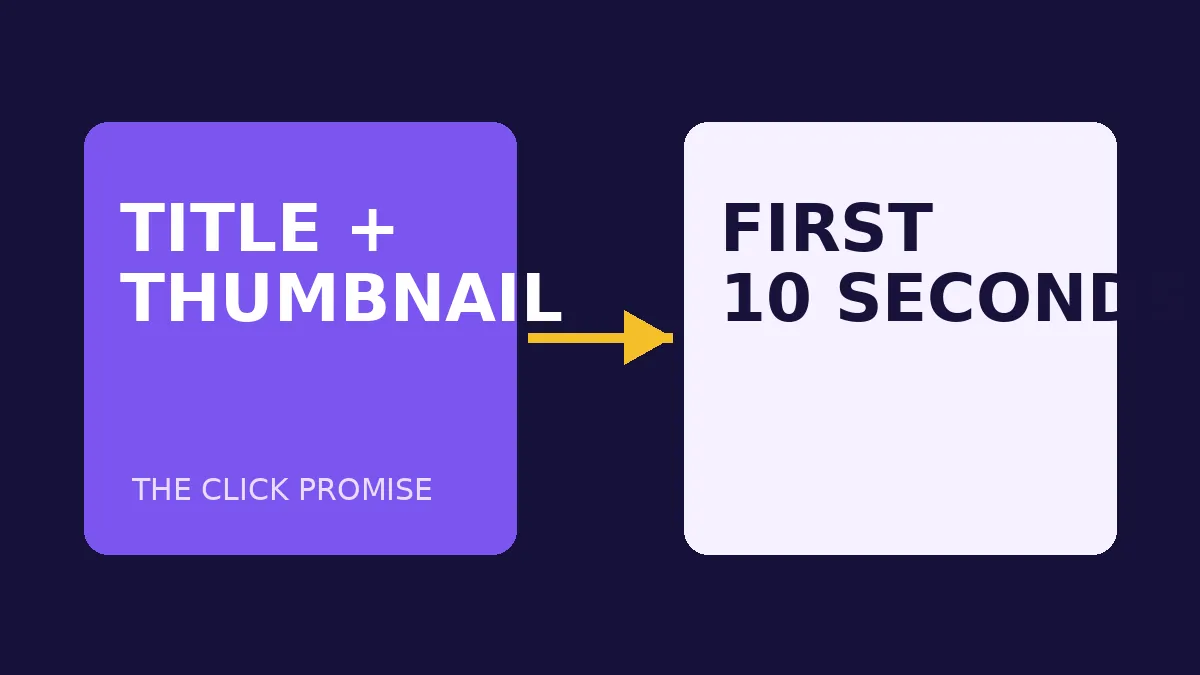
Every click is a promise. Keep it in the first seconds of your video, and viewers have a reason to stay. Break it, and even a compelling idea can lose them before it begins.
Introduction
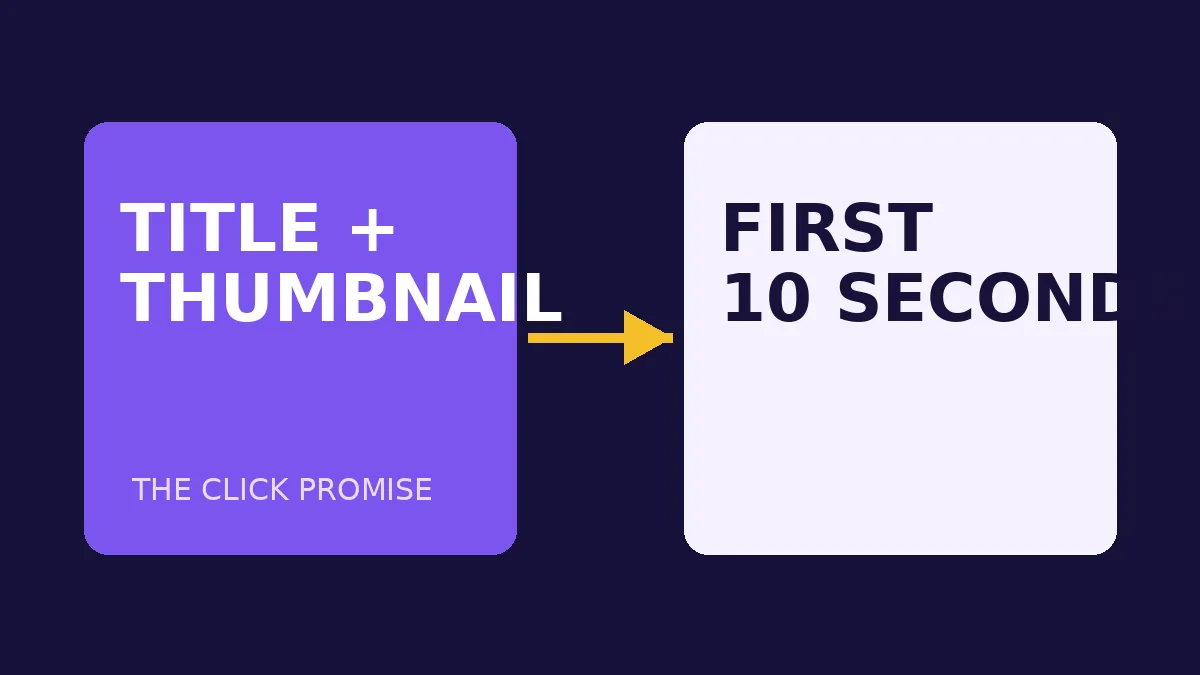
Your title and thumbnail earn attention before the video has spoken a word. Together, they tell a viewer what they will get and why it is worth a click. The first ten seconds must honour that expectation. This is the click promise: a practical way to connect packaging, opening line and the substance of a YouTube video into one honest, compelling experience.
It matters because a click-through rate alone does not describe satisfaction. YouTube defines an impression click-through rate as how often viewers watched after seeing a registered thumbnail, while its analytics also connect impressions to watch time. Packaging that persuades the wrong viewer—or delays the promised value—can win a click and lose the watch. This guide shows how to make your YouTube hooks specific, credible and aligned without resorting to clickbait.
Use the promise as a script constraint
Before you record, write the exact claim made by your title and thumbnail. Then make sure the first image and opening line verify it. RetentionYT can help audit the script for hook strength, pacing and likely drop-off risks before you film.
Why the first 10 seconds decide everything
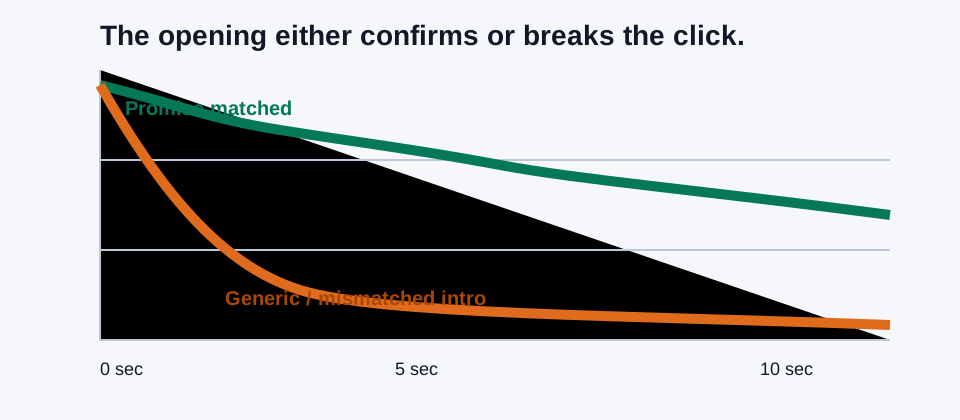
The click is not the finish line. It is the instant a viewer grants a video a small amount of attention in exchange for an expected result. The first spoken sentence, first visual and first edit decide whether that exchange feels fair. A creator can earn a high click-through rate and still lose momentum if the opening behaves like a different video. YouTube itself frames the intro metric as the percentage still watching after 30 seconds and says a high intro can mean that the first 30 seconds matched the thumbnail and title while keeping viewers interested. That is the operational definition of a click promise: the packaging makes a claim; the opening makes the claim unmistakably real. Do not reduce this to a magic phrase. A ten-second opening can be quiet, funny or cinematic. It only needs to answer three unspoken viewer questions quickly: Am I in the right place? Is this the specific thing I clicked for? Why should I continue rather than return to the feed? The answer can be a result on screen, a precise contrast, a decisive action or a credible preview. What it cannot be is a generic greeting that postpones relevance.
The psychology of the scroll
On a feed, people make fast comparisons rather than careful evaluations. A thumbnail provides a visual cue; a title supplies the interpretation; the viewer imagines a payoff. That imagined payoff becomes a mental contract. It may be modest: “I will learn the three edits that fix muddy audio.” It may be emotional: “I will see whether this impossible build works.” Either way, opening with housekeeping, a sponsor read, a broad history lesson or a different promise creates friction because it forces the viewer to revise a choice they just made. Curiosity is useful when it has an anchor. “I found one setting that doubled my export time” is a bounded curiosity gap: the subject, consequence and pending explanation are legible. “You will not believe this” asks for attention before establishing a reason. The first form can be fulfilled; the second often becomes an empty escalation. Scroll psychology rewards cognitive ease: make the next expected thing appear sooner than the viewer expects, then create the next question from what they have just seen.
What makes a hook fail
Most hook failures are not failures of energy. They are failures of alignment and order. A creator may deliver valuable information at minute three, but a viewer who clicked for it can leave at second eight if the video begins with channel branding. Other failures include changing the subject after a dramatic thumbnail, making a promise with no clear scope, repeating the title word-for-word without adding evidence, and burying the visual proof under a talking head. A useful diagnosis is to watch the first 15 seconds with sound off, then with the screen covered. With sound off, can a new viewer see the promised object, result or tension? With the screen covered, does the opening line name the specific value and the stakes? If either version is vague, the viewer receives mixed signals. The repair is usually subtraction: cut the greeting, move the caveat later, replace broad setup with the decisive fact, and bring the proof frame forward.
Warning: the greeting tax
If your opening begins with “hey guys,” your channel name and a subscription request, it charges viewers attention before it gives them the promised value. Move that material after the first useful beat.
Core principles of a high-retention hook
A reliable hook has five properties. Specificity names a subject rather than a category. Immediate evidence lets the viewer see or hear the proof of the title’s claim. Stakes tell them why the outcome matters. Direction tells them what happens next. Honesty keeps the claim within what the video actually delivers. These are not five lines to recite; they are five jobs the opening can perform across picture, voice, text and action. Think in terms of information density, not speed. A rushed montage full of unrelated claims can feel as evasive as a slow welcome. One clean sentence over an image that proves it is often more persuasive: “This $14 cable eliminated the buzzing in every take—here is the test that proved it.” The subject is visible, the outcome is stated, the proof is promised and the next beat is clear.
“The opening is not where you introduce yourself. It is where you prove the viewer made a good choice.”
A step-by-step click promise framework
Step 1: Write the package claim. Reduce the title and thumbnail to one sentence without hype. If you cannot explain the precise outcome, the viewer cannot reliably infer it. Step 2: Identify the proof frame. Choose the earliest shot, screen recording, result, quote or action that makes the claim credible. Put it in the cold open, not after the branded animation. Step 3: State the useful tension. Explain what is unresolved: a trade-off, a mistake, a test, a deadline or an obstacle. Tension is the reason to keep watching after the promise has been confirmed. Step 4: Map the next beat. Give the viewer a route. “First I will show the before-and-after, then the three changes.” This prevents a hook from becoming a trailer with no programme. Step 5: Delete the toll booth. Remove greetings, subscription requests and definitions that stand between the click and evidence. Ask for subscription after a meaningful payoff, not before it. Step 6: Read it against the packaging. Circle every word in the title and note where its equivalent appears in image, voice or action within ten seconds. A missing core term is an alignment risk.
Real hook examples: before and after
Example: tutorial. Title: “Fix Echo in Your Home Office in 10 Minutes.” Weak opening: “Hey everyone, welcome back. Today I have another audio video and I have some tips.” Better: “This is the echo your calls are sending—and these two panels removed it in ten minutes.” The second opening plays the problem, shows the fix and preserves the time promise. Example: commentary. Title: “Why This Viral Productivity Rule Backfires.” Weak: “There has been a lot of talk online about productivity lately.” Better: “The rule sounds efficient: schedule every hour. Here is the hidden cost it creates by 3 p.m.” It converts a broad topic into a specific reversal and keeps the promised argument intact. Example: challenge. Thumbnail: a cracked phone beside “24 HOURS.” Weak: “So, I had this crazy idea…” Better: “My phone screen is already cracked, and I have 24 hours to finish this shoot without replacing it.” The literal proof frame is the phone; the tension is the deadline; the viewer instantly knows the video has started.
Matching the hook to title and thumbnail
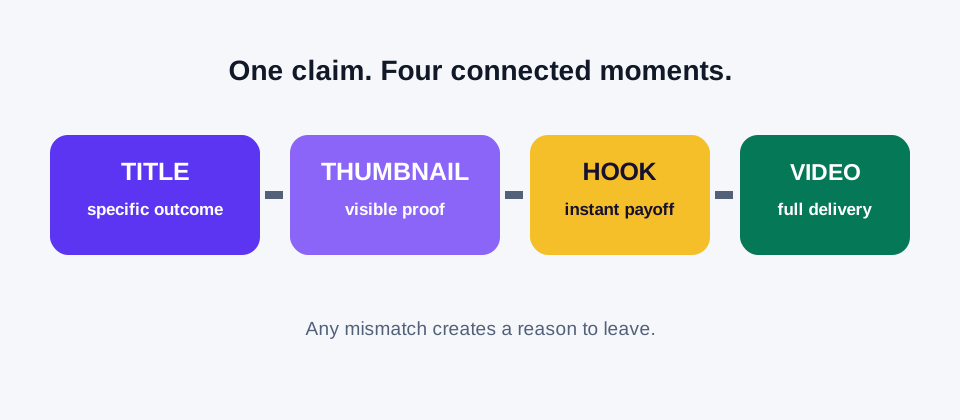
Treat the package and opening as a three-part system, not three independent creative tasks. The title handles precision: what is this about? The thumbnail handles the visual contradiction, outcome or emotion. The hook verifies that the interpretation a reasonable viewer formed is the right one. They need not repeat each other. In fact, they work better when each contributes a different layer of the same claim. For a video titled “I Tested 7 AI Note-Taking Apps,” a thumbnail might show “7 → 1” next to the winning interface. The hook should not start with a history of note-taking. Start with the decision: “After two weeks and 300 notes, only one app saved me time—and it was not the one I expected.” That shows the test happened, establishes the evaluation and opens a curiosity loop about the winner. Beware of semantic drift. A thumbnail showing a dramatic income number, a title about a beginner strategy and an opening about motivation may each be individually plausible, yet together they create three promises. Pick one primary promise and make the other elements support it.
Common mistakes to avoid
Do not confuse a title tease with an opening hook. A title can withhold part of the answer; the opening must deliver enough evidence to prove the question is worth pursuing. Do not apologise before value. “This video may be boring” trains the viewer to leave. Do not lead with a vague superlative—“the best,” “insane,” “game-changing”—unless you define the standard. Do not make every hook urgent; constant urgency loses contrast and credibility. Most importantly, do not optimise CTR in isolation. YouTube notes that clickbait can generate high CTR alongside low average view duration and lower-than-expected impressions. CTR varies by traffic source, audience and placement; YouTube’s own guidance says to compare over the long term rather than react to tiny movements. The goal is qualified clicks: people who recognised the promise and chose to stay for the actual video.
Testing and iterating your hook
Start with a hypothesis, not a hunch. Example: “The current opening spends six seconds on context before showing the result; placing the result at second zero will improve the opening’s hold.” Change one major variable at a time when practical: the first line, proof frame, order, or packaging. Keep the core video and distribution context in mind; a different source mix can change CTR without proving a thumbnail won. In YouTube Studio, inspect the audience-retention report at video level. Look for the shape, not a single universal benchmark. An immediate cliff often signals a broken click promise, unclear audio, a slow reveal or packaging mismatch. A dip when a long preamble begins suggests an ordering problem. Compare new versus returning viewers when available: returning viewers may tolerate familiar context that a cold audience will not. YouTube says detailed retention reports can show when viewers start and stop watching, making that graph a script-editing instrument rather than a post-mortem. Use RetentionYT before publishing to audit the opening in the same terms: is the promise explicit, is pacing delayed by filler, and are likely drop-off zones visible in the script? Its retention-readiness workflow is designed to flag hook strength, pacing and structural risks before recording. That does not replace real audience data; it makes the first draft more testable.
Actionable checklist
Before publishing, read the title, view the thumbnail for one second, then play the first ten seconds with no additional context. Can a stranger answer the following? • What exact result, story or lesson did I click for? • Is there an on-screen or spoken confirmation that this video contains it? • What tension, proof or route gives me a reason to keep going? • Is the first useful beat ahead of branding, greetings and calls to action? • Are the title, thumbnail and hook making one promise rather than three? • Does the rest of the video fulfil the scope, certainty and timeframe implied by the package? If any answer is “not yet,” revise the first ten seconds first. A stronger middle cannot reliably rescue a viewer who has already returned to the feed.
Click-promise field guide by video format
The same principle survives every format. What changes is the proof a reasonable viewer expects to see first. Use these drills while scripting and editing.
Search Tutorial
Search viewers need the answer named in the query. Put the setting, error or finished result on screen before you explain its background. If the title promises a fix, say what changed and show the outcome; reserve the reason it works for the next beat. After recording, compare the first frame, first line and first cut against the packaging. If one element introduces a different subject, revise it so each creates the same expectation in a different medium.
Product Review
A review promise is a verdict with evidence. Open with the product in use and the decisive trade-off: who should buy it, who should not, or the test that changed the conclusion. Avoid unboxing footage before the reason the review matters. After recording, compare the first frame, first line and first cut against the packaging. If one element introduces a different subject, revise it so each creates the same expectation in a different medium.
Case Study
Show the starting condition and the measurable change together. A case-study viewer clicked for a transformation, so do not make them wait through company history. Name the constraint, preview the method, then establish how the result will be verified. After recording, compare the first frame, first line and first cut against the packaging. If one element introduces a different subject, revise it so each creates the same expectation in a different medium.
Educational Explainer
Begin with the misconception, consequence or visual problem. Define terms only after the viewer knows why the definition matters. A simple contrast—what most people assume versus what is true—creates a clean route into the lesson. After recording, compare the first frame, first line and first cut against the packaging. If one element introduces a different subject, revise it so each creates the same expectation in a different medium.
Vlog Or Challenge
Use a literal proof frame: the deadline, broken object, location or rule. State what could go wrong and what counts as success. This preserves spontaneity while making the story legible to someone who has never watched the channel before. After recording, compare the first frame, first line and first cut against the packaging. If one element introduces a different subject, revise it so each creates the same expectation in a different medium.
Video Essay
Lead with the thesis in tension, not an extended scene-setting montage. A compelling opening can show an iconic example, make the argument and promise the evidence in one sequence. Context becomes more valuable once the destination is clear. After recording, compare the first frame, first line and first cut against the packaging. If one element introduces a different subject, revise it so each creates the same expectation in a different medium.
Comparison Video
Name the decision rule early: speed, cost, quality, beginner suitability or a constrained real-world test. The viewer should know why these two options are compared and how the winner will be selected before individual specifications arrive. After recording, compare the first frame, first line and first cut against the packaging. If one element introduces a different subject, revise it so each creates the same expectation in a different medium.
News Or Analysis
Establish the update and why it changes the viewer’s understanding. Avoid a generic recap when the title implies a new development. Put the newest, most consequential fact first and identify the question the analysis will answer. After recording, compare the first frame, first line and first cut against the packaging. If one element introduces a different subject, revise it so each creates the same expectation in a different medium.
Shorts-To-Long-Form Bridge
A fast short can open with the conclusion; long-form needs a reason to remain after that conclusion. Confirm the result quickly, then reveal a meaningful limitation, test or process that makes the full explanation worth the time. After recording, compare the first frame, first line and first cut against the packaging. If one element introduces a different subject, revise it so each creates the same expectation in a different medium.
Creative Process
Show the finished work and the hardest constraint together. “I made this in one day using only discarded materials” is more useful when the first frame shows both the outcome and the material. The process then feels earned, not delayed. After recording, compare the first frame, first line and first cut against the packaging. If one element introduces a different subject, revise it so each creates the same expectation in a different medium.
Gaming Guide
Show the exact encounter, loadout or result named by the package. A wide gameplay montage is not evidence of a specific strategy. State the condition where it works and give a preview of the key decision before the tutorial begins. After recording, compare the first frame, first line and first cut against the packaging. If one element introduces a different subject, revise it so each creates the same expectation in a different medium.
Finance Or Business Education
Be especially precise about scope and uncertainty. Replace promises of guaranteed outcomes with the model, evidence or scenario being examined. The hook should clarify what the viewer will learn, not imply that a complex decision has a universal shortcut. After recording, compare the first frame, first line and first cut against the packaging. If one element introduces a different subject, revise it so each creates the same expectation in a different medium.
Twelve hook patterns that keep the promise
A pattern is a container for clarity, not a substitute for a real claim. Select the one that matches what your packaging already promises.
Outcome first
Open on the finished result, then rewind to the decision that caused it. Use a concrete noun rather than an abstract category, and make the first image reinforce the sentence. The next line should add a new reason to continue—an obstacle, proof method or consequence—rather than restate the title. During the edit, remove any line that could appear unchanged at the start of a different video. That test protects specificity. Finally, listen to the transition into the body: the viewer should feel that the explanation has begun, not that the real video has been postponed.
Problem first
Let viewers hear or see the cost of the problem before naming the solution. Use a concrete noun rather than an abstract category, and make the first image reinforce the sentence. The next line should add a new reason to continue—an obstacle, proof method or consequence—rather than restate the title. During the edit, remove any line that could appear unchanged at the start of a different video. That test protects specificity. Finally, listen to the transition into the body: the viewer should feel that the explanation has begun, not that the real video has been postponed.
Surprising contrast
Pair the common assumption with the counterexample that the video will prove. Use a concrete noun rather than an abstract category, and make the first image reinforce the sentence. The next line should add a new reason to continue—an obstacle, proof method or consequence—rather than restate the title. During the edit, remove any line that could appear unchanged at the start of a different video. That test protects specificity. Finally, listen to the transition into the body: the viewer should feel that the explanation has begun, not that the real video has been postponed.
Live test
State the rule of the experiment and show the condition that could make it fail. Use a concrete noun rather than an abstract category, and make the first image reinforce the sentence. The next line should add a new reason to continue—an obstacle, proof method or consequence—rather than restate the title. During the edit, remove any line that could appear unchanged at the start of a different video. That test protects specificity. Finally, listen to the transition into the body: the viewer should feel that the explanation has begun, not that the real video has been postponed.
Specific mistake
Name the one error in the title and demonstrate its visible consequence immediately. Use a concrete noun rather than an abstract category, and make the first image reinforce the sentence. The next line should add a new reason to continue—an obstacle, proof method or consequence—rather than restate the title. During the edit, remove any line that could appear unchanged at the start of a different video. That test protects specificity. Finally, listen to the transition into the body: the viewer should feel that the explanation has begun, not that the real video has been postponed.
Deadline
Make the time limit physical through a clock, schedule or worsening condition. Use a concrete noun rather than an abstract category, and make the first image reinforce the sentence. The next line should add a new reason to continue—an obstacle, proof method or consequence—rather than restate the title. During the edit, remove any line that could appear unchanged at the start of a different video. That test protects specificity. Finally, listen to the transition into the body: the viewer should feel that the explanation has begun, not that the real video has been postponed.
Ranked decision
Reveal the evaluation rule before teasing the eventual winner. Use a concrete noun rather than an abstract category, and make the first image reinforce the sentence. The next line should add a new reason to continue—an obstacle, proof method or consequence—rather than restate the title. During the edit, remove any line that could appear unchanged at the start of a different video. That test protects specificity. Finally, listen to the transition into the body: the viewer should feel that the explanation has begun, not that the real video has been postponed.
Myth check
Quote the belief briefly, then put the strongest contradicting evidence in frame. Use a concrete noun rather than an abstract category, and make the first image reinforce the sentence. The next line should add a new reason to continue—an obstacle, proof method or consequence—rather than restate the title. During the edit, remove any line that could appear unchanged at the start of a different video. That test protects specificity. Finally, listen to the transition into the body: the viewer should feel that the explanation has begun, not that the real video has been postponed.
Behind the scenes
Lead with a finished moment and the unseen constraint behind it. Use a concrete noun rather than an abstract category, and make the first image reinforce the sentence. The next line should add a new reason to continue—an obstacle, proof method or consequence—rather than restate the title. During the edit, remove any line that could appear unchanged at the start of a different video. That test protects specificity. Finally, listen to the transition into the body: the viewer should feel that the explanation has begun, not that the real video has been postponed.
Transformation
Place the before and after side by side before beginning the method. Use a concrete noun rather than an abstract category, and make the first image reinforce the sentence. The next line should add a new reason to continue—an obstacle, proof method or consequence—rather than restate the title. During the edit, remove any line that could appear unchanged at the start of a different video. That test protects specificity. Finally, listen to the transition into the body: the viewer should feel that the explanation has begun, not that the real video has been postponed.
Expert reaction
Play the key claim or clip first, then identify the standard used to assess it. Use a concrete noun rather than an abstract category, and make the first image reinforce the sentence. The next line should add a new reason to continue—an obstacle, proof method or consequence—rather than restate the title. During the edit, remove any line that could appear unchanged at the start of a different video. That test protects specificity. Finally, listen to the transition into the body: the viewer should feel that the explanation has begun, not that the real video has been postponed.
Beginner roadmap
Name the starting point and practical destination; do not begin with every possible exception. Use a concrete noun rather than an abstract category, and make the first image reinforce the sentence. The next line should add a new reason to continue—an obstacle, proof method or consequence—rather than restate the title. During the edit, remove any line that could appear unchanged at the start of a different video. That test protects specificity. Finally, listen to the transition into the body: the viewer should feel that the explanation has begun, not that the real video has been postponed.
Frequently asked questions
What is a click promise on YouTube?
A click promise is the expectation created by the title and thumbnail. The hook should quickly confirm that the video contains the specific result, story or solution that the viewer clicked to see.
How long should a hook be to confirm the click promise?
Use however long is needed to confirm the promise and establish a reason to continue—often the first 5–10 seconds. The useful test is not a fixed length; it is whether the viewer receives evidence before filler or setup.
Should a hook repeat the title?
Not word for word. The hook should verify and deepen the title: show proof, state a stake, introduce a contrast or define the route through the video.
What does a big drop in the first 30 seconds mean?
It can indicate a mismatch between packaging and content, a slow or confusing start, technical friction, or an audience that was not the intended fit. Review the exact moment and compare it with the promise made by the title and thumbnail.
Can changing a thumbnail fix audience retention?
It can improve alignment by setting a more accurate expectation, but it cannot fix an opening that delays or contradicts the video’s value. Review packaging and the first 30 seconds as one system.
How do I test different YouTube hooks?
Document a single hypothesis, improve the early proof or clarity, publish enough comparable content to interpret the pattern, then use YouTube Studio’s retention report and traffic-source context to assess the result.
Conclusion: earn the next second
The best hook is not a trick designed to trap attention. It is an early act of delivery. Package the video with a clear, appealing claim; show the viewer that claim is real immediately; then use useful tension to guide them through the rest of the story. When a retention curve falls sharply, begin with the contract you made at the click—not with more noise in the edit.
Audit the promise before you publish
Use RetentionYT to find weak hooks, slow openings and structural drop-off risks while the script is still easy to improve.
Internal linking recommendations
Link this page from the RetentionYT Blog hub and future Hooks articles using contextual anchors such as YouTube hook formula, opening line and first 10 seconds. Recommended adjacent article targets: a guide to cold opens, a guide to reading audience-retention curves, a title-and-thumbnail testing guide, and a script pacing guide. Add the final canonical URLs when those pages are published so all internal links resolve directly.
Sources and further reading
- YouTube Help: Measure key moments for audience retention — explains the intro metric and the relationship between a matched opening, thumbnail and title.
- YouTube Help: Thumbnail & title tips — accuracy, clarity, testing and audience context.
- YouTube Help: Impressions & click-through-rate FAQs — CTR variation and why clickbait is a poor retention strategy.
- Google Search Central: Article structured data — implementation and validation guidance for Article markup.
Frequently asked questions
- What is a click promise on YouTube?
- A click promise is the expectation created by the title and thumbnail. The hook should quickly confirm that the video contains the specific result, story or solution that the viewer clicked to see.
- How long should a hook be to confirm the click promise?
- Use however long is needed to confirm the promise and establish a reason to continue—often the first 5–10 seconds. The useful test is not a fixed length; it is whether the viewer receives evidence before filler or setup.
- Should a hook repeat the title?
- Not word for word. The hook should verify and deepen the title: show proof, state a stake, introduce a contrast or define the route through the video.
- What does a big drop in the first 30 seconds mean?
- It can indicate a mismatch between packaging and content, a slow or confusing start, technical friction, or an audience that was not the intended fit. Review the exact moment and compare it with the promise made by the title and thumbnail.
- Can changing a thumbnail fix audience retention?
- It can improve alignment by setting a more accurate expectation, but it cannot fix an opening that delays or contradicts the video’s value. Review packaging and the first 30 seconds as one system.
- How do I test different YouTube hooks?
- Document a single hypothesis, improve the early proof or clarity, publish enough comparable content to interpret the pattern, then use YouTube Studio’s retention report and traffic-source context to assess the result.
Find your video’s drop-off points before you publish
RetentionYT audits your script for the moments viewers leave — so you can fix them before recording.
Get retention tips in your inbox
Occasional, practical emails on hooks, pacing, and retention. No spam.
Related posts
How to Write a YouTube Hook That Actually Works (Process + Examples)
A repeatable five-step process for writing YouTube hooks: mine the payoff, make it specific, add stakes, compress, and test — with two full before-and-after rewrites.
A 15-Second Phone Test Beats a 4K Reshoot
Before you light the A-cam, test three 15-second hooks on a phone in bad light with one cold viewer, then spend the 4K budget only on the winner.
Binary Choice to Camera as a Pattern Interrupt
Use a three-second A or B question to reset a YouTube video: put both choices on screen, pick one on camera, and keep the comment prompt out of the critical beat.