Documentary Cold Open: 20 Seconds of Scene Before the Thesis
Script a YouTube documentary cold open as a 20-second scene with a concrete object, then land the thesis before the viewer mistakes atmosphere for the story.

10 min readUpdated
In this guide
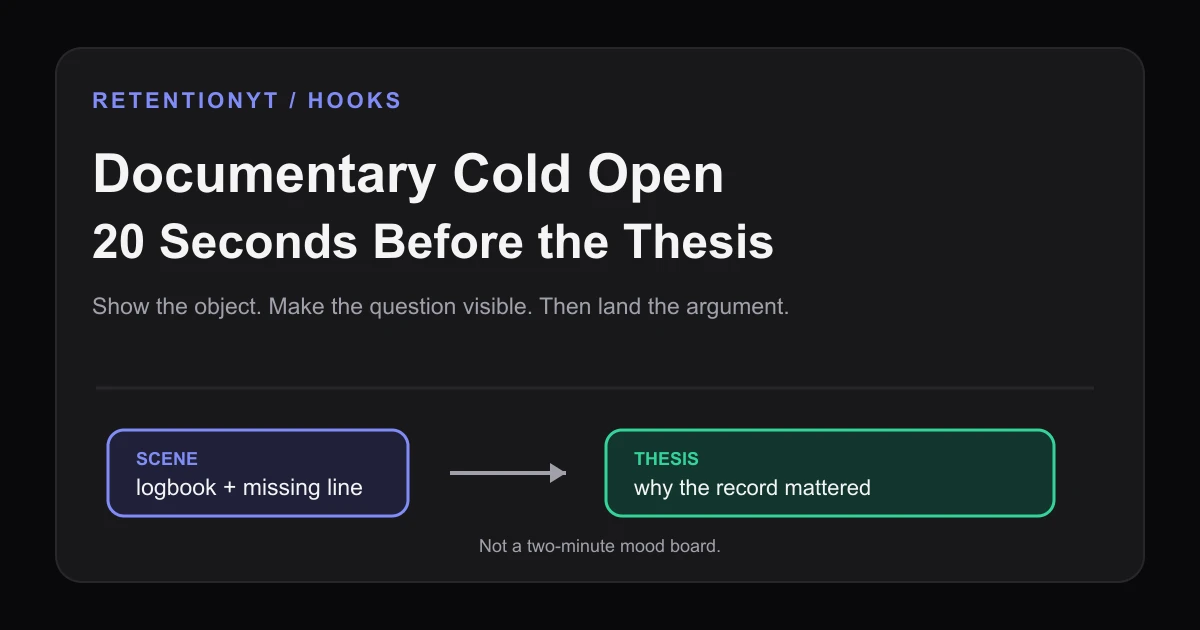
A documentary cold open is a working format: about 20 seconds of a concrete scene, then the thesis sentence. It is not a two-minute mood board with music. Give the viewer an object they can name, an action they can follow, and a question that the thesis will answer; otherwise, you have atmosphere, not an opening.
What Documentary Cold Open actually is (and what it is not)
A cold open starts inside the story before the formal explanation. For a documentary or essay, show a small event that contains the larger argument: a hand turning a key, a document with one line blacked out, a machine stopping, or a witness pointing to an empty space. The scene need not explain everything; it must make the thesis worth hearing.
A thesis states what the video will argue or demonstrate. Write it before the scene, even if you say it later. If the thesis is “the bridge failed because maintenance records were ignored,” show a maintenance ledger, a missing page, and the sound of water below. The object gives the viewer something to hold while meaning arrives.
| Cold-open ingredient | What the viewer should get | Script test |
|---|---|---|
| Concrete object | A visible thing that anchors the story | Can the viewer name it without your explanation? |
| Action or change | A movement, discovery, or consequence | Does something happen rather than simply appear? |
| Unresolved question | A reason to continue past the image | What does the viewer need to learn next? |
| Thesis sentence | The argument that gives the scene meaning | Does it explain why this object matters? |
The format is not a YouTube law. Use roughly 8–20 seconds when the footage carries a clean beat, and extend only when each second adds a fact or question. These timings are editorial guidance. You are preventing a two-minute preamble, not satisfying a secret counter.
Where RetentionYT fits
The manual method works without signing up. RetentionYT can shorten the script-review loop after you have written the scene and thesis. Try RetentionYT for an optional pre-record pass.

Why this shows up in YouTube Studio
Your cold open becomes testable when you mark timestamps in the script: object, question, and thesis. After publishing, inspect available analytics, but do not turn one curve into proof that a scene caused a result.
In August 2026, SOURCE 1 describes the Reach tab as a way to understand how viewers find content and lists metrics such as click-through rate, watch time, and views. Its current visible page is a Reach article, not the brief’s labelled “Audience retention” page. It gives an Android path through the YouTube Studio app: Content, select the video, Analytics, then Reach. The page does not support the seed claim that documentary hooks must last 8–20 seconds.
In August 2026, SOURCE 2 gives the current computer path YouTube Studio, Analytics, then Content. Under Videos, it describes “Key moments for audience retention” as a report showing how well different moments held attention, and says typical retention can compare the 10 latest videos of similar length. That is a legitimate place to inspect your opening; it is not evidence that a 20-second scene guarantees a lift.
Ask narrow questions: Did viewers reach the thesis? Did the first image match the title’s promise? Did the next beat answer the opening question? Tie edits to the script’s object and thesis, not an imagined benchmark.

Worked example 1: the failure
This is an illustrative failure, not YouTube data. The script opens with a black screen, music swell, three aerial coastline shots, and “Some places hold secrets.” At 0:18, the narrator finally names a missing lighthouse log. The opening has atmosphere, but no object or readable question.
The failure is not the coastline. A location shot works when the story is about that location and the viewer knows why it matters. Here, the object is the lighthouse log. The script delays the object and conflict, asking suggested viewers to wait for a thesis they cannot predict.
The timing and curve values below are illustrative planning values only, not published benchmarks. They show how a writer can mark the failure without pretending to have a dataset.
| Time | Failure beat | Illustrative review note |
|---|---|---|
| 0:00 | Black screen and music | Illustrative curve at 100%; mood begins, story does not |
| 0:06 | Empty coastline | Illustrative curve at 78%; location is unnamed and unconnected |
| 0:12 | Second aerial shot | Illustrative curve at 64%; visual variation without a new fact |
| 0:18 | Thesis delayed | Illustrative curve at 55%; the lighthouse log is still absent |
| 0:30 | First concrete object | Illustrative curve at 43%; the story finally becomes legible |

Read the opening without music. If words and images still contain a place, object, action, and question, the scene has structure. If it collapses into “mysterious,” “beautiful,” or “unforgettable,” you wrote a mood instruction, not a scene.
Worked example 2: the fix
Replace the mood board with a 20-second scene. At 0:00, show the lighthouse log on a wet table. At 0:04, a gloved hand opens to the storm date. At 0:09, one line is missing. At 0:14, the pen scratch stops. At 0:17, say: “That missing line is why this lighthouse was closed for 43 years.” The thesis lands before the scene becomes a trailer.
The object is the log; the action is discovering the missing line; the sound is the stopped pen. The question is what the line concealed. The thesis gives the sequence meaning for the next section. Use voice-over, picture-only, or both; test whether the choice sharpens the object and question.
Use this cue format: “[SCENE at 0:00: object and place; action by 0:09; question at 0:14; thesis at 0:17].” Write the source of the footage, the exact sound, and the exit point. If a shot only says “old building,” it is not ready for the editor.

The manual workflow works with a photograph, document scan, close-up, and one clean sound. For a separate hook process, use YouTube hook formulas and writing hooks that work. Keep this scene specific and the thesis close.
How to check this in YouTube Studio (step by step)
- Write the thesis sentence in one line before drafting the opening.
- Choose one object that makes the thesis visible or concrete.
- Write the action the viewer will see between 0:00 and 0:20; do not list a mood.
- Add one sound, texture, or physical change that the editor can actually source.
- Write the unresolved question in plain language and decide when it becomes clear.
- Place the thesis after the scene, then read the opening without music to test whether it still works.
- Open YouTube Studio. Use the analytics reports available to your account, then inspect the opening and Key moments for audience retention when that report is available.
- Compare the object reveal and thesis timestamp with visible viewer response; treat the pattern as an observation, not proof of causation.
- Rewrite the next cold open by replacing the weakest mood shot with a concrete action or object.
The manual method works without signing up. If you want a second pass before recording, use RetentionYT and the related documentary analyzer. The tool is optional; the scene test is the requirement.
The trap
The trap is confusing cinematic with legible. A slow push-in, low note, and wide landscape create feeling, but the viewer still needs to know what to look at. A cold open is a small event that makes the thesis necessary, not a mood trailer.
Another trap is stating the thesis before earning it. If “This town changed history” precedes unrelated footage, the viewer has no object to connect to the claim. Start with the object or action, then use the thesis to explain why it matters.
A third trap is packing 20 seconds with five objects. One ledger, one hand, one sound, and one missing line can carry more than a location montage. Choose the object that carries the argument, then widen the frame.
The trap
The move

Test every opening with: “The viewer can see ___, notice ___, and wants to know ___.” If a blank fails, rewrite the scene or shot list before editing.
What to do in the next upload
Run this pass before you open your stock library. Keep it manual even if you use an analyzer; the point is to make the scene’s job visible in the script.
- Write the thesis sentence before the cold open.
- Choose one concrete object that makes the thesis visible.
- Name the place and time without a generic establishing montage.
- Write one physical action the viewer can follow.
- Add one sound or texture the editor can source.
- State the unresolved question in plain language.
- Mark the object reveal, question, and thesis timestamps.
- Read the opening without music or decorative B-roll.
- Check the opening in available YouTube Analytics reports.
- Inspect Key moments for audience retention when available.
- Replace any mood shot that adds no object, action, or question.
A strong cold open does not hide the story behind atmosphere. Let the viewer see the object, notice the change, feel the question, and hear the thesis that makes the detail matter. Write the scene first, then widen the frame.
Give the viewer a scene they can name before you give them the argument.
For the next upload, start at 0:00 and write what the viewer can identify. At 0:08, ask whether the object has meaning. At 0:20, ask whether the thesis has arrived. Analytics tell you what to inspect; the script tells you what the viewer sees.
Frequently asked questions
- How long should a documentary cold open be on YouTube?
- Use about 20 seconds as a working format, not a platform guarantee. Give the viewer one concrete scene, one object they can name, and one unresolved question before you land the thesis. If the scene needs two minutes to become meaningful, it is probably a delayed introduction rather than a cold open.
- Do I state the thesis first?
- Usually, let the scene earn the thesis. Show the object, action, or consequence first, then state what the scene means. The thesis should arrive before the viewer feels lost, but it does not have to be the first spoken sentence. Write the thesis early in your notes so the scene has a destination.
- What counts as a scene?
- A scene has a place, a concrete object, an action or change, and a point in time. “Old factory footage” is atmosphere. “At 05:40, a gloved hand opens the factory ledger and one page is missing” is a scene because the viewer can name what is happening and what question it creates.
- Will suggested traffic sit through mood?
- Do not assume it will. Suggested viewers may recognize only the title and first frame, so make the first image legible and give the scene a concrete question. Mood can support the scene, but it should not replace an object, action, or consequence that tells a new viewer why to keep watching.
- Should I use VO or picture-only?
- Use voice-over when the words narrow the meaning of the image or plant the question. Use picture-only when the action is self-explanatory and sound carries the tension. You can combine both: let the object appear, use one precise line to frame it, and avoid narrating what the viewer can already see.
- How do I apply “Documentary Cold Open” on my next upload?
- Write the thesis sentence first, then design a 20-second scene that makes the thesis feel necessary. Choose one object, one action, one sound, and one unanswered question. Put the thesis after the scene, read the sequence aloud, and cut anything that creates mood without moving the question forward.
- Where in YouTube Studio do I check “Documentary Cold Open”?
- There is no Studio setting named Documentary Cold Open. Treat it as a script and edit method. Use YouTube Analytics reports available to your account to inspect how the opening behaves, then compare the scene timestamp with what viewers did. The method lives in your outline, not a product toggle.
- What is the most common mistake with “Documentary Cold Open”?
- The most common mistake is building a mood board instead of a scene. A slow montage, music swell, and anonymous landscape can look expensive while giving the viewer no object or question to hold. Replace atmosphere with a specific action, then land the thesis before the opening becomes a trailer for a different video.
Give your next script a second look
Paste a script into RetentionYT for suggestions on your hook, pacing, and structure. Choose the edits that serve your video, then check audience behavior in YouTube Analytics after publishing.
Get retention tips in your inbox
Occasional, practical emails on hooks, pacing, and retention. No spam.
Related posts
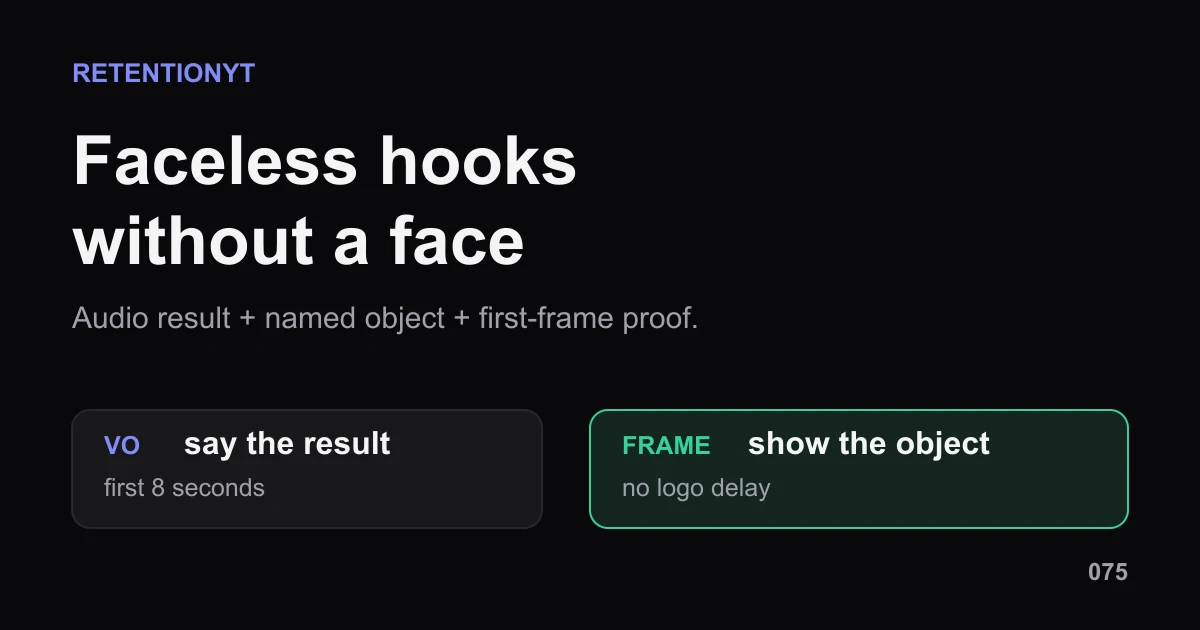
Faceless Channel Scripting: Audio Hooks When There's No Face
Faceless YouTube hook without a face: build the first 8 seconds from a voiceover result, a named object, and a first-frame graphic your viewer can read.
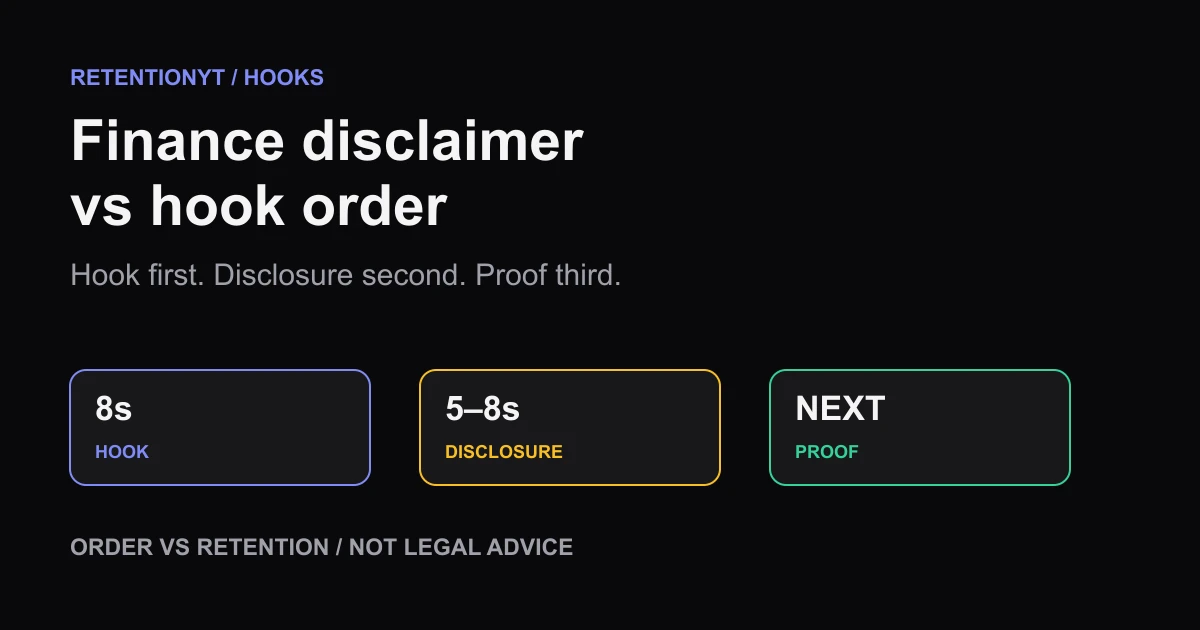
Finance YouTube: Disclaimer vs Hook (Order That Doesn't Cliff)
Put your finance disclaimer after the hook, not before it: deliver the promise in 8 seconds, add a short disclosure, then show proof without giving legal advice.
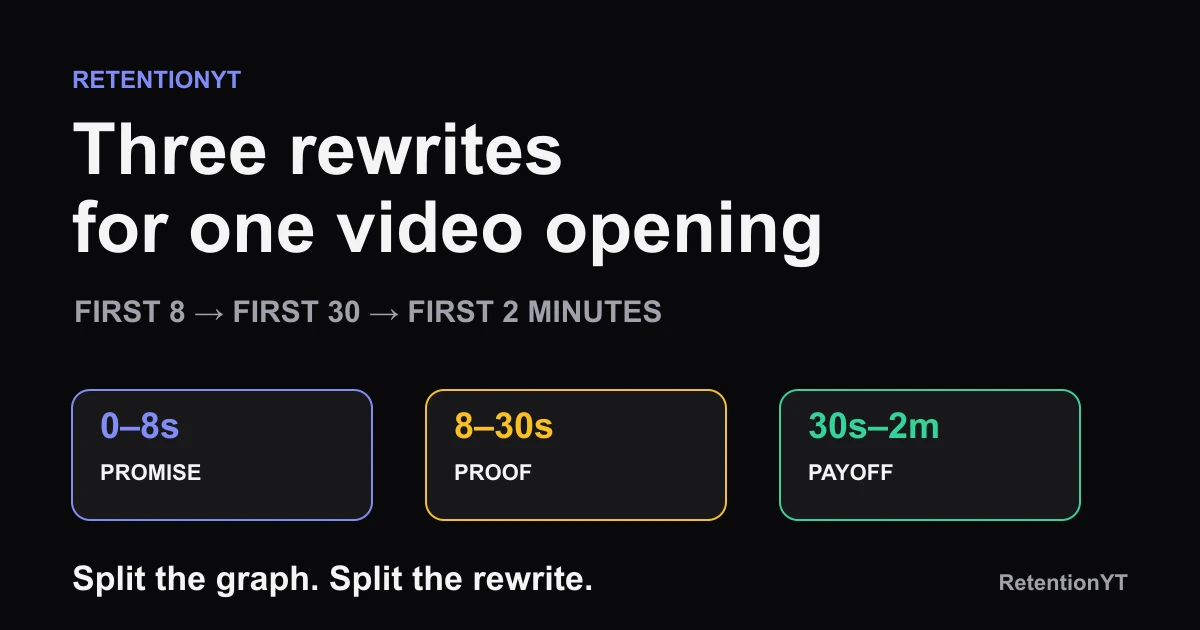
First 8 Seconds, First 30, First 2 Minutes: Three Different Rewrites
YouTube first 8 seconds vs first 30 seconds vs 2 minutes: use three rewrites to fix the promise, proof, and first payoff instead of one vague intro edit.