Finance YouTube: Disclaimer vs Hook (Order That Doesn't Cliff)
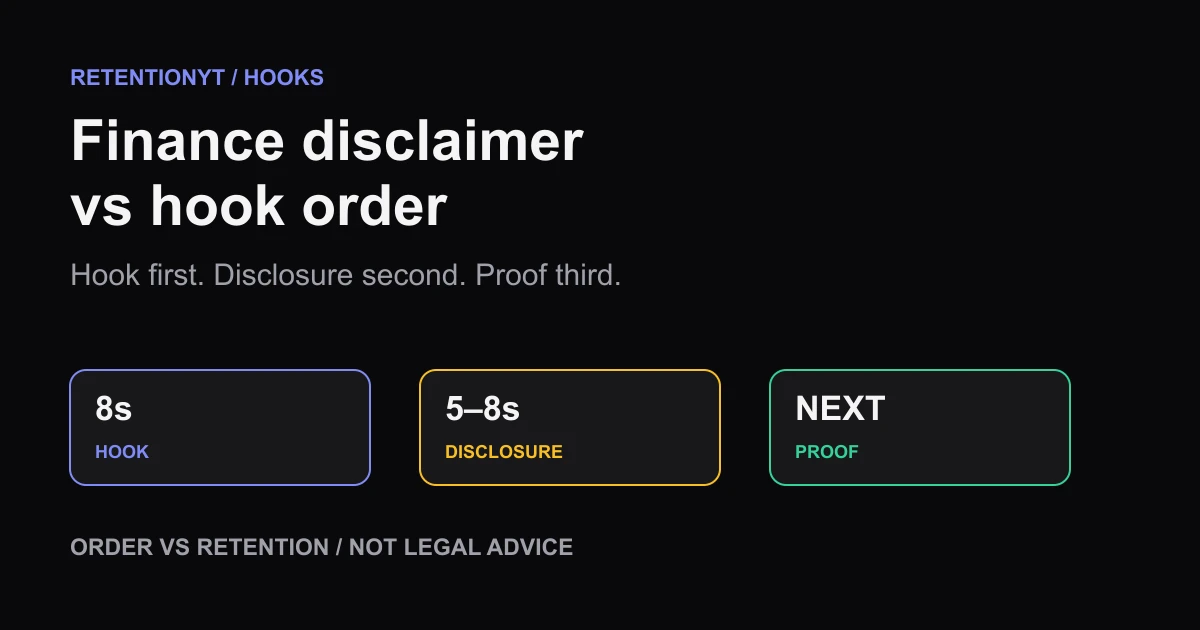
Put your finance disclaimer after the hook, not before it: deliver the promise in 8 seconds, add a short disclosure, then show proof without giving legal advice.

11 min readUpdated
In this guide
Do not spend 25 seconds on a disclaimer before a promise. Hook in 8 seconds, then a short spoken plus on-screen disclaimer in 5–8 seconds, then the proof. A lawyer decides the wording. Retention decides the order. This is not legal advice. Keep the approved words intact before anyone acts on the idea.

What Finance YouTube actually is (and what it is not)
Finance YouTube is not a special permission slip to skip disclosure. It is a high-stakes content context where you need two separate decisions: a qualified professional decides what the disclosure must say, and you decide how to sequence that approved wording so the viewer understands the promise before the disclosure and proof arrive.
A disclaimer is a disclosure that limits or clarifies how a viewer should interpret the content. This article does not decide whether you need one, whether it must be spoken, or whether a proposed sentence is legally sufficient. It gives you an editorial order to take to counsel: truthful hook, approved short disclosure, then evidence.
| Decision | What you control | What you do not control |
|---|---|---|
| Legal wording | Ask counsel for wording that fits your facts | Whether a disclosure is legally sufficient |
| Hook | State the real topic and useful outcome | Whether the viewer will stay for an unsupported claim |
| Timing | Place the approved disclosure after the hook | A universal “safe” number of seconds |
| Proof | Show the source, calculation, chart, or demonstration | Whether proof makes a recommendation suitable for anyone |
| CTA | Offer the next useful video before subscribe | Whether a viewer acts on financial content |
The unique gain is simple: do not make the disclaimer the hook. Your first line should tell the viewer what the video is about without promising a return, outcome, or certainty you cannot prove. Then place the approved disclosure where it can be heard and read before your proof begins.
Where RetentionYT fits
Manual method works without signing up. RetentionYT can shorten a repeatable hook-and-pacing review after your approved wording is set.
Why this shows up in YouTube Studio
Your transcript order is a pre-publish hypothesis. After publication, YouTube’s current Source 2 says the Content tab in YouTube Analytics shows how audiences find content, what they watch, and how they interact. Under Videos, it describes Key moments for audience retention and says typical retention can compare your 10 latest videos of similar length.
Use that report to ask a narrow question: did viewers encounter the promised subject, the approved disclosure, and the proof in the order you planned? Do not turn a graph into legal evidence. A retention report can show attention patterns; it cannot decide whether your wording is compliant or whether an investment claim fits a viewer.
The other locked Source 1 currently opens as “Understand your YouTube video reach,” not the supplied “Audience retention” title. Its current page describes the Reach tab as a way to understand how viewers find content and lists metrics such as thumbnail impressions click-through-rate, views, average view duration, and watch time. This article uses the current Reach wording only and uses Source 2 for retention-specific navigation.
That source conflict matters. The 8-second hook, 5–8-second disclosure window, 25-second warning, and 0–8 score are editorial rules from this brief, not promises made by YouTube. The score is a checklist: it is not a forecast, legal grade, or platform metric.

Worked example 1: the failure
Illustrative example: a creator opens a video with 25 seconds of approved-sounding legal language, but the viewer still does not know whether the video is about a budget, a portfolio, a tax question, or a product review. The disclaimer may be important, yet its position makes the opening feel like paperwork before a promise.
The creator then says “this will change your finances” before showing a calculation or source. That is a second problem: the hook makes an outcome claim that the proof has not earned. The viewer has to wait through legal framing and a broad promise before seeing the object that would make the video specific.
| Illustrative timeline | What the viewer hears or sees | Audit result |
|---|---|---|
| 0:00–0:25 | Approved-sounding disclaimer with no clear topic | Fail: promise delayed |
| 0:25–0:33 | “This will change your finances” | Fail: outcome overreach before proof |
| 0:33–1:30 | Background and credentials | Risk: more setup before evidence |
| 1:30 | Calculation or source finally appears | Late: useful object arrives after the decision point |
The numbers in this example are illustrative, not YouTube data and not legal guidance. The 0–8 score below is also illustrative: if four checks pass and four fail, write 4/8 with four evidence notes. Do not translate 4/8 into a predicted retention percentage or a conclusion about disclaimer compliance.
The repair is not to delete approved words. It is to move the approved short disclosure after a truthful hook, remove the unsupported outcome, and bring the calculation or source forward as proof.
Worked example 2: the fix
Illustrative example: the opening says, “This video compares two ways to read a company’s cash flow; I’ll show the exact line I check first.” The next beat places the approved 5–8-second spoken and on-screen disclosure, then the creator shows the filing line, calculation, or other proof. The hook names the object without promising a return.
The revised order respects both jobs. The hook answers “what is this?” The disclosure answers “how should I interpret this content?” The proof answers “what are you showing me?” If counsel requires different placement or wording, counsel’s direction wins; the edit plan changes around that approved requirement.
The improvement is not a guarantee. It is a cleaner contract with the viewer: the title’s subject appears first, the disclosure is visible before evidence, and the proof arrives before the creator asks for trust or action.

Any percentage, dollar amount, return, or outcome in a finance script needs a source or an explicit illustrative label. Do not borrow a number from a worked example and present it as evidence for a real investment decision.

How to check this in YouTube Studio (step by step)
- Open the title, transcript, and approved disclaimer together. Write the exact legal wording in a separate block so editing does not accidentally alter it.
- Read the first 8 seconds aloud. The viewer should know the finance topic and the truthful promise before the disclosure appears. Remove a greeting, biography, or result claim that the proof cannot support.
- Time the disclosure. The working editorial target is 5–8 seconds spoken plus on-screen, but it is not a legal safe harbor. Keep the approved words intact and make the text readable.
- Put proof immediately after the disclosure. Proof can be a source, filing line, calculation, screen recording, comparison, or demonstration; label what it is instead of calling a claim “proven” without showing the object.
- Inspect the first transition. If the video adds context before the proof, write one sentence explaining why that context is necessary. Cut context that only establishes the creator’s credentials.
- Score eight checks from 0 to 8: topic clear, hook truthful, disclosure approved, disclosure visible, proof follows, unsupported outcome removed, next video follows value, subscribe comes last. Add an evidence note beside each point.
- Read the order again with sound off. If the on-screen disclosure cannot be understood without colour, tiny text, or a spoken line the viewer cannot replay, fix the display while keeping counsel’s wording unchanged.
- After publishing, open YouTube Studio, then Analytics and Content. Source 2 describes Key moments for audience retention under Videos and typical retention comparisons. Follow the labels available in your current account.
- Compare a marked transcript with the finished video. If attention changes near the hook, disclosure, or proof, inspect the edit and promise alignment. Do not infer legal compliance from the curve.
- Save the approved disclosure, transcript audit, score, and post-publish note with the upload record. The next script should use what you observed, not a made-up benchmark.
This keeps two questions separate. “Did the viewer understand the topic before the disclosure?” is an editorial question. “What happened after publication?” is a Studio question. “What disclosure is required?” is a legal question for qualified counsel.
The trap
The trap is treating either side of the problem as permission to ignore the other. Some creators put a long disclosure first and call the resulting cliff “the cost of compliance.” Others put a tiny disclaimer after the CTA and call the video “retention-first.” Neither move proves the wording or order is right.
The safer workflow is controlled sequencing. Get the words approved. Put a truthful topic promise first. Show and say the approved short disclosure. Then provide the proof before context expands and before you ask the viewer to move to another video or subscribe.
The trap
The move
Do not use red or green wording as a substitute for legal review. A “good” editorial order can still contain a disclosure that counsel rejects. A “bad” draft can contain language that must remain but needs a different edit. Keep legal approval and retention editing in separate checkboxes.
What to do in the next upload
Run this checklist with counsel’s approved text, your title, and the transcript open.
- Write the finance topic in the first 8 spoken seconds.
- State a truthful promise without a guaranteed return or outcome.
- Place the approved spoken and on-screen disclosure after the hook.
- Time the disclosure against the 5–8-second editorial target only.
- Show the source, calculation, filing line, or demonstration next.
- Define technical finance terms at first use in plain language.
- Mark every unsourced number as illustrative or remove it.
- Score eight checks with an evidence note for each point.
- Put the next-video direction after the payoff or proof.
- Put the subscribe request last.
- Compare the finished order with Studio after publishing.
- Ask counsel, not the retention graph, whether the wording is adequate.
For a faster second pass after legal wording is approved, use the YouTube Script Analyzer. For hook construction, read 9 YouTube Hook Formulas and How to Write a YouTube Hook That Actually Works. The manual sequence remains usable without signing up.

A disclosure can be visible without becoming the reason the viewer leaves.
Hook first. Approved disclosure second. Proof third. Keep the wording with counsel, keep the order visible to the viewer, and use Studio to inspect attention after publication—not to decide what is legally required.
Frequently asked questions
- Should a finance disclaimer go first?
- Usually, do not spend the opening on a long disclaimer before the viewer knows the promise. Lead with a truthful hook, then add a short spoken and on-screen disclosure before the proof. A qualified lawyer decides the words and legal scope; this article only covers order versus retention, not what disclaimer your situation requires.
- Will a disclaimer kill retention?
- A disclaimer is not automatically a retention problem. A long, vague, or front-loaded disclosure can delay the reason someone clicked, while a short disclosure after the hook keeps the order clear. Treat the timing as an editorial test, then inspect your published retention report; do not promise that any fixed number of seconds guarantees performance.
- Can it be on screen only?
- Ask qualified counsel whether your disclosure must be spoken, written, or both for your situation. From an editing perspective, a concise on-screen disclosure can appear while you say it, after the hook and before the proof. Make the words readable, keep the visual long enough to be seen, and never hide required language in tiny type.
- How short can it be?
- The brief’s working target is 5–8 seconds for a short spoken plus on-screen disclaimer, but that is an editorial timing target, not a legal safe harbor. The shortest compliant wording depends on your topic, jurisdiction, relationships, and counsel. Time the approved wording, then check whether the hook’s promise remains clear before the disclosure ends.
- Is this legal advice?
- No. This is a content-order guide for a finance creator: hook first, short disclosure next, proof after that. It does not decide whether you need a disclaimer, what it must say, or whether your disclosure is legally sufficient. Ask a qualified lawyer for those questions and follow the wording they approve for your facts.
- How do I apply “Finance YouTube” on my next upload?
- Open your title, transcript, and approved disclaimer. Write the first 8 seconds as a truthful promise, place the 5–8-second spoken and on-screen disclosure immediately after it, then add the proof or demonstration. Read the sequence aloud, remove any unsupported outcome, and save the approved wording with the upload notes.
- Where in YouTube Studio do I check “Finance YouTube”?
- After publishing, open Analytics and then Content in YouTube Studio. The current YouTube Help page describes Key moments for audience retention under Videos and says typical retention can compare your 10 latest videos of similar length. Use the report to inspect what happened; it cannot decide your legal wording or replace counsel.
- What is the most common mistake with “Finance YouTube”?
- The common mistake is putting an unapproved 25-second legal preamble before the promise, then assuming the viewer will wait. The opposite mistake is hiding a required disclosure or making a performance claim before proof. Keep the approved words intact, put them after a truthful hook, and make the proof easy to see.
Give your next script a second look
Paste a script into RetentionYT for suggestions on your hook, pacing, and structure. Choose the edits that serve your video, then check audience behavior in YouTube Analytics after publishing.
Get retention tips in your inbox
Occasional, practical emails on hooks, pacing, and retention. No spam.
Related posts
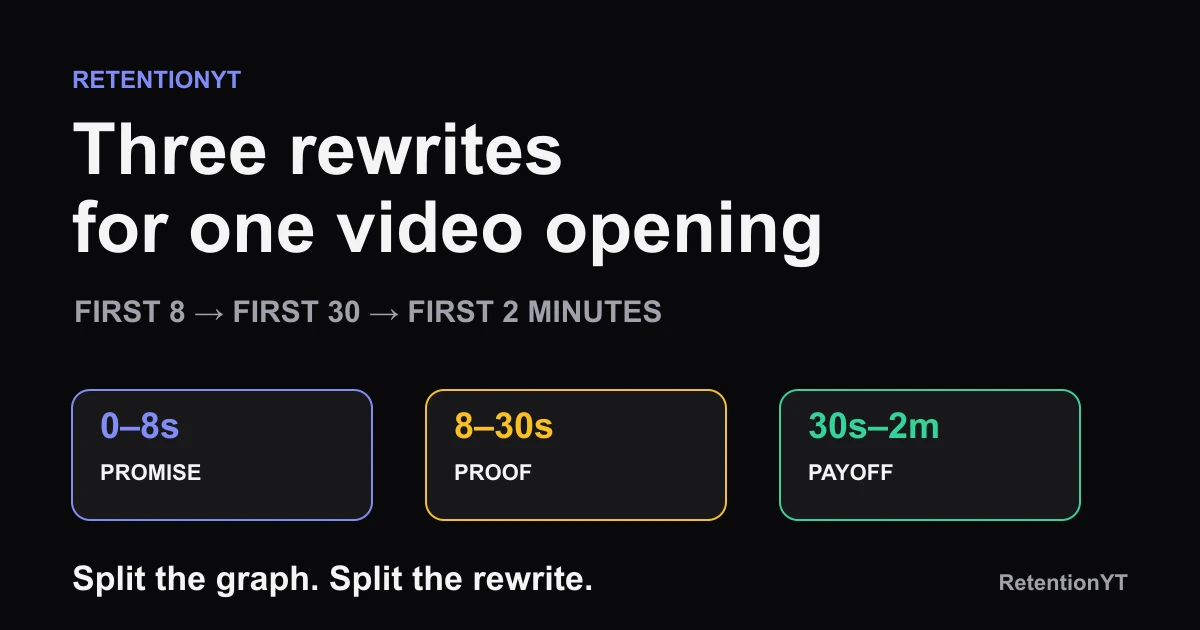
First 8 Seconds, First 30, First 2 Minutes: Three Different Rewrites
YouTube first 8 seconds vs first 30 seconds vs 2 minutes: use three rewrites to fix the promise, proof, and first payoff instead of one vague intro edit.
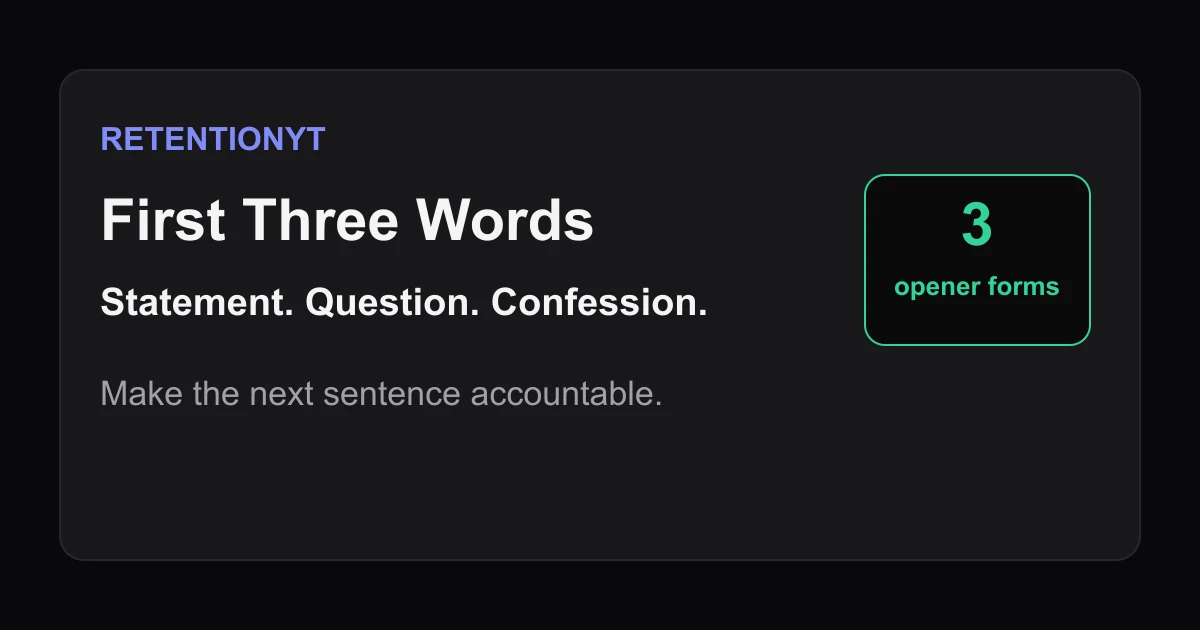
First Three Words: Statement vs Question vs Confession
Choose the right YouTube hook first three words: compare a statement, question, and confession, then test the opener against your title and first visual.
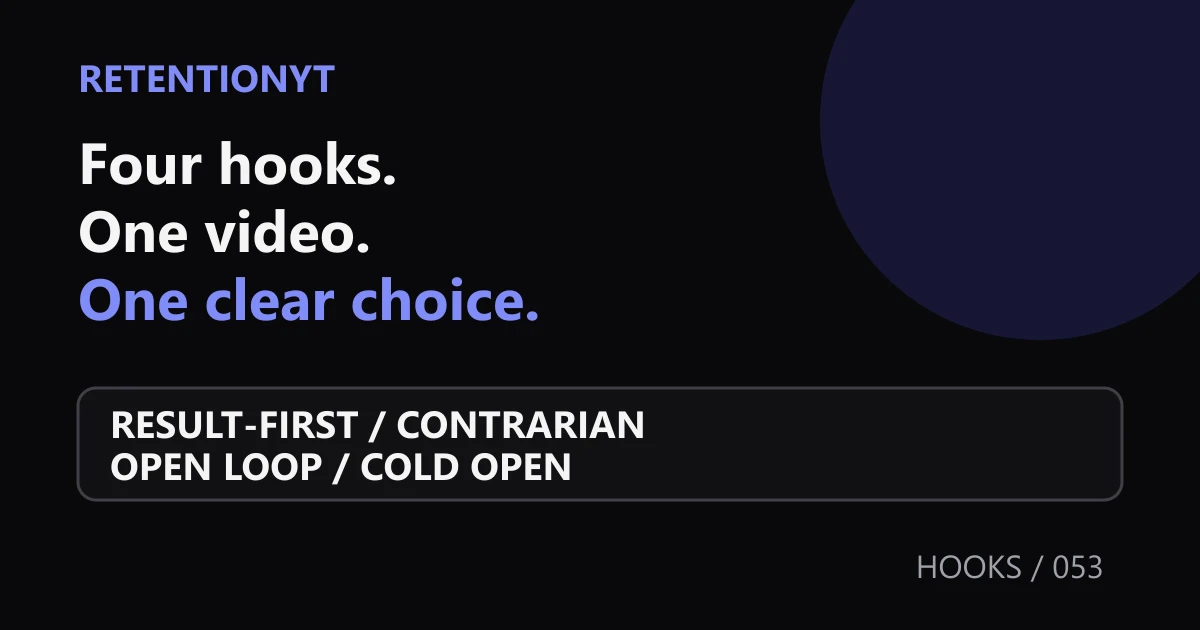
Hook Variation Matrix: Result-First x Contrarian x Open Loop x Cold Open
Test four YouTube hook formulas on the same video idea with one variation matrix. Learn the 3-take test, choose a winner, and read your own retention evidence.