Hook Variation Matrix: Result-First x Contrarian x Open Loop x Cold Open
Test four YouTube hook formulas on the same video idea with one variation matrix. Learn the 3-take test, choose a winner, and read your own retention evidence.

10 min readUpdated
In this guide
Take one video idea and write four first sentences: Result-First, Contrarian, Open Loop, and Cold Open. Put them in a table. Film three. The matrix is the work; the formulas post is the dictionary. Do not publish a fourth formula you did not hear out loud. Your first decision is not “which sounds clever?” but “which opening can you perform and support?”

What Hook Variation Matrix actually is (and what it is not)
A Hook Variation Matrix is a comparison sheet for one video, not four unrelated ideas. Keep the title promise, audience, payoff, footage, and topic fixed. Make four first-line candidates using four different entrances: lead with the result, challenge the expected belief, open a question, or start inside the scene.
The matrix makes the decision visible. You can hear whether the Result-First line sounds earned, whether the Contrarian line is actually defensible, whether the Open Loop has a payoff, and whether the Cold Open starts too late. You are comparing openings, not pretending that a formula produces a guaranteed retention outcome.
| Formula | First-line job | Best starting condition | Failure signal |
|---|---|---|---|
| Result-First | Show the outcome first | The result is real and easy to picture | The outcome is too broad to prove |
| Contrarian | Challenge the expected advice | You have a defensible disagreement | The “contrarian” claim is only hype |
| Open Loop | Plant a question the video will close | The payoff arrives later | The question never gets answered |
| Cold Open | Begin inside a moment | The footage has an immediate scene | The scene needs too much setup |
This is an editorial test, not a YouTube feature or guarantee. Run it with a notes app, phone, and planned video; no sign-up is required.
The four counts above are the brief’s operating method, not YouTube performance data. The useful discipline is keeping the comparison fair: one topic, four entrances, three spoken takes, one chosen line. If the candidates describe different videos, throw the matrix away and start again.
Why this shows up in YouTube Studio
The matrix happens before upload, but Studio is where you inspect what happened after the promise met viewers. You are not looking for a metric named “Hook Variation Matrix.” You are looking for your own evidence around the opening and asking whether the chosen line matched the video that followed.
The locked YouTube Help page describes the Reach tab as a snapshot of metrics such as click-through rate, watch time, views, and more. Its computer path is YouTube Studio → Content → select a video → Analytics → Reach (YouTube Help, August 2026). Use that path for the documented Reach context, not a guessed menu.
The second locked page documents YouTube Studio → Analytics → Content at channel level. For videos, it describes “Key moments for audience retention,” which shows how different moments held viewers’ attention, and typical retention, which can compare your 10 latest videos of similar length (YouTube Help, August 2026). Those reports help you inspect the result; they do not choose the formula for you.

Worked example 1: the failure
This is an illustrative example about a creator making a video called “How to Read Your Retention Graph.” The creator drafts four lines, but each line quietly changes the promise. Result-First says, “My graph found the exact second viewers leave.” Contrarian says, “Your retention graph is lying to you.” Open Loop says, “There is one dip you should never ignore.” Cold Open says, “At 0:08, the line drops and I know why.”
Those lines are not four openings for one video. They make four different claims: exact diagnosis, distrust, one dip, and a specific timestamp. The creator cannot fairly compare them because the audience is being promised a different payoff each time. The matrix has become a pile of ideas.
Table 2 — Illustrative worked-example numbers. These values are invented for the craft demonstration and are not YouTube data, a RetentionYT case study, or a published benchmark.
| Candidate | Illustrative first line | Illustrative number or time | Why the test fails |
|---|---|---|---|
| Result-First | “I found the exit point.” | 0:08 | It implies exact proof without a fixed promise. |
| Contrarian | “Your graph is lying.” | 1 claim | It changes the topic from reading to distrust. |
| Open Loop | “One dip matters most.” | 1 dip | It promises a ranking the video may not deliver. |
| Cold Open | “At 0:08, watch this.” | 0:08 | It fixes a timestamp without shared evidence. |
The failure is not that any sentence sounds weak. The failure is that the variables moved. A usable matrix needs four routes into the same video: how to read a retention graph without mistaking an illustrative pattern for a universal rule. Keep the claim modest, keep the lesson fixed, and let the first line change.
Worked example 2: the fix
The fixed illustrative matrix keeps one topic and one payoff: “read the early shape of your retention graph and decide what to investigate next.” The four lines now approach the same lesson from different angles. Result-First: “You can find the first moment worth investigating before you rewrite the whole video.” Contrarian: “The steepest dip is not automatically the first thing to fix.” Open Loop: “One early signal tells you where to look before you touch the edit.” Cold Open: “Open your graph and hover over the first sharp change.”
Now film three of the four as spoken takes. Record the same speaker, topic, title promise, and planned payoff. Do not score the takes from a silent screen. You are testing words in a voice, at a pace, with the hesitation or confidence the viewer will actually hear.
Pick the line that is clear, supportable, and natural to perform. If the video cannot deliver the promise, reject the line even if it sounds dramatic. The matrix is successful when it makes a defensible choice cheap, not when it gives you permission to publish the most intense sentence.
How to check this in YouTube Studio (step by step)
First, write the fixed brief at the top of a note: topic, target viewer, title promise, and payoff. Under it, write the four formula labels. If a candidate needs a new topic or a new result to sound interesting, mark it as a different idea instead of forcing it into the matrix.
Second, read all four lines aloud. Remove throat-clearing, greetings, and setup that the viewer does not need. Record three takes as 15-second phone clips, using the same delivery conditions. Listen for whether the sentence is understandable on the first pass and whether the next beat is obvious.
Third, choose one line and record the reason beside it. “It sounded strongest” is not enough. Write “I chose Cold Open because the footage begins inside the graph,” or “I chose Result-First because the outcome is visible and the video proves it.” This note makes the decision reusable.
Fourth, after publishing, open YouTube Studio and follow the documented reports rather than searching for a matrix card. Review the selected video’s opening against your chosen promise. A change in the curve is a prompt to investigate wording, delivery, title, thumbnail, edit, and audience match; it is not proof that a formula alone caused the change.
Fifth, carry one lesson into the next upload. Compare your own candidates and your own videos. Keep the same topic long enough to learn from the test, but do not turn an illustrative chart into a benchmark for another creator.
The trap
The trap is formula shopping. You write four hooks, pick the one with the loudest claim, and call the decision a test. That is not a test if you never say the candidates aloud, if each line promises a different video, or if you choose based on imagined performance instead of a defensible fit.
Another trap is hybrid fog. Combining Contrarian with Open Loop can work, and a Cold Open can contain a result. But if the viewer cannot tell what the video is about by the end of the opening, the combination has hidden the promise. Start with clean versions; add one hybrid only when you can name the primary job.
The trap
The move

What to do in the next upload
Make the matrix a five-minute decision, not a new production project. Put the fixed topic at the top, write the four lines underneath, then use the 3-take test. The formulas post is useful as a dictionary of patterns; this matrix is the discipline that makes you hear the differences.
- Write one fixed topic, title promise, audience, and payoff.
- Draft one Result-First first line.
- Draft one Contrarian first line.
- Draft one Open Loop first line.
- Draft one Cold Open first line.
- Keep the four lines in one comparison table.
- Film three takes with the same delivery conditions.
- Reject any line the video cannot support.
- Record which line you chose and why.
- Review your own Studio evidence after publishing.
- Carry one tested lesson into the next upload.
If you want a faster pre-recording review, the YouTube script analyzer is a related tool, not a replacement for hearing your own delivery. You can also read YouTube hook formulas for the formula vocabulary and writing hooks that work for the rewrite discipline. The manual matrix works without signing up for RetentionYT; RetentionYT is optional.

The final question is not which formula is universally best. It is which opening makes the same video easier to understand, easier to perform, and easier to defend. Four lines give you contrast. Three takes give you evidence about your delivery. One honest choice gives the upload a clear contract.

Frequently asked questions
- How do I write multiple hooks for one video?
- Keep the topic, promise, audience, and payoff fixed. Change only the opening approach: write one Result-First line, one Contrarian line, one Open Loop, and one Cold Open. Put all four beside each other, read them aloud, and record three of them as short phone takes before choosing.
- Which four formulas should I test?
- Start with Result-First, Contrarian, Open Loop, and Cold Open. They give you four different ways to enter the same promise: outcome, challenge, unresolved question, or immediate scene. The matrix is a practical editorial test, not an official YouTube feature or a guarantee that one formula will win.
- Can two formulas combine?
- Yes, but name the primary job first. A Cold Open can contain a Contrarian sentence, or a Result-First line can leave an Open Loop. Do not change the topic and formula at the same time. Write the clean versions first, then test one deliberate hybrid only if the promise remains clear.
- How do I choose a winner?
- Use the 3-take test: record three of the four candidates exactly as you would deliver them, then listen for clarity, energy, and a reason to continue. Choose the line you can perform naturally and defend with the video. After publishing, compare your own evidence; do not call an illustrative chart a benchmark.
- Should every video use Result-First?
- No. Result-First is useful when the outcome is visible and strong, but a story may need a Cold Open, a disputed belief may need Contrarian, and a process with a delayed payoff may need an Open Loop. Test the same promise through different entrances instead of forcing one formula onto every topic.
- How do I apply “Hook Variation Matrix” on my next upload?
- Write one topic in the first column, then draft four first lines for that same topic: Result-First, Contrarian, Open Loop, and Cold Open. Film three takes, note which line you chose and why, then review your own Studio evidence after publishing. Keep the winning lesson for the next upload.
- Where in YouTube Studio do I check “Hook Variation Matrix”?
- You will not find a dashboard card called Hook Variation Matrix. It is a pre-publish writing method. For post-publish feedback, use the documented Studio reports: a video’s Content, Analytics, and Reach path, plus the channel-level Analytics and Content path. Treat the reports as evidence to inspect, not as a formula selector.
- What is the most common mistake with “Hook Variation Matrix”?
- The common mistake is recording four different promises instead of four openings for one promise. When the topic, audience, title, and payoff all move, the comparison is useless. Keep those fixed, change the first line, record only three candidates, and write down the exact version you publish.
Give your next script a second look
Paste a script into RetentionYT for suggestions on your hook, pacing, and structure. Choose the edits that serve your video, then check audience behavior in YouTube Analytics after publishing.
Get retention tips in your inbox
Occasional, practical emails on hooks, pacing, and retention. No spam.
Related posts
'In This Video' as Retention Poison (and What to Say Instead)
The don't say in this video YouTube hook problem: lead with proof, then orient viewers with eight replacements that keep your first 8 seconds moving.
Named Object in the First Frame: How to Write It
Show a named object in frame 1 and say it in sentence 1. Use a graph, timer, or thumbnail to turn an empty desk into a clear YouTube hook today.
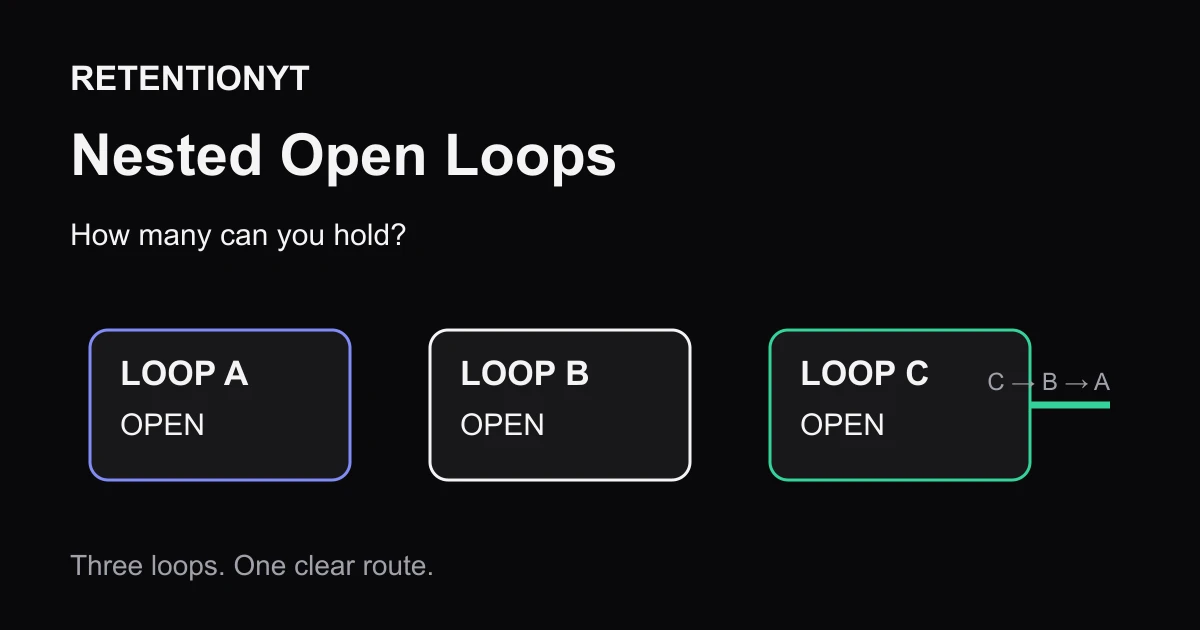
Nested Open Loops: How Many You Can Hold (Max 3)
How many open loops in a YouTube video? Use one for clarity, three max for a 10–15 minute upload, and close each promise in reverse order on camera.