First Three Words: Statement vs Question vs Confession
Choose the right YouTube hook first three words: compare a statement, question, and confession, then test the opener against your title and first visual.

9 min readUpdated
In this guide
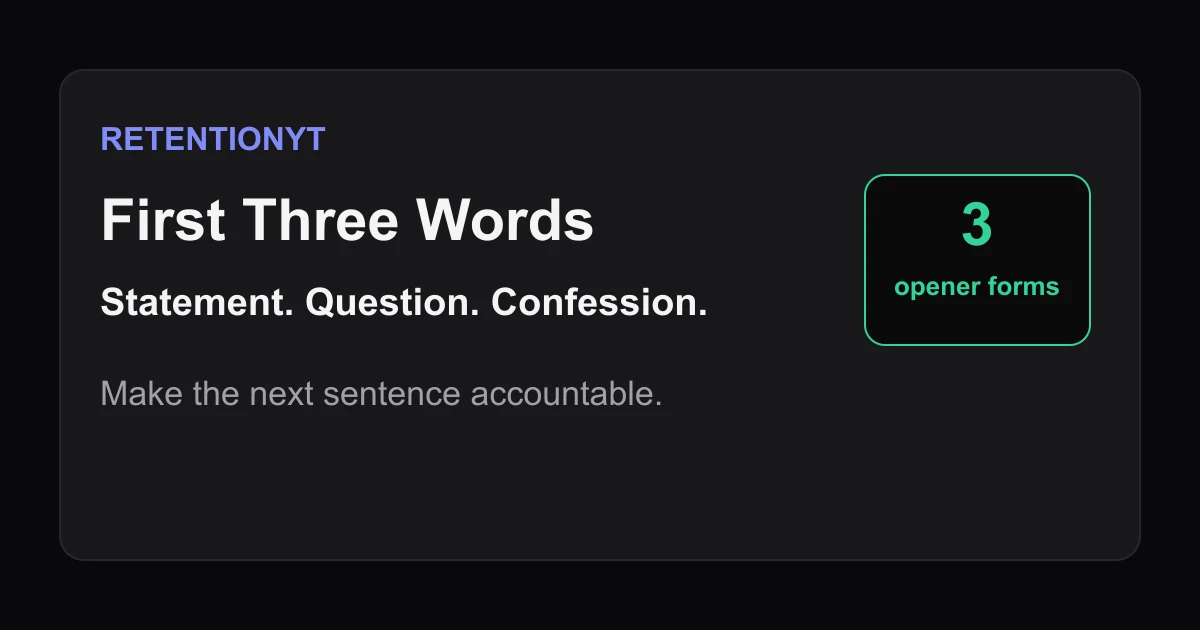
Your first three words set the contract for the next sentence. “This cliff…” names an object, “Have you ever…” asks for attention, and “I was wrong…” signals a confession. Choose from the video’s job, then read the line aloud: a question only earns its place when the next words answer it.

What First Three Words actually is (and what it is not)
“First Three Words” is a drafting constraint, not a magic phrase. Use the opening words to choose a sentence shape, then make the rest specific enough for the viewer to know what the video will prove, answer, or reveal.
A statement points to an object, result, setting, or visible change. A question is answered or narrowed next. A confession carries a mistake, reversal, or personal lesson. Forms can overlap, but the job stays clear.
| Opener form | Use it when | Example first three words | Next obligation |
|---|---|---|---|
| Statement | You can show proof or an object. | This cliff… | Name what the viewer is seeing. |
| Question | You can answer immediately. | Which export keeps… | Give the answer, not a waiting room. |
| Confession | A mistake or change drives the story. | I was wrong… | Show what changed and why. |
| Comment prompt | Only after the payoff. | Tell me which… | Invite context, not a missing answer. |
The brief’s “Have you ever” example is a test, not a law. Ask whether it delays the subject. If “This setting…” or “I was wrong…” is clearer, use it.
Where RetentionYT fits
Manual method works alone. Product shortens the loop. Use RetentionYT to review variants after you write them, but do not require signup to apply the method.
Six examples on one topic
Keep the topic fixed and change only the opener. For a falling graph, try “This cliff starts…”, “Which intro caused…”, or “I was wrong about…”. Three more options are “That first sentence…”, “Can this opening…”, and “I cut the…”. These lines are illustrative, not performance data.
Match the opener to evidence you can show. A statement without proof is vague; a question without an answer stalls; a confession without change becomes a tease.
Why this shows up in YouTube Studio
The locked SOURCE 1 page says the Reach tab helps you understand how viewers find content and snapshots click-through rate, watch time, views, and more. Its path is Studio, Content, selected video, Analytics, then Reach.
The locked SOURCE 2 page says the Content tab summarizes how viewers find, watch, and interact with content. Its “Key moments for audience retention” report shows how moments held attention and can compare the 10 latest videos of similar length.
Mark the first three words, sentence end, and first proof or answer. Compare those checkpoints with your available report. A graph movement tells you where to inspect, not that the opener caused it.

The current YouTube Studio destination may ask you to sign in, and visible reports can depend on your account and interface. Follow labels shown on your review date.
Worked example 1: the failure
Imagine an illustrative tutorial whose opening graph falls sharply. The creator begins, “Have you ever wondered why videos lose viewers?” Then comes a greeting, background, and delayed answer. The first three words ask for attention but do not state the object, cause, or task.
The line fails because you cannot tell what comes next. The question could introduce any topic, and the delay weakens the opener. The timestamps are illustrative, not YouTube data.
| Timestamp | Illustrative edit | What to inspect |
|---|---|---|
| 0:00 | “Have you ever…” question begins. | Does the topic appear immediately? |
| 0:08 | Greeting and channel context. | Illustrative delay before the job. |
| 0:30 | First example begins. | Is the promised object visible yet? |
| 1:00 | Answer is finally stated. | Illustrative lag; inspect your report. |
Not every question fails. The problem is unsupported delay: no answer, object, or proof follows. If you keep the question, resolve it next.
Worked example 2: the fix
Write three versions about the same graph. Statement: “This cliff starts at 0:08, and the first sentence is why.” Question: “Which first sentence caused the cliff? This one did.” Confession: “I was wrong about the intro; the greeting was the problem.” Each route points to the same evidence.
Choose the version your footage can deliver: statement for graph proof, question for an immediately answered choice, or confession for a mistake and correction. “0:08” is illustrative, not a benchmark.

Write the payoff sentence first and place it beside the title, thumbnail, and first visual. Change a statement whose object never appears, a question answered late, or a confession with no change to show.
For a second wording pass, use the YouTube script analyzer after making three variants. It can shorten review time; it cannot choose evidence or validate an unsupported promise.

How to check this in YouTube Studio (step by step)
- Write the payoff sentence first. Name the proof, answer, or change of mind your video will actually deliver.
- Draft one statement, one question, and one confession about the same topic. Keep the evidence constant so you are comparing opening shapes.
- Count the first three words of each version and read every line aloud. Remove a version if its next words do not make the job clear.
- Record the opener, first proof, and first answer as timestamps in your outline. Make the promised object, evidence, or change appear when the line says it will.
- Open the available Analytics and audience-retention report after publishing. Inspect the marked checkpoints; do not claim the first three words alone caused a result.
- Use the Content or Reach context available in your account to understand the report. Follow the visible labels and record the review date.
- Carry one observation into the next upload: make the statement more concrete, answer the question sooner, or attach evidence to the confession.
Keep the method manual: draft, count, read aloud, and compare your reports without signup. Use writing hooks that work after the opener has a clear job.
The trap
The trap is treating a phrase as a promise by itself. “This cliff…” is empty if no cliff appears; “Have you ever…” works only when answered next; “I was wrong…” needs a shown correction. The sentence must pay the first three words’ bill.
The trap
The move
Use the bad version as a draft warning, not as a ban on questions. Replace vague setup with the object, choice, or change you can show. Keep the question only when the next words do the answering.

What to do in the next upload
Put three opener shapes into the outline before you record. The YouTube hook formulas reference can give you additional patterns, while writing hooks that work can help you compress the payoff sentence.
- Write the payoff sentence before the opener.
- Name the video’s job: proof, answer, or change.
- Draft a statement, question, and confession.
- Count the first three words of each version.
- Read each line aloud without performing it.
- Keep a question only if the next words answer it.
- Make a statement point to an object or proof.
- Make a confession show the mistake and change.
- Align the opener with the title, thumbnail, and first visual.
- Mark the opener and payoff timestamps in the outline.
- Review the available Studio report without claiming causality.
- Label illustrative times and examples as illustrative.
Before publishing, ask whether the sentence makes the video’s job clear. If not, rewrite the next seven words before the first three.
Choose the first three words that make the next sentence accountable.
Frequently asked questions
- Should a YouTube hook start with a question?
- Not by default. Start with a question when the next words answer it or frame a clear choice immediately. If the question only asks the viewer to wait, use a statement or confession instead. Read the first sentence aloud, check whether the payoff is visible, and choose the form that matches the video’s job.
- What are strong first three words?
- Strong first three words name the video’s job quickly. A proof tutorial might start with “This cliff at…”; a vlog can start with “I was wrong…”; a comparison can start with “The cheaper one…”. Treat these as working examples, not universal formulas. The remaining sentence must make the promise concrete and honest.
- Is 'have you ever' bad?
- “Have you ever” is not automatically bad, but it often delays the subject. If you use it, finish the question immediately and answer it before the viewer has to guess why it matters. Replace it when a direct statement, object, or confession can state the video’s job with fewer setup words.
- When do I start with a confession?
- Start with a confession when the video is about a mistake, change of mind, failed attempt, or personal lesson. “I was wrong about…” gives the viewer a clear human position, but the next sentence must show what changed. Do not use a confession as theatre; connect it to the evidence or story you will deliver.
- What are good first three words for a tutorial?
- For a tutorial, use a statement that names the object, a question with an immediate answer, or a confession about the failed method. Examples include “This setting breaks…”, “Which export keeps…? The…”, and “I was wrong about…”. These are illustrative lines; adapt them to the exact task and evidence in your upload.
- How do I apply “First Three Words” on my next upload?
- Write the payoff sentence first, then draft a statement, question, and confession about the same topic. Read each aloud, count the first three words, and select the line that makes the video’s job clearest. Put the selected opener beside the title, thumbnail, and first visual so the edit can deliver the promised evidence.
- Where in YouTube Studio do I check “First Three Words”?
- There is no named Studio setting for this phrase. Review the opening in the available audience-retention report, then use the Content or Reach reports for context. Mark the timestamp where the opener ends and inspect what happens next. Record what your account actually shows; a graph is a place to investigate, not proof of causality.
- What is the most common mistake with “First Three Words”?
- The common mistake is choosing a clever first phrase that does not tell the viewer what the video will do. A question can be vague, a statement can be generic, and a confession can promise drama without evidence. Put the topic, object, or change of mind in the next words, then deliver that contract promptly.
Give your next script a second look
Paste a script into RetentionYT for suggestions on your hook, pacing, and structure. Choose the edits that serve your video, then check audience behavior in YouTube Analytics after publishing.
Get retention tips in your inbox
Occasional, practical emails on hooks, pacing, and retention. No spam.
Related posts
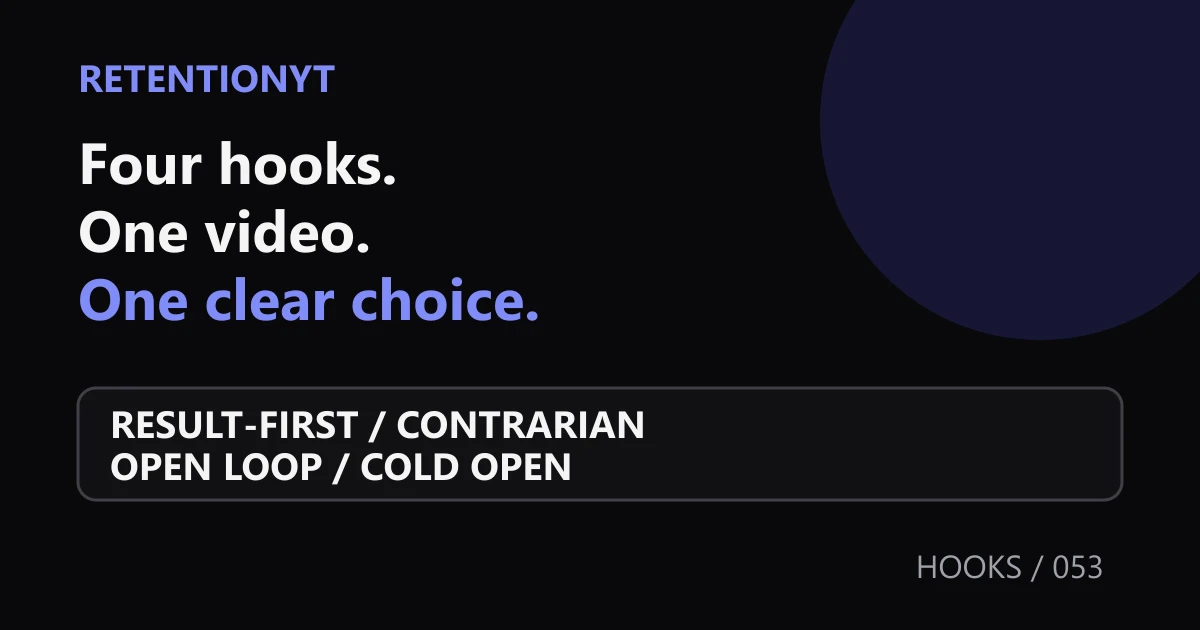
Hook Variation Matrix: Result-First x Contrarian x Open Loop x Cold Open
Test four YouTube hook formulas on the same video idea with one variation matrix. Learn the 3-take test, choose a winner, and read your own retention evidence.
'In This Video' as Retention Poison (and What to Say Instead)
The don't say in this video YouTube hook problem: lead with proof, then orient viewers with eight replacements that keep your first 8 seconds moving.
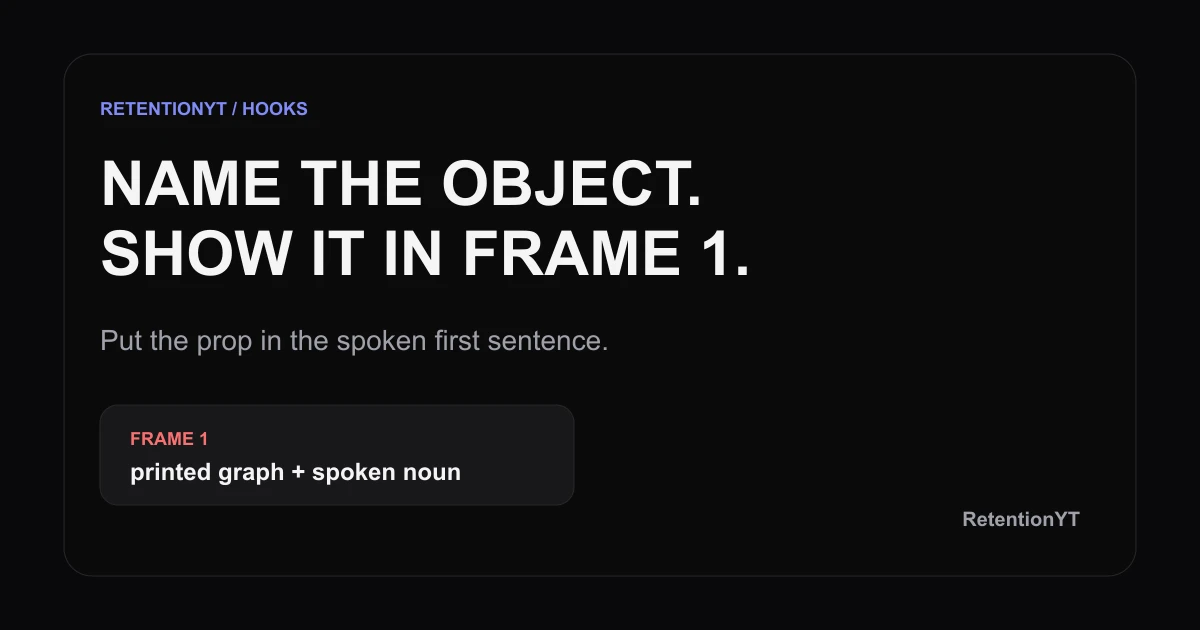
Named Object in the First Frame: How to Write It
Show a named object in frame 1 and say it in sentence 1. Use a graph, timer, or thumbnail to turn an empty desk into a clear YouTube hook today.