Myth-Bust Structure: Claim, Mechanism, Receipt, Rewrite
Build a YouTube myth-busting video script around a claim, mechanism, receipt, and rewrite so your viewer gets evidence, context, and a move to try tomorrow.

10 min readUpdated
In this guide
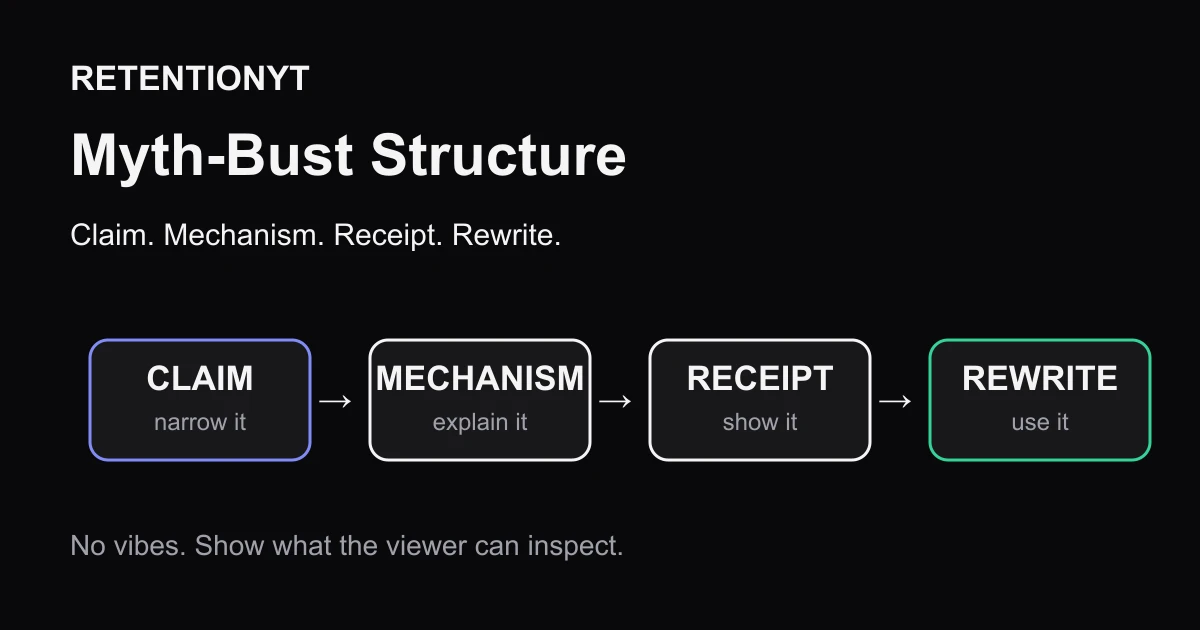
Myth-bust in four beats: state the claim, explain the mechanism, show a receipt from Studio or a primary source, then give the rewrite. A rant has no receipt. A receipt without a rewrite is a lecture. The rewrite is the move your viewer can try tomorrow.
What Myth-Bust Structure actually is (and what it is not)
Myth-Bust Structure is a scripting method for “X is wrong” videos. You name the claim, explain the mechanism underneath it, show a receipt that can be checked, and replace the old behaviour with a better one. “Mechanism” means the process that would make the claim true or false; “receipt” means evidence the viewer can inspect.
The four beats are not a YouTube setting, recommendation signal, or guaranteed retention formula. They are an editorial guardrail. The claim gives the video a question, the mechanism gives it depth, the receipt keeps it honest, and the rewrite gives the viewer a useful next step.
Where RetentionYT fits
Manual method works alone. Product shortens the loop. Use RetentionYT to pressure-test the claim and rewrite before recording.
| Beat | Viewer question | What belongs on the page |
|---|---|---|
| Claim | What is supposedly wrong? | One sentence, narrow enough to test |
| Mechanism | Why might it fail? | The process, not a rant or motive |
| Receipt | What can I inspect? | Studio evidence or a sourced number |
| Rewrite | What should I do instead? | One replacement line, cue, or behaviour |
The 10 in the Stats block is not a performance promise. It comes from SOURCE 2’s description of typical retention comparisons with your 10 latest videos of similar length. The four beats and one-rewrite recommendation are editorial guidance.

Why this shows up in YouTube Studio
A receipt is useful only when you can say what it measures. SOURCE 1 currently opens as “Understand your YouTube video reach.” It says the Reach tab helps you understand how viewers find content and provides a snapshot of click-through rate, watch time, views, and more. That page is about reach, not proof that a myth-bust structure works.
SOURCE 2 says the Content tab gives an overview of how viewers find content, what they watch, and how they interact with it. Its Videos section includes “Key moments for audience retention,” which shows how different moments held viewers’ attention. It also says typical retention can compare your 10 latest videos of similar length SOURCE 2, August 2026.
That is your post-publish receipt path. Mark the timestamp where your receipt appears, the timestamp where the rewrite lands, and the section where the claim is stated. Then inspect the corresponding moments in Studio. The report can show what happened around those moments; it cannot prove that the four beats were the only cause.
SOURCE 1 also describes how viewers found content within YouTube and external sources, including a YouTube search report showing the terms viewers searched SOURCE 1, August 2026. Use that for traffic context, not as proof that a particular audience believes or rejects a myth.

Worked example 1: the failure
Use this illustrative example: “Posting every day is the only way to grow.” It is a broad claim, but the creator treats it like a verdict. The video spends 45 seconds mocking the advice, never explains the mechanism, shows no receipt, and ends with “post better.” The viewer learns what to dislike but not what to change.
The example numbers below are illustrative production values, not YouTube data. The failure is structural: the creator has a claim and an attitude, but no inspectable path from claim to replacement.
| Time | Illustrative draft beat | What fails | Repair target |
|---|---|---|---|
| 0:08 | “Posting every day is the only way to grow.” | Claim is too broad to test. | Narrow the claim to a specific behaviour. |
| 0:30 | “The algorithm hates inconsistent creators.” | Mechanism is asserted, not explained. | Name the process you will examine. |
| 1:00 | No Studio report or sourced number appears. | No receipt. | Show a locked-source metric or actual report. |
| 1:20 | “Just make better videos.” | No usable rewrite. | Give one replacement action for tomorrow. |
This is not a claim that a 45-second opening causes a known percentage drop. It is an illustrative script diagnosis. The viewer’s problem is not that the creator disagrees; it is that the argument cannot be checked and the ending cannot be applied.
Worked example 2: the fix
Rewrite the same idea as a testable four-beat video. CLAIM: “Posting every day is not a complete growth plan.” MECHANISM: “More uploads can create more chances to learn, but frequency alone does not tell you whether viewers understood the promise or stayed through the video.” That mechanism is an editorial explanation, not a claim about a guaranteed algorithm rule.
RECEIPT: show the YouTube Help definition that the Content tab covers how viewers find content, what they watch, and how they interact with it, then show the Key moments for audience retention report after publish. You can also point to SOURCE 2’s sourced “10 latest videos of similar length” typical-retention comparison. REWRITE: “Choose a sustainable upload rhythm, then review the moment where your explanation loses attention and rewrite that beat before the next upload.”
The receipt does not prove that the rewrite will win. It makes the argument inspectable. For the script review step, use the related tool once, before filming, and keep the four beat labels beside the draft.
A myth-bust earns trust when the viewer can inspect the receipt and leave with a replacement.

Use related post 1 for the longer scripting workflow and related post 2 for a timed outline. Those links support planning, not a guaranteed outcome.
How to check this in YouTube Studio (step by step)
- Write the claim in one sentence. Remove words such as “always,” “never,” or “only” unless your receipt can support that scope.
- Write the mechanism in one sentence. Explain the process that could make the claim fail; do not substitute an insult for an explanation.
- Choose the receipt before recording. It must be a real Studio view you can show after publish or a sourced number/sentence from the locked Help pages.
- Put the receipt timestamp in the outline. If the evidence arrives after the rewrite, the viewer may remember the verdict but miss the proof.
- Draft the rewrite as one concrete behaviour: a line to say, a screen cue to add, a timing change, or a report to inspect.
- Record the claim and mechanism with the same scope. If the claim says “only,” do not quietly soften it to “often” when you reach the receipt.
- Open YouTube Studio after publish. SOURCE 2’s computer instructions say to open Analytics and select Content; use the available Key moments for audience retention report.
- Compare the claim, receipt, and rewrite timestamps with the report. SOURCE 2 says typical retention can compare your 10 latest videos of similar length; treat that as context, not a benchmark you must hit.
- Use SOURCE 1’s Reach reports when you need traffic context. It describes how viewers found content within YouTube and external sources; do not turn traffic source into a belief test.
- Rewrite the next upload from the observation. Keep the original receipt, state what it can support, and record what remains unknown.
The critical habit is separating evidence from interpretation. “The report shows a dip here” is different from “this sentence caused the dip.” The first is a receipt; the second is a hypothesis you can test by changing the next script.

The trap
The trap is treating confidence as the receipt. A creator says “everyone knows this is wrong,” adds a dramatic zoom, and calls the viewer’s disagreement proof. That is still a rant. It may sound decisive, but the viewer cannot inspect the number, report, or mechanism.
The trap
The move
Watch for three failure signals. The receipt is a screenshot with no explanation of what to read. The mechanism changes halfway through the video. The rewrite says “be consistent” but does not tell the viewer what to change in the next draft.
Do not use a made-up channel screenshot or a fabricated result to make the myth feel settled. If you cannot show a real Studio view, use a locked-source sentence or number and label any mock timing diagram illustrative. A clean limitation is stronger than a fake receipt.

What to do in the next upload
- Write the claim before the hook.
- Narrow “always,” “never,” or “only” before filming.
- Explain the mechanism in plain language.
- Choose a sourced receipt or real Studio report.
- Put the receipt timestamp in the outline.
- Say what the receipt proves and what it cannot prove.
- Write one replacement behaviour for tomorrow.
- Keep the same claim scope through the edit.
- Check Content and available retention reports after publish.
- Log the next rewrite as a test, not a guaranteed result.
The method is deliberately demanding: claim, mechanism, receipt, rewrite. If one beat is missing, change the claim or change the video. Your viewer does not need another confident takedown; they need evidence they can inspect and a better move they can use.
Frequently asked questions
- How do I structure a myth-busting video?
- Use four beats: state the claim, explain the mechanism that could make it wrong, show a receipt from Studio or a locked primary source, then give the replacement behaviour. Keep each beat tied to the same viewer problem. The structure is an editorial method, not a YouTube guarantee, so test the finished video against your own reports.
- Do I need data?
- You need evidence, but it does not have to be a giant dataset. Use a sourced number, a relevant Studio report, or a clearly labelled illustrative comparison. Name what the receipt proves and what it does not prove. If you have no receipt, turn the point into a question or cut the claim rather than presenting confidence as evidence.
- Should I name other YouTubers?
- Usually no. Name a creator only when the example is necessary, accurately sourced, and useful to the viewer’s rewrite. A myth-bust should attack the claim or mechanism, not a person. If your point works with a neutral example, use that instead; it lowers distraction and avoids turning a structural lesson into a personality dispute.
- Where does the rewrite go?
- Put the rewrite immediately after the receipt, while the viewer still remembers the mechanism. Show the original line, identify the weak move, then write the replacement sentence or behaviour. The final beat should be usable tomorrow: a new hook, a changed edit cue, a tighter test, or a specific Studio check.
- Can this open with the myth as a cold open?
- Yes, as an editorial choice. Open with the myth in one clean sentence, then signal that the mechanism and receipt are coming. Do not leave the claim hanging for the whole video. Give the viewer a reason to stay, show the evidence at a planned timestamp, and close with the replacement behaviour.
- How do I apply “Myth-Bust Structure” on my next upload?
- Write four lines before the script: CLAIM, MECHANISM, RECEIPT, REWRITE. Add a timestamp to the receipt, record the exact source or Studio report you will show, and draft the replacement behaviour before filming. In the edit, make the receipt readable, then let the rewrite land as the final practical move.
- Where in YouTube Studio do I check “Myth-Bust Structure”?
- The phrase is an editorial method, not a native Studio report. For a published video, use YouTube Studio’s Analytics and Content areas, then inspect the available Key moments for audience retention report. YouTube Help says that report shows how different moments held viewers and can compare typical retention with 10 recent videos of similar length.
- What is the most common mistake with “Myth-Bust Structure”?
- The common mistake is stopping at the takedown. A creator says the myth is wrong, shows no receipt, and gives the viewer no replacement. Keep the four beats visible in the outline: claim, mechanism, receipt, rewrite. If the evidence is weak, narrow the claim; if the rewrite is vague, make it a line or behaviour the viewer can use tomorrow.
Give your next script a second look
Paste a script into RetentionYT for suggestions on your hook, pacing, and structure. Choose the edits that serve your video, then check audience behavior in YouTube Analytics after publishing.
Get retention tips in your inbox
Occasional, practical emails on hooks, pacing, and retention. No spam.
Related posts
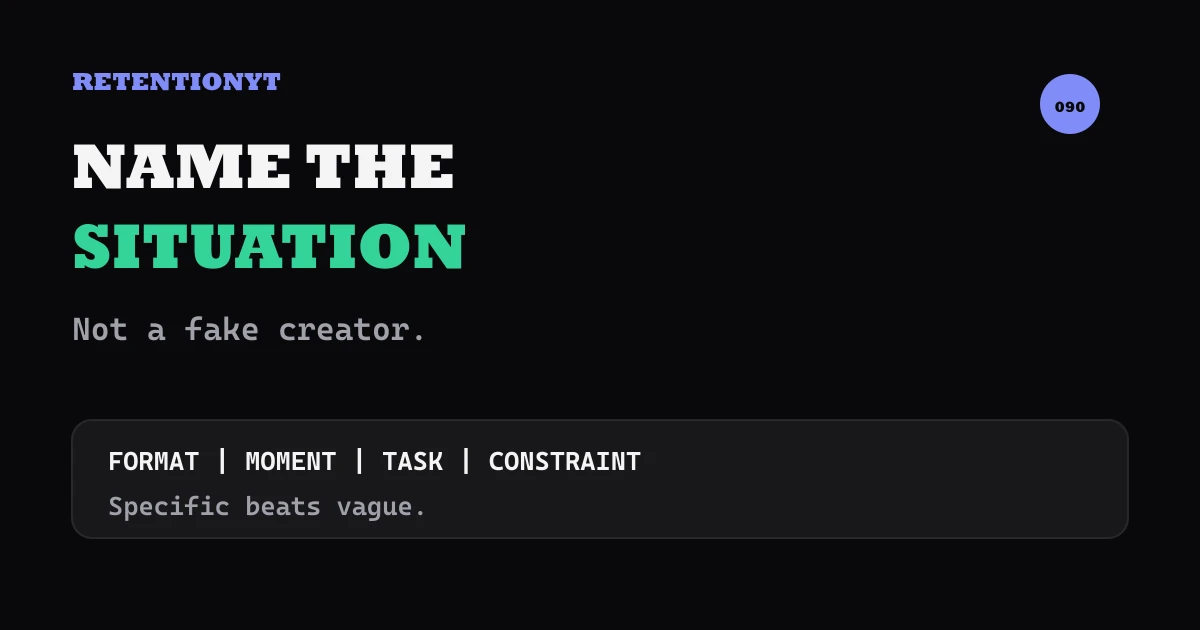
Character / Named Example in Tutorials
Use named situations, not invented creators, in YouTube tutorials: four honest rewrites that make examples specific, useful, and safe for retention.
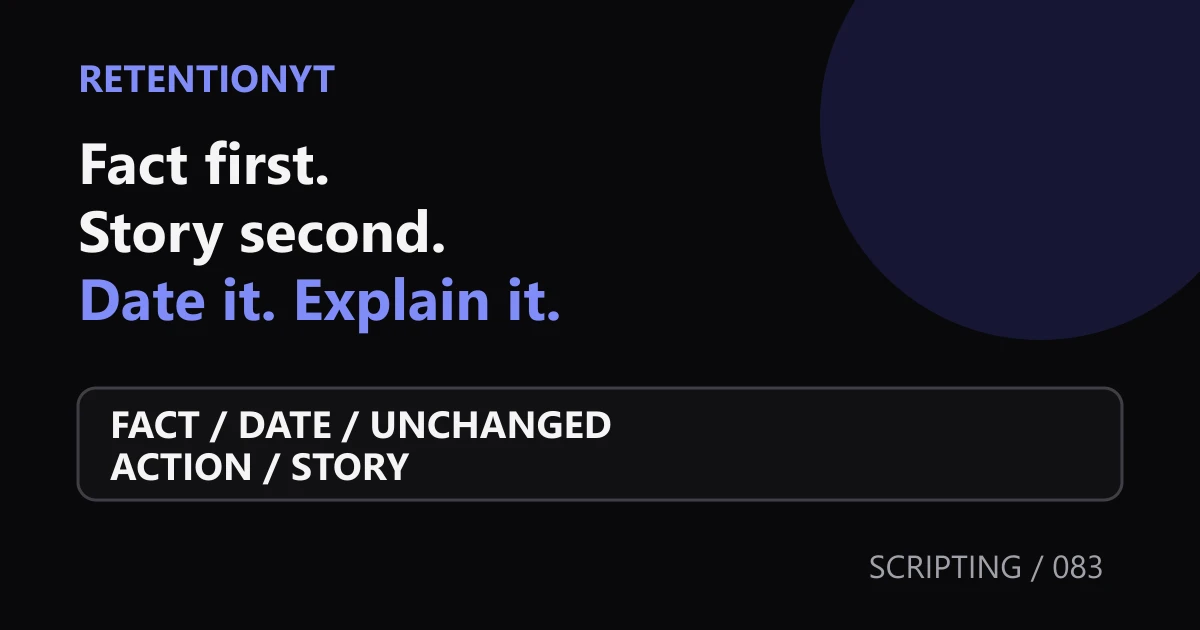
News/Explainer: Timestamped Facts vs Story
Script a YouTube news explainer with the fact and date first, then what did not change and what to do. Use the story only after the viewer has the answer.
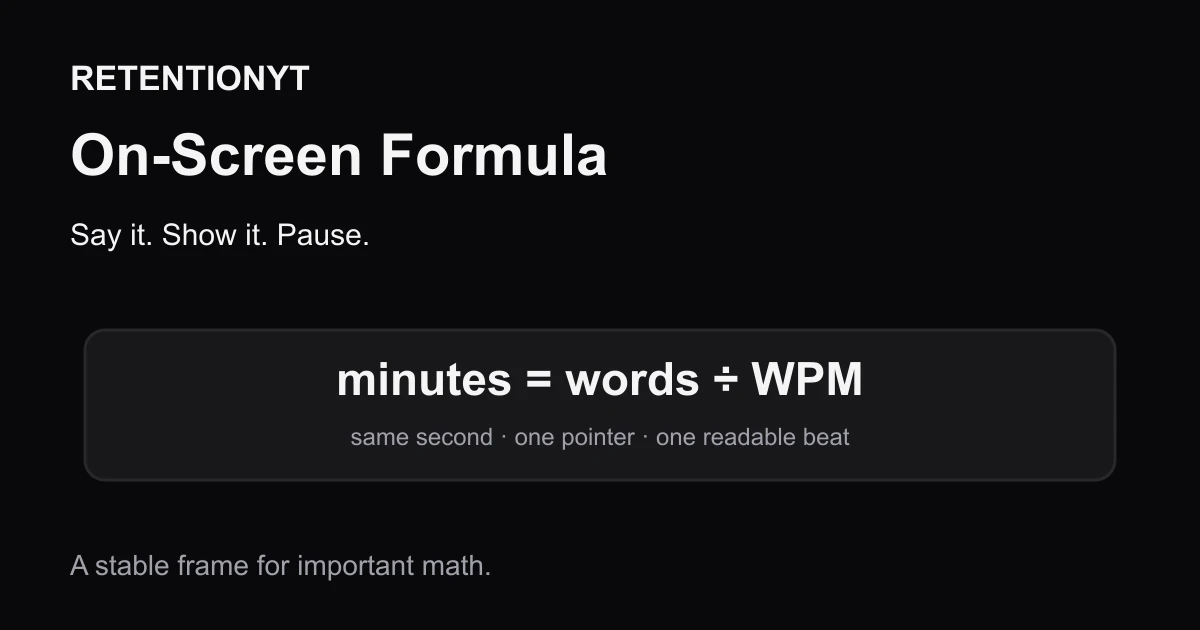
On-Screen Formula Beats Spoken Math
Put every important formula on screen as you say it. This YouTube tutorial method makes math pauseable, searchable, and easier to follow without slowing your spoken delivery.