Proof Before Promise vs Promise Before Proof
Show the result or name the promise first? Use a proof object, niche skepticism, and your first 8 seconds to choose the right YouTube hook order.

10 min readUpdated
In this guide
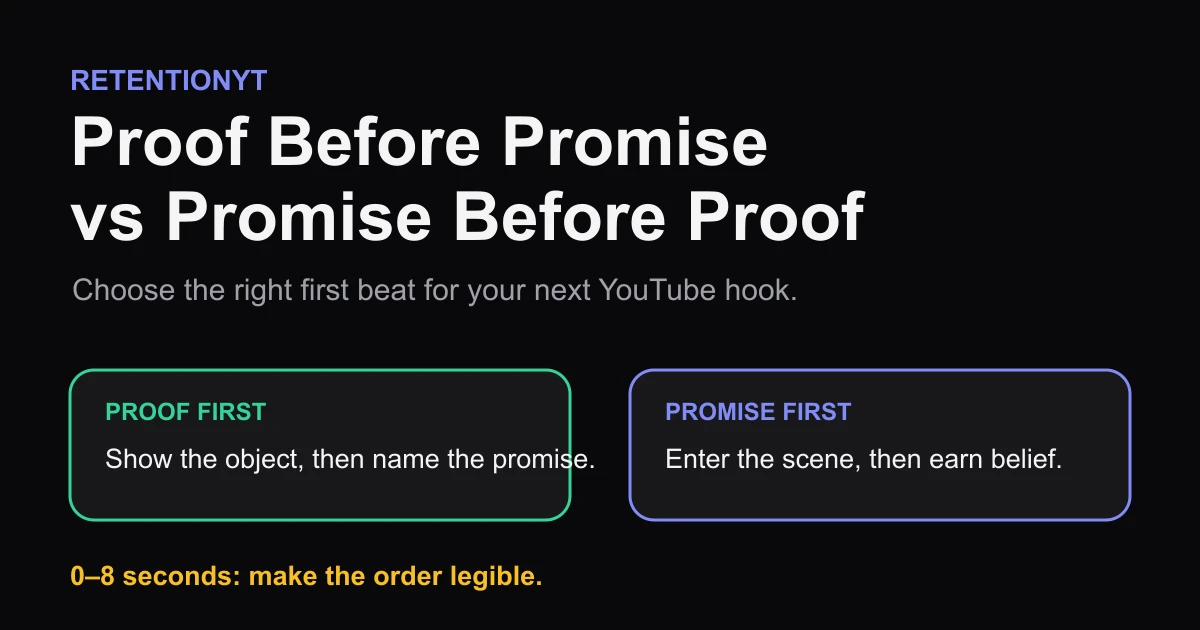
If your viewer is skeptical, show the object before you explain the promise. If the reveal itself is the entertainment, open on the promise or scene. You have about 8 seconds to make the order legible, so choose from the viewer’s doubt, not from a universal hook template right now.

What Proof Before Promise vs Promise Before Proof actually is (and what it is not)
Proof Before Promise puts a concrete object in the first beat, then names what that object proves. Use a finished build, before-and-after frame, failed take, or relevant number. Promise Before Proof states the outcome or enters the scene first, then gives evidence before the opening runs out of room.
This is a rule of thumb, not a YouTube setting. A promise creates a reason to continue; proof reduces doubt. Your niche, title, thumbnail, and available evidence decide which job must happen first. A proof object is evidence a viewer can see or hear and connect to the claim. A logo, credential, or confident face is not enough.
| Opening order | First beat | Best fit | Main risk |
|---|---|---|---|
| Proof Before Promise | Show an object or result | Skeptical finance, health, and AI-tool topics | Object needs a clear promise |
| Promise Before Proof | State outcome or enter a scene | Entertainment, story, and reveal videos | Promise sounds like an ad |
| Hybrid | Small proof cue, then promise and path | Topics with doubt and drama | Too many rushed beats |
For finance, health, and AI tools, treat “show the object first” as a rule of thumb, not a guarantee. A chart you explain, a filing excerpt, a calculation, or a visible change can answer doubt. A screenshot you never unpack can create more doubt.
Where RetentionYT fits
Manual method works alone. Product shortens the loop. Link RetentionYT once when you want a second read on the script before recording.
Why this shows up in YouTube Studio
Your decision is made in the edit, but its consequence becomes visible in Analytics. In August 2026, the locked Source 2 page says the Content tab gives an overview of how viewers find and interact with content. Under Videos, it describes Key moments for audience retention as a report showing how different moments held attention, with typical retention available for comparison with 10 latest videos of similar length.
That source does not endorse either order. Use the report to inspect the opening, then ask whether the promise was unclear, the proof confusing, or the opening mismatched the title and thumbnail.
The locked Source 1 currently opens as YouTube’s Reach page, not the brief’s supplied Audience retention page. It describes Reach as a place to understand how viewers find content and lists metrics including click-through rate, watch time, and views. It does not support a claim about a particular retention curve or an 8-second benchmark, so this article does not attribute those claims to Source 1.
The chart is therefore a reading aid, not platform data. It shows two illustrative shapes you might inspect after publishing. Your own graph is the evidence for your own upload.

Worked example 1: the failure
Take a finance explainer titled “Why this fee keeps eating your return.” The creator opens with a talking head, says the channel name, explains that fees matter, and promises to reveal the answer later. The thumbnail shows a red slice removed from a pie chart, but the first frame shows neither the chart nor the fee.
The opening asks the viewer to trust a promise before showing the object that makes it credible. The numbers below are illustrative, not YouTube data.
| Time | What the viewer sees | Diagnostic |
|---|---|---|
| 0:00–0:03 | Talking head and channel sting | Illustrative: topic arrives after the first beat |
| 0:03–0:08 | Unrelated setup frame | Illustrative: promise is delayed and proof is absent |
| 0:08–0:30 | General background | Illustrative: title-thumbnail contract is unresolved |
| 0:30–end | Fee chart appears | Illustrative: useful explanation begins late |
The fix is simple: delete the channel history and move the fee calculation into the first frame.
Worked example 2: the fix
Keep the title and topic, but open on the fee calculation. The first frame shows the red slice and the formula the video will explain. The voice says: “This fee is the reason your return looks higher than it is. I’ll mark it on this calculation, then show you the one assumption that changes the answer.”
The object is visible, the promise is concrete, and the viewer has a path. Those numbers and the script are illustrative, not investment advice or a claim about a real return. If the scene is more compelling than the chart, write a promise-first version and compare both aloud before recording.

A finance video does not always need a chart at time zero. In an investigation, the strongest proof may be a confrontation or document. Ask what the viewer doubts first, then choose the smallest honest object or scene that answers it.

How to check this in YouTube Studio (step by step)
- Write two versions of the first eight seconds. Version A puts the proof object first. Version B puts the promise or scene first. Keep the topic, title, and payoff the same.
- Read both aloud at real performance speed. Remove the greeting, channel history, and any sentence that only announces that a video is beginning.
- Open the video’s Analytics area in YouTube Studio after publishing. The current source guidance places the Content tab at channel level and describes Key moments for audience retention under Videos. Labels can change, so follow the interface you see.
- Inspect the first visible change in the curve. If the promise is unclear, shorten the setup. If the proof is confusing, enlarge it, simplify it, or match it more closely to the title.
- Compare the opening with the title and thumbnail. A title about a fee cannot begin with unrelated context; a dramatic object the body never explains is also a broken contract.
- Write one observable reason for the first meaningful drop: “the chart arrived after context,” “the scene was confusing,” or “the promise was larger than the payoff.” Do not write “the algorithm hated it.”
- Save both scripts and the observation beside the upload. On the next topic, change one opening variable so you learn from the comparison instead of collecting hook superstitions.
The locked source pages explain the reports; they do not turn an illustrative curve into a benchmark.
The trap
The trap is treating proof and promise as rival ideologies. A promise tells the viewer what is worth staying for; proof tells the viewer why the claim deserves attention. The wrong order is the order that leaves the viewer doing the most interpretation before the video becomes specific.
A red chart can look urgent, but it still needs a label, number, object name, or spoken explanation. Motion is not proof of relevance. Make the visual legible when the viewer sees it on a small screen with the sound briefly off.
The most common production error is an overloaded hybrid: a result flash, large promise, disclaimer, three chapter previews, and subscription request in eight seconds. Choose one dominant beat and let the next beat reinforce it.
The trap
The move
If your topic is skeptical, start with what a reasonable viewer would ask to see. If it is a story, start with the moment that makes the viewer ask what happened.
What to do in the next upload
Use this checklist before you record. It is mechanical enough to run with your script and Studio notes beside you.
- Write the payoff in one sentence before writing the greeting.
- Name the viewer’s biggest doubt about the claim.
- Choose one proof object, scene, number, or before-and-after frame.
- Draft a proof-first version and a promise-first version.
- Keep the topic, title, and payoff constant between versions.
- Read both versions aloud at real performance speed.
- Remove greetings and meta-commentary from the first 8 seconds.
- Make the proof object readable without colour alone.
- Check that the body explains the object or fulfils the promise.
- Mark example numbers as illustrative when they are not source data.
- After publishing, inspect the opening in the retention report.
- Write one observable reason for the first meaningful drop.
For more options, read 9 YouTube Hook Formulas and How to Write a YouTube Hook That Actually Works. If you want a pre-recording script check, use the YouTube Script Analyzer. They are options, not commandments: the right order comes from the doubt your viewer brings to this video.

The first beat is not a personality test; it is a decision about what your viewer needs to believe next.
Start with proof when doubt is the barrier. Start with the promise when the scene is the reason to care. Write both, remove the warm-up, and let the next upload tell you whether the opening kept the contract.
Frequently asked questions
- Should I show the result first?
- Show the result first when the viewer may doubt the claim or when the result is easy to understand in one frame. A screenshot, finished object, failed take, or concrete number can act as a proof object before you explain the mechanism. If the reveal is the entertainment, hold it back and use a promise-first cold open instead.
- When does a cold open beat a result-first hook?
- A cold open beats a result-first hook when the strongest evidence is a scene, reaction, conflict, or surprise that loses energy when explained. Start inside that moment, give the viewer a reason to ask what happened, then add the promise before the first eight seconds end. Do not prepend a greeting or biography.
- What is a proof object?
- A proof object is a visible or audible piece of evidence that makes your opening claim concrete. It can be the finished build, a before-and-after frame, a failed take, a receipt, a chart you made, or a measured result. It is not a logo, credential, or vague statement that you know what you are doing.
- Do finance channels need proof first?
- Often, yes, as a rule of thumb, because a finance viewer may question a bold claim before investing attention. Lead with the relevant chart, filing excerpt, calculation, or outcome you can actually explain. Do not imply guaranteed returns, hide uncertainty, or use an illustrative number as if it were a trading result.
- Can I do both in 8 seconds?
- Yes. Use a proof object in the first beat, state the promise immediately after it, and name the path before the eighth second. For example: show the failed opening, say the rewrite held the idea together, then promise the three edits you will make. The sequence matters less than making each beat readable.
- How do I apply “Proof Before Promise vs Promise Before Proof” on my next upload?
- Write two eight-second openings for the same topic. Version A starts with the object or result; Version B starts inside the promise or scene. Read both aloud, remove any greeting, and choose the version whose first frame answers the viewer’s biggest doubt without giving away the full mechanism. Check the published curve later.
- Where in YouTube Studio do I check “Proof Before Promise vs Promise Before Proof”?
- Use the video’s Analytics area to inspect the audience-retention report after the upload, then compare the opening shape with the promise you made. YouTube’s current content-performance guidance places Key moments for audience retention under the Videos area and also describes typical retention comparisons. The exact screen can change, so follow the live labels.
- What is the most common mistake with “Proof Before Promise vs Promise Before Proof”?
- The common mistake is showing a dramatic proof object that the video never explains, or making a large promise before the viewer sees why it is credible. In both cases the opening creates a contract the body cannot cash. Match the object, promise, title, and payoff, then cut any context that delays that match.
Give your next script a second look
Paste a script into RetentionYT for suggestions on your hook, pacing, and structure. Choose the edits that serve your video, then check audience behavior in YouTube Analytics after publishing.
Get retention tips in your inbox
Occasional, practical emails on hooks, pacing, and retention. No spam.
Related posts
Specificity: Why '$2,847' Beats 'a Lot of Money' in Second 3
Use specific numbers in your YouTube hook to make second 3 concrete. Learn when to use exact figures, honest rounding, and real video evidence without fake precision.
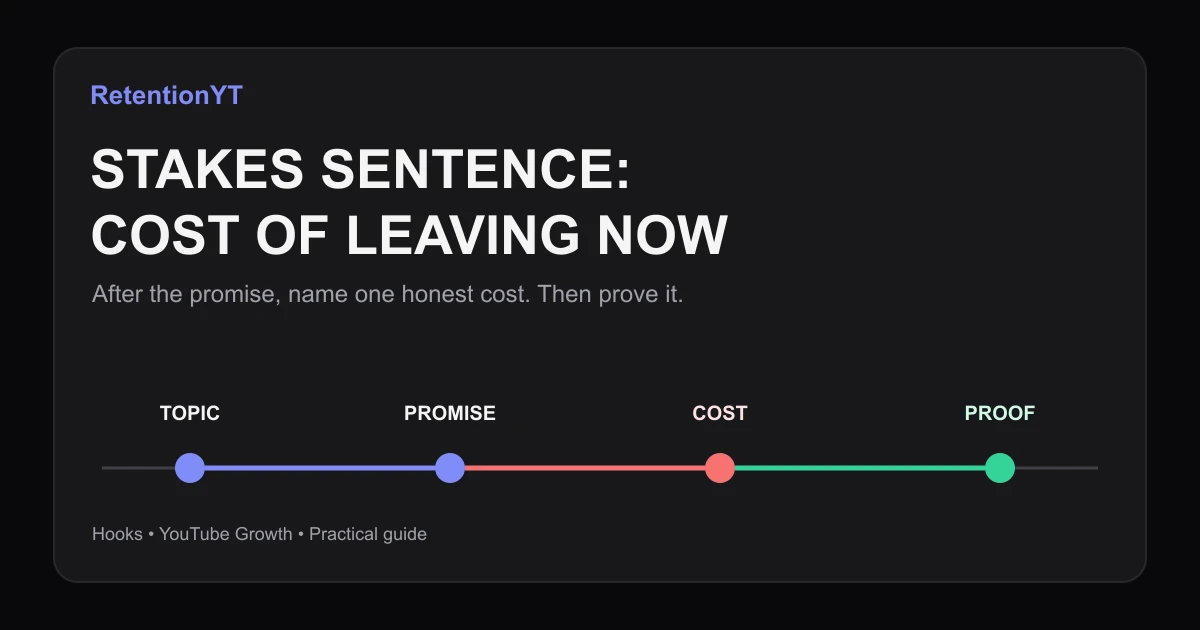
Stakes Sentence: Cost of Leaving Now
Use the YouTube hook stakes what you lose if you leave framework to turn a topic label into a specific cost, with eight practical examples and a Studio check.
Steelman the Viewer: A Skepticism Beat That Holds Minute 1
Address viewer skepticism in first minute YouTube with a spoken objection, a concrete Studio check, and a repeatable beat for finance, tech, and AI creators.