Steelman the Viewer: A Skepticism Beat That Holds Minute 1
Address viewer skepticism in first minute YouTube with a spoken objection, a concrete Studio check, and a repeatable beat for finance, tech, and AI creators.

10 min readUpdated
In this guide
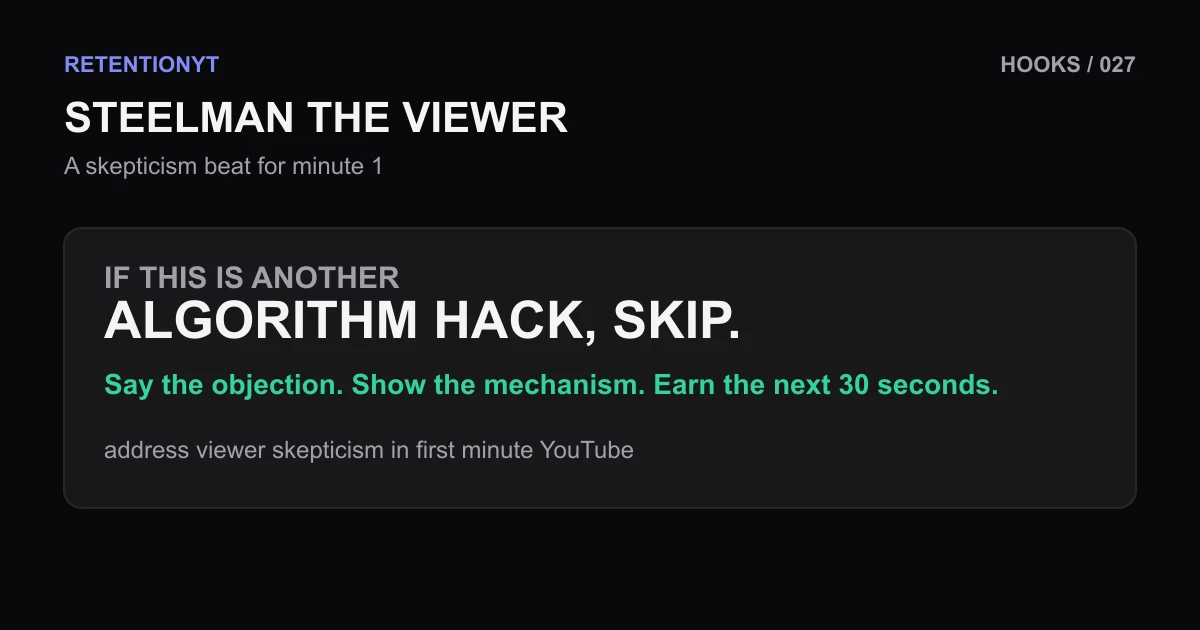
Say the rude thought out loud before the viewer has to type it: “If this is another algorithm hack, skip it.” Then give them the mechanism you will inspect, not a bigger promise. In 2026, a one-sentence objection followed by a visible check is a faster trust signal than pretending every viewer arrives ready to believe you.
What Steelman the Viewer actually is (and what it is not)
Steelman the Viewer is a spoken beat that presents the strongest reasonable objection to your video and answers it with a concrete method. “Steelman” means improving an opposing argument before responding to it, rather than knocking down a silly version. Here, the opposing argument is the viewer’s private reason to leave: this may be recycled advice, a sales pitch, or a result that cannot survive inspection.
The beat has three parts. First, say the objection in the viewer’s language. Second, name the test, source, demonstration, or limitation that will answer it. Third, move into that test quickly. The rhythm is objection, mechanism, evidence. If you only say “I know this sounds too good to be true,” you have named a mood, not a reason to stay.
| The viewer hears | Your job in the next sentence |
|---|---|
| “This may be another algorithm hack.” | Name the Studio signal, example, or limitation you will inspect. |
| “This may be sponsored praise.” | State the feature, constraint, or failure case you will test. |
| “This may be a stock-picking shortcut.” | Point to the filing, assumptions, downside case, or decision rule. |
| “This may be AI hype.” | Show the prompt, output, comparison, or boundary that can be checked. |

Where RetentionYT fits
Manual method works alone. Product shortens the loop. Try RetentionYT when you want a faster script review, then keep the editorial decision in your hands.
The last stat is intentional. You can use the method without signing up for a tool. Treat every numeric curve here as illustrative unless YouTube Help supports it.
Why this shows up in YouTube Studio
You do not check for a button labelled Steelman the Viewer. You check the viewer behavior that your opening is trying to influence. YouTube Help describes the Reach workflow as opening YouTube Studio, selecting Content, selecting the video, selecting Analytics, and selecting Reach. The same page lists reach-related reports and metrics such as impressions, click-through rate, views, average view duration, and watch time. Read the current instructions at SOURCE 1 before treating a menu label as permanent.
On August 24, 2026, YouTube’s content-performance page states that views are counted when a video starts to play across Shorts, long-form videos, and live streams. That is a product-definition update, not proof that a steelman beat works. Use it to interpret what the view metric means on the day you check it, and do not turn the date into a retention benchmark. SOURCE 2
After writing the question your first minute must answer, check YouTube Studio. Compare similar openings on your own channel as a rule of thumb, not as a YouTube-published experiment.
Worked example 1: the failure
Imagine a finance creator opening a video about reading a company’s cash flow. The first draft says, “You have probably heard a lot of people talk about finding the next ten-bagger, and today we are going to look at a few important numbers before I share my thoughts.” The tone is calm, but the viewer’s strongest objection remains unanswered: is this another confident shortcut that hides the downside?
The draft delays the method. “Important numbers” could mean anything, with no observable test or stated limitation.
The failure is not positivity. The opening makes the viewer supply the skepticism alone, then answers “show me what you will check” with biography and setup.
| Illustrative first-minute checkpoint | Draft retention read | What the creator should ask |
|---|---|---|
| 0:00 | 100% starting point, illustrative | What promise did the click create? |
| 0:08 | 70%, illustrative | Has the method appeared yet? |
| 0:30 | 50%, illustrative | Did the viewer see a reason to continue? |
| End | 30%, illustrative | Did the opening earn the later explanation? |
All table values are illustrative, not YouTube data.
Over-steelmanning is also a failure: a catalogue of fake gurus still does not name the filing or downside case to be checked.
Compress the repair to one objection, one visible method, and one boundary. Your first 8 seconds only need to make the next action legible.
Worked example 2: the fix
Rewrite the finance opening as: “If this is another stock-picking shortcut, skip it. We are checking the filing, the cash-flow trend, and the downside case before calling anything attractive.” The first sentence gives the viewer permission to leave, which makes it sound less like pressure. The second sentence identifies a method with visible work and an explicit limit.
Now compare a tech review. The objection might be, “If this is sponsored praise, skip it.” The mechanism is not “I am unbiased”; that is a claim about character. The mechanism is “we will test the feature that changes the workflow, compare it with the older version, and show where it fails.” The viewer can understand what evidence will appear.
For an AI creator, use a different objection: “If this is another AI demo that only works with a perfect prompt, skip it. I will show the prompt, one messy input, and the failure boundary before the polished result.” The point is not to sound anti-AI. The point is to remove the easiest reason to dismiss the demonstration.
These examples share a structure but not a script. Finance needs assumptions and downside. Tech needs a feature test and a comparison. AI needs the input, output, and boundary. The mechanism should sound native to the niche because the viewer’s skepticism is native to the niche.

Deliver the rewrite without rushing. If the objection is longer than the mechanism, you may be performing skepticism. If the mechanism cannot be shown or calculated, you are still asking for trust.

How to check this in YouTube Studio (step by step)
Start before you publish. Write the exact objection in one sentence, then write the mechanism in one sentence. Put both beside the title and thumbnail. You are checking alignment, not trying to predict a magic retention number.
- Open the script and underline the first concrete promise. If it takes more than one sentence to find, rewrite the opening before recording.
- Write the strongest reasonable objection a viewer in your niche could have. Avoid insults, caricatures, and objections that your video cannot answer.
- Add the mechanism you will actually show: a screen, filing, comparison, prompt, calculation, test, or failure case.
- Record the opening with the objection inside minute 1. Use the same delivery you intend to publish, including pauses and visuals.
- After publishing, open Studio, select Content, choose the video, select Analytics, and choose Reach. The exact menu can change; use the current YouTube Help path as your reference.
- Inspect the early part of the report and note what happened around the objection and the first proof. Do not call an illustrative comparison a causal result.
- Write one sentence about the next test. For example: “Next upload, I will move the visible comparison before the background explanation.”
- Compare the next upload against your own prior opening with a similar audience and promise. Record the date, edit, and reason for the comparison.
You can also run the draft through the related tool once, but the manual method is enough. The tool can shorten the review loop; it cannot replace your judgment about whether the objection is fair or whether the proof is real.

For adjacent craft, compare YouTube hook formulas and writing hooks that work. This article’s distinct beat is the spoken objection followed by a mechanism.
The trap
The trap is confusing “I understand your skepticism” with “I have shown you how I will test the claim.” Tone alone does not make a contract.
Do not hide proof behind a long preamble about credentials or channel history. That is a delayed answer wearing skeptical language.
The trap
The move

The colours in the figure are reinforcement, not the only signal. The words BAD and GOOD carry the distinction so the meaning survives a grayscale or low-contrast view. Apply the same principle to your script: do not make the viewer infer the important difference from tone alone.
What to do in the next upload
Use this checklist while your next script is open. It is deliberately small: the beat should remove friction, not become a second production system.
- Write the viewer’s strongest reasonable objection as one sentence.
- Keep the objection about the claim, risk, or wasted time, not a rival creator.
- Follow it with one concrete mechanism you can show.
- Put the beat after the first promise and before background expands.
- Make the title, thumbnail, objection, and mechanism describe the same job.
- Label numbers as illustrative when they are not from a locked source.
- Record the opening at the delivery pace you will publish.
- Check the relevant Studio report after publishing and date your note.
- Compare against a similar prior opening, not a stranger’s benchmark.
- Rewrite the next opening from the evidence you actually observed.
Keep the manual version even when you use a tool. You should be able to write the objection, choose proof, and check the result without an account. The editorial decision remains yours.
Do not make skepticism the channel’s personality. Use it as an early signal: say the thought, show the test, admit the boundary, and get to work.
Frequently asked questions
- How do I handle skeptical viewers?
- Say the strongest reasonable objection before you ask for trust. For example, say, “If this is another algorithm hack, skip it.” Then name the specific proof you will show and show it quickly. You are not apologizing for the topic; you are reducing the viewer’s cost of finding out whether your promise is real.
- Should I acknowledge hype in my niche?
- Yes, when the hype is part of the viewer’s context. Name it in one sentence, then separate your claim from the crowd with a concrete test, example, or limitation. Acknowledging hype works when it moves toward evidence. It fails when it becomes a long disclaimer that delays the useful part of the video.
- Won't this sound negative?
- It can sound negative if you attack other creators or repeat the objection without resolving it. Keep the focus on the viewer’s risk: wasted time, vague advice, or a promise that does not match the video. State the concern plainly, then move immediately to what you will check and what would count as a useful result.
- When in the video do I steelman?
- Use the beat in minute 1, usually after the first clear promise and before your explanation expands. The viewer should hear the objection early enough to affect the decision to stay, but not before they know what your video is testing. A practical target is the first 8 to 30 seconds, adjusted to your opening.
- Examples for finance and tech?
- A finance creator can say, “If this is another stock-picking shortcut, skip it; we are checking the filing and the downside case.” A tech reviewer can say, “If this is sponsored praise, skip it; we will test the feature that matters.” In both cases, the objection is followed by a visible method, not louder confidence.
- How do I apply “Steelman the Viewer” on my next upload?
- Write the most reasonable sentence a doubtful viewer could say, without making it absurd. Put that sentence beside your title and thumbnail, then answer it with one observable test. Record two versions: one that says the objection and one that does not. Review the opening retention curve afterward, but label any comparison as your own channel evidence.
- Where in YouTube Studio do I check “Steelman the Viewer”?
- There is no Studio setting named Steelman the Viewer. Check the result through the video’s analytics: YouTube Help describes opening Studio, selecting Content, choosing the video, selecting Analytics, and then selecting Reach for reach reports. Use that path to inspect the opening behavior you are trying to improve, rather than searching for a named feature.
- What is the most common mistake with “Steelman the Viewer”?
- The most common mistake is turning the objection into a performance of skepticism instead of a useful test. Creators say, “You may think this is clickbait,” then continue with the same vague promise. Steelman the concern, state the evidence you will use, and pay it off. If the objection does not change the next sentence, cut it.
Give your next script a second look
Paste a script into RetentionYT for suggestions on your hook, pacing, and structure. Choose the edits that serve your video, then check audience behavior in YouTube Analytics after publishing.
Get retention tips in your inbox
Occasional, practical emails on hooks, pacing, and retention. No spam.
Related posts
Table-Read Your Hook Out Loud at 0.75x and 1.25x
Read your YouTube hook out loud at 0.75x and 1.25x to expose extra clauses, missing breaths, and weak wording before the camera starts rolling.
The 3-Take Hook Test: Pick an Opening Without Publishing
Learn how to test YouTube hooks before uploading with three 15-second phone takes, one cold viewer, and a simple question that picks the opening worth filming.
Thumbnail Text vs First Sentence Alignment Checklist
Use this thumbnail text and first sentence alignment checklist before every YouTube upload so the promise on the image matches the receipt in your first 8 seconds.