The Retention-First Outline vs the SEO-First Outline
Build a YouTube outline for search vs retention without choosing one audience: compare SEO-first, retention-first, and a hybrid that names the query inside the first 8 seconds.

10 min readUpdated
In this guide
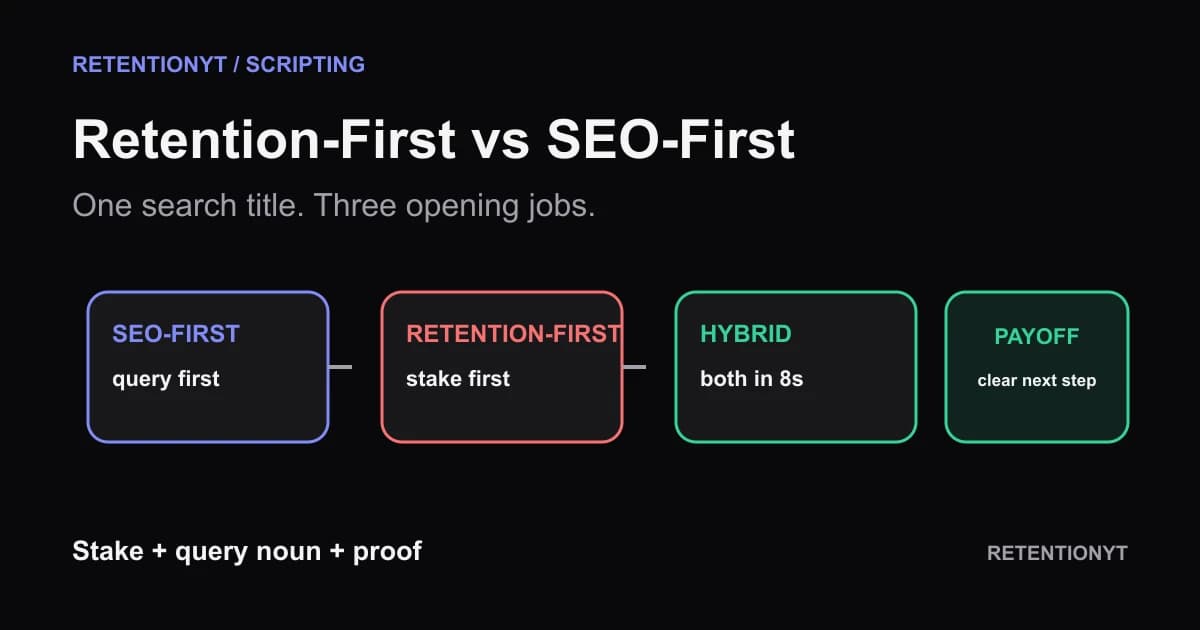
You have about 8 seconds to make a search viewer recognize the topic and a suggested viewer care about it. An SEO-first outline names the query immediately; a retention-first outline opens on the stake. The hybrid does both: stake in the first breath, query noun in the same 8 seconds, then a visible path to the payoff. Outline the jobs separately before you write the sentences.

Where RetentionYT fits
Manual outlining works alone. Product shortens the loop. Try RetentionYT when you want a second structural read before recording.
What The Retention-First Outline vs the SEO-First Outline actually is (and what it is not)
The SEO-first outline starts with the phrase a searcher is likely to recognize. Its first job is scope: make the video’s subject obvious, state the angle, and move to the promised answer. It is useful when the viewer arrives with a defined question and needs confirmation before investing attention.
The retention-first outline starts with the consequence of not solving the problem. Its first job is tension: show the cost, contradiction, or proof that makes the viewer want the explanation. It is useful when the same title can reach suggested viewers who did not arrive with a fully formed question.
The hybrid is not “half SEO and half retention” in every sentence. It is a timed sequence: the stake earns the first beat, the query noun removes ambiguity, the proof makes the promise concrete, and the outline gives the viewer a path. The editorial method below treats all three as deliberate choices, not as ranking guarantees.
| Outline | First job | Opening shape | Main risk |
|---|---|---|---|
| SEO-first | Confirm the search topic and scope | Query noun, angle, first step | Definition dump that sounds flat |
| Retention-first | Create a reason to stay now | Stake, proof, unresolved question | Energy without a recognizable topic |
| Hybrid | Do both jobs in sequence | Stake, query noun, proof, path | Trying to say everything at once |
Use the same search title for the comparison: “YouTube outline for search vs retention.” An SEO-first line might be, “This is a YouTube outline for search versus retention, and the first decision is where your payoff lands.” A retention-first line might be, “Your outline can answer the search and still lose the viewer before the payoff.” A hybrid line is, “Your YouTube outline can answer search without burning the first 8 seconds—here is the two-part structure.” These are illustrative opening lines, not measured performance claims.
Why this shows up in YouTube Studio
You are not looking for a single “SEO versus retention” score. You are checking the response to an opening whose promise, audience, and packaging you can describe. The locked YouTube source says the Content tab gives a channel-level overview of how viewers find content, what they watch, and how they interact with it. It also describes a Videos report for key moments for audience retention and typical retention comparisons. YouTube Help, August 2026
The Reach source gives a different piece of context. It says the Reach tab provides a snapshot of metrics such as click-through rate, watch time, and views, and that traffic-source reporting shows how viewers found content within YouTube and external sources. YouTube Help, August 2026 That helps you distinguish a packaging or audience-source change from an outline change.

Worked example 1: the failure
Here is one illustrative failure using the same search title. The creator wants to answer “YouTube outline for search vs retention,” so the opening begins with a definition:
“A YouTube outline is a document that organizes the structure of your video. Search engine optimization, or SEO, means optimizing content so people can find it. In this video, we’ll compare search and retention and explain the differences.”
The wording is not wrong, but it makes the viewer wait for the decision. The query is present, yet the line gives no consequence, proof, or next action. A searcher may understand the topic and still have no reason to stay; a suggested viewer may never decide that the topic matters.
| Timecode | Illustrative line job | What fails |
|---|---|---|
| 0:00 | Define “outline” | No stake or concrete problem |
| 0:03 | Define SEO | The opening becomes a glossary |
| 0:06 | Announce comparison | The payoff is still abstract |
| 0:08 | Promise explanation | The viewer has already been asked to wait |
These are illustrative checkpoints, not YouTube Analytics results. Read the opening aloud with a timer and mark the first moment a viewer can answer two questions: “Is this for my problem?” and “What will I see next?” If the answer arrives after the first 8 seconds, the outline has spent its opening on setup.
Worked example 2: the fix
Keep the title and rebuild the first 8 seconds with the hybrid outline:
“Your YouTube outline can answer search and still lose the viewer before the payoff. Put the query noun on screen, show the two outline cards, and choose the structure that earns the next step.”
This is an illustrative script. The first sentence supplies the stake, the phrase “YouTube outline” keeps the query recognizable, the cards are proof, and the final clause points to a decision. It does not claim that the hybrid will rank or retain better in every case; it gives the viewer a reason to understand the comparison.
Now outline the same video in three controlled versions. The SEO-first version puts the query and scope in sentence 1, then delivers the definition and comparison. The retention-first version opens with the failure—an outline that answers the query but loses the viewer—then names the topic as a label. The hybrid puts the failure in the spoken line, the query noun on screen, and the two-card comparison in the first visual.

How to check this in YouTube Studio (step by step)
Use Studio after publishing to inspect the response to the opening you actually recorded. You are not trying to reverse-engineer a universal formula from one line; you are building a dated record for the next outline.
- Open YouTube Studio on a computer and select the video you want to inspect.
- From the left menu, select Analytics, then select Content from the top menu. This is the computer path stated in the locked YouTube Help source.
- Review the cards and reports available for that content type. For a video, look for Key moments for audience retention when it is shown, and note what part of the opening you are comparing.
- Record three timecodes in your notes: 0:00, the end of the spoken query-and-stake line, and the moment the first promised method begins. These are review points, not universal targets.
- Check the traffic-source context before comparing two uploads. A search-heavy video and a suggested-heavy video may bring viewers with different expectations, so record the source limitation beside the observation.
- If a typical-retention comparison is available, use it as context for similar-length videos. The locked source describes typical retention as a comparison with the 10 latest videos of similar length.
- Use SEE MORE or ADVANCED MODE when the available report needs expanded data, comparison, or export. Save the exact report name and the date.
- Change one outline variable on the next upload: move the query label, sharpen the stake, or show proof earlier. Keep the title promise and the rest of the test as stable as your format allows.

The trap
The trap is turning the comparison into a false choice. SEO-first does not have to mean slow, and retention-first does not have to mean vague. The failure happens when one job is asked to do the other job’s work.
The trap
The move

Search tells the viewer what the video is; retention gives them a reason to stay for what it does.
What to do in the next upload
Write the search title at the top of an outline. Under it, write the stake in one sentence: what becomes harder, slower, or more confusing if the viewer does not solve the problem? Then draft three openings—SEO-first, retention-first, and hybrid—without changing the promised result.
- Write the exact search title before you write the opening.
- Put the viewer’s stake beside the query instead of hiding it in the introduction.
- Give the first 8 seconds a word budget and a visible first shot.
- Label a curve, comparison, or timing example as illustrative when it is not source data.
- Decide whether the query is spoken, shown on screen, or both.
- Keep the first visual tied to the promise, not to a logo or unrelated montage.
- Give every outline section a timecode, word budget, and one-line job.
- Schedule the core payoff before the final act.
- Plan a mid-video re-hook instead of hoping one appears in the edit.
- Test one changed variable on the next upload and record the limitation.
- Keep the unused opening versions as controlled alternatives for later tests.
If you want another structural check before recording, use the YouTube script review tool, but the manual outline works without signing up. For a broader writing process, read how to script a YouTube video. When you need a timed outline to hand to an editor, use the YouTube script outline template.
Choose SEO-first when immediate query clarity is the dominant job, retention-first when the stake is the clearest entry point, and hybrid when you need both. Write that choice into the outline and record what the next upload teaches you.
Frequently asked questions
- Should I say the keyword in the first sentence?
- Say the keyword in the first sentence when search clarity is part of the promise, but do not make the sentence a definition dump. A stronger opening pairs the query noun with a concrete stake or result. If the title is already clear, you can say the keyword as a label while the spoken line leads with the viewer’s problem.
- Do search videos need slower intros?
- No. Search viewers still need a fast confirmation that they clicked the right video. Keep the query recognizable, then move to the consequence, example, or first step. Slower pacing can be useful for a complex demonstration, but it is not a substitute for a clear promise. Budget the opening by spoken words and the first visual change, not by a vague idea of being thorough.
- How do I outline for both SEO and retention?
- Start with the search title and write the viewer’s stake beside it. In the first eight seconds, say the stake and show the query noun as spoken text or a natural phrase. Then outline the payoff, the proof, the mid-video re-hook, and the next action. This hybrid keeps the topic legible for search while giving a suggested viewer a reason to stay.
- Can a dry title still have a cold open?
- Yes. A dry title describes the destination; a cold open starts with the most concrete moment that proves the destination matters. For a tutorial, show the failed setting or the final result before naming the method. Add the query noun within the first eight seconds so the opening creates energy without making the video’s subject ambiguous.
- What is a hybrid outline?
- A hybrid outline gives search and retention separate jobs. Search supplies the recognizable query and scope; retention supplies the stake, proof, and forward motion. The opening can lead with the problem, place the query noun in the same eight-second window, and then show the next step. It is not a compromise that weakens both; it is a sequence that keeps each job clear.
- How do I apply “The Retention-First Outline vs the SEO-First Outline” on my next upload?
- Write the exact search title at the top of your outline, then draft three opening versions: SEO-first, retention-first, and hybrid. Give each a timecode, a spoken-word budget, a first visual, and a job. Read them aloud, choose the one that makes the promise clearest, and keep the unused versions as controlled alternatives rather than changing the opening by instinct.
- Where in YouTube Studio do I check “The Retention-First Outline vs the SEO-First Outline”?
- On a computer, open YouTube Studio, choose Analytics from the left menu, and choose Content from the top menu. For the video, inspect the reports available for its content type, including Key moments for audience retention when shown. Use the report as evidence about the published opening, not as proof that one outline caused a result without a comparable test.
- What is the most common mistake with “The Retention-First Outline vs the SEO-First Outline”?
- The common mistake is treating SEO as a reason to read the title aloud and then add background. That confirms the topic but gives the viewer no immediate stake. The opposite mistake is a dramatic cold open that never names the query. Keep the jobs separate: recognizable query, concrete stake, visible proof, and a planned payoff.
Give your next script a second look
Paste a script into RetentionYT for suggestions on your hook, pacing, and structure. Choose the edits that serve your video, then check audience behavior in YouTube Analytics after publishing.
Get retention tips in your inbox
Occasional, practical emails on hooks, pacing, and retention. No spam.
Related posts
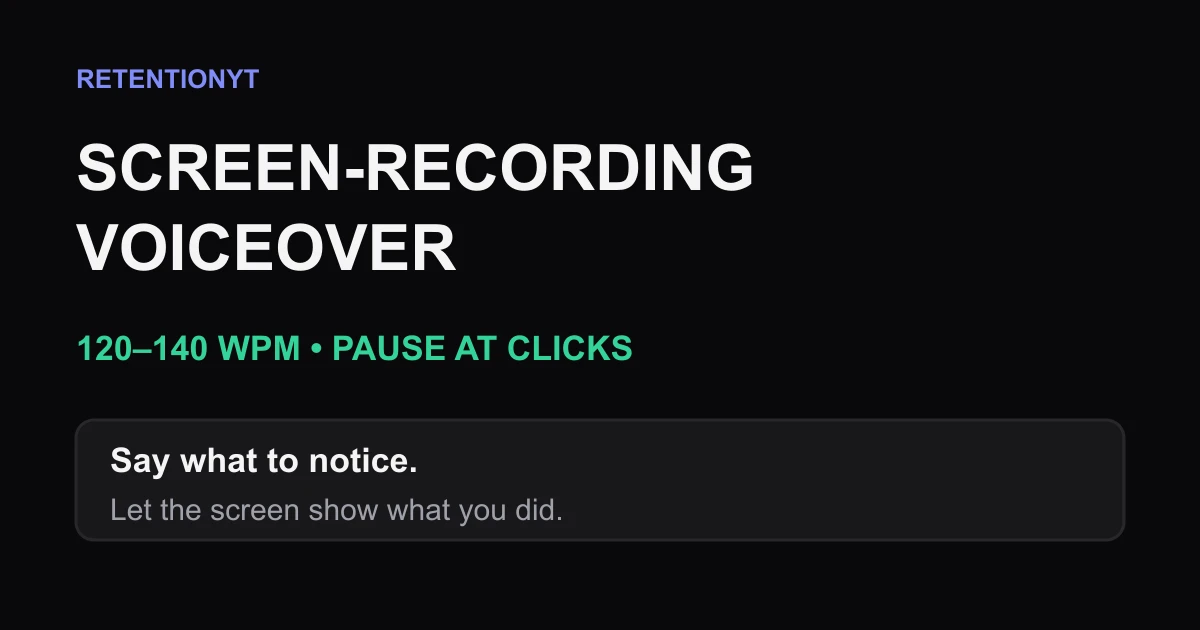
Screen-Recording Voiceover: WPM and Pause Marks
Learn how to script a screen recording voiceover at a slower 120–140 WPM, add pause marks for clicks, and guide attention without narrating every cursor move.
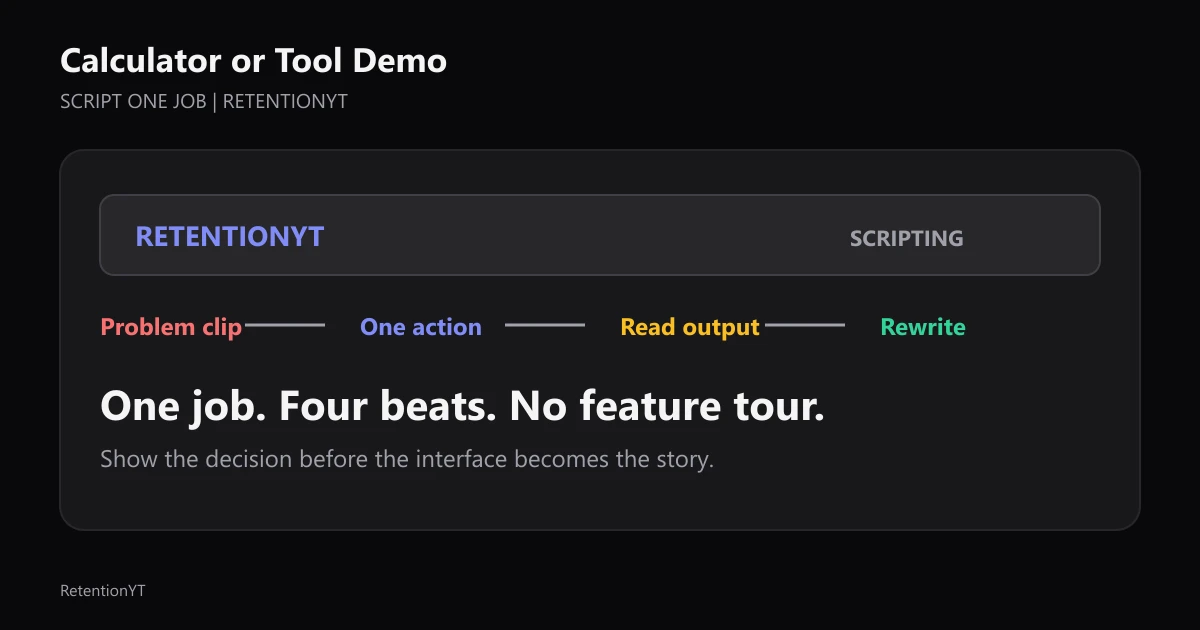
How to Script a Calculator or Tool Demo Without a Mid-Video Slump
Learn how to script a calculator or tool demo around one job, timestamp each click, read the output aloud, and rewrite before a feature tour drains your retention.
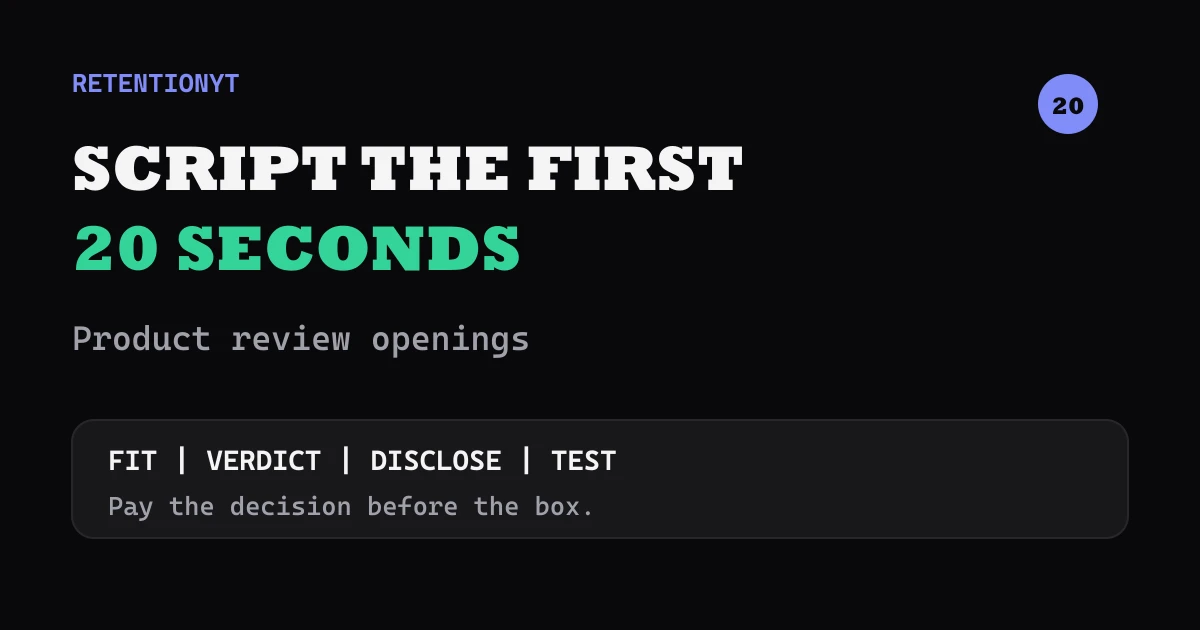
How to Script a Product Review's First 20 Seconds
Learn how to script a YouTube product review intro that pays off the thumbnail in 20 seconds with a verdict teaser, audience fit, disclosure, and a testable before-and-after.