Return Viewers vs New Viewers: Two Curves, One Script
YouTube new vs returning viewers retention is a promise test: read the two curves, find the 0:08 cliff, and rewrite one opening that serves strangers without losing fans.

11 min readUpdated
In this guide
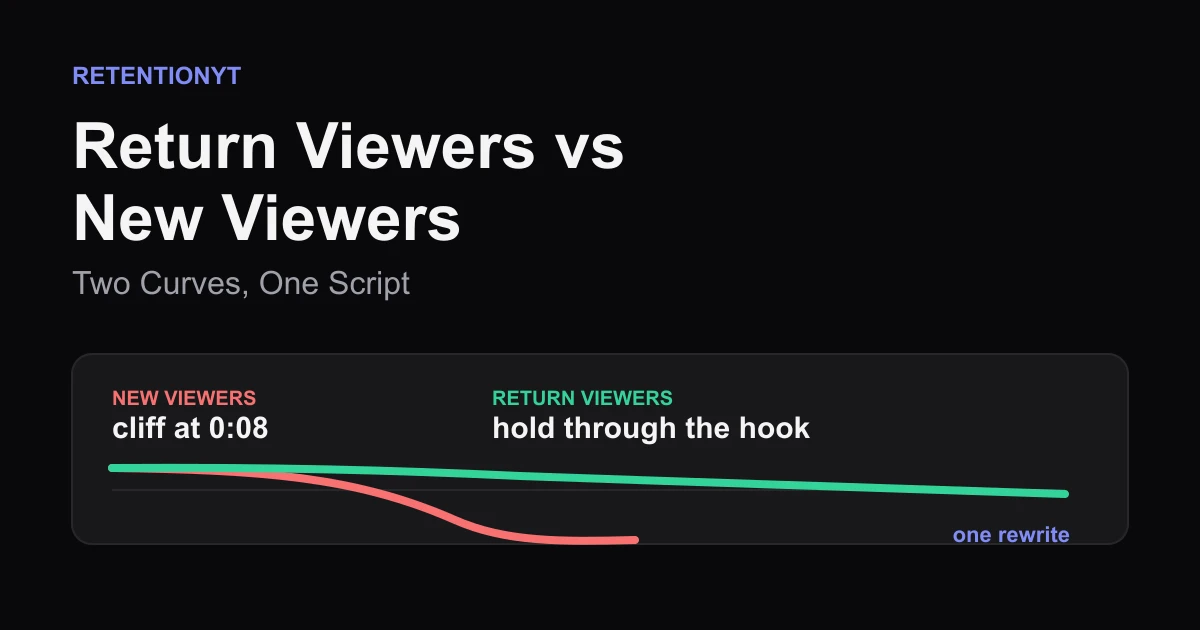
If returning viewers hold while new viewers cliff at 0:08, treat your first 8 seconds as a promise test, not a verdict on the whole channel. Your opening has to orient a stranger before it rewards a fan. Keep the familiar voice and the payoff, but move the inside reference until after the viewer knows why this video matters.

What Return Viewers vs New Viewers actually is (and what it is not)
“Return viewers” is this article’s working label for people familiar with your channel or series. YouTube Help defines “New viewers” as people who watched something on your channel for the first time during the selected period. The same sentence can feel confusing to the other group.
This is a diagnostic lens, not a promise that every account has a native Studio card with this exact label. Use the views your account actually shows and record any limitation.
| Viewer lens | What the viewer already knows | What your opening must do |
|---|---|---|
| New viewer | Little or no channel history | State the topic, promise, and immediate reason to stay |
| Return viewer | Familiarity with your voice, series, or recurring ideas | Reward recognition without making recognition a prerequisite |
| Shared script | The video’s actual topic and payoff | Put the universal promise before the insider reference |
Where RetentionYT fits
Manual method works alone. Product shortens the loop. Link RetentionYT once here. Not in every H2.
Line up the timestamp with the exact words, first frame, title, and thumbnail. If no segment comparison is visible, state that limitation and keep the diagnosis as a hypothesis.
Ask whether the packaging and first line agree for a stranger, or whether a familiar viewer met repetition or a late re-hook. Inspect the timestamp before rewriting the format.
Why this shows up in YouTube Studio
Start with documented reports. SOURCE 2 says the Content tab is channel-level, directs desktop users to Analytics then Content, defines New viewers by first-time channel viewing in the selected period, and describes Key moments for audience retention as a video report about moments that held attention. It also mentions typical retention for recent videos of similar length.
That gives you two coordinates: audience lens and video moment. “Return viewers” is shorthand here, not a quoted Studio label; document any unavailable comparison.
The locked SOURCE 1 page currently identifies itself as “Understand your YouTube video reach.” It says Reach helps explain how viewers find content and surfaces click-through rate, watch time, and views. That context can separate a packaging question from an opening question; inspect the first eight seconds before calling it a thumbnail failure.
Use the same video and date range. Write literal notes: “line drops at 0:08” is evidence; “viewers hate the series” is theory.

Worked example 1: the failure
Here is an illustrative failure, not a real channel report. The video is a 10-minute tutorial in an established series. Its title promises a practical editing fix, but the first line says, “You already know what happened last week.” Fans understand the reference; a first-time viewer waits for the topic and payoff.
The issue is not that one audience is better. The script spends its most expensive seconds on context only one audience owns: the fan gets a reward, while the stranger gets a missing noun.
| Timestamp | Illustrative new-viewer retention | Illustrative return-viewer retention | Script moment | Working diagnosis |
|---|---|---|---|---|
| 0:00 | 100% | 100% | Inside reference with no topic | Stranger lacks context |
| 0:08 | 61% | 88% | Reference continues | New-viewer cliff; fan recognition holds |
| 0:30 | 54% | 78% | Promise finally stated | Late orientation |
| 5:00 | 31% | 45% | Tutorial reaches the promised fix | Both groups have paid the delay |
| End | 18% | 27% | Recap and next step | Illustrative only; not a YouTube benchmark |
Every number is illustrative, not YouTube data or a normal threshold. The teaching shape is an early separation followed by slower decline after the delayed promise.
Read the failure in three passes: note the sound-off first frame, circle references in 15 seconds, and compare packaging with the first claim. Ask whether the reference can move.
Do not add explanation before the joke or delete every reference. The root problem is order: recognition is the entry ticket when it should be the reward.
Worked example 2: the fix
Keep the same illustrative tutorial and the same underlying promise. Rewrite the first 8 seconds for a stranger: “Your cuts feel slow because this one editing setting hides the moment your viewer is waiting for. I’ll show the fix before the first example.” Then add the recognition beat after the orientation: “And yes, it is the same setting that broke last week’s export.” The fan gets the callback; the stranger gets the promise.
This fix changes only the sequence: reference, delay, promise becomes promise, proof, recognition. Show the setting or before-and-after next so the opening earns trust without becoming a biography.
Use the related tool as an optional pre-recording check, not as evidence of a future YouTube curve. The control is manual: write the promise, mark the fan-service line, time the opening, and test stranger comprehension.

Measure the same window again. The curves need not match; remove the stranger’s comprehension tax while keeping a fan reward.
If the cliff moves, log the change. If not, inspect thumbnail, first frame, promise, and rhythm separately.
How to check this in YouTube Studio (step by step)
-
Open YouTube Studio and select the channel and video. If Studio asks you to sign in, access the correct account before drawing any conclusion.
-
On desktop, open Analytics and inspect Content. If your navigation differs, record the visible labels and date instead of copying an old path.
-
Select the video retention view or Key moments for audience retention report available to you. Keep date range and video context consistent.
-
Find the first separation or cliff. Start at 0:08 for this brief, then follow your actual timestamp. Record the visible time and value without turning it into a benchmark.
-
Read the spoken line and first visual there. Ask whether the promise arrived, a reference required prior knowledge, or the edit created a reason to leave.
-
If a segment comparison is visible, note both curves together. If not, state the limitation and compare available reports over matching periods. “Not visible” is better evidence than a guessed feature.
-
Classify the working diagnosis as packaging, promise, context, pacing, or series fatigue. These are editing labels; choose the smallest plausible change.
-
Rewrite only the opening or first re-hook. Keep topic, packaging, and payoff stable so the next upload tests the opening.
-
Read the opening aloud with a timer. Orient a stranger in sentence one, reward a fan next, and make the outcome visible.
-
After publishing, compare the same window. Save both scripts, timestamp notes, and the one intended change; wait for the next measurement before calling it successful.

Reports can differ by context, and the source notes that some may not be available on mobile. Record missing controls and use only data you can inspect; never invent a screenshot or menu label.
The trap
The trap is writing a script that wins the people who already understand the reference and loses the people who could become your next regular viewers. The opposite trap is stripping out every signature detail until the script sounds like a generic explainer. The answer is not “always write for new viewers” or “always serve the fans.” It is sequence.
The trap
The move

A curve difference is not a difference in worth. Familiar viewers show series depth; new viewers show whether the package travels.
Do not blame the thumbnail alone; a vague line, slow reveal, unexplained name, or hidden result can also cost new viewers. Use SOURCE 1’s Reach context with the opening frame.
Do not chase a universal percentage. Every number here is illustrative; your timestamp, script, traffic mix, and audience history decide the next change.
What to do in the next upload
Plan the opening before the middle. Give new viewers a clean entry, then let familiar details increase the reward.
- Write the thumbnail and title promise in one plain sentence.
- Draft a first line that a first-time viewer can understand without channel history.
- Mark every name, callback, or inside joke in the first 15 seconds.
- Move at least one nonessential reference after the first proof beat.
- Show the result, screen, object, or consequence that makes the promise concrete.
- Mark the first re-hook and the next payoff before recording.
- Check the exact timestamp where the new-viewer line separates, if the segment is available.
- Read the opening aloud and record its duration in seconds.
- Change one opening variable on the next upload, not five.
- Save the old script, new script, timestamp note, and comparison limitation.
Use this formula: promise first, proof second, recognition third, payoff next, re-hook before the middle goes quiet. If the draft starts with an inside joke, test it as beat two.
Make the next upload a clean test: keep accurate packaging and topic stable, change opening order, and compare the same timestamp notes.
If the comparison is unavailable, keep publishing with documented Content and retention views, the opening timestamp, and script notes. The process works without a signup. For a second pre-recording pass, read related post 1 and related post 2, then return to the line you can change.
Write line one for someone new, then use line two or three to remind the regular they are in the right place.
Write line one for a stranger; make the familiar reference the reward, not the entry fee.
Frequently asked questions
- Why do new viewers leave faster?
- New viewers have less context about your channel, so an opening built around an inside joke, a familiar name, or delayed setup may not answer their immediate question. Treat the first seconds as a promise check: repeat the useful outcome, show proof, and move background or fan service after the first payoff.
- Where is new vs returning in Studio?
- Do not assume every account shows a report with this exact label. Start at the channel-level Content tab, then inspect the audience and retention views available to your account. YouTube defines New viewers as people watching something on your channel for the first time in the selected period; use that definition before comparing any returning-viewer segment.
- Should I make fan-service videos anyway?
- Yes, if fan service serves a clear job rather than replacing the premise. Keep the reference, running joke, or familiar format, but give a first-time viewer a visible reason to care before it appears. Put the deepest callback after the opening promise, or translate it into a stake a stranger can understand.
- How do I write for both?
- Write line one for a stranger, then add a recognition beat for a fan. The stranger needs the topic, outcome, or tension; the returning viewer can enjoy a callback, faster context, or a familiar voice. Draft the universal promise first, mark the fan-service line, and move it until it no longer blocks comprehension.
- Is a low new-viewer retention a thumbnail problem?
- It can be, but the curve cannot identify the cause by itself. Compare the thumbnail promise with the first sentence and first frame. If the packaging says one thing and the opening delays or changes it, rewrite the opening or adjust the packaging. If the promise matches, inspect pacing, clarity, and the first visual transition.
- How do I apply “Return Viewers vs New Viewers” on my next upload?
- Before recording, write two versions of the first 8 seconds: one that assumes no channel history and one that leans into the audience’s familiarity. Keep the first version’s promise, borrow only the strongest recognition cue from the second, then mark the first re-hook and payoff. Review the resulting curves after publication.
- Where in YouTube Studio do I check “Return Viewers vs New Viewers”?
- On desktop, begin at YouTube Studio, open Analytics, and inspect the Content and audience-retention views available for the channel or video. The locked Help source describes the channel-level Content path and the video Key moments for audience retention report. If your interface differs, record the visible path instead of inventing a menu name.
- What is the most common mistake with “Return Viewers vs New Viewers”?
- The common mistake is treating a segment difference as a verdict on the whole script. A new-viewer cliff can point to an unclear promise, while a returning-viewer slump can point to repetition or a missing re-hook, but both are hypotheses. Check the timestamp, read the exact line, and change one variable on the next upload.
Give your next script a second look
Paste a script into RetentionYT for suggestions on your hook, pacing, and structure. Choose the edits that serve your video, then check audience behavior in YouTube Analytics after publishing.
Get retention tips in your inbox
Occasional, practical emails on hooks, pacing, and retention. No spam.
Related posts
Search Traffic Is Patient, Suggested Is Not
Learn why YouTube search vs suggested retention can look different, how to split the curve in Studio, and how to rewrite the hook for the impatient source.
What 'Typical Retention' Cannot Tell You (And What Your Last 8 Videos Can)
The limitations of YouTube typical retention line: use the grey comparison line, then check traffic mix, viewer type, and your last 8 in-band videos before rewriting.
Key Moments in Studio: Intro, Top Moments, Spikes and Dips
Decode YouTube Studio key moments with a practical timestamp method: keep spike lines, rewrite dips, and turn the intro label into a sharper first-30-second promise.