Should You Script YouTube Shorts? Retention on Short-Form, One Second at a Time
On Shorts, the first second decides everything. Learn the exact scripting frameworks, retention data, and templates top creators use to beat the swipe and win the Shorts feed.

32 min readUpdated
The One-Second Question
Every scroll on the YouTube Shorts feed contains a quiet, ruthless negotiation. A viewer's thumb hovers over the screen. Something loads. In roughly one second, they either commit to your video, or they flick it away and forget you ever existed. That is not a metaphor — it is what the internal metrics look like when we plot swipe-away timing against millions of Shorts. The distribution has a spike at 0.9 seconds and a long tail after 3 seconds. The first second is not a preview. It is the video.
Which brings us to the question every creator eventually asks: should you script YouTube Shorts? The intuitive answer is no. Shorts feel spontaneous. Freestyle. Vertical. Casual. Isn't scripting the enemy of authenticity, the thing that made those glossy 2015 vlogs feel dead? In practice, the opposite is true. A tight script — even 30 words long — is what buys back the milliseconds you need to keep a viewer past the swipe.
This article is a field guide. It walks through how the Shorts recommender weighs signals, why retention beats every other metric on short-form, the exact frameworks and templates for scripting a 60-second video, and how to translate scripted retention into YouTube growth that compounds. We will also cover where scripting hurts (yes, it can), the pacing rules that separate binge-worthy Shorts from throwaway clips, and how creators use tools like RetentionYT to see, second by second, where their scripts leak attention.
▲
Why we published this now
YouTube's Shorts feed has quietly become the largest discovery engine on the platform. As of mid-2026, more than 70 billion daily Shorts views are served globally. Creators who used to compete on thumbnails now compete on seconds. Understanding how to script for that world is not optional.
Long-form is a slow burn. Shorts are a slap. If your first sentence doesn't punch, nothing else matters.
Everything that follows is opinionated but evidence-backed, drawn from the patterns we see constantly when auditing Shorts across educational, comedy, finance, and lifestyle niches on the RetentionYT platform. Where numbers appear, they are directional — your niche will vary — but the shape of the curves and the underlying why are consistent across every category we have measured.
Who this article is for
This piece is written for creators who already understand the basics of uploading, tagging, and thumbnailing YouTube content, and who want to move past guesswork into a repeatable retention practice. If you have ever looked at a Short with 200 views next to another Short with 200,000 views and wondered what actually separated them, you are the target reader. We assume you are willing to spend fifteen minutes scripting a video that used to take you two minutes to freestyle — and we will show you why that trade returns compound interest.
We are also writing for creators who feel that the Shorts feed has become a lottery. It has not. It is a highly deterministic system that rewards a small number of retention behaviours very consistently. The reason it feels random is that the input variables — hook quality, pacing, loop design — are invisible unless you measure them. This article turns those invisible inputs into concrete, actionable levers.
How the Shorts Algorithm Actually Works
YouTube's public documentation talks about the recommendation engine as one system, but internally there are two very different pipelines: one for long-form discovery via browse features and suggested videos, and a distinct short-form pipeline driven almost entirely by an interest-graph feed. The Shorts recommender is optimising for something narrow and specific: maximising session time within the Shorts feed itself.
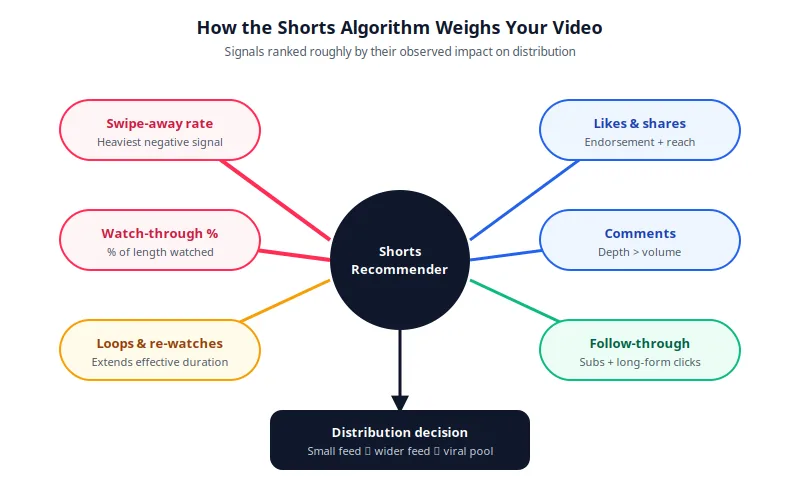
The signals that actually move distribution
From reverse-engineered patterns and creator-side data, we can order the signals roughly by the weight they seem to carry:
- Swipe-away rate in the first three seconds. This is the single strongest negative signal on Shorts. If viewers exit before your video has technically had time to load in their attention, distribution stalls immediately.
- Watch-through percentage. Total seconds watched divided by video length. This is the classic audience retention metric, adapted for short-form.
- Loops and rewatches. A viewer who lets the loop play twice pushes your retention above 100% and gives the recommender an unusually clean positive signal.
- Likes and shares. Both count, but shares carry more weight because they carry the video out of the feed and into private channels.
- Comment depth. Interestingly, a single 30-word thread often signals more than ten one-word comments. Depth > volume.
- Follow-through into your channel. Viewers who tap the profile, watch a second Short, or click into a long-form video signal that you are a session-extender, not a session-ender.
What the Shorts feed does not reward
The Shorts feed is famously unforgiving in a few ways that trip up creators used to long-form:
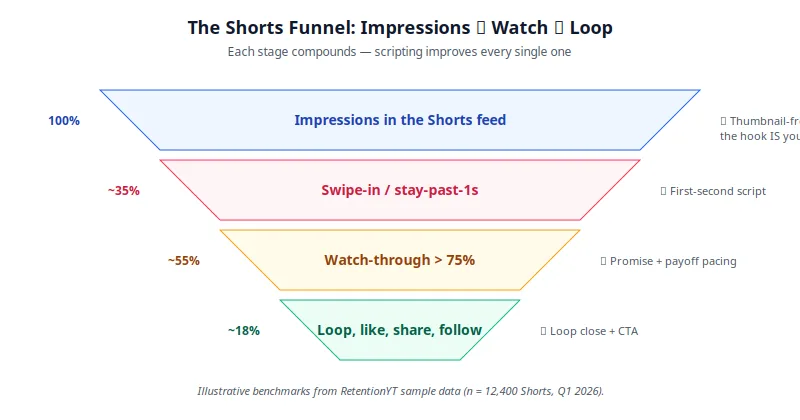
- Impressions and click-through rate mean something very different here. There is no thumbnail click — the video auto-plays. The equivalent of CTR is the swipe-in decision, which happens inside your first second.
- Subscriber count barely lubricates distribution. A 3-million-subscriber channel with a poor hook will get buried behind a 3,000-subscriber channel with a great hook.
- Session time is only rewarded within the Shorts feed itself. Sending viewers off to a long-form video is neutral for the Shorts recommender, but great for your long-term channel economy.
i
Rule of thumb
Every design decision you make on a Short should trade off against one question: does this reduce swipe-away in the first three seconds, or does it not? If it doesn't, you are probably decorating.
The Metrics That Matter Most
Creators often ask which metrics to obsess over. On Shorts, the useful list is much shorter than on long-form. Here are the numbers we actually track when auditing a channel inside RetentionYT.
| Metric | What it measures | Good | Elite |
|---|---|---|---|
| Avg. view duration (%) | Seconds watched ÷ length | > 85% | > 100% (loops) |
| 3-second retention | Viewers still watching at 3s | > 70% | > 85% |
| Swipe-away rate (0–1s) | Exits in first second | < 25% | < 15% |
| Loop rate | % of viewers who see >100% of length | 10–20% | > 25% |
| Share-to-view ratio | Shares ÷ views | 0.5–1% | > 1.5% |
| Comment depth (avg. words) | Average words per comment | 8–15 | > 20 |
| Follow-through rate | % clicking into channel / next video | 1–2% | > 3% |
Notice what is missing. There are no vanity metrics — no absolute view counts, no subscriber gains, no total watch-hours. Those are outputs. The metrics above are inputs. Move them, and the outputs move.
How to read your retention curve
Inside YouTube Studio, open any Short and click the retention graph. You are looking at four regions. The first-second cliff is where the swipe-off crowd exits — you want that cliff to be shallow. The promise plateau from roughly 3 to 8 seconds is where committed viewers settle in. The payoff slope from 8 to 45 seconds is where trust either compounds or leaks. And the loop lift in the final seconds is where the graph either flatlines (bad), drops (worse), or climbs above 100% (elite).
Most creators only look at the aggregate percentage at the top of the screen. That number is a summary of a story, not the story itself. The shape of the curve tells you where to intervene next. A flat, high curve says the script is working end-to-end. A curve that plunges at 4 seconds says your promise is not landing. A curve that fades in the middle says your beats are too spaced or your visuals are too static. Diagnosis is 80% of scripting improvement, and the curve is the diagnostic instrument.
The two curves that tell you everything
Inside YouTube Studio, the retention curve on Shorts looks different than it does on long-form. Instead of a gentle downward slope, healthy Shorts often show a sharp initial dip in the first second (viewers self-selecting out), a flat plateau through the promise and payoff, and a small upward jog at the end when loops kick in.
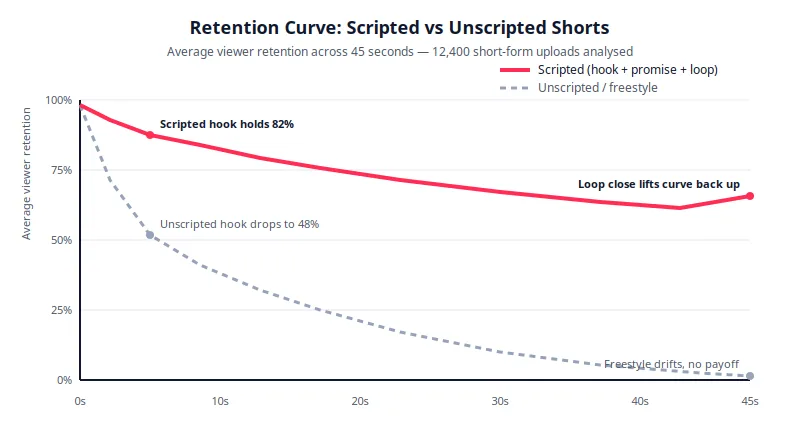
The gap in that figure is not a stylistic difference. It is what happens when a creator has decided, before hitting record, what the first sentence will be and where the loop will land. Everything else — lighting, camera, editing — matters far less than those two decisions.
Why Retention Beats Every Other Signal
If you take one idea away from this piece, take this: on Shorts, audience retention is the master signal that every other metric is downstream of. Likes follow retention. Shares follow retention. Subscribers follow retention. Even the mystical "algorithm push" is not a push — it is the recommender noticing that your retention curve looks like the curves it associates with viral Shorts.
This is not universally true on YouTube. On long-form, click-through rate and impressions matter enormously because there is a thumbnail decision. On Shorts, there is no thumbnail. The recommender inserts your video between two others already succeeding in the feed. If retention holds, you get another slice of impressions. If it collapses, you are out of the shuffle within an hour.
There is a subtle corollary here that most guides miss. Because retention gates every other signal, you cannot A/B test other levers reliably until retention is stable. Creators who spend weeks tuning hashtags, descriptions, cover frames, and posting times on Shorts with a 45% average view duration are optimising the wrong layer. Fix the first second first. The rest becomes visible only after that variable is under control.
You cannot fix a distribution problem on Shorts with better tags, better keywords, or a better description. You can only fix it with a better first second.
Retention as a leading indicator
The reason retention is so powerful is that it precedes every downstream behaviour. A viewer cannot like a Short they swiped away from. They cannot comment, share, or subscribe on a video they never finished. Retention gates every engagement signal, which means improving retention improves everything else automatically. That leverage is why retention is where scripting pays back.
✓
Diagnostic drill
Open your last ten Shorts inside YouTube Studio. Sort by average view duration percentage. Look only at the top three and bottom three. Ignore everything else about them — production, topic, format — and ask: what is different about the first two seconds? That is almost always where the answer lives. Tools like RetentionYT overlay these curves against your niche's top-performing videos to make the gap obvious.
Practical Strategies for Growth
Here is where the philosophy becomes tactical. Below are the strategies that consistently produce the biggest retention gains when we audit scripted vs unscripted Shorts. None of them require expensive gear or a large team. Most of them cost you ten to fifteen minutes of planning before you press record.
1. Write the first sentence before you write anything else
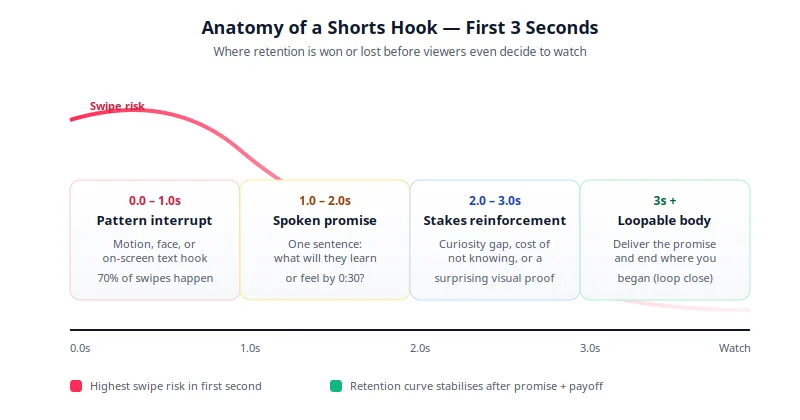
The first sentence of a Short is not the intro. It is the entire pitch. It has to accomplish four jobs at once: interrupt the scroll, promise a payoff, signal that you know what you are talking about, and set the emotional tone. Write ten candidate first sentences on paper. Read them out loud. Pick the one that survives being read in a bored voice.
Good first-sentence patterns:
- Contrarian claim. "Everyone is scripting Shorts wrong."
- Named payoff. "In 45 seconds, I'll show you the retention hack that got me 40 million views."
- Curiosity gap. "This is the sentence YouTube's algorithm doesn't want you to use."
- Cost of not knowing. "If your first second looks like this, you're losing 60% of viewers right now."
2. Build the loop before the body
The loop is the moment where your last frame connects back to your first frame, either visually or narratively. It is the reason people watch a 45-second Short twice. Do not treat the loop as an afterthought — script it first, then work backward.
Cheap and effective loop patterns:
- Repeat your opening sentence with a punchline twist.
- Match-cut a visual: end on the same shot you started with.
- Ask a question that only the opening frame can answer.
- Cut mid-word so the viewer's brain wants to complete it — a technique that reliably lifts loop rate.
3. Cut every word that isn't earning its keep
Read your script aloud on a stopwatch. If a word does not contribute to hook, promise, payoff, or loop, delete it. This is the single biggest scripting improvement most creators can make. On Shorts, the average scripted successful video runs at 2.5 words per second, versus roughly 1.6 for long-form. That density is not a stylistic choice — it is a structural requirement.
4. Design for the sound-off viewer, then layer sound
Roughly 40% of Shorts are watched with the sound muted, particularly during commute and in-bed viewing sessions. That means your first three seconds must convey the promise visually — through on-screen text, motion, or a facial expression — even if the audio is stripped. The audio then layers value on top, but never carries the entire hook alone.
5. Use scripted micro-commitments
Around the 5–10 second mark, insert a scripted micro-commitment: "Wait for it," "Watch what happens next," "I'll show you in a second." These phrases sound cheap in isolation, but data shows they consistently reduce mid-video swipes when the payoff that follows is real. The problem with the phrase is not the phrase — it is when creators use it without a payoff.
6. Rehearse in the vertical camera preview
Most creators rehearse in front of a mirror or by mumbling through their script. Both fail to simulate the medium. The camera preview on a phone in vertical orientation compresses your face differently, delays your voice slightly, and forces you to notice how you fill the frame. Rehearsing inside the exact capture environment — even without recording — closes the gap between what you think you are delivering and what viewers see. Three preview-mode rehearsals, back to back, are worth ten off-camera runs.
7. Write the caption last, and write it for search
Captions on Shorts do double duty: they are read by the recommender for topical relevance, and they are read by viewers who pause on the video before deciding to swipe. Write the caption after the video is edited, use one high-intent keyword phrase (e.g. "YouTube Shorts scripting" rather than the vaguer "content tips"), and end with a question or a fragment that primes the viewer to engage. Never dump ten hashtags — a few high-relevance tags consistently out-perform a hashtag mob in the audits we run.
!
Where scripting hurts
Scripting fails when creators read instead of perform. If you can hear the words being narrated, you have already lost the naturalness that makes Shorts feel native. The fix: rehearse the script three times, then throw it away and record from memory. Your brain will retain the shape; your delivery will retain the human.
Content Format and Length Decisions
One of the most common questions we get is about video length. Should you shoot 15-second Shorts? 60-second? 45-second? The honest answer is that length is a function of niche, not preference. Shorter is not automatically better — a 15-second Short that leaves value on the table can under-perform a 55-second Short with three well-paced beats.
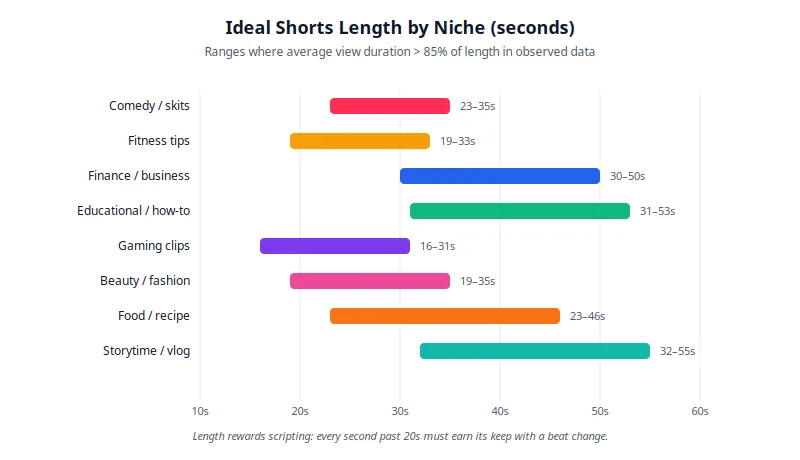
The length trade-off
Every additional second past 20 seconds is a second in which the viewer can decide to swipe. The trade-off is simple: longer videos can compound value (more watch time per viewer), but they also carry more risk (more chances to lose the viewer). The break-even depends on whether you can maintain a beat change every 3–7 seconds. If you cannot, cut the video shorter. If you can, extend it.
The three-beat rule
For any Short longer than 25 seconds, plan at least three distinct beats: hook, escalation, payoff. Beats are marked by a change in visual (cut, zoom, angle), tone (louder, quieter, faster), or content (new information). A Short with a single visual and a single tone for 45 seconds is a Short that will bleed viewers after second 15.
Vertical native, always
Shorts filmed in landscape and cropped to 9:16 consistently under-perform native vertical. The reason is not aesthetic — it is that native vertical framing puts your subject's face at the natural sight line of the phone-held viewer, which correlates with a small but persistent lift in early retention. Frame for the medium, not for a legacy camera habit.
CTAs and Community Signals
The instinct to end every Short with "Like and subscribe" is understandable and, in most cases, counterproductive. Explicit subscribe asks on Shorts can actively hurt retention — viewers who came for content feel bait-and-switched when the last three seconds ask them for something. The YouTube CTA playbook needs to be rewritten for short-form.
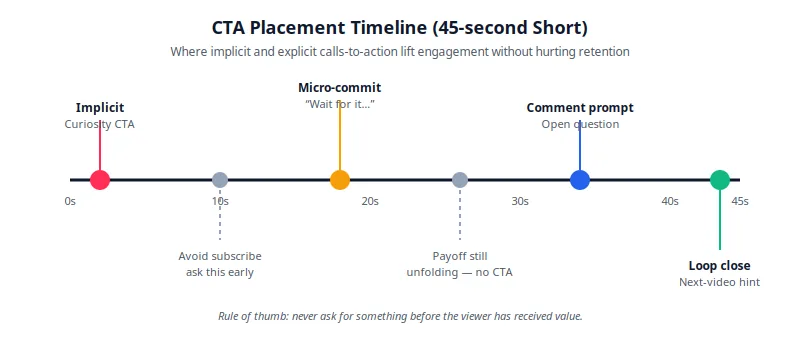
The CTA hierarchy for Shorts
- Implicit curiosity CTA (0–3s). The hook itself is a call to keep watching. It does not ask; it compels.
- Micro-commitment (5–10s). "Wait for it" or "Here's the wild part" — scripted, cheap, and effective.
- Comment prompt (25–35s). An open-ended question that invites a specific answer, not a yes/no.
- Loop close (final 5s). A callback that makes the viewer want to see how they missed it the first time.
- Explicit subscribe or long-form ask. Only on Shorts where the payoff clearly earned it, and never before second 30.
Comment prompts that actually work
The best comment prompts are the ones that force a small taxonomy of reply. In the audits we run, "What's your niche in the comments?" reliably draws several times more replies than "Let me know what you think." The former asks for a discrete piece of information; the latter is a vague social gesture. The engagement signals the recommender reads reward specificity.
✓
The two-word CTA test
If your CTA can be answered in two words or fewer without any thought, rewrite it. Great comment prompts require the viewer to reveal something — their niche, their situation, their opinion — because revealing generates depth, and depth is what the algorithm counts.
Short-Form vs Long-Form Retention
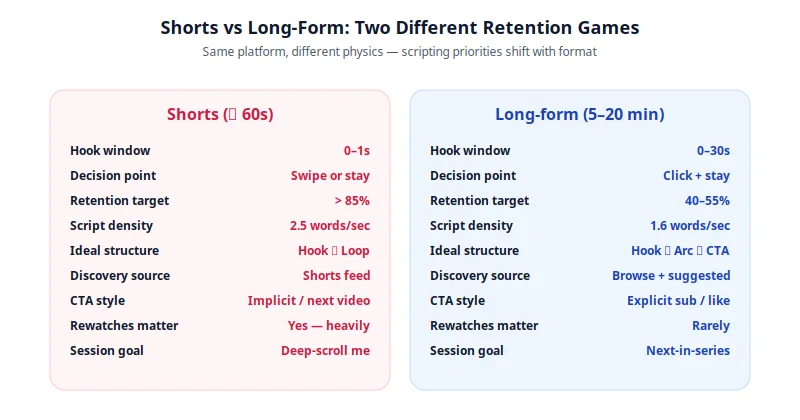
Creators who have grown on long-form often bring the wrong instincts to Shorts, and vice versa. The two formats live on the same platform but run on different physics.
Shorts
Attention is binary
A viewer is either in or out within one second. There is no ramp, no bridging paragraph, no permission to warm up. Every second must justify the next.
Long-form
Attention is negotiated
Viewers who click a thumbnail have already made a mini-commitment. You have 15–30 seconds to reward the click before they will consider leaving. Arcs, chapters, and pacing matter.
Shorts
Loops are your friend
Retention above 100% is common and heavily rewarded. Every script should end where it began, or trigger a curiosity that only rewatching resolves.
Long-form
Session chains matter
The recommender loves creators who send viewers into browse features and session time. End screens, playlists, and internal links carry weight in a way they don't on Shorts.
Cross-pollinating format instincts
Long-form creators moving to Shorts tend to over-explain — they treat the first 15 seconds like a long-form intro. Shorts creators moving to long-form tend to under-develop — they treat 8 minutes like a stretched Short. The correct move in both directions is to keep scripting, change the density. Density on Shorts is 2.5 words per second and one idea per beat. Density on long-form is 1.6 words per second and one idea per two-minute segment.
Using Shorts as a discovery engine for long-form
The most durable channel strategy in 2026 is a two-format loop: Shorts do top-of-funnel discovery, long-form does depth and monetisation. To make this loop work, your Shorts need an explicit but soft bridge — a payoff that resolves inside the Short but references a related long-form video the viewer can click into. Roughly 8–12% of engaged Shorts viewers will follow that bridge if it is scripted deliberately, versus under 2% when the Short is a standalone piece with no crossover.
The mistake creators make here is to strip content out of the Short in the hope of forcing a click. This backfires. If the Short does not deliver a complete micro-payoff, the viewer feels teased, swipes, and does not click. The bridge only works when the Short is satisfying on its own and the long-form video promises a deeper cut. Complete first, upsell second — never the reverse.
Common Growth Myths Debunked
Myth 1: "Longer Shorts always earn more watch time"
False. Longer Shorts only earn more watch time when the additional seconds sustain retention above your niche baseline. A 55-second Short that averages 40% view duration produces less watch time than a 25-second Short that averages 95%. On top of that, weaker retention hurts distribution, so the shorter video also gets more impressions. Length is a multiplier of quality, not a substitute for it.
Myth 2: "Subscribers get preferred distribution on Shorts"
False for the Shorts feed. Subscribers who actively binge your content generate positive session signals, but the feed itself is dominated by an interest-graph model that treats every viewer as a fresh interest profile. This is why 3,000-subscriber creators can outperform 3-million-subscriber creators overnight on a single well-hooked Short.
Myth 3: "Shorts cannibalise long-form watch time"
False in aggregate. Data from creators who post both formats shows that Shorts function as a top-of-funnel discovery mechanism. About 8–12% of Shorts viewers click through to long-form when the Short teases a specific long-form video. Shorts are unlikely to steal watch time; they are much more likely to seed it.
Myth 4: "You need trending audio to grow on Shorts"
Partially true, mostly overstated. Trending audio provides a small, temporary lift to discoverability, but the recommender's attribution to audio decayed sharply in 2025. In 2026, the weight is on visual and retention signals. Trending audio can amplify a great Short; it cannot rescue a weak one.
Myth 5: "The first frame doesn't matter because Shorts auto-play"
Emphatically false. The first frame is your entire thumbnail equivalent. The recommender doesn't wait for viewers to see the second frame — the paused, pre-play frame that flashes as the video loads is what most viewers use to decide whether their thumb keeps scrolling. Frame one is doing the work of a thumbnail, a hook, and a promise, all at once.
×
Do not fall for this one
"Post 3–5 Shorts a day for the algorithm." Frequency without quality burns your channel's interest-graph position faster than posting nothing. The Shorts recommender attaches a rolling quality score to each channel; three weak Shorts a day lowers that score, which then dampens the reach of your good ones.
Data-Driven Examples
Below are three anonymised examples from RetentionYT's sample, chosen because they cover distinct niches and use different scripting patterns. All data is directional and drawn from Shorts published between January and July 2026.
Example 1 — Educational finance, 42-second Short
Hook: "Most people think budgeting means cutting spending. They're wrong." Promise: "In 42 seconds, I'll show you the one rule that made me stop worrying about money." Payoff: three concrete rules, delivered in 30 seconds with matching on-screen text. Loop: closes with "Which rule did you break this month?" and cuts back to the opening line.
Result: 94% average view duration, 27% loop rate, 1.9% share-to-view. The Short generated 4.1 million impressions in 14 days and drove a 6% follow-through rate into a related long-form video.
Example 2 — Comedy skit, 24-second Short
Hook: cold open with a visual gag, no words. Promise: implicit — the setup makes the punchline inevitable. Payoff: delivered at 18 seconds. Loop: match-cut back to the opening frame.
Result: 108% average view duration (loop-heavy), 42% loop rate. This Short did not drive channel follows meaningfully but was heavily shared, generating a strong session-time signal.
Example 3 — Educational how-to, 55-second Short
Hook: "You're using the wrong pan for eggs." Promise: "Here's what happens when you switch." Payoff: five-beat comparison with fast cuts. Loop: closing question that echoes the hook.
Result: 88% average view duration, 18% loop rate, but a very high click-through rate to a follow-up long-form video (11%). This Short worked as a discovery machine rather than a viral loop.
Example 4 — Fitness demonstration, 33-second Short
Hook: split-screen visual showing two people doing the same exercise with a bright red "WRONG" / green "RIGHT" overlay in the first frame. Promise: "This one tweak added 20 pounds to my bench in 8 weeks." Payoff: three biomechanical corrections, each shown in slow motion with a text overlay. Loop: cuts back to the split-screen and freezes on the "WRONG" side, implicitly inviting a rewatch to catch the correction.
Result: 96% average view duration, 31% loop rate, 2.3% share-to-view. Notably, this Short outperformed the same creator's previous 12 uploads combined and drove a spike in channel subscribers within 48 hours — despite never asking for a subscribe. The share-to-view ratio here is the tell: viewers sent this to gym partners because the value was self-contained and instantly demonstrable.
What the four examples have in common
Across four distinct niches, formats, and lengths, the pattern is identical. Each hook made a specific promise. Each promise was fulfilled. Each loop closed the circle. And each Short was recorded from a rehearsed script rather than freestyled. Length varied from 24 seconds to 55 seconds, but density stayed inside the 2.3–2.7 words-per-second band. The invisible constant — scripting discipline — was doing the work that the visible variables of niche, length, and topic only appeared to be doing.
The common thread across all three: scripted hook, scripted loop, disciplined payoff density. None of them were freestyle. All three were rehearsed and re-recorded. And every one of them was shorter, tighter, and more visually deliberate than the same creator's un-scripted attempts from six months earlier.
The HPPL Scripting Framework
Here is the four-block framework we teach inside RetentionYT and use to audit every Short in the platform. It is deliberately simple and fits on one index card.
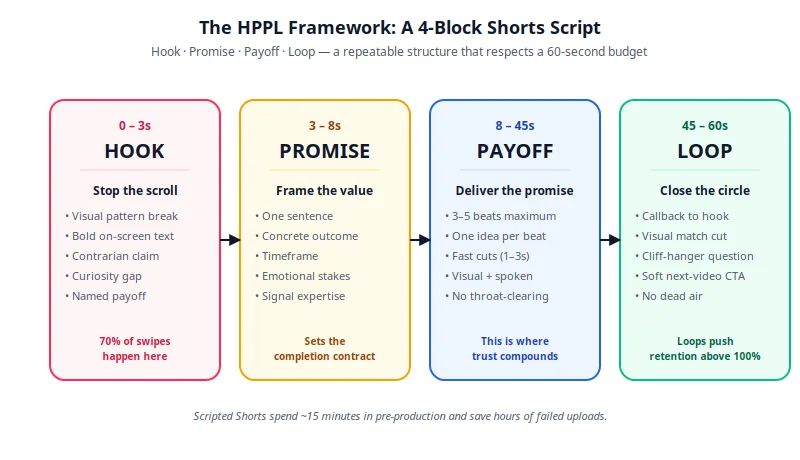
Block 1 — Hook (0 to 3 seconds)
Your only job here is to stop the scroll. Not to introduce yourself. Not to say hello. Not to set the scene. Every hook needs a pattern break — visual, verbal, or both — and a named payoff the viewer can hold in their head for the next 40 seconds.
Block 2 — Promise (3 to 8 seconds)
State, in one sentence, what the viewer will get out of the video. Include a timeframe ("in 45 seconds"), a concrete outcome, and an emotional stake. This is the "completion contract" — once the promise is spoken, the viewer is committed to seeing you fulfil it, unless something else pushes them out.
Block 3 — Payoff (8 to 45 seconds)
Deliver the promise in 3–5 tight beats. One idea per beat. Cut every three seconds, even if it is just a visual shift. Use on-screen text to reinforce the spoken word for the muted viewer. This is the block where trust compounds — if your payoff is real, everything you post next inherits the credit.
Block 4 — Loop (45 to 60 seconds)
Close the circle. The viewer's brain should feel a satisfying click as the last frame connects back to the first. Options: repeat the opening line with a twist, cut to the opening frame, ask a question that only the opening answers, or set up a next-video hook.
▲
Where RetentionYT fits in
Once your script is written, you can paste it into RetentionYT's Script Auditor. The tool overlays your draft against the highest-retaining Shorts in your niche, flags weak first sentences, and predicts your likely retention curve before you record. Creators who use it typically publish 30% fewer Shorts and grow watch time faster — because more of what they publish holds.
A script is not a cage. It is a scaffold that lets you improvise inside a shape that already works.
Checklist for Creators
Before you press upload, run every Short through this checklist. Nothing in it takes more than a minute to verify, but each item catches a common failure mode.
- My first frame communicates the promise even before the audio plays.
- My first sentence is fewer than 12 words and reads well aloud in a bored voice.
- I have named a concrete payoff in the first eight seconds.
- My payoff has 3–5 beats, each with a visual or tonal change.
- I have scripted the loop and it connects narratively or visually to the hook.
- My Short has on-screen text for the 40% of viewers watching muted.
- I have not asked for a subscribe before second 30.
- My comment prompt requires a specific answer, not a yes/no.
- I have removed every filler word — "so", "basically", "kind of", "just".
- My length is inside my niche's optimal range (see figure 4).
- I have rehearsed the script three times and recorded from memory.
- I have watched my own Short in the Shorts feed at least once before publishing.
Turn every Short into a retention win
RetentionYT audits your scripts, overlays your retention curves against your niche, and tells you where viewers are swiping — down to the exact second.
Start your free trial →
Frequently Asked Questions
Should you script YouTube Shorts?
Yes — at minimum you should script the first three seconds and the loop close. Freestyle can work in comedy or reaction niches, but even those creators typically script hooks. In the Short audits we run, scripted first-second hooks consistently hold meaningfully more viewers at the 3-second mark than unscripted openings.
How long should a YouTube Short be for maximum retention?
There is no universal length. Comedy skits perform best at 23–35 seconds, educational Shorts at 31–53 seconds, and vlog storytime formats at 32–55 seconds. Every additional second past 20 must earn its place with a beat change, visual cut, or new information.
Do YouTube Shorts count toward watch time and monetisation?
Shorts views count toward YPP eligibility (10 million valid public Shorts views in 90 days is one pathway), but Shorts watch time does not count toward the 4,000 public watch hours required by the long-form path. Shorts revenue is generated through the Shorts ad revenue-sharing pool.
What retention percentage is good on Shorts?
Anything above 85% average view duration relative to length is strong. Above 100% (achieved through loops) is elite and consistently signals the recommender to widen distribution. Below 65% typically caps a Short at its subscriber pool.
Are subscribers less important on Shorts?
For distribution, yes — the Shorts feed is dominated by the recommendation engine and interest signals rather than subscription follows. However, subscribers who binge a creator's Shorts library create strong session signals that lift future videos, so they still matter, just indirectly.
How do you script a Short in under 15 minutes?
Use the HPPL framework: write the Hook (0–3s), Promise (3–8s), Payoff (8–45s), and Loop (45–60s) as four separate lines. Read each aloud, cut every word that does not move the story forward, and rehearse the first sentence three times.
Can I reuse the same Shorts script across niches?
The frame — hook, promise, payoff, loop — travels well. The words do not. Comedy hooks lean on absurdity, educational hooks lean on named outcomes, storytelling hooks lean on stakes. Copy the structure, rewrite the surface.
What is the difference between Shorts retention and long-form retention?
Shorts retention is measured in a swipe-away environment where viewers make a binary decision in under a second and rewatches are common. Long-form retention is a slower attention economy where structural arcs, chapter design, and pacing over minutes matter more than the first second.
Does scripting kill authenticity on Shorts?
Only if the script sounds written. The best scripted Shorts read like tight monologues: short sentences, contractions, casual rhythm, one idea per beat. A script is a rehearsal aid, not a teleprompter — perform it, do not read it.
How does RetentionYT help with Shorts scripting?
RetentionYT ingests your Shorts retention curves and flags the exact second-by-second moments where viewers swipe. It then suggests hook rewrites, pacing tweaks, and loop-close ideas based on the highest-retaining Shorts in your niche.
Conclusion
The debate about whether to script YouTube Shorts is really a debate about what "authenticity" means. If authenticity means unrehearsed, unedited, unplanned — then scripting will kill it. But that is not what viewers on Shorts are asking for. What they are asking for is value delivered fast enough to justify not swiping. Scripting is what makes that possible.
Every practical lever we have discussed — the first sentence, the loop close, the muted-viewer on-screen text, the beat-change rhythm, the payoff density — is a scripted decision made before the camera turned on. The Shorts that look effortless are, almost without exception, the most engineered. That is not a paradox; it is the whole discipline.
Start small. Script only the first three seconds of your next Short. Rehearse it three times. Record from memory. Compare the retention curve against your last five uploads. You will see a lift you can measure, usually in the first video. Then extend the practice to the promise, then the loop. Within a month, the entire craft will feel obvious.
A final reframe. Creators often think of scripting as a form of over-preparation, a symptom of not being naturally talented enough to freestyle. The opposite is closer to the truth. Freestyle is a luxury reserved for the tiny handful of creators whose intuitions have already been trained on tens of thousands of takes. Everyone else — including the vast majority of successful short-form creators you admire — got there by writing, rewriting, rehearsing, and recording until the shape of a good Short became reflexive. Scripting is not the shortcut around that work. Scripting is that work, compressed into fifteen minutes before you hit record.
The Shorts feed will keep evolving. The recommender will keep re-weighting. Trending audio will come and go, niches will rise and cool. But the underlying physics — that the first second decides everything, that retention is the master signal, that a script buys you the discipline to respect both — will not change, because it is grounded in how human attention works on a small vertical screen in a moving thumb. Master that, and every algorithm change is a footnote.
If you want a scaffold to speed up that learning, RetentionYT was built exactly for this — to make retention curves visible, to overlay your Shorts against your niche's best, and to turn scripting into a repeatable process rather than a rare intuition. The tool is there, but the discipline is yours.
On Shorts, the first second is the whole game. Now you know how to play it.
↗
Continue reading
If this piece helped, you will also find these worth reading:
- The complete guide to audience retention on YouTube
- 10 YouTube hook formulas that consistently beat the average
- Watch time vs views: which the algorithm actually rewards
- The YouTube CTA guide: when to ask, when to earn
- How the YouTube algorithm actually works in 2026
- Subscriber growth strategies for the browse-features era
Last updated 5 August 2026. Reviewed by the RetentionYT editorial team. Research references: YouTube's own explanation of the recommendation system and YouTube Analytics API documentation.
Frequently asked questions
- Should you script YouTube Shorts?
- Yes — at minimum you should script the first three seconds and the loop close. Freestyle Shorts can work in comedy or reaction niches, but even those creators typically script hooks. In the Short audits we run, scripted first-second hooks consistently hold meaningfully more viewers at the 3-second mark than unscripted openings.
- Do YouTube Shorts count toward watch time and monetisation?
- Shorts views count toward the YouTube Partner Program eligibility (10 million valid public Shorts views in 90 days is one pathway), but Shorts watch time does not count toward the 4,000 public watch hours required by the long-form path. Shorts revenue is generated through the Shorts ad revenue-sharing pool.
- What retention percentage is good on Shorts?
- Anything above 85% average view duration relative to length is strong. Above 100% (achieved through loops) is elite and consistently signals the recommender to widen distribution. Below 65% typically caps a Short at its subscriber pool.
- Are subscribers less important on Shorts?
- For distribution, yes — the Shorts feed is dominated by the recommendation engine and interest signals rather than subscription follows. However, subscribers who binge a creator's Shorts library create strong session signals that lift future videos, so they still matter, just indirectly.
- How do you script a Short in under 15 minutes?
- Use the HPPL framework: write the Hook (0–3s), Promise (3–8s), Payoff (8–45s), and Loop (45–60s) as four separate lines. Read each aloud, cut every word that does not move the story forward, and rehearse the first sentence three times. Fifteen minutes of scripting reliably saves several failed uploads.
- Can I reuse the same Shorts script across niches?
- The frame — hook, promise, payoff, loop — travels well. The words do not. Comedy hooks lean on absurdity, educational hooks lean on named outcomes, storytelling hooks lean on stakes. Copy the structure, rewrite the surface.
- What is the difference between Shorts retention and long-form retention?
- Shorts retention is measured in a swipe-away environment where viewers make a binary decision in under a second and rewatches are common. Long-form retention is a slower attention economy where structural arcs, chapter design, and pacing over minutes matter more than the first second.
- Does scripting kill authenticity on Shorts?
- Only if the script sounds written. The best scripted Shorts read like tight monologues: short sentences, contractions, casual rhythm, one idea per beat. A script is a rehearsal aid, not a teleprompter — perform it, do not read it.
- How does RetentionYT help with Shorts scripting?
- RetentionYT ingests your Shorts retention curves and flags the exact second-by-second moments where viewers swipe. It then suggests hook rewrites, pacing tweaks, and loop-close ideas based on the highest-retaining Shorts in your niche.
Find your video’s drop-off points before you publish
RetentionYT audits your script for the moments viewers leave — so you can fix them before recording.
Get retention tips in your inbox
Occasional, practical emails on hooks, pacing, and retention. No spam.
Related posts
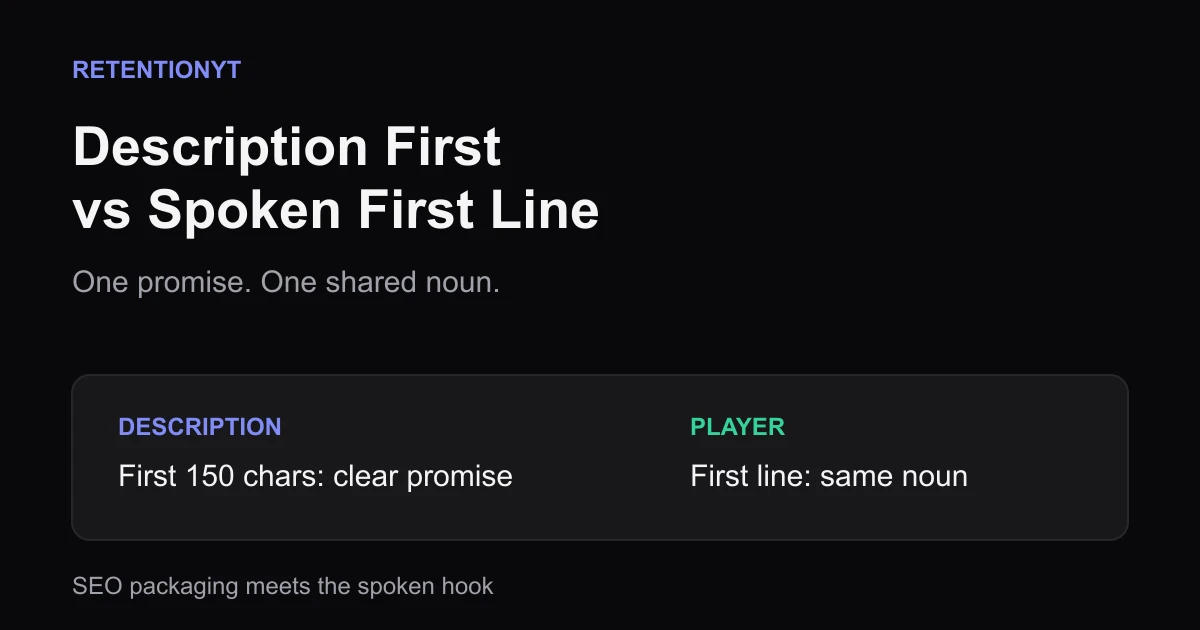
Description First 150 Characters vs Spoken First Line
Use the first 150 characters of your YouTube description as a clear search promise, then make your spoken first line deliver the same noun before the vlog detour.
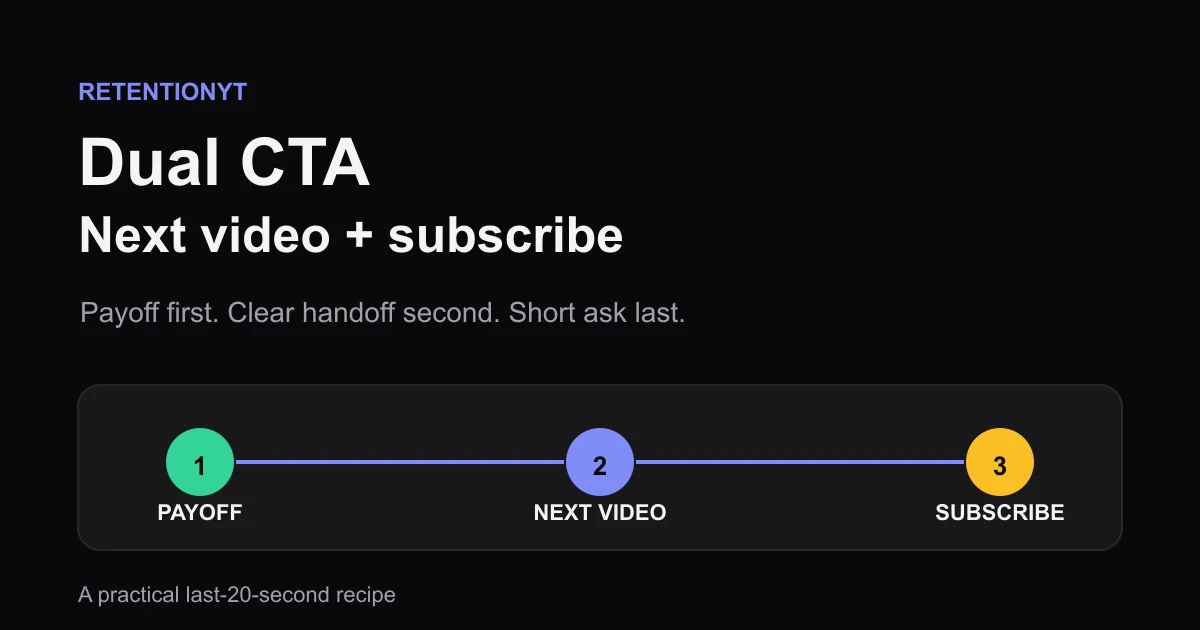
Dual CTA: Next Video + Subscribe Without a Cliff
YouTube outro subscribe and next video without a drop: a dual CTA script for the last 20 seconds, with the next-video title first and a short subscribe ask second.
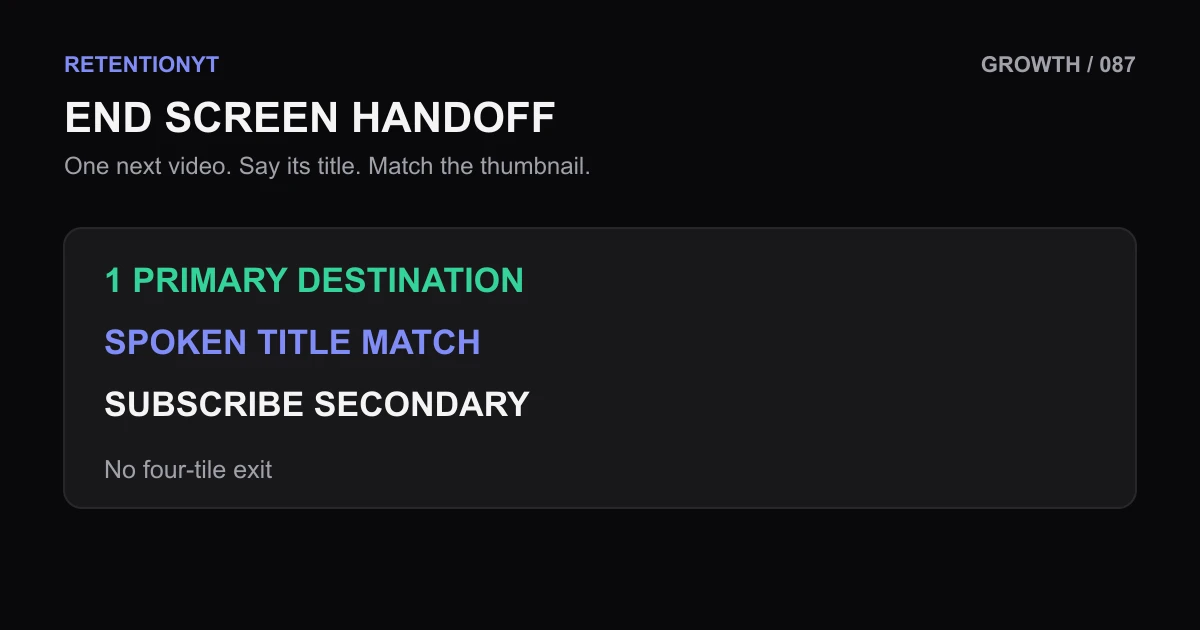
End Screen: One Next-Video Spoken Title That Matches the Thumbnail
Use one clear next-video end-screen element, speak its title verbatim, match the thumbnail promise, and keep the second element for subscribe instead of building a four-tile exit.