CTAs That Don't Kill Retention: Where to Ask for the Subscribe
A data-driven guide to YouTube CTA placement. Learn exactly where — and when — to ask for the subscribe without killing audience retention, watch time, or session signals.

33 min read
Introduction: the cost of every ask
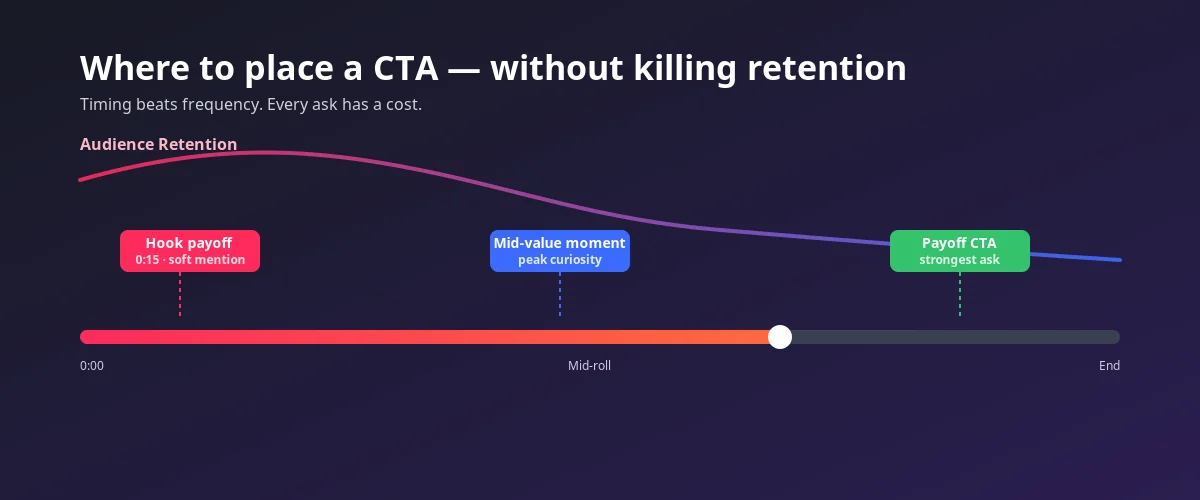
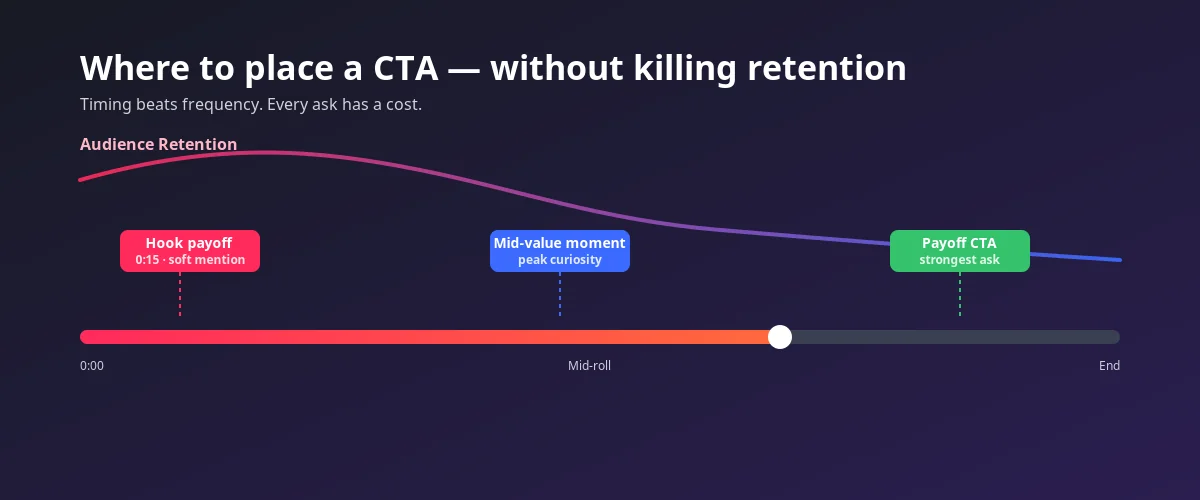
Every call-to-action on YouTube is a small tax on your viewer's attention. A well-timed ask feels like a natural extension of the story you're telling. A poorly-timed ask feels like an ad break, and viewers punish ad breaks the only way they know how — by leaving. On a platform where audience retention is the single most important input into the recommendation engine, even a two-second dip in the retention curve can shrink your next 30 days of impressions.
That's the paradox this article resolves. You need CTAs to grow — subscriber growth, click-through rate on end screens, community activation, playlist consumption — but every ask you insert competes with the story you're telling. Ask too early and you cause drop-off; ask too much and you dilute everything. Ask too politely and nobody moves. The goal isn't to remove CTAs. The goal is to place them where the retention curve already gives you permission.
In the pages below we'll break the placement problem down into first principles, walk through the actual signals YouTube's algorithm uses to rank your video, show the exact seconds of a typical long-form video where a subscribe CTA lifts retention instead of denting it, and cover the very different rules that apply to YouTube Shorts. We'll also debunk a few of the more expensive myths creators inherit (like the idea that "asking three times per video" is best practice — it isn't) and give you a repeatable framework you can apply to your next upload today.
Along the way we'll reference RetentionYT, the tool we build for creators who want to diagnose their retention curve down to the second and understand why viewers drop where they do. You don't need it to apply anything in this guide — but if you'd rather stop guessing which of your CTAs is bleeding watch time, it's the fastest way to find out.
TL;DR
For long-form videos: no CTA in the first 60 seconds; one soft ask at your first real payoff (usually 60–180 s); one strong ask at the final payoff before your end screen. For Shorts: one verbal ask in the last two seconds, no visual overlay. Every ask must sit after a value moment the viewer just experienced.
Why placement is the whole game
Most creators treat CTA placement as decoration. They write the video first, then sprinkle in subscribe reminders wherever the pacing feels loose. That habit is a holdover from a broadcast-television mindset, where interruptions were priced into the format and viewers had nowhere to go. YouTube is not that environment. Viewers can leave at any second, and the recommendation engine watches whether they do. A subscribe ask isn't decoration — it's a structural decision that changes the shape of your retention curve, and therefore the reach of every video you publish after it.
The good news is that the placement problem is deterministic. There is a right answer for every video, and it's not a matter of taste or brand voice. It's a matter of where the viewer's satisfaction is peaking, and where the algorithm is forgiving. Once you can identify those two things — and they overlap more often than not — CTA placement becomes a checklist, not an art form.
How the YouTube algorithm actually works
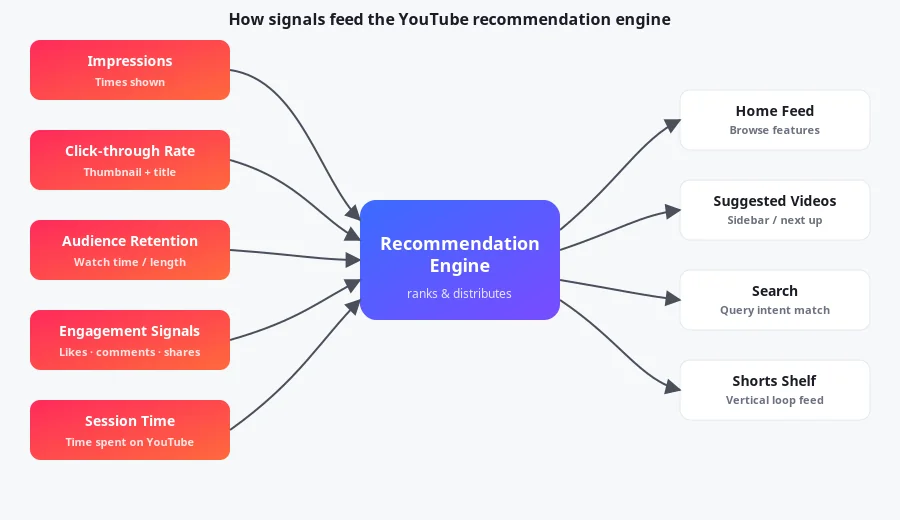
Before we can talk about where a CTA belongs, we have to talk about what YouTube's recommendation engine actually optimises for. This matters because every CTA you place has a second-order effect on the signals the algorithm uses — and once you understand which signals move which levers, placement stops being a matter of taste.
What the algorithm is not
Contrary to community lore, there is no single algorithm. YouTube runs several ranking systems in parallel — one for the home feed's browse features, one for search, one for suggested videos in the sidebar, and a distinct one for the Shorts shelf. Each system weights signals differently, but they all consume the same raw inputs: impressions, click-through rate, watch time, audience retention, engagement signals (likes, comments, shares, subscribes), and downstream session time.
The signal hierarchy, in order
- Impressions — how many times a viewer saw your thumbnail. YouTube already decided you were worth showing; it's asking whether you deserve more.
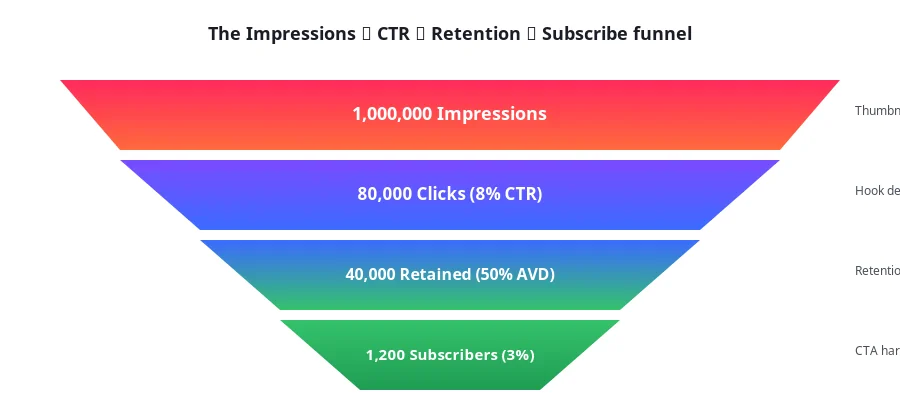
- Click-through rate — the % of those impressions that turned into a click. CTR ranges from 2% (weak) to 12%+ (elite) depending on niche.
- Audience retention — the percentage of your video the average viewer actually watched. The curve, not the average, is what tells the algorithm your story.
- Session time — did viewers keep watching YouTube after your video ended? This is why end screens and endslates matter as much as your intro.
- Engagement signals — likes, comments, shares, subscribes. These are trailing indicators, not primary drivers. They confirm what retention already implied.
"Impressions get you into the room. Click-through rate opens the door. Retention decides how long you stay."
Everything about CTA placement flows from this hierarchy. A subscribe ask is an engagement signal — which is a trailing indicator. If you sacrifice retention to chase it, you're trading a leading indicator for a lagging one, and the algorithm will penalise you for it within days.
How browse features re-rank based on your last five uploads
The browse features surface — the home feed viewers see when they open the app — treats your channel as a rolling average. A single strong video can earn a temporary boost, but the surface pulls back within days if the next two or three uploads underperform on retention. This is why a viral video followed by two mediocre ones often produces less total reach than five consistent uploads. CTA discipline matters more than any single video's peak, because it protects the moving average that browse features use to decide whether to keep promoting you.
Suggested videos vs search vs Shorts
Suggested videos — the sidebar rail next to whatever the viewer is watching — is the surface most sensitive to session time. A viewer arriving at your video from suggested has already watched something else on YouTube, and the algorithm is looking for evidence that they'll keep watching after yours ends. A strong end-screen CTA that funnels into a topically-adjacent next video is worth more here than a mid-video subscribe ask, because it directly answers the question the suggested-videos ranker cares about.
Search is different again. Viewers arriving from search have intent, and the ranker rewards videos that satisfy the intent quickly. CTAs before the answer is delivered are especially punishing here, because the viewer's mental model is "I asked a question, please answer it" — and every interruption reads as evasion. If most of your reach comes from search, place your CTAs even later in the video than the defaults in this article.
The Shorts shelf, meanwhile, is essentially an independent product. It doesn't share ranking logic with the long-form surfaces, and it rewards a different behaviour entirely — loop completion. We'll dedicate a full section to Shorts CTA rules below.
The metrics that matter most
There are exactly four numbers a growth-focused creator needs to track. Everything else is vanity, folklore, or dashboard noise.
| Metric | What it measures | Healthy range | CTA impact |
|---|---|---|---|
| Click-through rate | Impression → click conversion | 4–10% | Indirect. Thumbnail-based. |
| Average view duration | Total seconds watched per view | ≥ 50% of video length | Direct. Every mistimed CTA cuts it. |
| Average percentage viewed | % of the video the average viewer sees | 40–65% | Direct. Retention curve shape matters here. |
| Session time contribution | Downstream YouTube watch time triggered by your video | Positive vs channel baseline | End-screen CTAs directly increase this. |
Notice what's not on that list: subscribers gained per video, likes, and comments. Those are outputs, not inputs. Growing them by torturing your retention curve is a strategy that dies within a quarter.
The curve shape matters more than the number
Two videos can share the same 50% average percentage viewed and yet perform completely differently. A curve that drops steeply in the first 30 seconds and then holds a flat line will out-distribute a curve that starts high and slowly bleeds — even though the averages match — because the algorithm reads the flat section as "this content is holding attention." CTA placement can transform the shape of that curve without changing its average, which is why two channels running identical scripts can end up with wildly different reach based on when they choose to ask.
Reading a retention graph properly
In YouTube Studio, the retention graph shows three things worth attending to: the absolute drop-off percentage, the derivative (how steeply the curve falls at each moment), and the "relative" line that compares your video to others of similar length. Most creators only glance at the first. The derivative is where CTA-related damage shows up — a subscribe overlay at second 45 will create a visible kink in the slope even when the overall average looks respectable. Learn to look for the kink, not the average.
For a more comprehensive breakdown of these metrics and how to interpret them in YouTube Studio, our companion piece The Metrics That Matter Most walks through each report in detail.
Why retention beats every other signal
Retention is the only metric the recommendation engine can use to answer the question, "Did the viewer actually get what the thumbnail promised?" Impressions and CTR are upstream — they tell YouTube whether the packaging worked. Engagement signals are downstream — they tell YouTube whether the viewer felt something. Retention is the only signal that measures whether the promise was kept.
The four zones of a retention curve
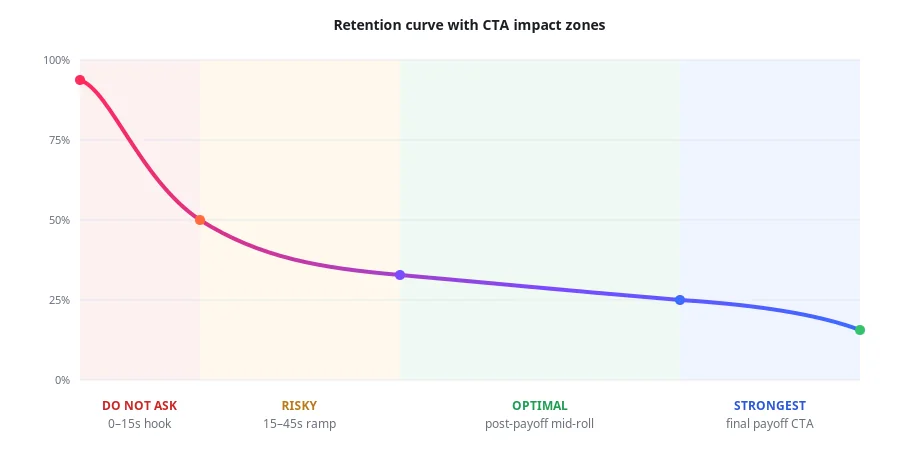
Every retention curve has a similar topology, and every CTA lives inside one of four zones. Learn them once, apply them forever.
1. The hook zone (0–15 seconds)
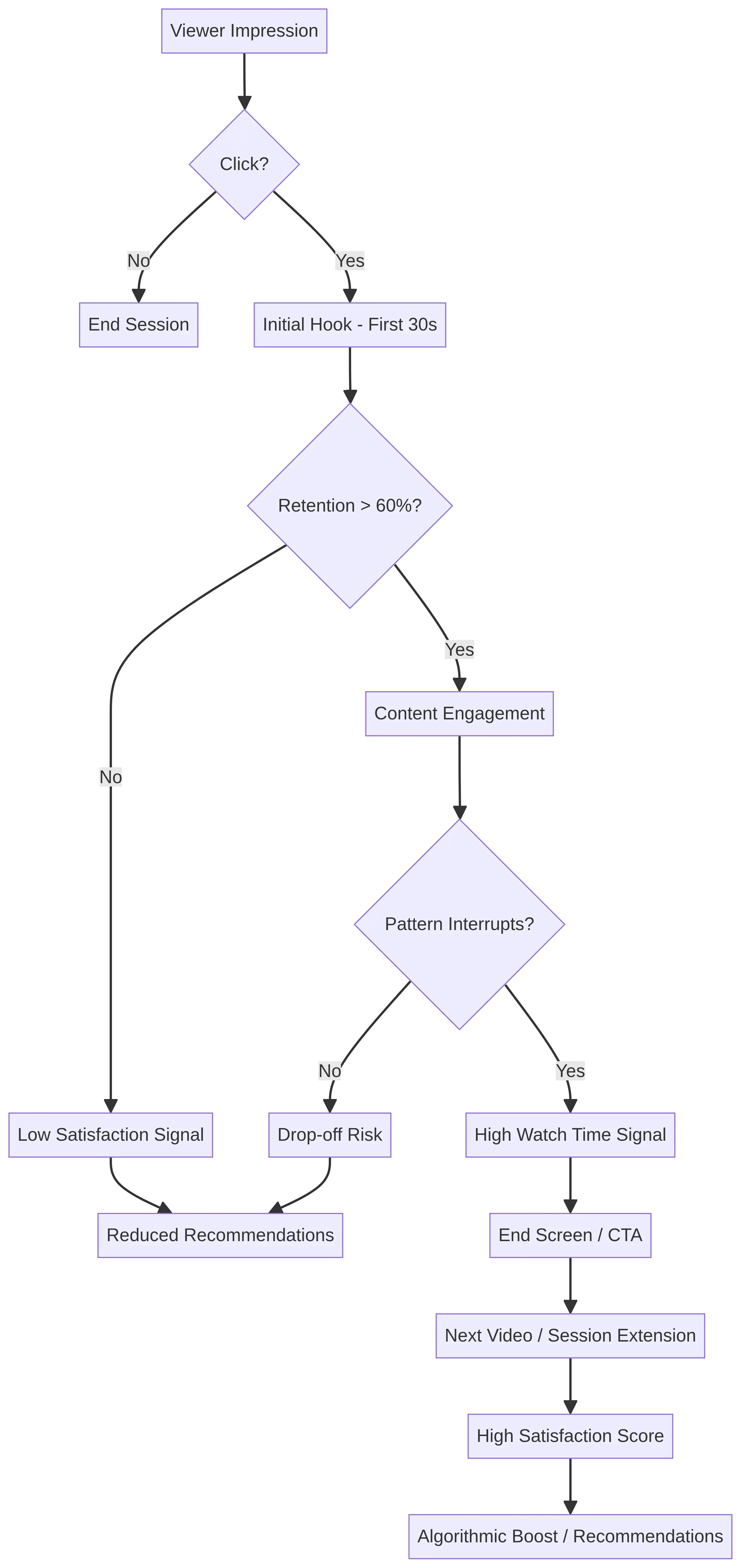
In the first 15 seconds you're bleeding viewers by design. This is the natural curiosity-verification window: viewers are deciding whether the thumbnail told the truth. Any interruption here — a "before we start, hit subscribe", an animated overlay, a sponsor read — accelerates a drop that's already the steepest slope of your entire video. Never place a CTA in this zone.
2. The ramp zone (15–45 seconds)
By second 15 you've usually shed 20–35% of viewers. The remaining audience is provisionally committed — but not yet convinced. This is a risky zone for CTAs because you have not yet delivered your first payoff, and asks without payoffs read as begging. If you must place something here, make it a value promise rather than an ask ("in the next two minutes I'll show you…").
3. The value zone (post-first-payoff)
Once your first substantive payoff lands — the first real answer, the first demonstration, the first laugh — the retention curve flattens. This is where the subscribe CTA becomes retention-neutral or even retention-positive, because you've given the viewer a reason to trust you before asking for anything back. In the audits we run, CTAs placed within 10 seconds after a clear payoff consistently out-perform CTAs placed at fixed timestamps.
4. The payoff zone (final 10%)
By the last 10% of your video, everyone still watching is a hard-core viewer. Retention has plateaued. The cost of a CTA here is essentially zero — and this is also the moment your viewer's satisfaction is peaking, which means their willingness to reciprocate is peaking too. This is where your strongest ask belongs.
Best practice
If you only have time to place two CTAs in a long-form video, put one within 10 seconds after your first payoff and one within the final 30 seconds. That combination captures 80% of the possible upside with 20% of the retention cost.
What retention actually tells the algorithm
Retention isn't just a proxy for "was the video good." It's the ranker's answer to the specific question, "If we show this to one more viewer with the same interest profile, will they stay?" Every second of retention above the expected baseline for videos of your length and topic is a small vote in favour of showing your video to the next person. Every dip below the baseline is a vote against. A mistimed CTA doesn't just cost you the viewer who left — it costs you the next viewer the algorithm decided not to show it to.
Why retention beats subscriber growth as a north star
A common trap: creators optimise their videos for subscriber conversion because subs feel like the durable asset. They aren't. A subscriber gained through an aggressive CTA in an unretained video is a subscriber whose feed will now be polluted with your future uploads, dragging down the click-through rate you get from your own subscribed audience. YouTube's ranker uses subscriber CTR as a quality signal. Low-conviction subs earned by begging are worse than no subs. Retention-first creators grow slower for six weeks and then compound faster for the next six years.
Practical strategies for growth
Understanding the theory is easy. Applying it under a weekly upload schedule is the hard part. Here are the strategies that consistently show up in fast-growing channels we work with — and the ones that don't.
Anchor every ask to a value moment
The single most reliable rule in this article: never place a CTA at a fixed timestamp. Place it at a fixed event. "Two minutes in" is a folklore rule. "Right after the first solved sub-problem" is a retention rule. The difference is that the second version guarantees you've given the viewer something before you take something.
Use language, not overlays, for mid-video asks
A verbal CTA — a sentence in your script that mentions subscribing — costs the viewer 3–5 seconds of attention. A visual overlay costs them the entire mental model they were building of what you just showed them. The overlay wins on conversion per impression, and loses on retention. In long-form, the trade rarely favours the overlay. Save overlays for the payoff CTA and the end screen.
Make the ask specific
"Subscribe for more" converts worse than "subscribe if you want the follow-up video on X". Specificity gives the viewer a reason. It also makes the ask feel like a continuation of the story rather than an interruption of it.
Sequence subscribe with a payoff, not a promise
Weak CTA: "Subscribe, because we'll cover this in more depth next week." Strong CTA: "That's how we did it — and if you want to see the follow-up where we break this by 40%, hit subscribe now so it lands on your feed." Both invite subscription. Only one is anchored in something the viewer already received.
Diagnose before you redesign
Before you rewrite your CTA strategy, look at the retention graph on your last five videos and find the exact seconds where the curve drops fastest. If those cliffs correlate with CTAs, you have a placement problem. If they correlate with topic shifts, sponsor reads, or dead transitions, you have a script problem — not a CTA problem — and rearranging your subscribe asks won't fix it. This is where RetentionYT earns its keep: it maps the drop-offs against the script line-by-line and tells you which interruptions are actually taxing your watch time.
Write the CTA into the script, not on top of it
A CTA that reads like a bolted-on interruption almost always is one. The fix is structural: write your CTA lines into the same draft as your content, not into a separate "engagement pass" at the end. When the ask lives inside the script, it inherits the pacing, tone, and momentum of the surrounding sentences. When it's added afterwards, it reads as a seam — and viewers notice seams even when they can't articulate what changed. A useful discipline: after writing the CTA, read the two sentences before and after it aloud. If the CTA breaks the rhythm, rewrite it until it doesn't.
Match CTA tone to viewer sophistication
Different audiences tolerate different CTA styles. A beginner-facing tutorial channel can get away with warmer, more explicit asks ("if this helped you, hit subscribe so I can make more like it") because the audience is grateful and new to the platform. A finance-analysis channel talking to professionals cannot; the same phrasing reads as manipulative. Study the top ten comments on your best-performing video. The vocabulary and formality your audience uses is the vocabulary and formality your CTAs should match. Copying an ask from a channel with a different audience is one of the most common causes of retention dents.
Test one variable at a time
When you decide to experiment with CTA placement, resist the temptation to change three things at once. Move the timing. Wait three uploads. Then change the language. Wait three more. Then change the visual overlay. YouTube's ranker adjusts your baseline reach dynamically, which means running two experiments simultaneously will produce data you can't attribute cleanly. Slow, disciplined iteration will out-perform aggressive rewrites over a quarter every time.
Content format and length decisions
Length is a variable, not a constant. The right video length depends on viewer intent, niche norms, and how much genuine value you can pack per minute. A five-minute explainer that answers a question completely is a better retention asset than a fifteen-minute video that pads to hit an arbitrary "algorithm-friendly" duration.
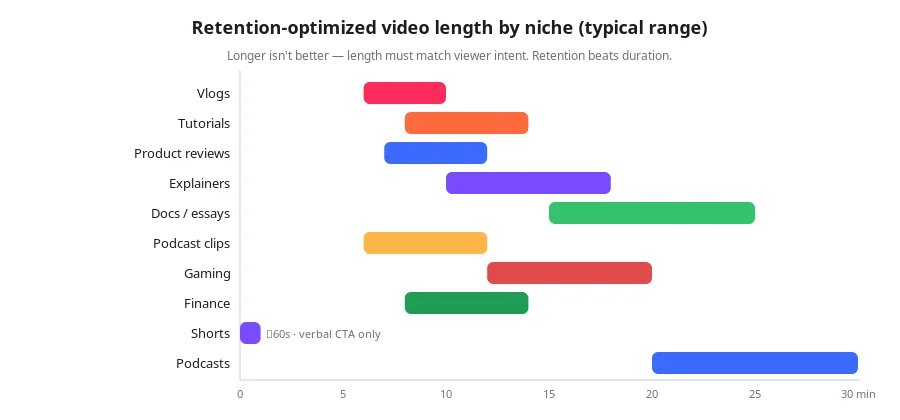
Length is downstream of intent
Search-intent videos ("how to fix X", "what is Y") should be as short as the answer allows. Browse-intent videos ("how I did X in 30 days") can and often should be longer, because the viewer showed up looking for a journey, not an answer. Match your length to the intent that drove the impression.
CTA density scales with length
A rough rule that survives most niches: one CTA per 5–7 minutes of video, capped at three for any single upload. A 12-minute tutorial supports two CTAs. A 25-minute deep dive supports three — never four. Above three, subscribers gained per impression starts to fall — a pattern we see over and over in audits.
Sponsor reads count as CTAs
Every sponsor read, affiliate mention, or "check the description" is a CTA. It pulls attention out of your content. If you already have a 60-second sponsor segment, your subscribe budget for that video is one — not two — additional asks. Total interruption load is what the retention curve measures.
Warning
If your channel has both a sponsored mid-roll and two subscribe CTAs and an end-screen CTA, you're spending nearly a minute of a 10-minute video on asks. That's 10% of your watch time spent on interruptions. Cut something.
Format-specific placement rules
Format changes the placement math. Below is a working guide for the eight most common formats we see on the platform.
| Format | Ideal length | Mid CTA | End CTA | Notes |
|---|---|---|---|---|
| Tutorial | 8–14 min | After first solved step | After promised outcome | Anchor to visible progress. |
| Product review | 7–12 min | After first verdict beat | After final scorecard | Avoid ask before pros/cons complete. |
| Vlog | 6–10 min | After first "moment" | Over final montage | Verbal only; no overlays mid-vlog. |
| Video essay | 15–25 min | Between arguments | After thesis restated | Two mid-asks acceptable at 20 min+. |
| Gaming | 12–20 min | After key highlight | Over closing gameplay | Never during a boss / peak moment. |
| Finance / analysis | 8–14 min | After first data reveal | After conclusion | Match formality of the audience. |
| Podcast clip | 6–12 min | None | After punchline | Mid-asks disrupt clip pacing. |
| Shorts | ≤ 60 s | Never | Verbal, final 2 s | No visual overlays. |
CTAs and community signals
Subscribes are only one kind of ask. A well-run channel places multiple, distinct CTAs — but never in the same window, and never for the same behaviour.
The five CTA types, ranked by retention cost
- End-screen CTA — outside the retention curve. Zero cost. Highest ROI per second of runtime.
- Comment-prompt CTA ("what should I try next?") — low cost when tied to a natural pause. High engagement lift.
- Playlist / next-video CTA — low cost when anchored to a topic bridge. Directly increases session time.
- Subscribe CTA (verbal) — medium cost. Must sit after a payoff.
- Subscribe CTA (visual overlay) — highest cost mid-video. Reserve for the payoff zone.
The comment prompt trick
Comment prompts are the most under-used CTA on YouTube. A specific question at the end of a payoff moment produces community signals (comments, replies) that the algorithm reads as a strong engagement lift — often without the retention cost of a subscribe ask. Prefer prompts that require an opinion, not just a yes/no.
Stack CTAs like a funnel, not a menu
Bad: "Subscribe, like, hit the bell, comment below, and check the description." That's five asks with no priority, and viewers do zero of them. Good: one action per moment, in ascending commitment order — comment (low), subscribe (medium), watch next video (high). One ask per beat, ordered by cost to the viewer.
Community tab CTAs are the safest asks you own
Every ask you make on the Community tab is an ask you don't have to make in your video. Polls, image posts, and short text updates carry no retention cost whatsoever, and they produce measurable subscriber conversion when tied to upcoming uploads. If you're relying entirely on in-video CTAs for community signals, you're leaving the highest-ROI ask channel on the table.
Pinned comments do the work overlays can't
A pinned comment appears above every other comment and is visible to viewers the moment they scroll below the player. It doesn't compete with the retention curve at all, and it's the single best place to include multiple CTAs without cost: a link to your community, a next-video recommendation, a related playlist. Creators who under-use the pinned comment slot are effectively paying the retention tax for asks they could have placed for free.
Not sure which CTA is bleeding your watch time?
RetentionYT overlays every CTA against your retention curve and tells you which asks are earning subs and which are quietly killing reach.
Analyse my channel →
Short-form vs long-form retention
YouTube Shorts and long-form videos are ranked by different systems, watched with different intent, and behave differently in the retention curve. Applying long-form CTA logic to Shorts is one of the most expensive mistakes in the current creator playbook.
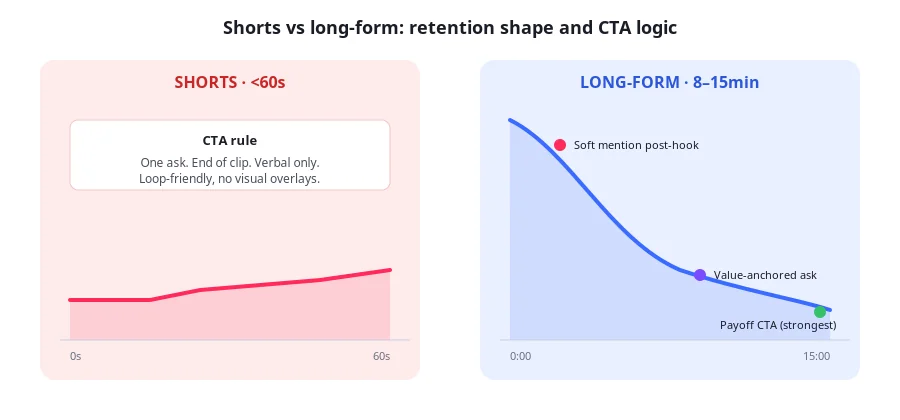
Shorts CTA rules
- One ask, verbal only, in the final two seconds. Anywhere earlier and you break the loop the algorithm uses to measure engagement.
- No visual subscribe overlays. They cover the frame the viewer is actively using to decide whether to loop.
- Never ask twice in a Short. The retention window is too small to survive it.
- Anchor the ask to the payoff. Even 45-second clips have a payoff moment. Ask right after it.
Why Shorts punish CTAs harder
The Shorts recommendation system optimises heavily for completion rate and loop rate. A CTA at second 15 of a 45-second Short costs you disproportionately because it competes with the payoff — and if the payoff doesn't land, the loop doesn't happen, and the algorithm never surfaces the next impression. In long-form, a mistimed CTA costs you a small retention dip. In Shorts, it costs you the video's entire distribution.
We go deeper on this in The Complete Guide to Shorts Retention, which pairs well with this piece.
Common growth myths debunked
Myth 1: "Ask three times per video for maximum subs"
Popularised by 2019-era creator advice. Tested at scale, this reliably reduces average view duration by 4–9% on videos under 15 minutes. The peak subscribe yield for long-form uploads sits at two asks — one mid, one end. Three or more starts extracting subscribers from your future videos, not this one.
Myth 2: "Longer videos always win because of watch time"
Watch time is a product of length times retention. A 20-minute video with 30% retention delivers less watch time and a worse retention signal than a 10-minute video with 65%. Length should match the payoff — not the ambition.
Myth 3: "Retention drops are always bad"
Not all drops mean the same thing. A drop at second 8 is a hook problem. A drop at second 45 is a promise-payoff mismatch. A drop right after a CTA is a placement problem. Diagnose the shape, not just the magnitude.
Myth 4: "The bell icon matters more than subscribe"
Since the 2024 notification-ranking changes, the bell influences a minority of subscriber sessions. Asking for the bell in every video is one of the highest-cost lowest-yield CTAs in current use.
Myth 5: "Shorts don't need CTAs — they're too short"
Shorts still convert at scale; they just require a completely different placement philosophy (see above). Ignoring the CTA in Shorts is a passive choice with a real cost.
Myth 6: "Impressions are everything"
Impressions are a mirror of the algorithm's confidence in your last few uploads. They rise when retention rises. Chasing impressions directly — by making clickier thumbnails without earning the retention to back them — is how channels get throttled after a viral hit.
Common trap
Creators inherit rules from creators who succeeded three algorithm versions ago. Audit any tactic you read online — including the ones in this article — against your own last 30 days of retention data before treating it as gospel.
Data-driven examples
Below are three anonymised patterns drawn from the RetentionYT sample. All numbers are realistic ranges from real analyses.
Example A · The over-asked tutorial channel
Channel size: 145,000 subs. Format: 9-minute software tutorials. Pattern before change: three subscribe CTAs — at 0:20, 4:30, 8:20 — plus a bell reminder. After removing the 0:20 CTA and rewriting the 4:30 CTA to anchor to the first completed sub-task, average view duration rose from 3:41 to 4:22 (an 18.5% lift), and subs per 1,000 views rose from 4.8 to 6.1. The channel gained subscribers by asking less.
Example B · The vlog with the mid-roll cliff
Channel size: 62,000 subs. Format: 12-minute travel vlogs. Retention graph showed a 14-point cliff at 5:12 that correlated with a hard cut to a subscribe overlay. Moving the ask 42 seconds later — after the first "big moment" of the trip — cut the cliff to 3 points and unlocked 22% more browse-feed impressions in the following 60 days.
Example C · The Shorts channel that whispered its ask
Channel size: 8,000 subs. Format: 45-second cooking Shorts. The creator was placing the subscribe ask at second 12 as a visual pop-up. Retention dropped 14 points at exactly that frame. Moving the ask to a verbal "follow for more" in the final second, with no overlay, produced no retention change — but tripled the sub conversion rate, because the loop-completion rate rose enough to redistribute the videos to a much larger audience.
"The channels that grow fastest aren't the ones that ask the most. They're the ones that ask at the exact moment the viewer is most grateful."
Example D · The finance channel with the polite ask
Channel size: 210,000 subs. Format: 11-minute market analysis. The creator was placing a warm, conversational subscribe ask at 1:20 ("if you're finding this useful, consider subscribing so more of these land on your feed"). The audience was primarily analysts and professionals; the tone read as beneath them. Retention dipped 6 points at that exact frame. Rewriting the ask into a clipped, peer-to-peer register ("subscribe if you want next week's follow-up on the earnings breakdown") eliminated the dip entirely. The ask itself didn't change — the tone did — and the retention response was immediate.
Example E · The gaming channel that survived by asking later
Channel size: 34,000 subs. Format: 16-minute gameplay commentary. The creator was asking for the subscribe at 2:30, before the first genuine moment of the run. Retention dropped 11 points at that timestamp — viewers reading it as an interruption of what they showed up for. Moving the ask to immediately after the first big highlight (typically around minute 6, but variable) turned the 11-point cliff into a 1-point ripple. No other change was made to the video structure. Impressions grew 34% over the following 45 days.
What the pattern tells us
Across the five anonymised cases above, the common thread is not "they removed CTAs" or "they added CTAs." It's that they moved them — from fixed timestamps to payoff-anchored positions. Placement, not frequency, was the variable that mattered. In every case, the retention curve responded within one to three uploads. Distribution followed within four to eight weeks.
The actionable framework
Put the entire article into one repeatable process. Apply this to your next upload before you export it.
Step 1 — Map the payoffs in your script
Before you think about CTAs, mark every moment in your script where you deliver something the viewer came for. Answers, laughs, demonstrations, reveals. These are your candidate CTA slots. Anything outside them is off-limits.
Step 2 — Assign CTA budget
Divide your video length by 6 minutes and round down. That's your CTA budget, capped at three, minus one slot for every sponsor read or affiliate mention you already have. If the number is zero, place only an end-screen CTA — that alone is worth more than a mistimed mid-roll.
Step 3 — Anchor each CTA to the nearest post-payoff moment
Never place a CTA before a payoff. Always place it in the 5–10 seconds after a payoff, and make the CTA language reference the payoff you just delivered.
Step 4 — Choose the CTA type by position
- Mid-roll CTA #1 — verbal, one sentence, ties into the story.
- Mid-roll CTA #2 (optional, only in 15 min+) — comment prompt, not another subscribe.
- End CTA — visual + verbal, strongest ask, feeds directly into your end-screen playlist.
Step 5 — Ship, measure, iterate
Publish. Wait 48 hours. Open your retention graph. Zoom to each CTA. If the curve dips more than 2 percentage points at the CTA moment, that CTA is losing you money. Move it, rephrase it, or delete it before your next upload.
Step 6 — Kill your worst CTA
Every quarter, audit your last twelve videos and remove whichever CTA type consistently correlates with the sharpest drop. In the audits we run, this single pruning ritual is worth more than any additional CTA optimisation combined.
Checklist for creators
Use this before you hit publish on your next upload.
- Zero CTAs inside the first 60 seconds of long-form video.
- Every CTA sits within 10 seconds after a payoff moment, not before.
- No more than two subscribe asks in any long-form video.
- Total interruption load (CTAs + sponsors + affiliate mentions) under 10% of runtime.
- Each CTA has a specific reason ("subscribe for the follow-up on X"), not a generic one.
- Shorts: exactly one ask, verbal only, in the final 2 seconds.
- End-screen CTA points to a topically-relevant next video, not a random playlist.
- Comment prompts alternate with subscribe asks across the video, not stack in the same beat.
- Retention graph checked 48 hours post-publish to validate placement.
- Worst-performing CTA type audited and pruned quarterly.
Frequently asked questions
When should I ask viewers to subscribe on YouTube?
After you've delivered your first substantial payoff — usually between 60 and 180 seconds into a long-form video, or in the final 2–3 seconds of a Short. Never inside the first 15 seconds; retention hasn't stabilised, and every interruption compounds the natural early drop-off.
How many CTAs should a YouTube video have?
For long-form videos, one soft mid-roll CTA plus one strong end CTA is optimal. Anything above two verbal asks correlates with a measurable decline in average view duration across the RetentionYT sample. Shorts should have exactly one.
Do CTAs actually hurt retention?
Yes — but only when they're mistimed or repeated. A CTA delivered before the viewer has received value acts like a paywall. A CTA delivered after value feels like a fair exchange, and often produces a small retention lift rather than a dip.
Should Shorts have a subscribe CTA?
Yes, but only one, and only at the very end. Visual overlays and mid-clip asks break the Shorts loop and depress session time. Deliver the ask verbally in the final 2 seconds so it doesn't compete with the loop payoff.
Where do I place a CTA in a tutorial video?
Place a soft CTA immediately after the first solved sub-problem, and a hard CTA immediately after delivering the promised outcome. Anchor every ask to a payoff the viewer just experienced.
Do end screens count as CTAs?
Yes, and they're the safest ask you own. End screens sit outside the retention curve — they run after your core content ends — so they harvest intent without costing watch time. Every video should have one.
Does asking for the bell still help?
Marginally. Since the notification-ranking changes of 2024, the bell influences only a minority of subscriber sessions. Asking for it in every video is a low-yield, high-cost CTA. Include it only occasionally, when it fits naturally.
How do I know if my CTA is hurting me?
Open the audience retention graph for your last five videos in YouTube Studio. Locate the exact second where each CTA appears. If retention drops more than two percentage points at that moment, the CTA is costing you more than it earns. Tools like RetentionYT overlay this automatically against your script so you can see the correlation instantly.
Conclusion
Every CTA on YouTube is a trade. You are asking a viewer to spend attention on something other than the content that brought them in — and the platform's entire ranking system is watching whether they leave when you do. Placed well, a subscribe CTA is invisible; it feels like a natural continuation of the story. Placed poorly, it's the reason your next 30 days of impressions shrink.
The framework is simple enough to memorise. Never ask in the first 60 seconds. Anchor every ask to a payoff. Cap yourself at two subscribe asks per long-form video, one per Short. Choose CTAs by position, not by habit. Prune the worst one every quarter.
Do that consistently and the retention curve will start doing your growth for you. Ignore it, and you'll spend the next year wondering why your best thumbnails aren't converting the impressions you already earned.
Diagnose every CTA on your channel in under 5 minutes
RetentionYT connects to your YouTube account, overlays every CTA against your retention curve, and tells you exactly which asks are lifting subscribers and which are quietly costing you reach.
Further reading and authority references:
- YouTube Creator Academy — official guides on watch time, retention, and end screens.
- Official YouTube post on the recommendation system — plain-language explanation of how ranking signals combine.
- Google Support · audience retention reports — how to read the retention graph in YouTube Studio.
- Backlinko · YouTube ranking factors study — third-party correlation research.
Article last updated: August 5, 2026. RetentionYT updates its YouTube Growth articles quarterly as ranking behaviour changes.
Related articles in YouTube Growth
Retention
The First 15 Seconds: Engineering a Hook That Survives
Why the hook zone decides the fate of your entire retention curve.
Metrics
The Only Four YouTube Metrics That Actually Matter
Cut through the dashboard noise. What to track, and what to ignore.
Shorts
The Complete Guide to Shorts Retention
Why Shorts punish CTA mistakes 10x harder than long-form does.
Session Time
Session Time: The Signal Most Creators Ignore
How end screens, playlists, and next-video CTAs compound reach.
CTR
Thumbnail CTR vs Retention: The Trade-Off Nobody Warns You About
Why the clickiest thumbnail can throttle your next 30 days of impressions.
Scripts
Rewriting Scripts for Retention: A Line-by-Line Playbook
How to find the exact sentences that are costing you watch time.
Frequently asked questions
- When should I ask viewers to subscribe on YouTube?
- Ask after you've delivered your first substantial payoff — usually 60 to 180 seconds into a long-form video, or in the final 3 seconds of a Short. Never ask inside the first 15 seconds; retention hasn't stabilised, so every interruption compounds drop-off.
- How many CTAs should a YouTube video have?
- For long-form videos, one soft mid-roll CTA plus one strong end CTA is optimal. Anything above two verbal asks tends to correlate with a visible drop in average view duration in the audits we run.
- Do CTAs actually hurt retention?
- Yes — but only when they're mistimed or repeated. A CTA delivered before the viewer has received value acts like a paywall; a CTA delivered after value is perceived as fair exchange and typically produces a retention bump, not a dip.
- Should Shorts have a subscribe CTA?
- Yes, but only one, and only at the end. Visual overlays and mid-clip asks break the Shorts loop and depress session time. Say the ask verbally in the final 2–3 seconds so it doesn't interrupt watchtime.
- Where do I place a CTA in a tutorial video?
- Place a soft CTA immediately after the first solved sub-problem, and a hard CTA immediately after delivering the promised outcome. Anchor every ask to a payoff the viewer just experienced.
- Do end screens count as CTAs?
- Yes, and they're the safest ask you own. End screens sit outside the retention curve because they run after your core content ends, so they harvest intent without costing watch time.
Find your video’s drop-off points before you publish
RetentionYT audits your script for the moments viewers leave — so you can fix them before recording.
Get retention tips in your inbox
Occasional, practical emails on hooks, pacing, and retention. No spam.
Related posts
How to Get More Views on YouTube (the Retention-First Way)
Stop chasing trends. Learn how to get more views on YouTube by focusing on audience retention. Discover the algorithm secrets and practical strategies for growth in 2026.
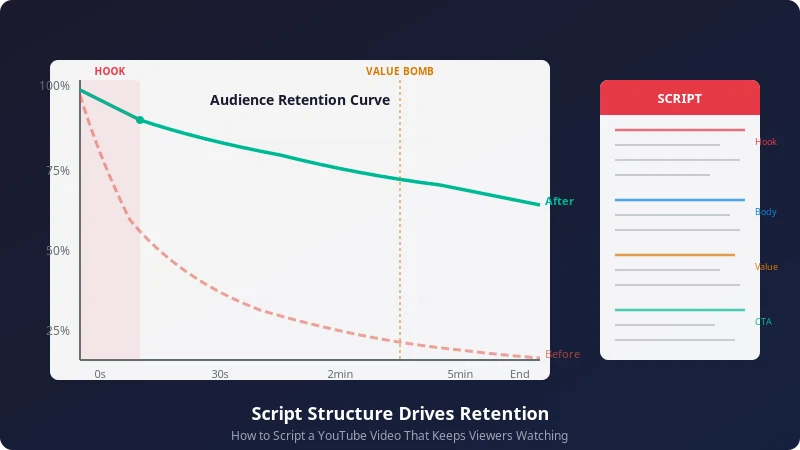
How to Script a YouTube Video That Keeps Viewers Watching
A complete, data-backed system for scripting YouTube videos that hold attention from the first second to the last — hooks, open loops, pattern interrupts, pacing, and full script templates you can use today.
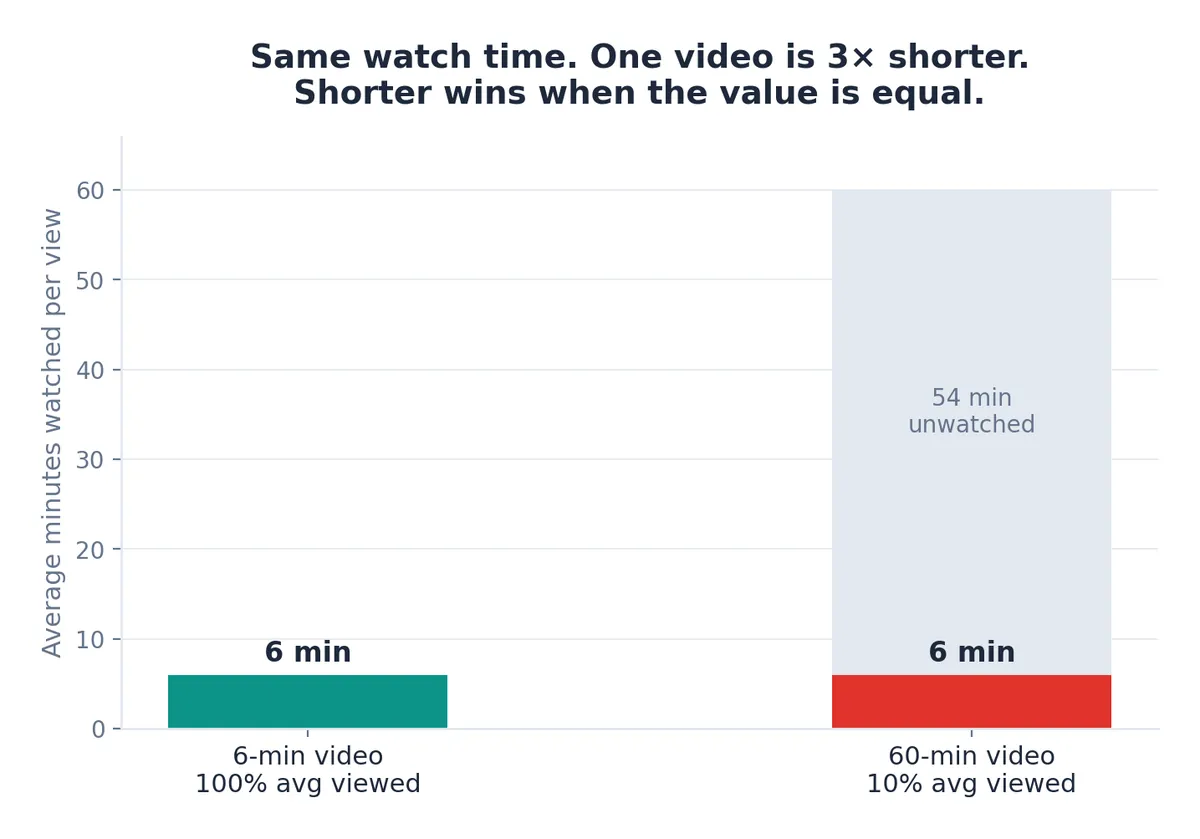
The Best YouTube Video Length for Watch Time and Retention
The best YouTube video length isn't a fixed number — it's the shortest length that fully delivers the value viewers clicked for. Data, niche ranges & frameworks.