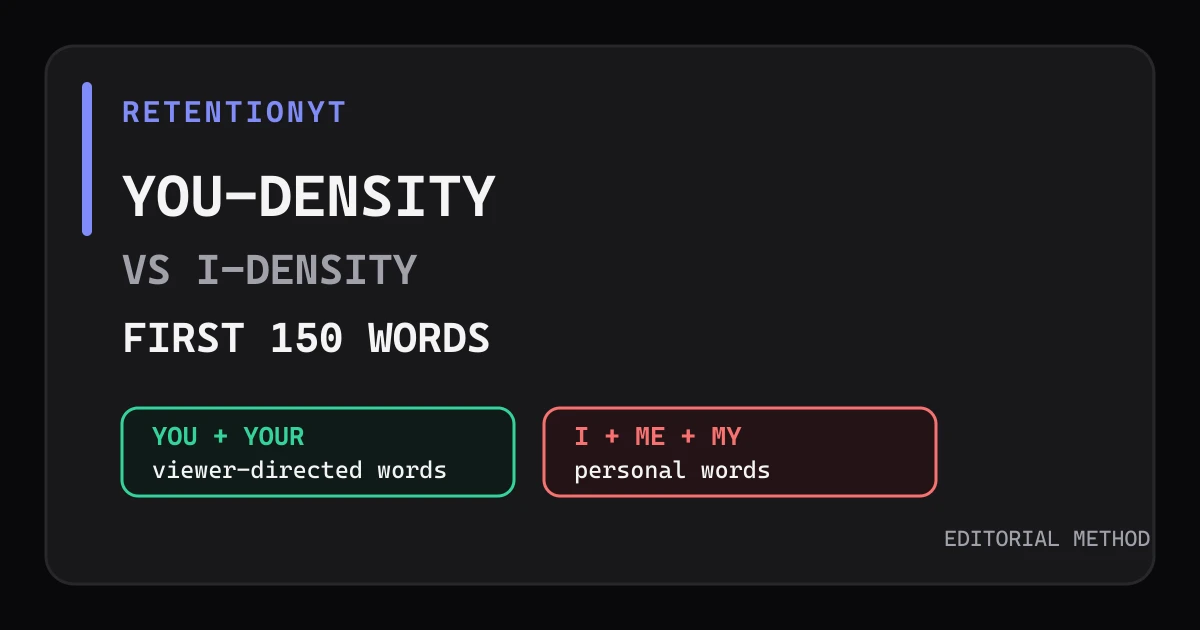
You-Density vs I-Density in the First 150 Words
Use you more than I in a YouTube script intro by counting the first 150 words, spotting diary-style openings, and rewriting the hook for the viewer.

9 min readUpdated
In this guide
If the first 150 words contain 12 I's and only 2 you's, the intro probably starts as a diary. Count the two groups before you film, then rewrite the first sentence around the viewer's problem, desired result, or risk. Growth videos usually tilt toward you; a confession can invert the count when the confession is the hook.

What You-Density vs I-Density in the First 150 Words actually is (and what it is not)
You-density is an editing lens. Take the first 150 spoken words, mark you and your, then mark I, me, and my. The result tells you which person occupies more of the intro's language: the viewer or the creator.
That is a craft diagnostic, not a YouTube rating. It does not predict a view count, replace a retention graph, or prove that one pronoun caused a drop-off. It gives you a fast question to answer while the script is still cheap to change: does a new viewer recognize their situation before you explain your backstory?
| Lens | Growth-video default | Confession or case-study exception |
|---|---|---|
| Primary subject | The viewer's problem, goal, fear, or choice | The creator's experience is the promised story |
| Useful first-person line | One line that establishes credibility or stakes | Several lines may be necessary to tell the event honestly |
| Count to run | you plus your against I, me, plus my | Run the same count, then label why the personal tilt is intentional |
| Rewrite question | Can the viewer see the payoff in sentence one? | Is the confession itself the payoff, or is this only warm-up? |
Where RetentionYT fits
Manual method works alone. Product shortens the loop. Link RetentionYT once here.
Why this shows up in YouTube Studio
The count is made in your script, but the reason to keep it practical is that your published video has performance context you can review. The locked YouTube Help page for the Content area says it gives an overview of how an audience finds, watches, and interacts with content, and that the Content tab is available at the channel level (Source 2, August 2026). That is context for your review, not evidence that YouTube calculates You-Density.

Worked example 1: the failure
Here is an illustrative failure, not YouTube data. The creator is making a growth video about fixing a weak script intro. The first 150 spoken words begin with a personal diary: “I was sitting at my desk. I opened my old draft. I remembered how nervous I felt...” The viewer's problem arrives late.
Illustrative count: you plus your = 2; I, me, plus my = 12. The personal group wins by a wide margin, but the count alone is not the defect. The defect is that none of those first-person lines establishes what the viewer will learn or why the next seconds matter.
| Illustrative first-150-word check | Count | Editorial reading |
|---|---|---|
you plus your | 2 | The viewer is barely addressed |
I, me, plus my | 12 | The creator occupies the opening |
| Difference | 10 | A clear diary tilt in this example |
| Immediate fix | 1 sentence | Name the viewer's problem before the backstory |
Worked example 2: the fix
Now keep the same topic and make the viewer the subject: “If your YouTube intro starts with your morning, your viewer has to wait for the reason to stay. Count the first 150 words, compare you with I, and rewrite the first sentence before you record. I’ll show you a failure, a fix, and the exception for confession videos.”
This version gives the viewer a recognizable problem immediately, names the 150-word method, and previews a route. It still uses first person once, but that line supports the promised demonstration instead of opening a diary. These numbers are illustrative counts for the sample rewrite, not a platform benchmark.
In the rewrite, count again and listen for the job of every sentence. A higher you-density is useful only when the words are specific: “your first 8 seconds,” “your viewer,” and “your promised result” point toward decisions. Vague “you can improve” language may inflate the count without making the hook more useful.

How to check this in YouTube Studio (step by step)
The count happens before or beside Studio; it is not a built-in You-Density report. Use YouTube Studio for the surrounding performance workflow, and keep the manual check tied to the exact upload.
- Paste the words you actually plan to say into a plain text note. Remove stage directions, camera instructions, and silent b-roll descriptions.
- Stop at word 150, or at the end of the intro if it is shorter. Mark the boundary so a later edit does not quietly change the sample.
- Highlight
youandyourin one colour. HighlightI,me, andmyin another. Record both totals and the date of the draft. - Write the viewer's promised outcome in one sentence. If you cannot name the outcome, the count is warning you about a missing hook, not merely a pronoun imbalance.
- After publishing, sign in to Studio, select the relevant content, open its Analytics, and use the available performance area. The locked YouTube Help page describes that computer path for the Reach area (Source 1, August 2026).
- Compare the saved intro and the published opening without claiming that the count caused the result. Note the upload date, any title or thumbnail change, and what you will test next.
The source pages support the navigation and metric context above, but neither defines “You-Density vs I-Density in the First 150 Words.” Keep that distinction visible in your notes. Manual craft method on one side; platform reporting on the other.

The trap
The trap is worshipping the ratio. A script can say “you” ten times and still feel self-centred if every line is vague, manipulative, or unrelated to the title. Conversely, a confession can use “I” more often and be exactly right when the personal event is the promised value.
Use the count to find the first question, not to manufacture a score. Ask what the viewer can recognize, do, or anticipate in the next eight seconds. Then ask whether the opening visual proves the sentence. If the words and image point in different directions, changing pronouns will not solve the larger mismatch.
The trap
The move

What to do in the next upload
Before you record, make the count a two-minute gate. Do not wait for a polished draft. Paste the rough intro, mark the boundary, rewrite the first sentence, and read the new version at the pace you will use on camera.
Use the checklist below for a growth video. For a confession, keep the first-person tilt only when you can name the story payoff and label the exception in your notes.
- Paste the spoken intro, not the outline.
- Mark the first 150 words or the complete shorter intro.
- Count
youandyour. - Count
I,me, andmy. - Write the two totals and the draft date.
- Name the viewer's problem in sentence one.
- Keep personal context only when it creates stakes.
- Read the rewrite aloud before filming.
- Save the final intro beside the upload record.
- Review performance context without claiming causation.
If you want a second pass on the wording, use the YouTube script review tool after you have done the manual count. For the next planning step, compare this intro check with the YouTube script guide and the script outline template. The goal is not to eliminate your voice. It is to make sure your voice earns the seconds it takes before the viewer sees the promised value.
Count the first 150 words before you defend the first 150 words.
Frequently asked questions
- Should I say you or I in a YouTube hook?
- For most growth videos, start with you because the viewer is deciding whether the promise fits them. Use I when your personal experience is the reason to watch, such as a confession or case study. Count the first 150 words, then make sure the personal context earns its place instead of delaying the viewer's problem.
- What is you-density?
- You-density is a simple editorial count: the number of viewer-directed words such as you and your in a defined script sample. In this method, the sample is the first 150 words. It is a rule of thumb for checking whether an intro addresses the viewer, not a native YouTube Studio metric or a published benchmark.
- Do vlogs break this rule?
- No. A vlog can open with I when the confession, surprise, or personal stake is the actual hook. The test is whether the first sentence gives a new viewer a reason to care. If the story is only a diary entry, add the viewer's question, consequence, or promised payoff before the background.
- How many words should I count?
- Count the first 150 words for this method, including the spoken intro but excluding stage directions that the viewer never hears. Stop at the word boundary, mark every you or your and every I, me, or my, and record the totals. Treat the number as an editing checkpoint, not a scientific score.
- Does this apply to Shorts?
- Use the same idea, but adapt the sample to the Short's opening rather than forcing 150 words into a much shorter script. Mark the first complete hook and count its viewer-directed and personal words. The shorter the format, the more important it is to reach the viewer's situation before adding context.
- How do I apply “You-Density vs I-Density in the First 150 Words” on my next upload?
- Paste your spoken intro into a plain text document, trim it to the first 150 words, and highlight the two pronoun groups. Write one replacement sentence that names the viewer's problem or desired result, recount the sample, and read it aloud. Keep the personal line only if it creates stakes or proves the promise.
- Where in YouTube Studio do I check “You-Density vs I-Density in the First 150 Words”?
- You do not check this phrase as a built-in Studio report. Keep the count beside your script, then use YouTube Studio to review the video's available performance context after publishing. The locked YouTube Help pages describe Content and Reach areas, but they do not define a You-Density metric, so do not present your count as an official score.
- What is the most common mistake with “You-Density vs I-Density in the First 150 Words”?
- The common mistake is treating the ratio as a law and deleting every first-person sentence. That can flatten a confession or case study. The useful question is whether each I, me, or my line earns its seconds. In a growth video, rewrite diary-style setup toward the viewer; in a confession, label the exception and deliver the story.
Give your next script a second look
Paste a script into RetentionYT for suggestions on your hook, pacing, and structure. Choose the edits that serve your video, then check audience behavior in YouTube Analytics after publishing.
Get retention tips in your inbox
Occasional, practical emails on hooks, pacing, and retention. No spam.
Related posts
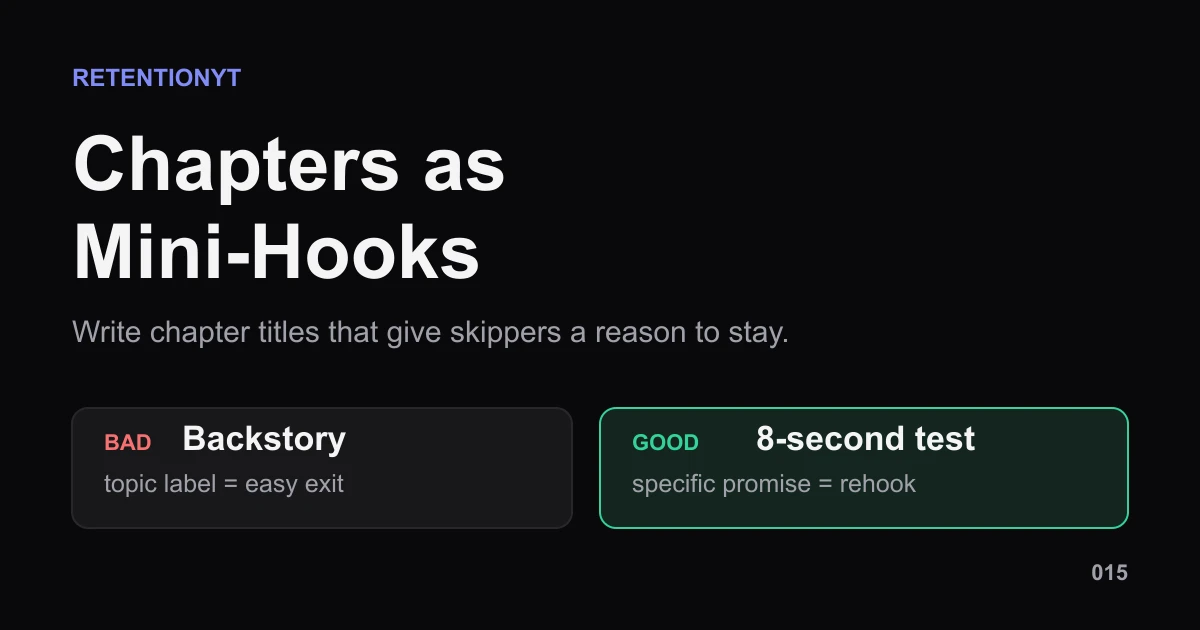
Chapters as Mini-Hooks: Writing Chapter Titles That Don't Leak Viewers
Learn how to write YouTube chapter titles that protect retention: turn spoilers into mini-hooks, add a five-second recap, and check the cut in Studio.
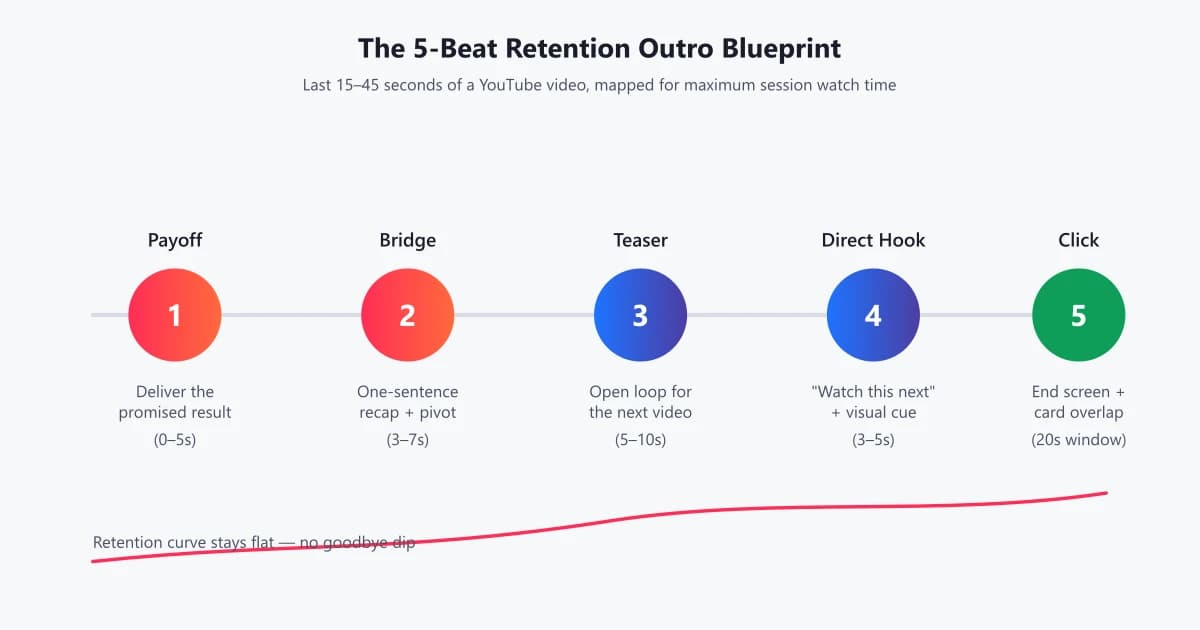
How to End a YouTube Video: Outros That Keep Viewers Watching
'Thanks for watching' is where retention goes to die. Learn how to script YouTube outros that hand viewers straight into the next video — with templates, WPM pacing data, and before/after examples.

How to Script a Talking-Head Video (Without Sounding Robotic)
A complete, retention-first framework for scripting talking-head videos that sound natural, hold attention, and outperform improvised takes. Templates, pacing data, and word-choice principles inside.