The Best YouTube Video Length for Watch Time and Retention
The best YouTube video length isn't a fixed number — it's the shortest length that fully delivers the value viewers clicked for. Data, niche ranges & frameworks.

34 min readUpdated
The best YouTube video length is not a fixed number. It is the shortest length that fully delivers the value your viewer clicked for — and this guide shows you how to find it, prove it, and build your channel around it.
The short answer
The best YouTube video length is the shortest runtime that fully delivers the value promised in your title and thumbnail. For most tutorials, reviews, and how-to content that lands between 6 and 15 minutes. For podcasts, interviews, and documentaries it can exceed an hour. Length is an output of your script — never a target you pad toward.
Why "how long should my video be?" is the wrong question
Every week, thousands of creators search for a magic number. Eight minutes. Ten minutes. Twelve minutes and thirty seconds. The hope is understandable: if a specific runtime unlocked the YouTube algorithm, hitting it would be the easiest growth lever on the platform.
Here is the uncomfortable truth we see across the channels we analyze at RetentionYT: there is no magic number — and chasing one actively hurts channels. When a creator stretches a five-minute idea to eight minutes "for the algorithm," the audience retention curve sags in exactly the padded sections. When a creator compresses a twenty-minute idea into eight minutes "because attention spans are short," viewers leave confused and unsatisfied. Both videos underperform, and both creators conclude the algorithm is broken.
The algorithm is not broken. It is measuring something most creators never think about: value density — how much of the promised value a viewer receives per minute of their time.
The best YouTube video length is not a fixed number — it is the shortest length that fully delivers the value your viewer clicked for.
Think about your own behavior as a viewer. You click a video titled "Fix a Leaky Faucet in 10 Minutes." If the creator spends four minutes on their plumbing origin story before touching a wrench, you feel the padding. You skip ahead, or you leave. Either way, YouTube's recommendation engine records it: this video asked for more time than the value justified. Now imagine the same fix delivered in a tight six minutes. You watch to the end, maybe you subscribe, maybe you click the next video. Every signal improves — and the video is shorter.
That is the lens for everything in this guide. We will look at how the YouTube algorithm actually weighs length, watch time, and retention; the ideal video length ranges by niche; where CTAs belong on the retention curve; the myths that keep creators padding their videos; and a five-step framework you can apply to your next upload. By the end, you will stop asking "how long should my video be?" and start asking the question that grows channels: how fast can I deliver the full value of this click?
Why trust this guide
The benchmarks in this article draw on YouTube's own creator documentation, public statements from the YouTube product team, and the audience-retention patterns we see constantly when running RetentionYT's diagnostic tools on real channels.
How the YouTube algorithm actually works
You cannot make a smart length decision without understanding what the recommendation engine is optimizing for — because the answer is not what most creators assume. YouTube does not promote videos. YouTube matches videos to viewers. According to YouTube's official explanation of video recommendations, the system evaluates hundreds of signals to predict, for each individual viewer, which video they are most likely to watch and be satisfied with right now.
Impressions are the currency
Every time your thumbnail appears on a home screen, in search results, or in the suggested feed, that is an impression. Impressions are the scarcest resource on YouTube, and the algorithm spends them carefully. For each impression, the system is making a prediction: if we show this thumbnail to this person, how much viewing — and how much satisfaction — will it generate?
Notice what is missing from that prediction: runtime. The algorithm does not know or care whether your video is 6 minutes or 60. It cares about expected watch time per impression — a product of two things:
- Click-through rate (CTR): the probability the viewer clicks when shown the thumbnail.
- Expected average view duration: how long viewers like this one typically stay, based on your retention history.
Impression
thumbnail shown
Click
driven by CTR
Viewing session
shaped by retention
Watch time + satisfaction signals
feed back to earn the next impressions
Length is an
input to the
script — not a
ranking factor.
The recommendation loop. Impressions convert to clicks, clicks convert to viewing, and viewing quality determines the next round of impressions. Nowhere in the loop is runtime rewarded for its own sake.
Browse features vs search vs suggested
The three big traffic sources weigh length differently, which is why a single "ideal length" can never exist:
- Browse features (the home page) favor videos with proven satisfaction across broad audiences. Home is a lean-back environment; viewers will commit to longer videos here — if the retention curve of similar viewers says the commitment pays off.
- Search favors intent match. A viewer searching "how to change a bike tire" wants the answer fast. In search, the tight 6-minute tutorial often beats the 25-minute workshop version, because searchers click, get the answer, and leave satisfied — and YouTube measures that satisfaction.
- Suggested video favors session extension: does this video keep viewers on YouTube after the current one ends? Mid-length videos with strong end screens perform disproportionately well here.
The same channel can win all three surfaces with different lengths. That is not a contradiction — it is the whole point. The algorithm evaluates each video against the intent of each surface, and "best length" is simply the runtime that best serves the intent you are targeting.
Best practice
Before you script, decide which traffic surface the video is built for. Search-intent videos should be ruthlessly tight. Browse and suggested videos can breathe — as long as the retention curve justifies every minute.
The metrics that matter most
Creators obsess over the visible numbers — views and subscribers — while the algorithm optimizes on numbers you only see inside YouTube Studio. Four of them drive almost everything about your video's distribution, and every one is affected by the length decisions you make.
| Metric | What it measures | How length affects it |
|---|---|---|
| Impressions CTR | Percentage of thumbnail impressions that become views | Indirectly: runtime shown on the thumbnail sets the viewer's time-commitment expectation. A 47-minute runtime suppresses clicks for quick-answer queries. |
| Average view duration (AVD) | Mean minutes watched per view | Directly: longer videos can raise AVD — but only if retention holds. Padding inflates the denominator, not the numerator. |
| Average percentage viewed (APV) | Mean share of the video watched | Inversely with padding: every unnecessary minute drags APV down and signals weak value density. |
| Session time | How long viewers stay on YouTube after your video | End screens and natural next-video flow matter more than runtime. A tight video with a strong exit beats a long video with a dead end. |
Watch time is a product, not a number
Total watch time — the metric YouTube's creator team has publicly called the primary optimization target since 2012, per the official YouTube Blog — is deceptively simple:
Watch time = views × average view duration.
Every variable in that equation moves with length decisions. Make the video longer than the value supports, and views fall (weaker CTR and weaker recommendations) faster than duration rises. Make it shorter than the value requires, and duration falls faster than views rise. The maximum sits exactly where the video fully delivers its promise — no more, no less.
Engagement signals: the supporting cast
Likes, comments, shares, subscribes, and "not interested" clicks are secondary signals — they refine recommendations rather than drive them. But they are not noise. A video that ends while the viewer is still engaged earns a comment; a video that drags to an exhausted ending earns silence. Length decisions echo into every downstream signal, which is why retention-first editing lifts the entire metrics stack rather than one number.
70%+
of watch time on YouTube comes from recommendations, not search — per YouTube's own product communications
2–10%
typical impressions CTR range for established channels; length on the thumbnail shapes this directly
30 sec
the critical window: most videos lose 20–40% of viewers in the first half-minute, before length even matters
Why retention beats every other signal
If you could only improve one metric on your channel, it should be audience retention — and the reason is mathematical, not philosophical. Retention is the only signal that multiplies the value of everything else.
Retention is a lie detector for value
A click can be bought with a sensational thumbnail. A like can be begged for. A subscriber can be incentivized. But a retention curve cannot be faked: it is the moment-by-moment record of whether real viewers, with real alternatives one tap away, chose to keep watching. This is why the recommendation engine weights viewing behavior so heavily — it is the hardest signal to game and the purest measure of whether the video delivered what it promised.
Consider what different curve shapes tell the algorithm:
- A steep drop in the first 30 seconds says the thumbnail over-promised. Length is irrelevant — the video failed at the intro.
- A long, gentle slope to the end screen says value density is high. The algorithm reads this as "safe to recommend broadly," regardless of whether the video is 4 minutes or 40.
- A cliff at the midpoint says the video is twice as long as its content. This is the signature of padding — and it is the single most common pattern we flag when creators run their library through RetentionYT's retention diagnostics.
The math the algorithm sees
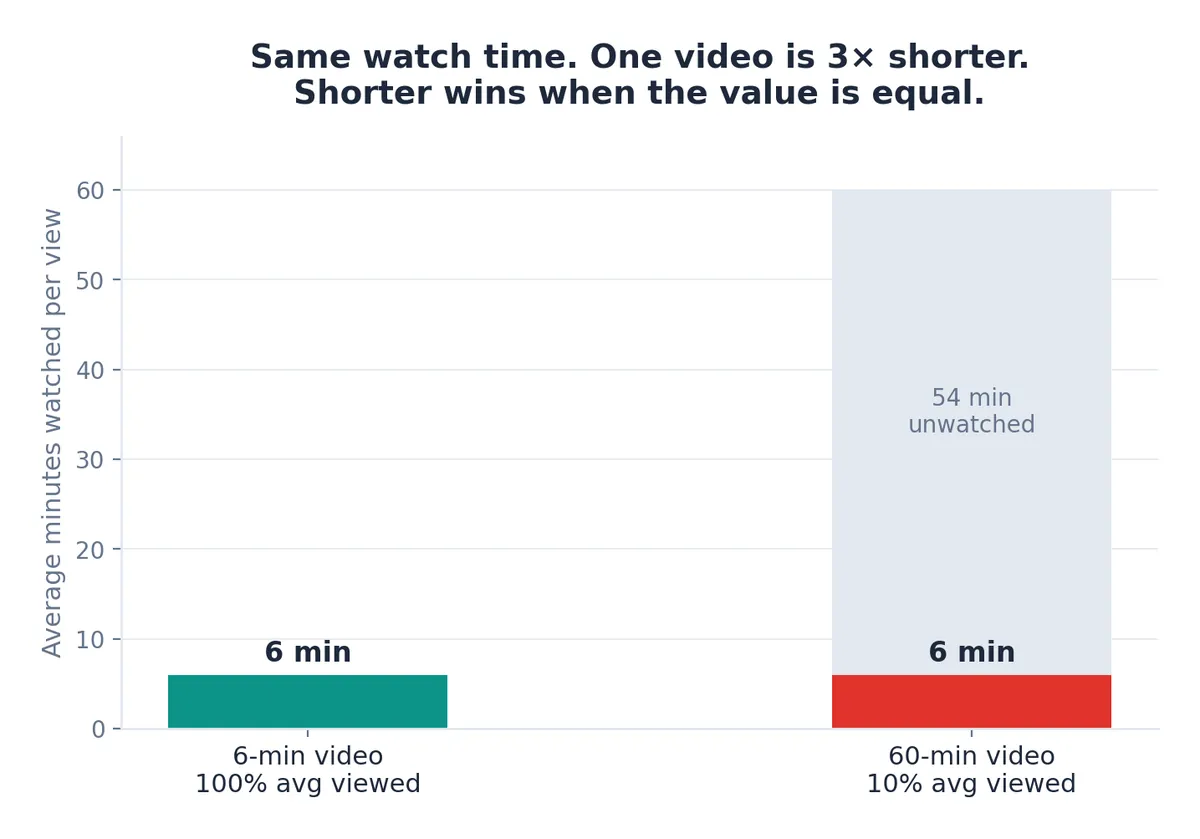
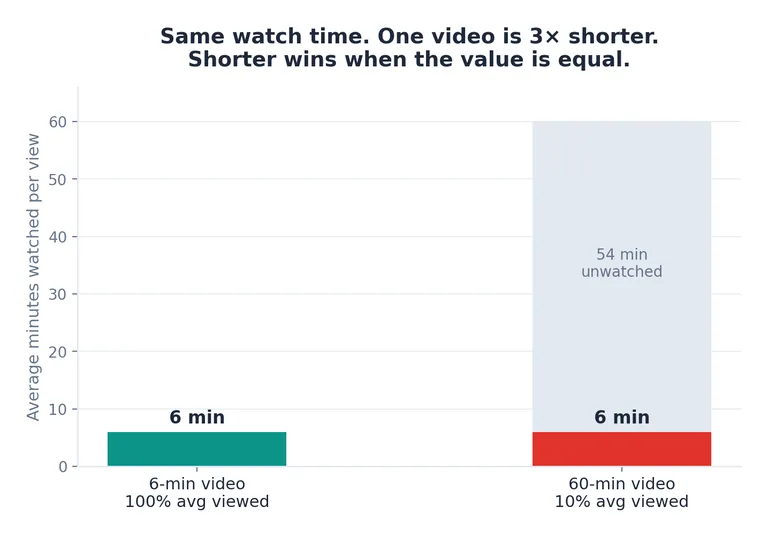
Return to the hero chart at the top of this article. Video A is 6 minutes long and viewers watch 100% of it on average. Video B is 60 minutes and viewers watch 10%. Both earn 6 minutes of watch time per view. From a pure watch-time standpoint they are identical — but the algorithm sees two very different assets:
- Video A's viewers are satisfied completers. They finish, they engage, they are primed for the next video. Session time extends.
- Video B's viewers are abandoners. Ninety percent of its runtime goes unwatched, and most exits happen mid-video — the strongest dissatisfaction signal the platform tracks.
Given identical watch time, YouTube will spend its next impression on Video A almost every time. This is the concrete mechanism behind the central principle of this guide: the shortest length that fully delivers the value wins, because it maximizes retention per unit of watch time.
Diagnose it, don't guess it
See exactly where your videos lose viewers
RetentionYT turns your retention curves into a script-level diagnosis: the intro that over-promises, the padded middle, the ending that starts too late. You will know whether your videos are the right length — and precisely which minutes are costing you impressions.
Benchmark retention inside length bands
Expectations for audience retention scale with runtime, so the fair comparison is never your 6-minute video against your 40-minute one — it is each video against its own length band. As working ranges for long-form content: videos under 5 minutes should hold 60% or more of viewers on average; 5-to-15-minute videos are healthy at 45–60%; 15-to-40-minute videos perform well at 35–50%; and anything past 40 minutes is doing fine above 30%, because absolute minutes watched are large even when the percentage is modest. These bands are exactly why "the best length" cannot be universal: a 50% average percentage viewed means something excellent at 30 minutes and something mediocre at 3 minutes.
Build your own baselines the same way. Group your last twenty uploads into bands by runtime, compute the median average percentage viewed inside each band, and judge new uploads against their band's median. A video that beats its band is the right length. A video that trails its band is telling you something specific: either the runtime exceeded the value (a sagging middle), or the promise was bigger than the delivery (a collapsing intro). Different diagnosis, different fix — and the band analysis is what separates the two.
Relative retention: the comparison that matters
YouTube Studio shows two retention views: absolute (your curve) and relative (your curve against every other video of similar length on the platform). Relative retention is the fairer judge — it normalizes for the fact that 60-minute videos naturally hold a lower percentage than 6-minute ones. If your 12-minute video retains above the median for 12-minute videos, length is not your problem. If it retains below, no runtime change will save it; only editing will.
Warning
Do not compare retention percentages across lengths. "My 8-minute video holds 55% but my 20-minute video only holds 38%" is not evidence that 8 minutes is your ideal length — 38% might be exceptional for a 20-minute video. Always benchmark within length bands.
Practical strategies: engineer the length out of the problem
The creators with the best retention numbers do not think about length at the end of production. They make length decisions at five specific points, before a frame is shot. Apply these and runtime takes care of itself.
1. Script the promise, then script to the promise
Write down the exact promise your title and thumbnail make, in one sentence. Every scene in the script must either deliver that promise or build anticipation for it. Anything else — channel news, sponsor-adjacent tangents, the "quick story" — is a retention leak by definition. Creators who run this filter typically cut 15–30% of their draft runtime without losing a single piece of value.
2. Win the first 30 seconds or lose the video
The steepest part of almost every retention curve is the opening half-minute. YouTube's own creator guidance on audience retention treats early retention as a core diagnostic, and for good reason: a viewer who leaves at 0:20 barely registers as watch time at all. Your intro should do three things in under 30 seconds: confirm the click was right ("yes, this video fixes your faucet"), create an open loop (show the finished result), and start delivering. Branded intros, logos, and "hey guys, welcome back" are paid for in viewers.
3. Re-hook every two to three minutes
Attention decays in waves. The antidote is the pattern interrupt: a new visual, a new question, a mini-payoff, a change of pace. Plan one every two to three minutes of runtime. This is also how longer videos become viable — a 25-minute video with nine deliberate re-hooks holds retention that a meandering 8-minute video cannot.
4. Edit for the cut you are afraid to make
In the edit, watch your rough cut at 1.5× speed and mark every moment you feel bored. Your viewers, watching at 1× with a phone in reach, are less patient than you are. The scene you "worked so hard on" that serves neither the promise nor a re-hook is the scene that costs you the recommendation.
5. End while they still want more
The end of your video is not a summary — it is a launchpad to the next view. Summaries invite exits. Instead, land the final payoff, then immediately bridge to the next video ("now that the leak is fixed, here's the five-minute upgrade that stops it ever coming back") and let the end screen do its job. Session time is a recommendation input; a strong exit compounds across your whole catalog.
Best practice
Track one number per upload: 30-second retention. It is the fastest feedback loop in YouTube growth. Fix intros before you touch anything else — most "length problems" are actually intro problems measured later in the curve.
Content format and length decisions
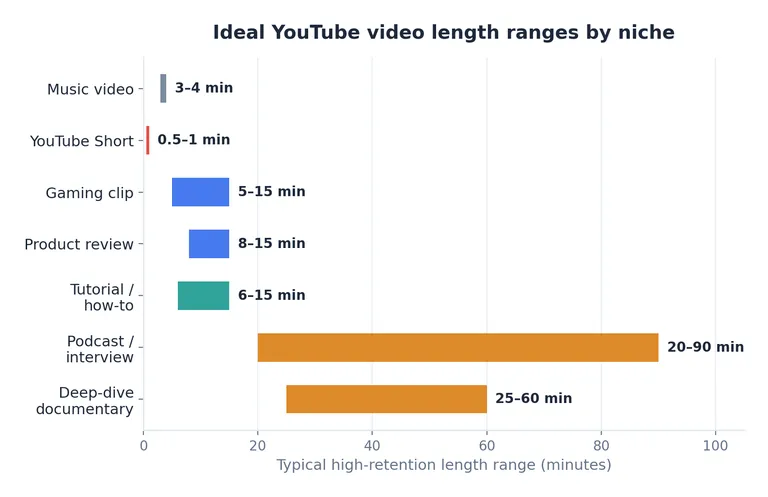
"Shortest length that delivers the value" means something different in every niche, because the value itself differs. A music video delivers its value in three minutes; a documentary cannot deliver its value in ten. The chart below shows the ranges where high-retention performance typically clusters across common formats, based on the channel patterns we analyze and widely reported creator benchmarks from sources like Tubefilter and Social Media Examiner.
How to read these ranges
Three principles keep the ranges honest:
- The range follows the value, not the category. "Tutorial" spans replacing a guitar string (4 minutes) to rebuilding an engine (45). The range above assumes a single well-scoped task.
- Channel authority shifts the range. A creator with deep trust can hold viewers through longer runtimes because the audience pre-believes the payoff. New channels should operate at the short end of every range until retention data earns them the long end.
- Intent beats habit. The same person who swipes away from a 3-minute video at lunch will watch a 90-minute interview on a TV at night. Consider where and why the viewer watches, not just who they are.
When to go long on purpose
Long-form is not the enemy of retention — under-valued long-form is. Three formats consistently justify 30-plus minutes:
- Cumulative narratives — experiments, builds, challenges — where the payoff only works because you lived through the process.
- Comprehensive references — full courses, complete walkthroughs — where viewers self-navigate with chapters and partial views still generate large absolute watch time.
- Conversation formats — podcasts and interviews — where the value is the relationship, and the audience treats the video as ambient viewing.
Note on chapters
Chapters change the retention math for long videos. Viewers who skip to their section still count toward watch time, and chapter-driven sessions often out-perform linear ones. If you publish over 15 minutes, chapters are not optional — they are how you let each viewer compress the video to their ideal length.
CTAs and community signals
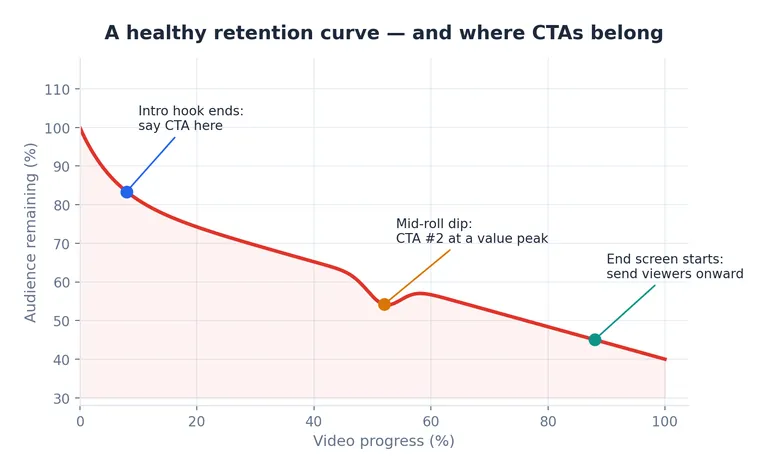
A YouTube CTA placed at the wrong moment is a retention tax. Placed at the right moment, it is free engagement that feeds the algorithm exactly the signals it wants. The difference is entirely about where the ask sits on the retention curve.
The three CTA windows
- Post-hook (5–10% of runtime): The only acceptable early ask — one sentence, after the intro has proven the video's value: "If this saves you a plumber's bill, the subscribe button is right there." Fifteen seconds of begging before any value is delivered is the most reliable way to turn a healthy curve into a cliff.
- Mid-video value peak: Immediately after the biggest payoff of the middle section, when goodwill is highest. This is where engagement asks (comment prompts, "which one would you pick?") convert best.
- The end screen (final 20 seconds): Reserve this for session extension — one next video, one playlist. Do not ask for likes here; ask viewers to keep watching.
Comments, likes, and community posts as retention infrastructure
Engagement signals and retention are a flywheel. Pinned comments that answer the video's most common follow-up question keep viewers in the ecosystem (and give lurkers a reason to return). Community posts that tease the next upload create returning viewers — and YouTube's recommendation engine treats returning viewers as a strong quality signal, per guidance shared on the YouTube Creators channel. None of this requires longer videos. It requires videos that end with the viewer still warm.
Common mistake
Front-loading a 30–60 second subscribe pitch before any value is delivered. In the retention data we review, this pattern correlates with first-minute drop-off 10–20 percentage points worse than channel baseline. Earn the ask.
Short-form vs long-form retention
YouTube Shorts and long-form videos are governed by different mechanics, and treating them as one system is a category error. Shorts are judged primarily on viewed-versus-swiped ratio and loop rate; long-form is judged on watch time and satisfaction. That changes what "best length" means in each format.
| Dimension | YouTube Shorts | Long-form |
|---|---|---|
| Primary signal | Viewed vs. swiped away; loop rate | Average view duration; satisfaction |
| Discovery surface | Shorts feed (swipe, zero-commitment) | Home, search, suggested (click, chosen commitment) |
| Length ceiling | 3 minutes (since October 2024) | 15 minutes unverified; effectively unlimited verified |
| Sweet spot | 15–45 seconds, loopable | Shortest runtime that fully delivers the promise |
| Retention goal | 100%+ via loops | Above-median relative retention for its length band |
| Growth role | Reach engine — new audience discovery | Depth engine — watch time, trust, revenue |
Why shorter Shorts win
In the Shorts feed, the viewer's default action is to swipe. Your video earns every second. A 20-second Short watched twice (200% retention) sends a stronger signal than a 90-second Short watched once at 60%. This is the value-density principle in its purest form: the payoff must arrive before the swipe instinct does. If your Short's payoff sits at second 55, most viewers never see it — move the payoff earlier or the Short is 40 seconds too long, full stop.
The bridge strategy
The strongest channels use Shorts as a discovery layer that feeds long-form: the Short delivers one complete, loopable payoff, then a related long-form video — linked and teased — delivers the deep version. Each format is cut to its own ideal length. What you must not do is slice a 10-minute video into ten 60-second Shorts; fragments deliver fragments of value, and both formats punish that.
Common growth myths debunked
Bad length advice spreads because it sounds mechanical and safe. Here are the four myths that cost creators the most retention, with what the data actually shows.
Myth 1: "Videos must be over 8 minutes for mid-roll ads"
Mid-roll eligibility begins at 8 minutes — that part is true. The myth is the leap to "therefore stretch every video past 8 minutes." Revenue is RPM multiplied by monetized views, and monetized views depend on distribution. A padded 8:04 video that tanks its retention earns fewer impressions, fewer views, and often less total revenue than the tight 6:30 version would have — even with zero mid-rolls. Let content cross 8 minutes naturally; never cross it artificially.
Myth 2: "Longer videos rank better because YouTube wants watch time"
YouTube wants watch time per impression served, which is a ratio — not raw minutes. A 40-minute video watched for 5 minutes on average generates 5 minutes per view. A 10-minute video watched for 7 minutes generates 7, plus a healthier satisfaction profile. As covered earlier, the algorithm's prediction is about expected viewing per impression, and padding degrades every term in that prediction. This myth survives because creators see big channels publishing long videos — confusing the authority those channels earned with the runtime they happen to use.
Myth 3: "Attention spans are shrinking, so keep everything under 3 minutes"
Attention is not shrinking; tolerance for low value density is. The same audiences "with no attention span" binge three-hour video essays and 90-minute podcasts. Truncating a meaty topic to 3 minutes forces you to strip out exactly the depth that builds trust and subscribers. If your value needs 15 minutes, a 3-minute version is not punchy — it is incomplete, and viewers feel it.
Myth 4: "The algorithm has a favorite length"
If YouTube had a preferred runtime, every successful channel would converge on it. Instead, the top of every niche spans an order of magnitude: two-minute explainers and hour-long documentaries thrive side by side. What converges is not length — it is retention shape. Winners hold viewers through whatever runtime they choose. The algorithm's only "favorite" is satisfaction, and satisfaction has no timestamp.
Myth 5: "Subscriber growth needs a consistent video length"
Consistency builds channels, but it is consistency of value and format — not runtime. Audiences subscribe to a promise about what they will get from you, and that promise survives length variation easily: the same viewer happily watches your 8-minute quick fix on Tuesday and your 35-minute deep dive on Saturday, as long as each delivers what its own title sold. What erodes subscriber growth is unpredictability of quality, and ironically, forcing every idea into one fixed runtime is a quality killer: simple ideas get padded, rich ideas get amputated. The channels we see grow fastest treat length as a per-video decision inside a consistent editorial identity — same promise style, same standard of delivery, whatever runtime the topic earns. If you want a rule, make it this: be rigid about value, flexible about minutes.
Warning
Beware any advice that gives you a number without asking about your content. "Make your videos X minutes" is a tell that the advisor is selling certainty, not analysis. Your retention curve is the only length consultant that knows your audience.
Data-driven examples: what the funnel actually looks like
Abstract principles become useful when you can see the numbers. The examples below use realistic figures modeled on the channel patterns we work with — treat them as illustrations of the math, not as universal benchmarks.
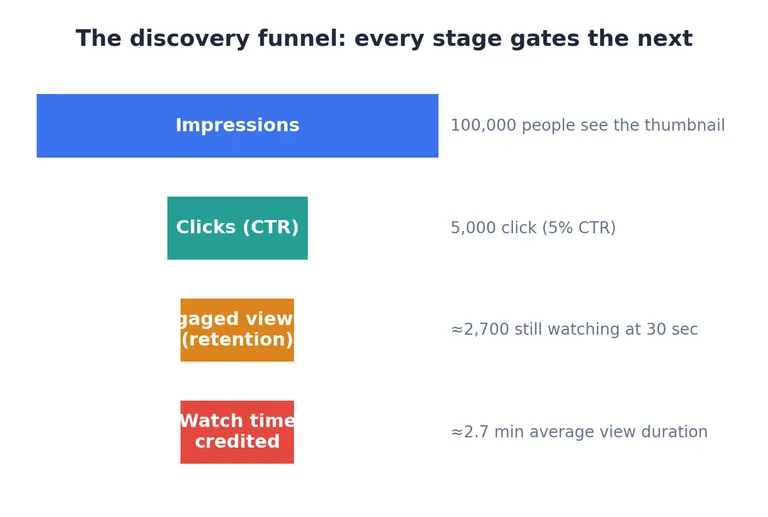
Example 1: The tutorial channel that cut 4 minutes and doubled watch time
A home-repair channel published "How to Fix a Leaky Faucet" at 12:40. The numbers after 30 days: 100,000 impressions, 4.2% CTR (4,200 views), 38% average percentage viewed — about 4:50 per view, or roughly 338 hours of watch time. The retention curve showed a clean first two minutes, then a long sag through a padded middle section about tools history, before recovering at the actual repair.
The channel re-shot the same repair at 8:10 — same promise, tighter delivery, no tools lecture. After 30 days: 4.6% CTR (the shorter runtime on the thumbnail helped), 57% average percentage viewed — about 4:38 per view. Watch time per view barely moved, but relative retention jumped, and the recommendation engine responded: impressions climbed to 210,000 over the same window. Total watch time more than doubled — from a shorter video. The 4:30 of cut content was not adding watch time; it was suppressing distribution.
Example 2: The podcast clip that was two videos pretending to be one
An interview channel posted a 52-minute conversation whose retention curve fell off a cliff at minute 31 — exactly where the topic switched from the guest's business failure story (the promise in the title) to their favorite books. Average view duration: 19 minutes. The fix was not a shorter video; it was two videos. The 31-minute failure story was re-titled to match its actual content and held 61% average percentage viewed. The books segment became a standalone 14-minute video that found its own, smaller but highly satisfied audience. Combined watch time rose 40%, because each video finally delivered one complete promise at its own ideal length.
Example 3: The Shorts channel that cut its Shorts in half
A cooking Shorts creator averaged 55-second Shorts with a 71% viewed-versus-swiped ratio — decent, not great. Analysis showed the payoff (the finished dish) consistently landing in the final 5 seconds, with a slow buildup. They restructured: payoff tease in the first 2 seconds, compressed process, full reveal by second 25. New average runtime: 28 seconds. Viewed-versus-swiped rose to 84%, loop rate climbed past 1.3 views per viewer, and average views per Short tripled in six weeks. Same recipes, same production quality — half the length, because the value density doubled.
Example 4: When longer was the right answer
Not every case study points downward. A software-education channel published 6-minute "quick tip" videos on a complex design tool. Retention was fine — 52% — but comments repeatedly asked for the full workflow. They tested a 34-minute complete project tutorial with chapters. Average percentage viewed dropped to 41%, as expected for the length band, but average view duration hit 13:56 — nearly three times the quick tips. Session time rose as viewers worked through chapters, and the long video became the channel's top subscriber driver. The value genuinely required 34 minutes; delivering it in 6 had been the length mistake all along.
The pattern
Across all four examples, the winning move was never "longer" or "shorter" — it was matching runtime to the promised value. Diagnose first, then cut or expand. Creators who guess at length flip a coin; creators who read their retention curve know.
The V-A-L-U-E framework: find your ideal length in five steps
Everything in this guide condenses into a repeatable pre-production process. Run every video through these five steps and the length question answers itself — with your own data as the final judge.
V — Validate the promise
Before scripting, write the one-sentence promise your title and thumbnail will make. Test it: would you click it? Would you feel satisfied if the video delivered exactly that sentence and nothing more? If the promise needs a paragraph to describe, it is actually two videos (see Example 2 above). One video, one promise.
A — Audit the minimum viable delivery
List the scenes required to deliver the promise completely: the setup the viewer must understand, each step or argument, the payoff. This list is your video's skeleton. Its length is a property of the list, not a decision you make separately. If the skeleton takes 11 minutes, the video is 11 minutes — and now you know why.
L — Locate the re-hooks
Mark a pattern interrupt every two to three minutes of the planned runtime: a visual change, a question, a mini-payoff, a story beat. If a section has no natural re-hook, it is a candidate for cutting — un-hookable content is usually un-watchable content.
U — Undercut your draft
In the edit, challenge every scene with one question: "If I delete this, does the promised value diminish?" Delete everything that fails. Professional editors describe the target as a cut that hurts a little — if the edit feels painless, you have not cut enough. A good working heuristic: most scripts compress 15–30% in a disciplined edit without losing value.
E — Evaluate against your own curve
After publishing, read three numbers at the 48-hour and 28-day marks: 30-second retention (intro quality), relative retention versus same-length videos (length appropriateness), and average view duration versus your channel baseline (absolute watch time earned). Log them per video. Ten uploads of this log will show you your channel's true ideal length range — measured, not guessed.
Stop asking how long your video should be. Start asking how fast you can deliver everything the viewer clicked for — and nothing they didn't.
Step E is where most creators stall, because reading retention curves against script structure is genuinely time-consuming in raw YouTube Studio exports. This is the specific problem RetentionYT was built to solve: it overlays your retention curve on your script, flags the exact minutes where viewers leave, and benchmarks each video against your channel baseline — so the "evaluate" step takes minutes instead of an afternoon. Whether you use a tool or a spreadsheet, make the evaluation step non-negotiable. It is the difference between a channel that iterates and a channel that guesses.
The ideal-length checklist for creators
Print this. Run it before every upload. If you can check every box, your video is the right length — whatever the runtime counter says.
Before scripting
- One promise. The title's promise fits in one sentence, and I know exactly which traffic surface (search, browse, suggested, Shorts) this video is built for.
- Skeleton first. I listed the scenes required to deliver the promise — the video's length will come from this list, not from a target number.
- Niche range checked. My planned runtime sits inside the typical high-retention range for my format, or I have a deliberate reason to break it.
Before publishing
- 30-second test. The first 30 seconds confirm the click, open a loop, and start delivering — no branded intro, no preamble.
- Re-hooks placed. A pattern interrupt lands every two to three minutes of runtime.
- The cut test. Every scene survived the question "does deleting this diminish the promised value?"
- CTA discipline. Asks come after proof of value (post-hook, mid-video peak, end screen) — never a pre-value pitch.
- Chapters added. Any video over 15 minutes has descriptive chapters so viewers can self-navigate.
- Ending launches forward. The final 20 seconds bridge to a specific next video, not a summary.
After publishing (48 hours / 28 days)
- Intro audited. 30-second retention is at or above my channel baseline; if not, the next intro gets rebuilt first.
- Length validated. Relative retention is at or above the median for this length band; a midpoint cliff means the video was longer than its value.
- Logged. Runtime, 30-second retention, average percentage viewed, and average view duration are recorded for my rolling 10-video analysis.
Frequently asked questions
What is the best length for a YouTube video?
There is no single best length. The best YouTube video length is the shortest runtime that fully delivers the value promised in your title and thumbnail. For most tutorials and reviews that lands between 6 and 15 minutes; for podcasts and documentaries it can exceed an hour. Length should be an output of your script, not a target you pad toward.
Do longer YouTube videos get more watch time?
Only when viewers actually stay. Total watch time equals average view duration multiplied by views, so a longer video helps only if its retention holds up. A 20-minute video watched for 6 minutes on average earns the same per-view watch time as a tight 6-minute video — while usually getting fewer impressions because its retention percentage is weaker.
Is an 8-minute video better for monetization?
Videos over 8 minutes are eligible for mid-roll ads, which can raise revenue per view. But stretching a 5-minute idea to 8 minutes typically lowers average percentage viewed, weakens the engagement signals that drive impressions, and can cost more in lost reach than the extra mid-roll earns. Add mid-rolls only when the content genuinely justifies the runtime.
What is a good audience retention percentage on YouTube?
As a working benchmark, retaining 70% or more of viewers at the 30-second mark and around 50% at the halfway point is healthy for long-form content. Average percentage viewed of 45–60% is strong for videos under 10 minutes. Compare every video against your own channel baseline and same-length peers rather than chasing a universal number.
How long should a YouTube Short be?
Shorts can run up to 3 minutes, but the highest loop rates and viewed-versus-swiped ratios typically come from Shorts between 15 and 45 seconds. Because Shorts are judged heavily on swipe-away rate and repeat viewing, a shorter, loopable video almost always beats a longer one that delivers the same payoff.
Does YouTube promote longer videos in search and browse features?
No. YouTube's recommendation engine ranks videos by expected watch time and satisfaction per impression, not by runtime. Browse features and suggested traffic reward videos that generate the most viewing per impression served, which is why a high-retention 8-minute video routinely out-ranks a 40-minute video covering the same topic.
How do I find the ideal length for my own videos?
Script to the value, then cut. Write the video with no length target, list every promise the title makes, and remove anything that does not serve those promises. After publishing, read the retention curve: if viewers drop at a predictable midpoint, that is where the video should have ended. Repeat across 10 uploads and your ideal length range will emerge from your own data.
Should I split a long video into a series?
Split when each part can stand alone with its own clear promise and payoff — for example a multi-step build or a ranked list with distinct sections. Keep it as one video when the value depends on cumulative context, such as a narrative, an experiment, or an argument that builds to a single conclusion. Series work best when every episode earns its own click.
Conclusion: length is a byproduct, value is the product
The creators who win the watch-time game stopped thinking about length years ago. They think about promises. They write one clear promise per video, build the shortest script that delivers it completely, cut everything that does not serve it, and let the runtime be whatever it needs to be. Then they read the retention curve, learn, and do it again.
That is the whole secret behind "the best YouTube video length for watch time and retention": the best length is the shortest one that fully delivers the value your viewer clicked for — in your niche, for your audience, proven by your data. Sometimes that is 28 seconds. Sometimes it is 34 minutes. The algorithm rewards both, because both respect the viewer's time.
Your next step is simple. Take your last five uploads, open their retention curves, and find the midpoint cliffs. Those cliffs are your padded minutes — and cutting them from your next script is the fastest retention improvement available to you. If you want that diagnosis in minutes instead of hours, with script-level precision, that is exactly what we built.
RetentionYT
Find your ideal video length from your own data
Connect your channel and RetentionYT benchmarks every video against your baseline, flags the exact minutes losing viewers, and shows whether your runtime matches your value — upload after upload.
Keep building your retention strategy
- YouTube Audience Retention: The Complete Guide to Reading Your Curve
- How to Increase Watch Time on YouTube: 11 Proven Levers
- How the YouTube Algorithm Works in 2026 (Explained for Creators)
- YouTube Click-Through Rate: Benchmarks and Fixes That Actually Work
- YouTube Hooks: 15 Openers That Survive the First 30 Seconds
- YouTube CTAs That Convert Without Killing Retention
- YouTube Shorts Strategy: Turning 30 Seconds into Channel Growth
- How to Get More YouTube Subscribers with Retention-First Content
- End Screens and Session Time: Keep Viewers Watching After Your Video
Frequently asked questions
- What is the best length for a YouTube video?
- There is no single best length. The best YouTube video length is the shortest runtime that fully delivers the value promised in your title and thumbnail. For most tutorials and reviews that lands between 6 and 15 minutes; for podcasts and documentaries it can exceed an hour. Length should be an output of your script, not a target you pad toward.
- Do longer YouTube videos get more watch time?
- Only when viewers actually stay. Total watch time equals average view duration multiplied by views, so a longer video helps only if its retention holds up. A 20-minute video watched for 6 minutes on average earns the same per-view watch time as a tight 6-minute video — while usually getting fewer impressions because its retention percentage is weaker.
- Is an 8-minute video better for monetization?
- Videos over 8 minutes are eligible for mid-roll ads, which can raise revenue per view. But stretching a 5-minute idea to 8 minutes typically lowers average percentage viewed, weakens the engagement signals that drive impressions, and can cost more in lost reach than the extra mid-roll earns. Add mid-rolls only when the content genuinely justifies the runtime.
- How long should a YouTube Short be?
- Shorts can run up to 3 minutes, but the highest loop rates and viewed-versus-swiped ratios typically come from Shorts between 15 and 45 seconds. Because Shorts are judged heavily on swipe-away rate and repeat viewing, a shorter, loopable video almost always beats a longer one that delivers the same payoff.
- Does YouTube promote longer videos in search and browse features?
- No. YouTube's recommendation engine ranks videos by expected watch time and satisfaction per impression, not by runtime. Browse features and suggested traffic reward videos that generate the most viewing per impression served, which is why a high-retention 8-minute video routinely out-ranks a 40-minute video covering the same topic.
- How do I find the ideal length for my own videos?
- Script to the value, then cut. Write the video with no length target, list every promise the title makes, and remove anything that does not serve those promises. After publishing, read the retention curve: if viewers drop at a predictable midpoint, that is where the video should have ended. Repeat across 10 uploads and your ideal length range will emerge from your own data.
- Should I split a long video into a series?
- Split when each part can stand alone with its own clear promise and payoff — for example a multi-step build or a ranked list with distinct sections. Keep it as one video when the value depends on cumulative context, such as a narrative, an experiment, or an argument that builds to a single conclusion. Series work best when every episode earns its own click.
Find your video’s drop-off points before you publish
RetentionYT audits your script for the moments viewers leave — so you can fix them before recording.
Get retention tips in your inbox
Occasional, practical emails on hooks, pacing, and retention. No spam.
Related posts
Should You Script YouTube Shorts? Retention on Short-Form, One Second at a Time
On Shorts, the first second decides everything. Learn the exact scripting frameworks, retention data, and templates top creators use to beat the swipe and win the Shorts feed.
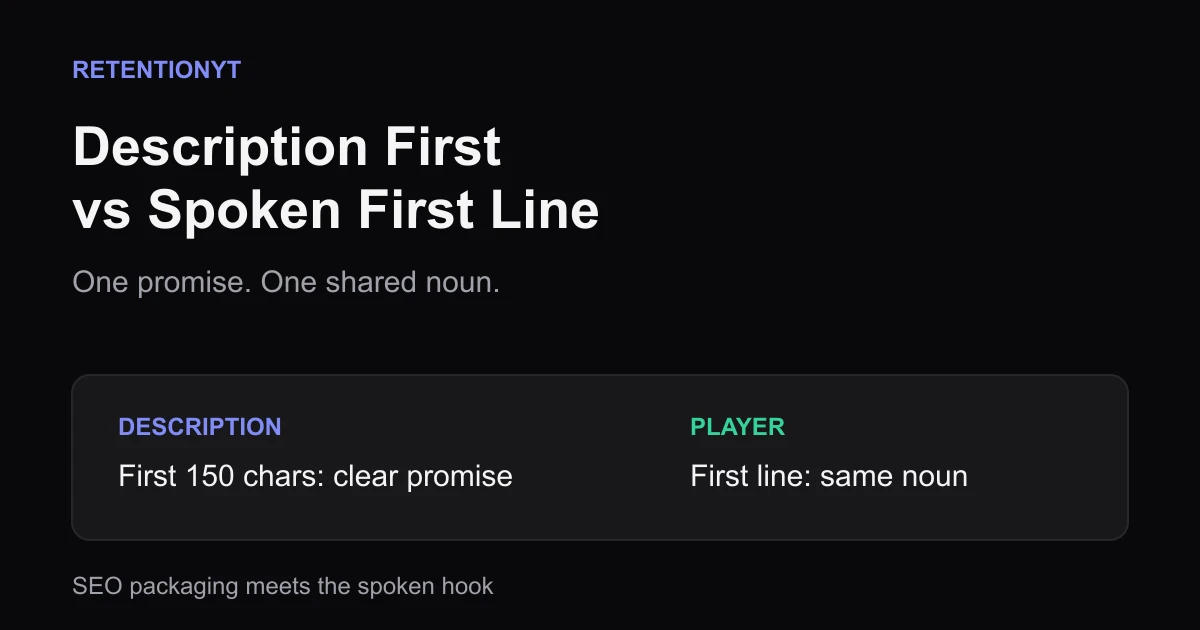
Description First 150 Characters vs Spoken First Line
Use the first 150 characters of your YouTube description as a clear search promise, then make your spoken first line deliver the same noun before the vlog detour.
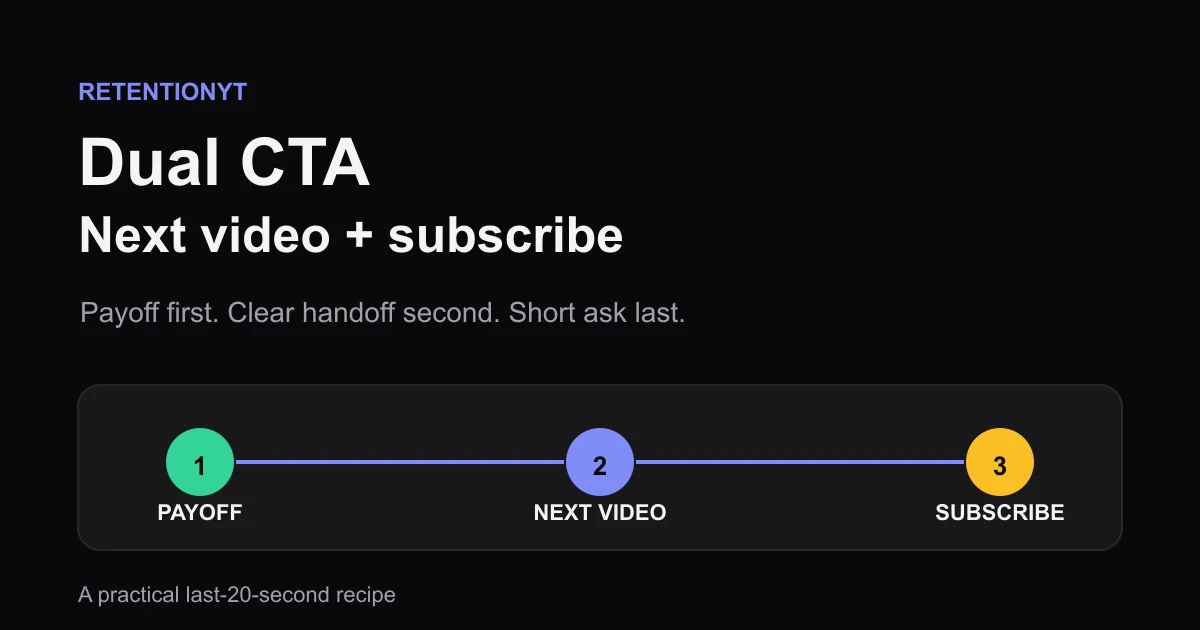
Dual CTA: Next Video + Subscribe Without a Cliff
YouTube outro subscribe and next video without a drop: a dual CTA script for the last 20 seconds, with the next-video title first and a short subscribe ask second.