Subscribe CTA at 30% vs End: Retention Cost
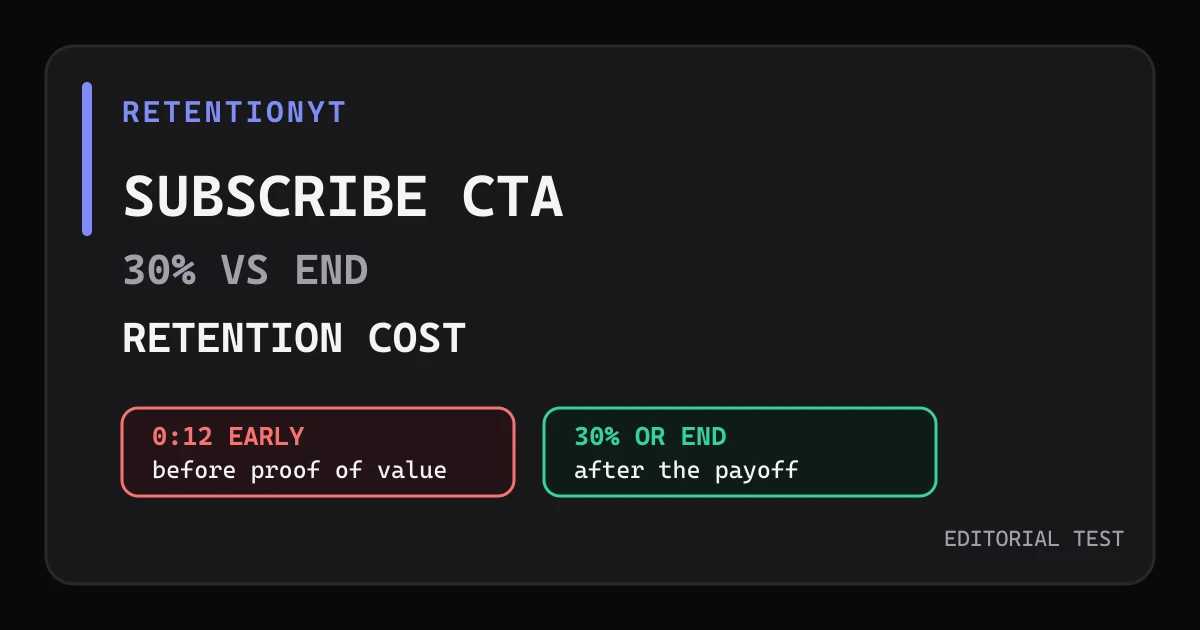
Test your subscribe CTA at 30% versus the end: compare the retention cost of an ask at 0:12, after a mini-payoff, and in the closing seconds.

9 min readUpdated
In this guide
If you ask for a subscribe at 0:12, you may spend the viewer’s first trust before delivering the first payoff. Use 30% as an editorial test point after a mini-payoff, and keep the end as the safer baseline for uninterrupted viewing. The right choice depends on your viewer mix and the shape of your own graph, not a universal percentage.

What Subscribe CTA at 30% vs End actually is (and what it is not)
A subscribe CTA is a call to action that asks the viewer to subscribe. “Subscribe CTA at 30% vs End” is a placement experiment: compare one short ask after an early mini-payoff with a request in the closing seconds. The 30% mark is a practical starting point, not a native YouTube threshold.
The decision is about sequence. A viewer who has just received a useful answer has evidence that your channel may be worth following. A viewer who has only heard setup has heard a request before the receipt. That is why the central question is not “Which timestamp is best?” but “What did the viewer receive immediately before the ask?”
| Placement | Job of the moment | Editorial risk | Best starting use |
|---|---|---|---|
| 0:12 | Ask before the main route develops | The request competes with the first proof of value | A deliberately tested exception, not the default |
| Around 30% | Ask after a mini-payoff | The ask can still interrupt the next beat | Growth video with a clear early win |
| End | Ask after the promised value | Viewers may leave before the request | Baseline when uninterrupted viewing matters |
Treat the percentage as a coordinate on your script, not a promise about performance. A three-minute tutorial and a twenty-minute documentary do not deliver the same kind of payoff at the same clock time. Mark the moment where the viewer can say, “That solved the first problem,” and test there.
The source pages do not publish a rule that says 0:12 harms retention or that 30% converts better. Keep those statements in the editorial-method category. Your experiment can be disciplined without pretending the platform has endorsed the threshold.
Where RetentionYT fits
Manual method works alone. Product shortens the loop. Start with RetentionYT after you have written the two CTA versions.
Why this shows up in YouTube Studio
Your CTA lives in the script, but the upload gives you a place to review the surrounding performance context. The locked YouTube Help page for content performance says the Content tab gives an overview of how your audience finds, watches, and interacts with content, and that the tab is available at the channel level (Source 2, August 2026). It does not define this CTA experiment as a native report.

Worked example 1: the failure
This is an illustrative example, not channel data. A creator publishes a six-minute growth tutorial and inserts a subscribe request at 0:12, before the first complete technique. The line is friendly, but it asks for a relationship before the video has shown what the viewer will receive.
The failure is not the number 0:12 by itself. The failure is the order: request, then proof. The intro now has two jobs competing for the same seconds, and the viewer has not yet reached the first mini-payoff. When you inspect the draft, the CTA is the first sentence that sounds like it is for the channel rather than for the viewer.
| Illustrative failure check | Example value | What it tells you |
|---|---|---|
| Video runtime | 6:00 | A short tutorial with an early decision point |
| CTA timestamp | 0:12 | Request arrives before the first full technique |
| First mini-payoff | 0:48 | The viewer waits after the ask for proof |
| Test status | Illustrative | Not a YouTube benchmark or measured channel result |
Move the request out of the first proof window and read the intro without music. If the video still needs a subscribe ask at 0:12, make that an explicit test variant. Do not call it a best practice merely because the line sounds concise.
Worked example 2: the fix
Keep the tutorial, but make the first payoff complete before the ask: “You now have the three-line fix. If you want more script edits like this, subscribe; next I’ll show the version that fails when the promise arrives late.” The viewer receives a usable answer, the request has a reason, and the next beat still has a job.
This is an illustrative rewrite, not a conversion benchmark. Compare it with an end version that asks after the final takeaway. Keep the title, thumbnail, topic, and broad audience as comparable as you can, record the CTA position, and treat the result as evidence from that upload only.
The 30% position is useful when it lines up with a real payoff, not because the clock has magical properties. If the payoff lands at 42%, place the ask after the payoff or redesign the sequence. A clean experiment respects the script's logic before it respects the percentage.

How to check this in YouTube Studio (step by step)
The CTA comparison is a manual test around the upload; it is not a built-in “30% vs End” report. Use YouTube Studio for the available performance context and keep the editorial test note beside your script.
- Open the script and mark the first complete mini-payoff. Write its timestamp and the sentence that proves the title promise.
- Draft a 30% version that follows that payoff. Draft an end version that follows the final takeaway. Keep both to one clear sentence.
- Choose the test unit. Use comparable uploads or a clearly documented before-and-after experiment; do not change the title, thumbnail, topic, and CTA placement at once if you want to learn from the result.
- Record your viewer mix, including the share of new viewers available in your own analytics. Do not invent a threshold from the brief.
- After publishing, sign in to Studio, select Content, open the selected video’s Analytics, and use the available performance area. The locked YouTube Help page documents the computer path to the Reach area (Source 1, August 2026).
- Log the CTA timestamp, exact words, first payoff, and what the graph shows. Label all small-sample or invented example numbers as illustrative; do not treat the drawing below as platform data.
If the first 30% arrives before any proof, move the CTA later. If the end ask is invisible because viewers leave earlier, test the first genuine payoff. The placement rule follows the value moment, while the result comes from your measured upload context.

The trap
The trap is treating “30%” as a magic number. A creator moves a CTA from the end to 30%, sees a different curve, and claims the placement caused the result. That skips the variables that matter in the actual test: the topic, the opening, the payoff, the words, the viewer mix, and whether the ask sounded earned.
The second trap is making the ask longer because the viewer has stayed. Retention is not permission to add a speech. Name the relationship, keep the sentence clean, and return to the next piece of value. An end ask can be safer precisely because it does not interrupt the body of the video.
The trap
The move

What to do in the next upload
Before you film, write both placements into the script. The question is not whether you should ask; it is when the viewer has enough evidence to understand why subscribing helps them.
- Mark the first complete mini-payoff.
- Write one CTA after that payoff.
- Write one CTA after the final takeaway.
- Keep the 0:12 version only as a documented test.
- Record the 30% coordinate and the real payoff timestamp.
- Note the share of new viewers from your own analytics.
- Hold title, thumbnail, topic, and broad audience steady when possible.
- Log the exact CTA words and the upload date.
- Review the graph without claiming single-variable causation.
- Choose the next placement from the evidence you actually collected.
For a second editing pass, use the YouTube retention tool once after the manual review. Then compare the broader context in Watch Time vs Retention and YouTube CTA placement.
A subscribe ask is a receipt only after the viewer has received something worth keeping.
Use the end placement as your baseline, test the first real payoff as your alternative, and keep 0:12 in the experiment log rather than in the default script. The best CTA is the one that fits the value sequence your viewer actually experienced.
Frequently asked questions
- When should I ask viewers to subscribe?
- Ask after the first clear payoff when the request naturally follows what the viewer just received. For many growth videos, that may be around 30% of the runtime, but the percentage is a testing starting point, not a YouTube rule. Put the ask at the end when the video is designed to maximize uninterrupted session flow.
- Does an early subscribe ask hurt retention?
- It can interrupt the opening if the viewer has not received a reason to stay. Do not treat that as a universal penalty: compare your own opening with and without the ask, hold the title and thumbnail steady, and label any numbers illustrative unless they come from your own measured upload data.
- Is the end too late?
- The end is not automatically too late. It is often the safest placement for the main video because the viewer has already received the promise, but some viewers will leave before it. Use an end ask when session continuity matters more than capturing a mid-video conversion, and test a post-payoff alternative when you have enough traffic.
- What about a mid-video verbal ask?
- A mid-video verbal ask can work when it follows a completed mini-payoff and takes one clean sentence. Name what the viewer just got, state who should subscribe, and return to the next beat. Avoid stacking a verbal ask, an overlay, and a bell reminder in the same moment unless the test specifically isolates that combination.
- Do new viewers hate subscribe asks?
- New viewers do not automatically hate a subscribe request; they lack context about whether your channel deserves a relationship. A cold opening ask asks for trust before evidence. Give them a useful payoff first, then make the request specific to the problem the video is already solving.
- How do I apply “Subscribe CTA at 30% vs End” on my next upload?
- Mark the first payoff in your script, then place one short subscribe line immediately after it and a second version at the end in a separate draft. Run the 30% and end placements as controlled editorial tests across comparable uploads, record the viewer mix and retention shape, and change one placement variable at a time.
- Where in YouTube Studio do I check “Subscribe CTA at 30% vs End”?
- You do not check this phrase as a built-in Studio report. Keep the CTA timestamp in your script, then use the available performance context for the upload. YouTube Help describes Content and Reach areas, but it does not define a 30%-versus-end CTA metric, so keep your experiment label separate from official platform reporting.
- What is the most common mistake with “Subscribe CTA at 30% vs End”?
- The common mistake is moving the ask without changing anything else, then calling the next result proof. A title, thumbnail, topic, traffic mix, or opening can change the graph. Keep a dated test note, describe the payoff before the CTA, and treat the result as evidence from that upload rather than a universal placement law.
Give your next script a second look
Paste a script into RetentionYT for suggestions on your hook, pacing, and structure. Choose the edits that serve your video, then check audience behavior in YouTube Analytics after publishing.
Get retention tips in your inbox
Occasional, practical emails on hooks, pacing, and retention. No spam.
Related posts
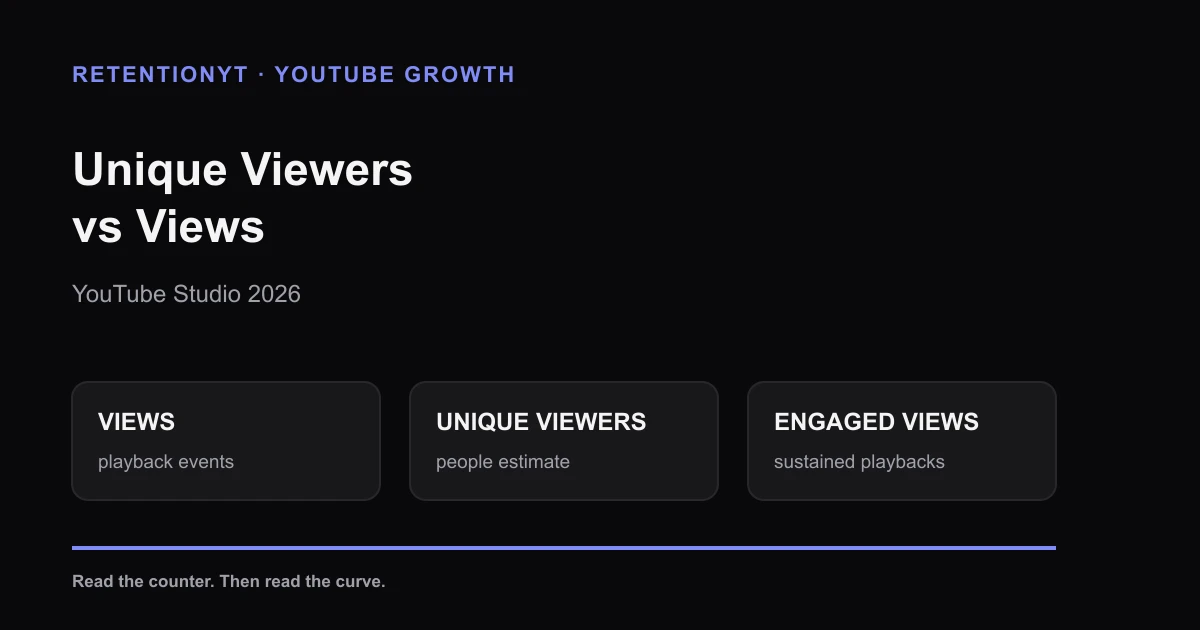
Unique Viewers vs Views in YouTube Studio 2026
Unique viewers vs views in YouTube Studio 2026: understand the new first-frame count, separate people from playbacks, and use retention to judge your next upload.
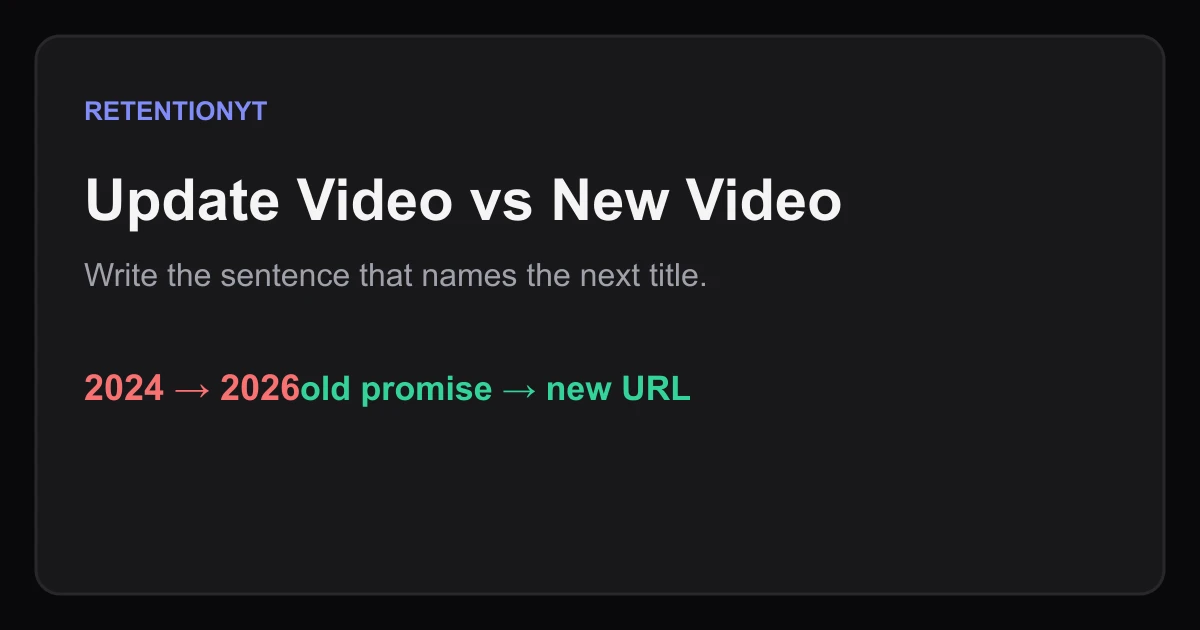
Update Video vs New Video: When to Rescript
Should you update an old YouTube video or make a new one? Compare the promise, metric meaning, and workflow before you rescript, annotate, or publish a fresh lesson.
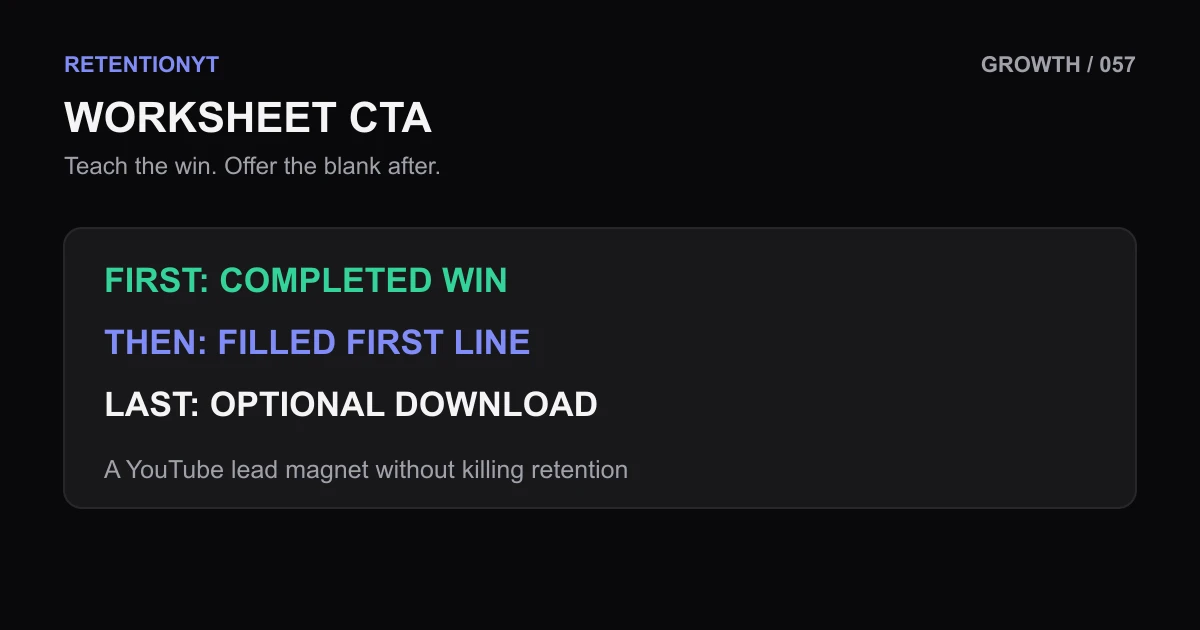
Worksheet CTA: Why It Should Come After the Win
Use a YouTube lead magnet without killing retention: teach one completed win first, then show the filled worksheet line before offering the blank PDF.