How the YouTube Algorithm Works in 2026 (A Creator's Guide)
How the YouTube algorithm works in 2026: the signals it actually rewards, why retention beats every other metric, and a practical framework creators can use to get more views, watch time, and subscribers.

41 min read
Every year, thousands of creators upload videos that never break past a few hundred views. Every year, a small percentage of channels grow by an order of magnitude — sometimes from a single video. If you ask both groups what the difference is, the underperformers will almost always blame the algorithm. The winners rarely mention it.
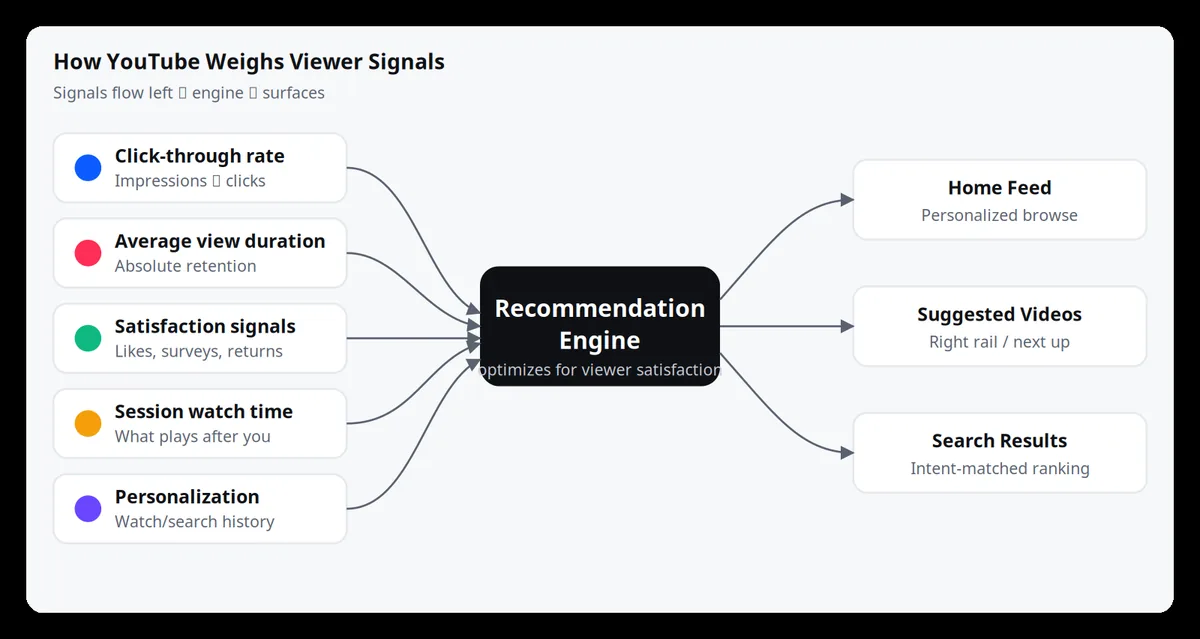
That's not a coincidence. The YouTube algorithm is not a lottery, a gatekeeper, or a black box designed to punish new creators. It's a recommendation engine — a piece of machine learning infrastructure whose job is to predict, for each individual viewer, which video is most likely to keep them satisfied on the platform right now. Once you understand that framing, most of the mystery evaporates.
This guide is a working creator's reference. It covers what the algorithm actually optimizes for in 2026, which metrics move the needle (and which are vanity), why audience retention beats every other signal, and a concrete framework you can apply to your next upload. Along the way we'll use RetentionYT to illustrate how modern retention analysis turns raw analytics into decisions you can make before you hit publish.
The algorithm doesn't rank your video against every other video. It ranks your video against every other thing a specific viewer could do with the next ten minutes of their life. That's a much more honest way to think about it.
Before we go further, a note on what this guide is not. It is not a list of ten quick hacks. It is not a promise that if you follow a formula, you'll hit 100k subscribers in ninety days. It is not a decoding of some hidden ranking factor that only insiders know about. The truth is more useful than any of those things, and much more durable. The people who reliably grow on YouTube in 2026 are the ones who have internalized how the recommendation engine thinks, and who then design each individual video around the way that thinking is scored. That takes practice and iteration, not tricks.
If you already run a channel with more than a few uploads, you have every piece of data you need to apply everything in this guide. YouTube Studio hands you the exact signals the algorithm is scoring — you just have to know which ones matter, in what order, and what to do about them. That is what the rest of this document is about.
How the YouTube Algorithm Actually Works
Officially, YouTube has never published a full specification of its recommender. Unofficially, its own engineering team has published enough research — most notably the seminal 2016 paper on deep neural networks for recommendations, and multiple follow-ups on multi-objective ranking — that we can describe the system with high confidence.
Two systems, not one
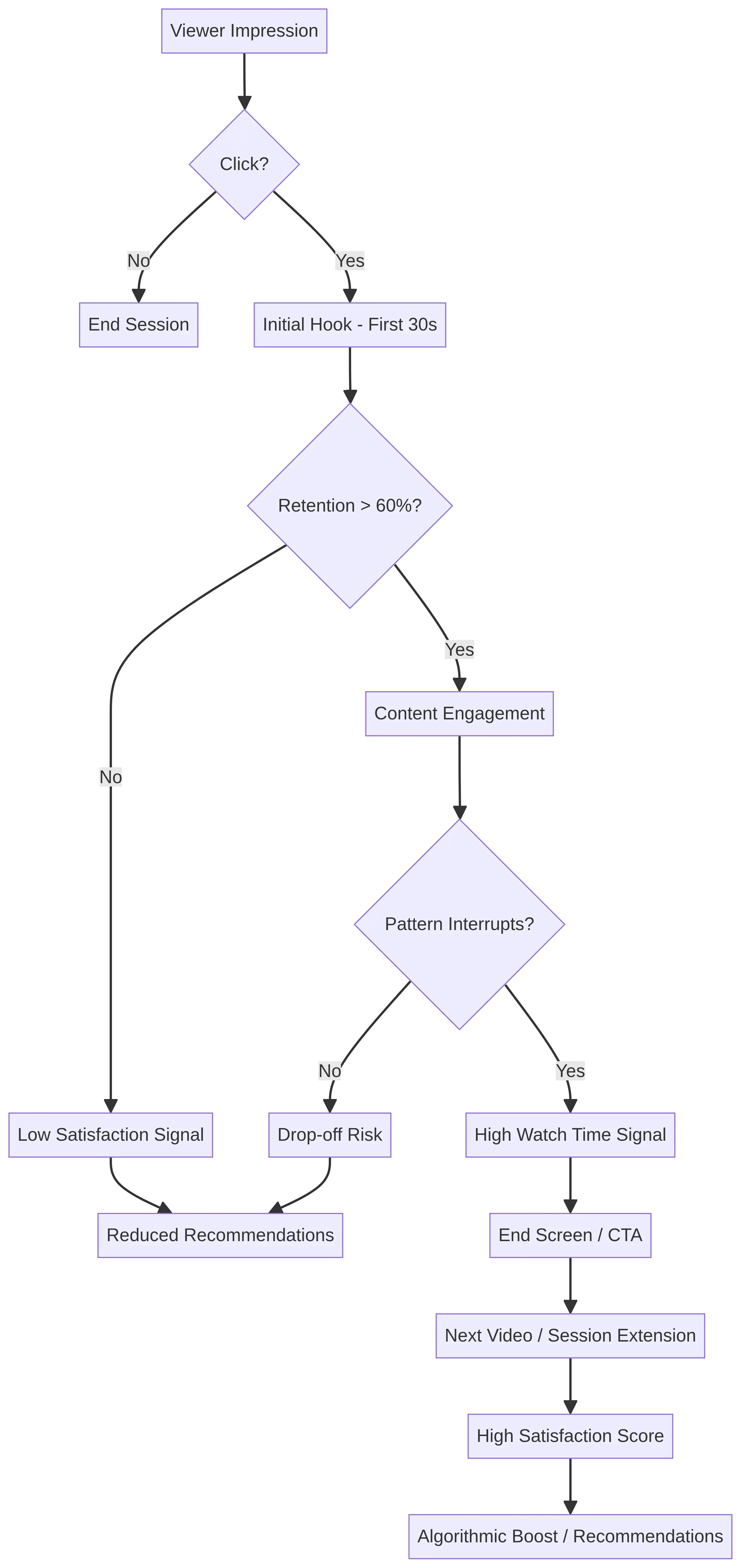
The recommendation stack is not one giant model. It's a pipeline with (at least) two stages:
- Candidate generation. From YouTube's catalog of billions of videos, a lightweight model produces a shortlist of a few hundred candidates that might be relevant to you right now. This is where broad topical fit, watch history, and channel affinity live.
- Ranking. A heavier model then scores each candidate on multiple predicted outcomes — probability of a click, expected watch duration, likelihood of a like, likelihood of a satisfaction signal — and orders them into your final feed.
Everything a creator worries about — impressions, click-through rate, watch time, subscriber growth — is downstream of that two-stage process. Your job is to give the ranker enough positive signal, on a video the candidate generator is willing to consider, that it beats whatever else the viewer might have watched.
The three surfaces you're actually competing on
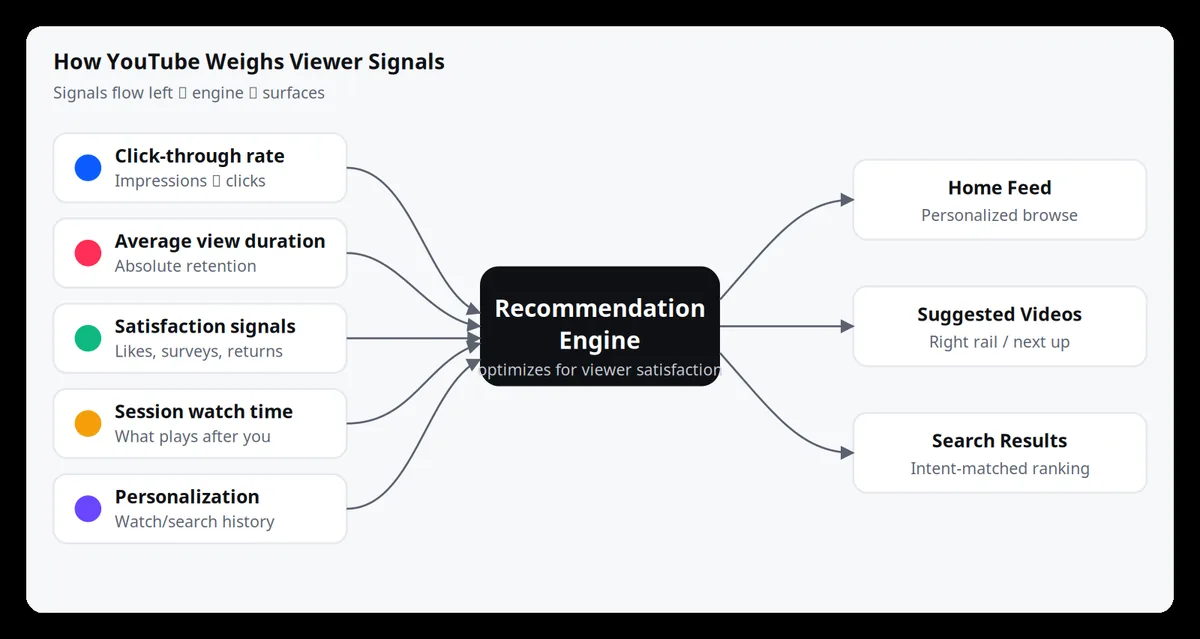
Views come from three main browse features — and each one behaves slightly differently:
- Home feed. Highly personalized. The algorithm shows viewers what they're likely to watch now, based on their history and freshness signals. Big topical channels dominate here.
- Suggested videos. The right-rail (or next-up) recommendation. Session-driven — YouTube is deciding what maximizes total session time, not just your video's watch time.
- Search. Intent-driven. Titles, descriptions, and topical authority matter more here than pure watch history. Evergreen educational content earns most of its lifetime views from search.
A useful mental model: Home asks "what does this viewer want next?", Suggested asks "what keeps this session going?", and Search asks "which video best answers this query?". Different surfaces reward slightly different content, but they all funnel through the same underlying satisfaction objective.
i
Key idea
YouTube does not push your video to your subscribers first. It pushes it to whichever viewers — subscribers or not — are most likely to watch it deeply. Distribution is earned per-video, not granted per-channel.
What the algorithm is actually optimizing for
The single sentence to memorize: the algorithm optimizes for long-term viewer satisfaction, using watch behavior as its proxy. Every other signal exists because it predicts satisfaction. Click-through rate predicts whether a viewer wanted to open the video. Average view duration predicts whether the video paid off the click. Session watch time predicts whether the recommendation kept the viewer on YouTube instead of losing them. Likes, surveys, and returns predict whether the viewer would recommend the video to their future self.
That framing has a powerful implication: you cannot game the algorithm by faking the signals. You can only earn better signals by making the video more satisfying. This is why every "secret hack" post ages badly, and why the fundamentals — promise, delivery, and retention — have been the same since 2016.
Why the algorithm has evolved this way
It's worth understanding why YouTube designs its recommender this way, because the design choices explain why some strategies work and others don't. YouTube's revenue is a function of one thing: total viewer time on the platform, monetized by ads and Premium subscriptions. Every incentive inside the company is aligned around that objective. The recommendation engine is not tuned to make individual creators rich, or to distribute views fairly, or to reward loyalty. It is tuned to maximize the expected time a viewer will spend on YouTube today and the probability they'll come back tomorrow. Those two objectives, taken together, form what the internal team refers to as long-term user value.
Once you internalize that objective, three consequences fall out naturally. First, videos that keep viewers engaged for their full duration are worth much more than videos that inflate views but disappoint. Second, videos that lead viewers into a longer session — a second, a third, a fourth video — are worth even more, because they extend platform time. Third, videos that produce satisfied viewers who return the next day are the most valuable of all, because retention over time is what turns casual visitors into daily users. Each of these three tiers maps directly onto a signal a creator can influence: AVD for the first, session watch time for the second, and long-term satisfaction (surveys, likes, returns) for the third.
What the 2026 model actually looks at
Over the last two years, YouTube's public statements and engineering talks have signaled several meaningful shifts in how the ranker weights signals. The direction of travel is consistent: more emphasis on quality signals, less on raw quantity. Specifically:
- Satisfaction surveys — those small "how would you rate this video?" prompts a subset of viewers see — carry more weight per response than they did in 2022. A one-star rating from a real viewer will do more damage than a hundred views with weak retention.
- Return visits after watching a specific video are tracked explicitly. If a viewer watches your video, closes the app, and returns to YouTube within 24 hours, that is a strong positive signal attributed to your video.
- Comment quality, not just quantity, is now scored. Long, substantive comments with replies are weighted more than one-word reactions.
- Predicted regret — a proprietary signal derived from behaviors like clicking "not interested," hiding a channel, or immediately closing after clicking — actively suppresses videos that produce it, even if their surface metrics look good.
None of this changes the strategic answer, but it does change the margin of error. In 2022 you could publish a mediocre video and expect the algorithm to reward you for producing content. In 2026 the ranker is significantly less forgiving. Videos that don't earn their distribution are quietly de-emphasized within hours, not days.
The Metrics That Matter Most
YouTube Studio surfaces dozens of metrics. Most of them are noise for growth decisions. Here are the ones that genuinely predict distribution in 2026, ordered by causal weight.
| Metric | What it measures | Why the algorithm cares |
|---|---|---|
| Average view duration (AVD) | Mean seconds watched | Direct proxy for satisfaction |
| Absolute audience retention | Shape of the drop-off curve | Reveals where the video breaks |
| Session watch time | Total minutes on YouTube after your video | Determines Suggested boost |
| Click-through rate (CTR) | Clicks ÷ impressions | Gates further distribution |
| Satisfaction signals | Likes, dislikes, "not interested", survey scores | Corrects for surface-level clicks |
| Impressions | How often the thumbnail was shown | Output, not input — a scoreboard |
| Subscribers gained | Net subs after watching | Weak signal; only counts if new subs watch back |
Two things about that table are worth pausing on. First, impressions are an output, not something you can directly control. When creators say "the algorithm gave my video more impressions", they're describing the effect of good ranking, not the cause. Second, subscribers are famously overrated as a signal. YouTube will happily leave a new video with 50,000 subscribers at 200 views if those subscribers don't engage. Retention still gates everything.
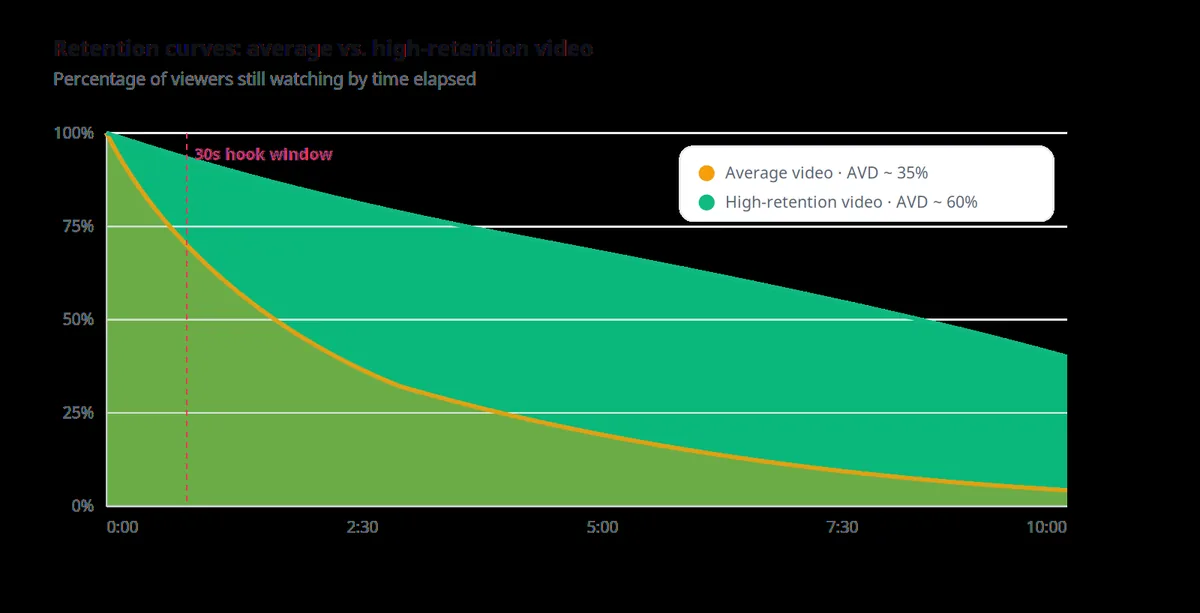
Reading a retention curve
Every retention curve tells a story, and most stories fit one of four patterns:
- The cliff: a steep drop in the first 15–30 seconds. Your hook and promise are misaligned with the thumbnail or title. Fix the opening first.
- The slump: a valley in the middle where energy drops. Usually caused by a slow explanation, a redundant recap, or a poorly placed sponsor read.
- The plateau: a shallow, mostly flat line. This is what you want — steady value delivery all the way through.
- The staircase: distinct drops at chapter transitions. Reveals which sections are pulling their weight and which ones aren't.
✓
Best practice
Judge every new video on its retention shape, not the flat AVD number. A 45% AVD earned with a shallow decline is a different animal from a 45% AVD earned with a cliff-and-recovery pattern.
How impressions really work
Impressions are the metric most creators misunderstand first. When YouTube shows your thumbnail to a viewer, that counts as one impression. If the same viewer sees the thumbnail three times on Home over the course of a day, that counts as three impressions. Impressions are not a fixed budget the algorithm allocates to your channel each week. They are an output of a per-viewer ranking decision that is made millions of times per hour across YouTube.
What creators experience as "the algorithm gave me fewer impressions" is usually one of three things: (a) the ranker is scoring your recent uploads worse than your prior baseline, so you're being outbid on more viewer slots; (b) your typical audience has already been shown the video enough times that the marginal value of another impression to them is close to zero; or (c) YouTube is testing your thumbnail against a broader audience and the CTR from that audience is too low to justify continued distribution. Only the first is a channel-health problem. The other two are normal.
The relationship between CTR and AVD
New creators often ask which they should optimize first, click-through rate or average view duration. The honest answer is both, but not equally, and not at the same time. Think of it as a two-part filter. CTR gets you past the first gate: if it's below your niche's baseline, the ranker interprets that as "this video doesn't compete for attention against alternatives," and it stops trying. AVD is what happens after the gate: it decides whether the video is amplified, held steady, or quietly deprioritized.
Concretely, if you have a video with a 3% CTR and 55% AVD, work on the thumbnail and title first. The retention is telling you the content is good; you're just not selling it. If you have a video with a 10% CTR and 25% AVD, the opposite is true — the packaging is doing its job, but the delivery is losing viewers immediately. Do not try to fix both at once. You will not know which change helped.
Session watch time — the metric almost no one talks about
Of the seven metrics in the table above, session watch time is the one creators most consistently under-appreciate. YouTube does not just care whether the viewer watched your video. It cares whether the viewer stayed on YouTube afterward, and whether the video before yours led into yours, and whether the video after yours held their attention too. Your video is judged partly on the company it keeps in a viewing session.
Practically, this means two things. First, an end-of-video handoff that successfully sends viewers to a second video is worth substantially more than the raw watch time of your video alone. Second, if your typical viewer arrives on your channel by clicking away from another creator's video, you inherit a small piece of credit for that creator's earlier retention. This is why building topical clusters — several videos that naturally follow each other — outperforms single hits over time.
Why Retention Beats Every Other Signal
If you take one idea away from this guide, take this: retention is not a metric — it's the ground truth. Every other engagement signal exists because it correlates with retention. When you improve retention, everything else improves as a side effect. When you neglect it, no amount of thumbnail A/B testing will save the video.
Retention is not one of the levers you pull. Retention is the outcome of pulling every other lever correctly.
Retention compounds; other signals don't
A good CTR wins you the click. A good hook wins you the first minute. A good middle wins you AVD. A good ending wins you the next click on your channel. Each of those is a separate skill, but they all feed into one downstream number: watch time. And watch time is what YouTube converts into money, distribution, and future recommendations.
Contrast that with a metric like subscriber count. A subscriber gained on a low-retention video is nearly worthless: they'll skip your next video, drop your channel-level engagement rate, and pull your future distribution down. This is the paradox many mid-sized channels hit at 100k–500k subs — they built the audience on hooks that outran the delivery, and now they're paying interest on that debt.
Retention as a signal to your future videos
Perhaps the least obvious property of retention is that it doesn't only influence the distribution of the current video. It also updates the ranker's confidence in your channel as a whole. A channel that consistently produces well-retained videos earns something like a "prior" — a slight tilt in favor of new uploads, applied before any per-video data comes in. Conversely, a channel with a run of low-retention uploads sees the opposite: even its next strong video gets a colder start than it deserves, and has to overcome the weight of prior evidence.
This is why one bad quarter tends to compound. It is also why the best recovery move for a struggling channel is often to slow down, not speed up. Uploading a weaker video every three days simply gives the ranker more evidence to lower its estimate of your baseline. Uploading one carefully retained video every two weeks resets the trajectory faster than most creators expect.
The three phases of a retention decision
Every viewer makes three decisions while watching your video:
- Should I keep watching? Answered in the first 15 seconds. Governed by hook clarity and payoff pacing.
- Is this still worth my time? Answered continuously in the middle. Governed by information density, pattern interrupts, and stakes.
- Would I watch this creator again? Answered at the end. Governed by satisfaction, closure, and whether the video honored its promise.
Miss any one of those three checkpoints and retention drops. Diagnose each one separately.
Diagnose retention drops before you upload
RetentionYT scores your script against the same signals YouTube's ranker cares about — hook strength, information density, promise-payoff alignment — and flags the exact timestamps most likely to lose viewers. Iterate the script, not the finished edit.
Analyze a script free
The economics of retention
Here is a way to make the retention argument concrete. Suppose two videos launch on the same day. Both get 50,000 impressions in the first hour, both convert at a 6% CTR, so both get 3,000 clicks and enter the retention-testing phase with similar surface metrics. Video A holds 55% AVD; video B holds 30% AVD. On raw watch-time alone, video A has already produced 83% more minutes of viewing. But the interesting part happens next.
Because video A's session watch time is higher, its Suggested and Home ranking improves, and the next batch of impressions is 3–5× larger. Because its satisfaction signals are higher, the ranker also tilts a share of those impressions toward viewers who are historically strong retainers — not just anyone browsing YouTube. Video B, meanwhile, is being shown to fewer and fewer viewers, and the ones it is shown to are increasingly close to the tail of the interest curve, which further depresses its CTR. Within 48 hours, video A is on a compounding curve; video B is on a decaying one. The gap between them, which was a factor of 1.83 at hour one, is often a factor of 20 or more by day thirty.
None of this requires the algorithm to "like" video A more. It just requires the algorithm to allocate its next impression to the video most likely to hold a viewer. Compounding does the rest.
Practical Strategies for Growth
Enough theory. Here are the concrete techniques that move the metrics that matter — grouped by which phase of the video they affect.
Before the click: CTR strategies
CTR determines whether your video is even given a chance to prove its retention. In 2026, healthy CTR on Home and Suggested lands between 4% and 10% for most niches. Under 3% and the algorithm quietly stops surfacing you.
- Title as a promise, not a summary. The title should imply a payoff the viewer can't get elsewhere. "How I edit my videos" is a summary. "The one editing habit that doubled my retention" is a promise.
- Thumbnail as a visual question. The best thumbnails create a small, resolvable curiosity gap. Faces with clear emotion still outperform text-heavy designs, but only when the emotion matches the story inside.
- Title–thumbnail–hook consistency. If any of the three contradicts the others, CTR will inflate but AVD will collapse. This is the number-one cause of "great first hour, dead by day two" videos.
The first 30 seconds: hook strategies
Roughly 20–35% of viewers who click will drop off within the first 30 seconds. That drop-off is expected; the goal is to keep it well below the average. A durable hook usually contains three elements in the first 20 seconds:
- Restate the promise in the viewer's own words. Don't repeat the title verbatim; translate it into the problem they came to solve.
- Signal stakes. Why does this matter to them right now? What do they lose by clicking away?
- Preview the payoff. A one-sentence teaser of the specific insight or result waiting later in the video.
The middle: retention strategies
The middle is where most videos die quietly. Techniques that reliably lift middle retention:
- Pattern interrupts. Change camera angle, cut to a graphic, insert a b-roll sequence, or shift music every 45–90 seconds. The visual system re-engages when the pattern changes.
- Open loops. Introduce a question, then delay the answer by one section. "We'll get to why in a minute, but first…" is a cliché because it works.
- Information density. Cut anything that doesn't advance the promise. If a sentence could be deleted without losing meaning, delete it.
- Chapter design. Use YouTube chapters not just for navigation, but as internal micro-hooks — each chapter title should promise a specific payoff.
The ending: session strategies
The end of the video is where you convert watch time into session time. YouTube heavily rewards videos that keep viewers on the platform after they finish. Two techniques dominate:
- End-screen alignment. The recommended next video should match the topical intent of the current one. Not your latest upload — your most relevant upload.
- Verbal handoff. Tell the viewer specifically what to watch next and why. "If this was useful, this next video walks through the framework in detail" outperforms a silent end screen every time.
A subtler technique that experienced creators use: shape the last 60 seconds of the video to raise the viewer's curiosity for the next one, rather than to summarize the current one. Summaries produce closure; closure produces platform exits. Curiosity produces sessions. If you can end the video on a specific unanswered question that the recommended next video obviously addresses, the handoff will happen automatically — no plea required.
Metadata that actually matters
Metadata is the least glamorous topic in creator strategy, and also one of the most misunderstood. In 2026, the useful hierarchy looks like this:
- Title. Read by both the ranker and every human who sees the thumbnail. First 60 characters carry the most weight; anything after may get truncated in feeds.
- Chapters. Machine-readable structure that the ranker uses to understand the video, and that dramatically improves search intent matching. Chapters should be promise-driven, not descriptive.
- Transcript. Whether uploaded manually or auto-generated, the transcript is a major topical-understanding signal. If you use unusual terminology, upload a corrected transcript.
- Description. The first 150 characters echo the title's promise in a slightly different form. The rest of the description is mostly for humans — links, context, timestamps.
- Thumbnail file name and ALT. Weak signal, but not zero. Use a descriptive filename, not
final-v3-real.jpg. - Tags. Weakest formal signal. Useful only for disambiguating rare terms (e.g., a product name that overlaps with a common English word).
Publishing time and cold-start behavior
Publishing time matters, but not the way most guides describe it. YouTube does not have a "prime time" that rewards uploads at specific hours. What matters is the availability of your likely audience during the video's cold-start window. If most of your viewers are online in the evening in one time zone, publishing eight to twelve hours before that peak lets the ranker collect enough early signal to justify wider distribution when your audience arrives.
For most channels, the practical answer is: publish 10–14 hours before your analytics-reported peak viewing time, on a day of the week when your channel typically performs well. Then, critically, do not upload again within 48 hours. The ranker needs uninterrupted signal from the new video to make a strong distribution decision. A second upload steals attention from the first.
Content Format and Length Decisions
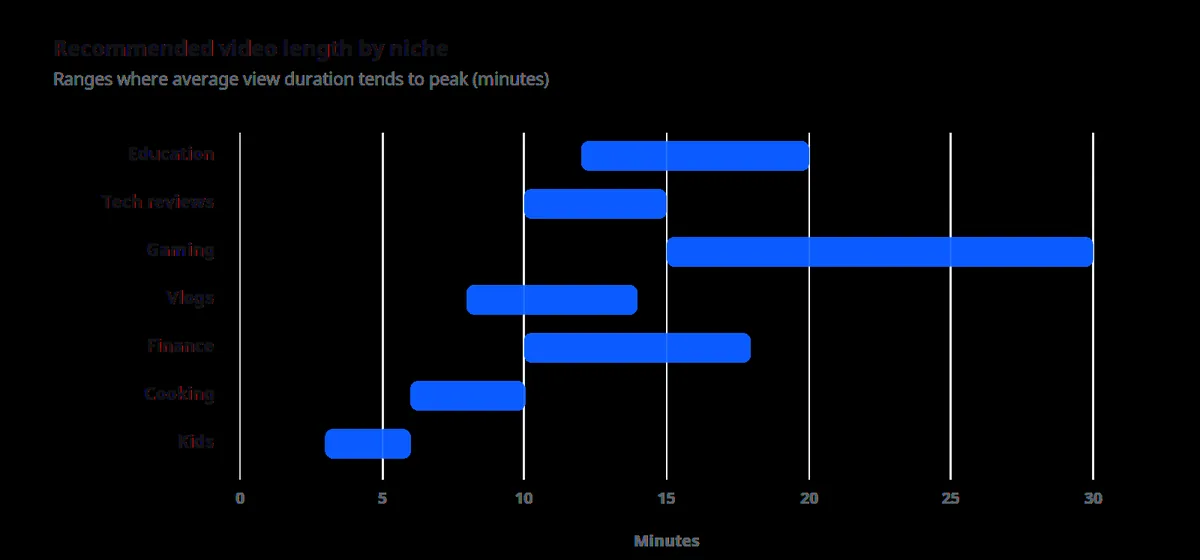
The right video length is one of the most misunderstood topics in creator strategy. There is no universally optimal length. The correct answer is the shortest length at which your content still delivers full value. Cut past that and AVD collapses; extend past it and AVD collapses just as fast.
How to find your channel's ideal length
Look at your last 20 uploads. Plot video length on one axis and AVD on the other. There will usually be a visible sweet spot — the region where your AVD is highest. That's your target. Videos above the sweet spot are being padded; videos below are being cut short of full payoff.
A common mistake is to chase 10-minute videos because they unlock mid-roll ads. If your natural content peaks at 6 minutes, forcing 10 will destroy retention and cost you far more revenue than the extra ad slot earns.
!
Warning
Do not lengthen videos to hit ad breakpoints. YouTube rewards watch time per impression, not raw length. A 6-minute video with 65% AVD earns more distribution than a 12-minute video with 30% AVD.
Series, standalone, and evergreen
Format has as much impact as length. Three formats compound differently:
- Standalone hits. High CTR, wide appeal, short lifespan. Good for growth spikes.
- Series. Lower per-video CTR, but strong session watch time as viewers binge episodes. Excellent for subscriber conversion.
- Evergreen. Search-optimized, slow to peak, but earn views for years. The compounding is enormous — one strong evergreen video can outperform ten trend chases over a two-year window.
The best channels balance all three. A viewer arrives on a trend-driven standalone, gets pulled into a series, and eventually finds the evergreen library.
Live, Premieres, and Community as retention tools
Three underused formats deserve mention because they interact with retention differently. Live streams generate exceptional session watch time (viewers stay for tens of minutes at a time) but weak per-video AVD when watched later. Premieres are useful for coordinating a first-hour comment surge, which lifts early engagement signals more than a silent launch. Community posts function as retention warm-ups: viewers who engage with a community post before a video's launch tend to click at 2–3× the baseline CTR when the video goes live. None of these are shortcuts, but each one is a lever most creators leave untouched.
CTAs and Community Signals
Calls to action are one of the few tools you fully control. They can help retention or hurt it, depending on where and how you place them.
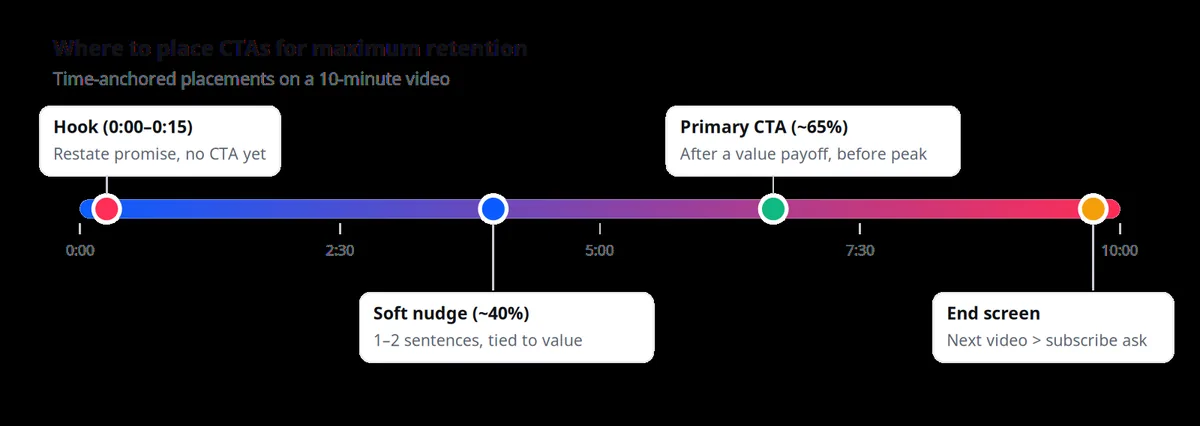
The rule of the value payoff
Place any explicit ask — like, subscribe, download, sign up — immediately after a moment of value delivery, not before it. Asking early conditions the viewer to distrust you; asking after a payoff turns the ask into gratitude capture.
Community signals worth optimizing
- Comments in the first hour. A strong early-comment velocity tells the algorithm the video is generating conversation. Ask a specific, easy-to-answer question in the hook or first chapter.
- Replies from the creator. Responding to comments in the first 24 hours meaningfully lifts engagement metrics. It's high leverage; treat the first hour like a launch.
- Community tab and Shorts as pre-launch tools. A community post 24 hours before publish primes engagement. A Shorts teaser tied to the same topic warms up the recommendation surface.
Subscribers as a signal, not a goal
Ask for subscribers once, briefly, after clear value. Chasing the ask itself will hurt more videos than it helps. A subscriber gained on a satisfying video is worth ten gained on a manipulative one — the former will boost future distribution, the latter will drag it down.
The pinned comment as a retention tool
Almost every guide treats the pinned comment as an afterthought. It is one of the highest-leverage placements on the entire page. A well-written pinned comment can raise reply velocity in the first hour by 30–50%, and reply velocity is one of the engagement signals the ranker uses most aggressively during cold start. The formula that works most consistently: pin a comment that asks viewers a specific, low-effort question tied to the video's premise, then reply personally to the first ten responses. That single practice, repeated on every upload, produces measurable channel-level lift over three to six months.
Short-Form vs Long-Form Retention
YouTube Shorts and long-form videos are ranked by different sub-systems with different retention thresholds. Treating them identically is one of the most common — and most expensive — creator mistakes.
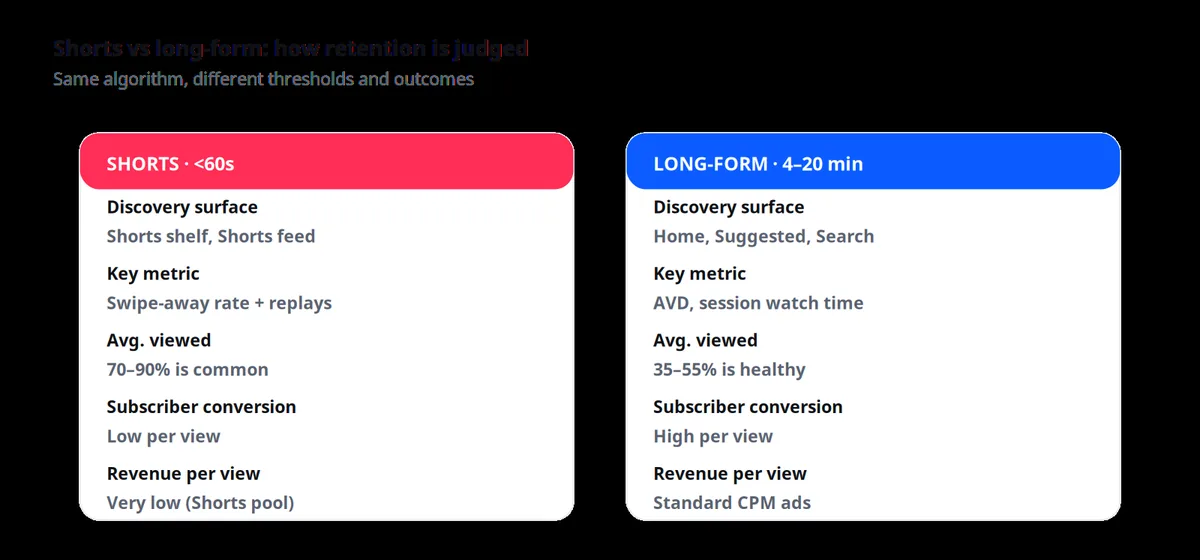
What Shorts actually reward
The Shorts feed judges retention very differently from long-form. Because the format is 60 seconds or less, the meaningful signals become:
- Swipe-away rate — how quickly viewers move to the next Short.
- Replay rate — did the viewer watch the video more than once?
- Full-loop completion — did they watch it end-to-end?
Good Shorts routinely hit 80%+ average viewed. That's a completely different bar from long-form, where 40–55% is a healthy AVD. Trying to score long-form Shorts by the same yardstick will make good Shorts look like failures and vice versa.
How to use Shorts strategically
Shorts are unmatched for reach but weak for subscriber conversion and revenue. The right role for Shorts in most channel strategies:
- Top-of-funnel reach. Introduce your channel to viewers who would never have found your long-form content.
- Trailer for long-form. Tease a specific insight from a long-form video with a clear "full breakdown on the channel" hand-off.
- Idea validation. Test a topic in Shorts before committing to a full production.
Do not, however, expect Shorts to compound the way long-form does. A viral Short is a spike; a hit long-form is an annuity.
The Shorts-to-long conversion mechanics
The single biggest question in short-form strategy is how to actually convert Shorts reach into long-form watch time. YouTube offers a small set of native tools — pinned links, related-video cards, direct references — but most of the conversion is behavioral, not mechanical. What consistently works: use the Short to demonstrate a specific insight, then explicitly reference the long-form video that expands on it, with the specific value the viewer will get. "I explain the full framework in a 12-minute video on my channel — it walks through the exact scripts I use" converts far better than "link in bio."
Measure conversion by tracking two numbers: the click-through from Shorts to your channel page, and the subsequent play-through on long-form videos in the following 48 hours. If Shorts are driving traffic but long-form AVD from that traffic is low, the mismatch is topical — your Shorts and long-form videos are speaking to different audiences, and the hand-off is failing.
When Shorts are actively bad for your channel
There is one scenario where Shorts hurt more than they help. If your long-form audience skews older, longer-attention, and higher-intent — think finance, deep tech, long-form education — flooding your channel with Shorts can dilute the channel-level audience signal the ranker uses to identify your target viewer. Suddenly the algorithm is trying to serve your videos to a mixed audience of short-attention swipers and deep-attention watchers, and neither group is well-served. If you're in one of these niches, either commit to Shorts as a separate channel or use them sparingly and topically.
Common Growth Myths Debunked
Myth 1: "You need to upload every day"
Frequency has no direct algorithmic weight. YouTube ranks videos, not upload schedules. Consistency helps because it gives you more learning cycles and keeps your channel top-of-mind for returning viewers, but a well-retained weekly upload will outperform three low-retention daily uploads every time.
Myth 2: "The algorithm hates small channels"
The algorithm doesn't know or care how many subscribers you have when evaluating whether to push a specific video. What smaller channels lack is data — fewer prior videos means less predictive power for the ranker. A new channel that publishes a video that outperforms its early impressions will get more impressions immediately.
Myth 3: "Longer is always better"
This one dies hard because it was briefly true around 2015 when the platform shifted to a watch-time objective. In 2026, the objective is satisfaction-weighted watch time. Padding a video destroys AVD, which destroys ranking, which destroys total watch time. Length must serve content, not gaming.
Myth 4: "Engagement bait works"
Explicitly begging for comments, likes, or subs still lifts raw counts, but YouTube's satisfaction models penalize videos where engagement diverges from actual watch behavior. A comment from a viewer who watched 15 seconds hurts you.
Myth 5: "You need to hack the tags"
Tags are a weak signal — useful for disambiguating rare terms, mostly ignored otherwise. Your title, description, thumbnail, chapters, and transcript do the heavy lifting for topical understanding. Spending time on tags is one of the lowest-ROI activities in creator work.
Myth 6: "Sub-for-sub and view groups help"
They actively hurt you. Low-quality watch from disinterested viewers destroys AVD and satisfaction signals, which then throttles your distribution to viewers who would have loved the video. Engineered engagement is one of the fastest ways to poison a channel.
Myth 7: "The algorithm rewards niche consistency"
This one is half true, half misleading. The algorithm does reward channels that produce a consistent viewer experience, because that consistency makes the ranker's job easier — it can confidently identify who to serve you to. But this does not mean you must stay in a rigid topic box. It means each video should be recognizable as belonging to your channel, and each new topic should be introduced in a way that lets the ranker connect it to your existing audience. Channels that successfully expand topically almost always bridge the shift with a video that explicitly ties the new topic to the old one.
Myth 8: "Deleting old videos boosts the channel"
It rarely does. The ranker evaluates videos individually, and old low-performers do not measurably drag down new ones. What deleting them does do is remove watch time from your total, break inbound links from other sites, and cost you long-tail search traffic. Unless a video is actively embarrassing or misleading, unlist rather than delete — you keep the watch time credit and the URL history without surfacing the video to new viewers.
Data-Driven Examples
Let's ground this in numbers. The following examples are composite scenarios modeled on the channel patterns we see in audits across mid-sized education and entertainment channels.
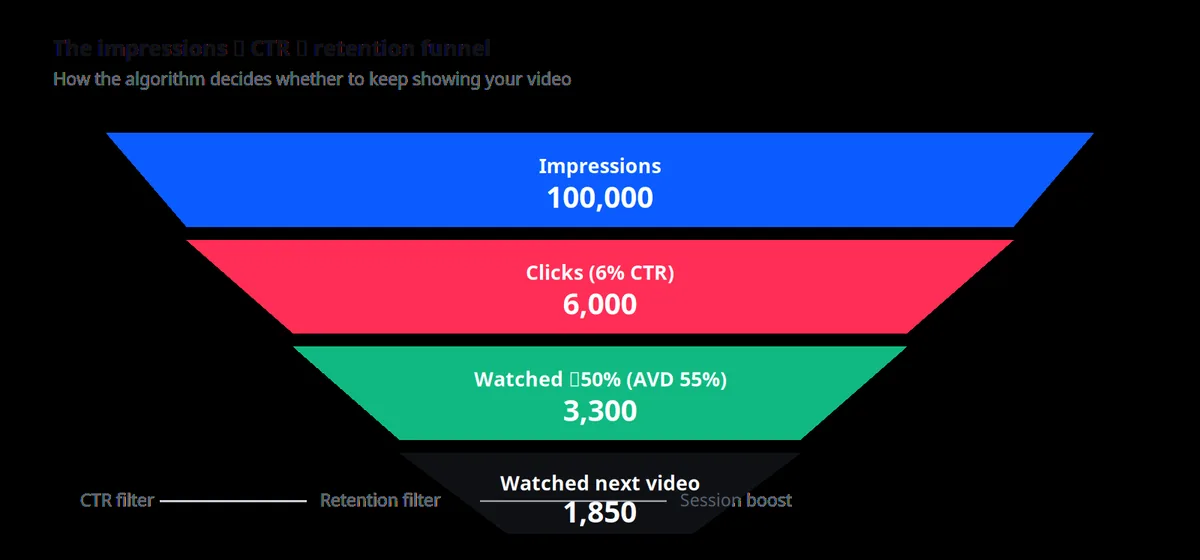
Example 1: The CTR trap
Channel A publishes a video with a highly clickbaity thumbnail. CTR spikes to 12% — well above the channel average of 6%. Impressions balloon to 250,000 in 24 hours. But AVD lands at 22% versus the channel's usual 48%. Within 48 hours, distribution collapses; the video ends its lifetime around 40,000 views. Comparable channel videos with 6% CTR and 48% AVD comfortably clear 90,000 views. Lesson: CTR without retention is negative EV.
Example 2: The retention rescue
Channel B republishes a video after diagnosing a middle-of-video valley at the 4:30 mark. The valley was caused by a two-minute origin story that viewers didn't need. After a re-edit that removes the segment (video drops from 11:20 to 9:15), AVD lifts from 38% to 54%. Impressions do not initially change — but session watch time improves, and within a week impressions grow by ~1.8×. Same content, tighter delivery, materially more distribution.
Example 3: The Shorts-to-long conversion
Channel C tests a Shorts-first strategy for 60 days: three Shorts per week teasing insights from long-form. Shorts views: 4.2M. Long-form views over the same window: +38% vs. the prior 60 days. Subscribers: +12,400. Revenue: +6%. Shorts alone didn't grow the business; Shorts plus a strong hand-off to long-form did.
✓
Pattern
In every high-growth case we see at RetentionYT, the winning move is not more views on the same content — it's better content on the same views. Distribution follows retention. It does not precede it.
Example 4: The metadata rescue
Channel D publishes a well-produced tutorial that stalls at 8,000 views over two weeks — well below its ~40,000 baseline. AVD is healthy at 51%; CTR is a disappointing 2.7% against a channel median of 5.2%. The retention shape is nearly flat, meaning the content is excellent but discovery is broken. The creator republishes with a new thumbnail (moved from a wide product shot to a face plus specific outcome text) and a rewritten title that makes the payoff explicit. CTR climbs to 6.4%. The ranker sees the CTR lift, promotes the video harder, and because AVD was already strong, the compounding is aggressive. The video finishes at 187,000 views. Same content, different packaging, more than 20× the lifetime views.
Example 5: The cold-start rescue
Channel E publishes on a random Tuesday morning without any of the usual pre-launch groundwork. The video collects only 4,200 impressions in the first six hours — a fraction of the channel's typical first-day distribution. The retention curve is fine (48% AVD, gentle decline) but the ranker never gathered enough signal from the cold start to justify wider distribution. The video plateaus at 12,000 views. The next upload, otherwise similar, is preceded by a community post 24 hours earlier and a topically-related Short 36 hours earlier. First-hour impressions come in at 22,000. The video reaches 96,000 views. The lesson is not that community posts "boost" videos — it is that the ranker needs early data, and a warm audience produces early data faster than a cold one.
What these examples all share
Look carefully at the five examples and you'll notice that none of them involved a change to the actual content of the video. Every improvement came from something outside the video itself: better packaging, better editing choices around the same content, better sequencing, better audience preparation. This is the pattern that surprises most creators when they first study it seriously. You do not need to make dramatically different videos to grow. You need to help the ranker make better decisions about the videos you're already making.
An Actionable Framework: The R.E.T.A.I.N. Method
Everything in this guide compresses into a six-step framework you can apply to every upload. We call it R.E.T.A.I.N.
R — Restate the promise
In the first 15 seconds, restate the promise of the title in the viewer's language. Do not repeat the title; translate it into the problem the viewer came to solve. This is the single highest-leverage edit in most videos.
E — Establish stakes
Give the viewer a specific reason to keep watching. Not "this is important" — but "if you skip this, here's what you lose." Stakes anchor attention through the middle.
T — Tighten the middle
Cut anything that doesn't advance the promise. Every 45–90 seconds, change the pattern: angle, cut, graphic, music, pace. Density beats length.
A — Anchor a payoff
Deliver a clear, specific insight or result at roughly 65% of the runtime. This is where AVD earns its keep — a strong payoff before the natural drop-off flattens the curve.
I — Invite one action
Immediately after the payoff, invite one action. Just one. Sub, like, comment, or click through — never all four. Choose the one that most serves the video.
N — Nominate the next video
In the last 20 seconds, name and recommend a specific next video. Handoff verbally, then reinforce visually with the end screen. This is how you convert watch time into session time.
Apply R.E.T.A.I.N. to your next upload. Score each letter on a 1–5 scale. Any score under 3 is a red flag and probably explains a retention drop you already have data for.
The 90-day retention rebuild plan
If you're taking over a channel with a retention problem — or if your own channel has drifted — here is a concrete 90-day sequence that reliably rebuilds the ranker's confidence.
Days 1–14: audit. Pull the last twenty uploads. For each, note the retention shape (cliff, slump, plateau, staircase), the AVD, the CTR, and the largest single drop-off timestamp. Do not publish anything new. Identify the two failure patterns that appear most often.
Days 15–45: publish weekly. Each upload should specifically address one of the two dominant failure patterns from the audit. Do not chase new topics; deepen the ones your audience already responds to. Aim for AVD above your channel's rolling 90-day median.
Days 46–90: compound. If retention has climbed for four consecutive uploads, the ranker's confidence has been re-established and you can begin experimenting with new formats or topics. If retention has not climbed, the failure pattern is deeper than editing — usually a mismatch between what your titles promise and what your niche can deliver. Revisit the promise, not the production.
Most channels that follow this sequence see impressions per upload climb by 40–120% within the 90-day window, without any change in subscriber count. That is what "unlocking distribution" actually looks like in practice.
Pre-Publish Checklist
Run every video through this list before you hit publish. If more than two boxes fail, revisit the edit.
- Title makes a clear, specific promise the viewer can't easily get elsewhere.
- Thumbnail creates a resolvable curiosity gap and matches the title's tone.
- First 15 seconds restate the promise in the viewer's language.
- Stakes are established before the 30-second mark.
- Pattern changes every 45–90 seconds throughout the middle.
- No sentence in the video can be deleted without losing meaning.
- A clear value payoff lands between 60% and 75% of runtime.
- Chapters are set with promise-driven titles, not generic labels.
- End screen recommends the most topically relevant next video, not the newest.
- Description opens with the same promise as the title, followed by chapters.
- One CTA — and only one — after the value payoff.
- You have a plan for the first hour of comments and replies.
Turn the checklist into a workflow
RetentionYT scores your script against every item on this list before you record. Fix retention drops on paper — the cheapest place to fix them.
Frequently Asked Questions
How does the YouTube algorithm work in 2026?
The YouTube algorithm is a two-stage recommendation engine. A candidate generator produces a shortlist of videos a viewer might want to watch, and a ranking model scores each candidate on predicted click, watch duration, satisfaction, and session outcomes. It optimizes for long-term viewer satisfaction across Home, Suggested, and Search surfaces.
What is the single most important YouTube metric?
Average view duration and its close cousin, absolute audience retention. They tell YouTube whether the video delivered on its promise, and they influence every downstream signal — session time, satisfaction, and future recommendations.
How long should a YouTube video be in 2026?
Long enough to deliver on the title and no longer. Educational content typically peaks between 12 and 20 minutes, tech reviews between 10 and 15, vlogs between 8 and 14, cooking between 6 and 10, and kids' content between 3 and 6. Aim for the length where your average view duration stays above 50%.
Do Shorts hurt long-form channel growth?
Not inherently. Shorts and long-form live in different recommendation surfaces with different retention thresholds. Shorts are excellent for top-of-funnel reach; long-form is where subscribers, watch time, and revenue accumulate. Use Shorts to introduce the channel, then convert with long-form.
Does subscribing still matter for the algorithm?
Subscribers are a satisfaction signal and a distribution lever, but the algorithm does not blindly push videos to every subscriber. If your subscribers do not engage, the algorithm reduces distribution. Treat subscriber growth as a byproduct of retention, not a shortcut around it.
Why did my video underperform after a great first hour?
Most underperformance comes from one of three failures: a mismatched thumbnail and title that inflated CTR without matching intent, a weak first 30 seconds that collapsed retention, or a middle-of-video valley that broke session watch time. Read the retention curve and identify the exact timestamp where viewers left.
How many uploads per week does YouTube reward?
There is no upload-frequency bonus. YouTube optimizes per viewer, not per channel. Consistency helps you learn faster and gives the algorithm more data to work with, but a single well-retained video will always outperform three poorly retained ones.
What CTR should I aim for?
For most niches, healthy CTR on Home and Suggested lands between 4% and 10%. Under 3% and the algorithm quietly stops surfacing you. Above 12% without matching retention usually signals a clickbait mismatch that will hurt the video within 48 hours.
How do I recover a channel with declining retention?
Audit your last 20 videos. Identify the retention shape for each, then look for common failure modes: cliff hooks, mid-video valleys, over-long endings. Fix the highest-frequency issue first, republish or pin a corrective new video, and rebuild the retention baseline before chasing new topics.
Conclusion
Understanding the YouTube algorithm in 2026 does not require secret knowledge. It requires a single mental shift: stop thinking of the algorithm as a distributor and start thinking of it as a recommender for your viewer's next ten minutes. Every choice you make in your title, thumbnail, hook, middle, and ending is either widening the case for your video winning that recommendation, or narrowing it.
The good news is that the strategy is durable. The signals that mattered in 2020 still matter in 2026, in the same order, for the same reasons. Retention wins because satisfaction wins. Everything else is downstream.
Pick one video from your last five uploads. Open its retention curve. Find the largest drop. Ask the R.E.T.A.I.N. question that maps to it. Fix that one thing on your next upload, and only that one thing. Iterate. That's what compounding on YouTube actually looks like — and it's why creators who focus on retention end up growing while everyone else is still hunting hacks.
Ready to make retention your unfair advantage?
RetentionYT gives you a script-level view of the exact signals YouTube's ranker uses. Diagnose weaknesses, rewrite with confidence, and publish videos that earn their distribution.
External authority references
- Covington et al., "Deep Neural Networks for YouTube Recommendations" (Google Research).
- YouTube Official Blog — "On YouTube's recommendation system."
- YouTube Creator Academy — reference guides for creators.
- YouTube Help — how the algorithm surfaces content.
Continue learning
YouTube Growth
The complete guide to audience retention
Read the curve, diagnose drop-offs, and design videos that earn their watch time.
YouTube Growth
7 hook formulas that keep viewers past 30 seconds
Battle-tested opening structures — with real examples from high-retention channels.
YouTube Growth
CTR vs retention: which one to optimize first
Why chasing CTR without retention is negative EV — and how to know when to switch focus.
Frequently asked questions
- How does the YouTube algorithm work in 2026?
- The YouTube algorithm is a recommendation engine that predicts, for each viewer, which video is most likely to keep them satisfied on the platform. It uses signals like click-through rate, average view duration, satisfaction (likes, surveys, returns), session watch time, and personalized history, then ranks candidates for Home, Suggested, and Search.
- What is the single most important YouTube metric?
- Average view duration and its close cousin, absolute audience retention. They tell YouTube whether the video delivered on its promise, and they influence every downstream signal — session time, satisfaction, and future recommendations.
- How long should a YouTube video be in 2026?
- Long enough to deliver on the title and no longer. Educational content typically peaks between 12 and 20 minutes, tech reviews between 10 and 15, vlogs between 8 and 14, cooking between 6 and 10, and kids' content between 3 and 6. Aim for the length where your average view duration stays above 50%.
- Do Shorts hurt long-form channel growth?
- Not inherently. Shorts and long-form live in different recommendation surfaces with different retention thresholds. Shorts are excellent for top-of-funnel reach; long-form is where subscribers, watch time, and revenue accumulate. Use Shorts to introduce the channel, then convert with long-form.
- Does subscribing still matter for the algorithm?
- Subscribers are a satisfaction signal and a distribution lever, but the algorithm does not blindly push videos to every subscriber. If your subscribers do not engage, the algorithm reduces distribution. Treat subscriber growth as a byproduct of retention, not a shortcut around it.
- Why did my video underperform after a great first hour?
- Most underperformance comes from one of three failures: a mismatched thumbnail and title that inflated CTR without matching intent, a weak first 30 seconds that collapsed retention, or a middle-of-video valley that broke session watch time. Read the retention curve and identify the exact timestamp where viewers left.
- How many uploads per week does YouTube reward?
- There is no upload-frequency bonus. YouTube optimizes per viewer, not per channel. Consistency helps you learn faster and gives the algorithm more data to work with, but a single well-retained video will always outperform three poorly retained ones.
Find your video’s drop-off points before you publish
RetentionYT audits your script for the moments viewers leave — so you can fix them before recording.
Get retention tips in your inbox
Occasional, practical emails on hooks, pacing, and retention. No spam.
Related posts
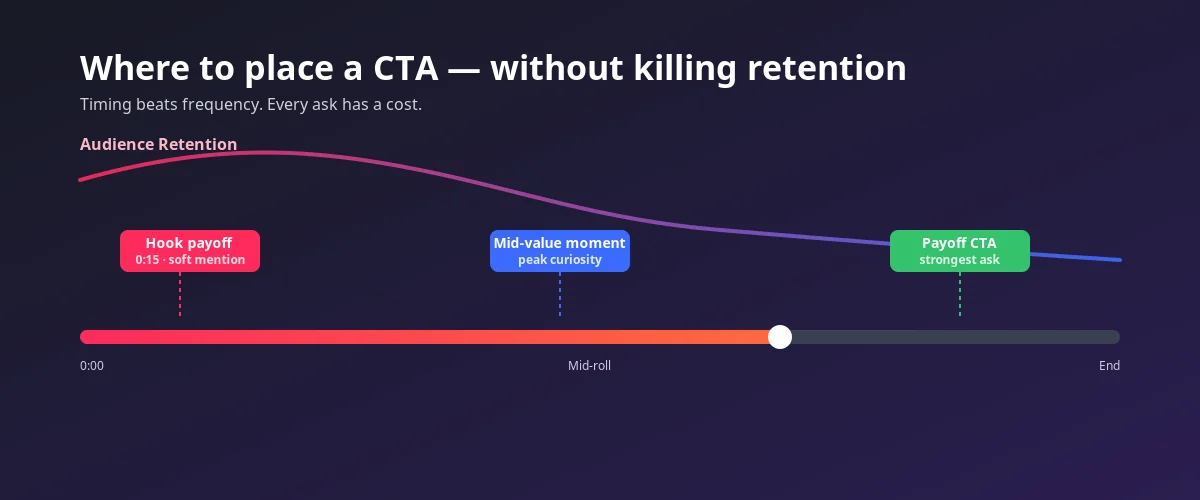
CTAs That Don't Kill Retention: Where to Ask for the Subscribe
A data-driven guide to YouTube CTA placement. Learn exactly where — and when — to ask for the subscribe without killing audience retention, watch time, or session signals.
How to Get More Views on YouTube (the Retention-First Way)
Stop chasing trends. Learn how to get more views on YouTube by focusing on audience retention. Discover the algorithm secrets and practical strategies for growth in 2026.
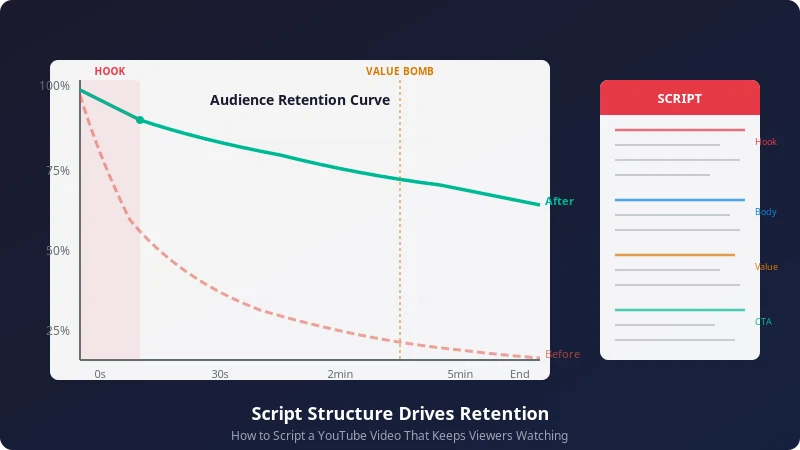
How to Script a YouTube Video That Keeps Viewers Watching
A complete, data-backed system for scripting YouTube videos that hold attention from the first second to the last — hooks, open loops, pattern interrupts, pacing, and full script templates you can use today.