The Anti-Hook: How to Beat Viewer Skepticism in 10 Seconds
Learn the Anti-Hook framework — a proven system for beating YouTube viewer skepticism in the first 10 seconds. Frameworks, scripts, examples, and templates from RetentionYT.

30 min read
Modern viewers don't trust hooks — they exit them. This is the framework, script blueprint and psychology behind openings that earn the click instead of trying to trick it.
Somewhere between 2018 and 2024, the traditional YouTube hook quietly stopped working. The zoom-punch openers, the "you won't believe what happened next" cliffhangers, the "hey guys — massive announcement today" intros — the exact patterns growth channels taught for a decade — began triggering the opposite of the intended response. Viewers stopped leaning in. They started leaning out.
The reason isn't mysterious. Modern viewers have watched roughly 15,000 hours of video by the time they're 25. They've been burned by clickbait so many times that their nervous system now runs a live scam-detection routine on every intro. When your opening pattern-matches something that wasted their time before, the exit tab is already open before you finish your first sentence.
This guide covers the antidote: the Anti-Hook. It's not a hook you drop in favor of nothing — it's an opening designed to disarm skepticism first and earn attention second. If you write scripts, coach creators, or run a channel yourself, this is the retention playbook we'd hand you before anything else.
What you'll leave with
A four-pillar framework, a 10-second script blueprint broken into 2-second beats, six ready-to-adapt Anti-Hook templates, five weak-vs-strong opening comparisons, and a retention checklist you can run on any script before you record.
What Is Viewer Skepticism?
Viewer skepticism is the automatic, mostly unconscious suspicion a viewer brings into your video from second zero. It's not a mood — it's a protective reflex. Every viewer arrives having recently exited a video that wasted their time. That recent memory is loaded into their working attention like a cached filter.
Skepticism does three things simultaneously:
- Runs pattern-matching against known low-value formats (long intros, empty greetings, over-promised thumbnails).
- Raises the cost of ambiguity. Anything vague in your first sentence gets read as "he doesn't know what this video is about either."
- Compresses the trust window. Ten years ago a viewer might give you 30 seconds to prove yourself. In 2026, effectively 6–10.
This is why "improve your hook" advice keeps failing. Most creators are optimizing for curiosity, when the actual bottleneck is credibility. Curiosity without credibility feels like manipulation. And manipulation, in 2026, is the fastest way to lose a viewer.
It's worth separating skepticism from disinterest, because they behave differently. A disinterested viewer clicks away because the topic isn't relevant to them — no opening can save that video and no opening should try to. A skeptical viewer, on the other hand, is already interested — that's why they clicked — but is now suspicious that the video won't deliver on the interest they brought with them. This is the group the Anti-Hook is designed for, and it's by far the largest group inside the first 30 seconds. Most creators lose skeptical viewers and misdiagnose it as topic mismatch. It almost never is.
The other important nuance: skepticism isn't hostility. Viewers aren't rooting against you. They're running a subconscious pattern-match to decide whether the next 90 seconds are worth their attention. That decision is fundamentally low-stakes and low-effort for them — and enormously high-stakes for you. Understanding this asymmetry is the mindset shift every creator has to make before any of the tactics below will feel natural.
Why Viewers Decide Within Seconds
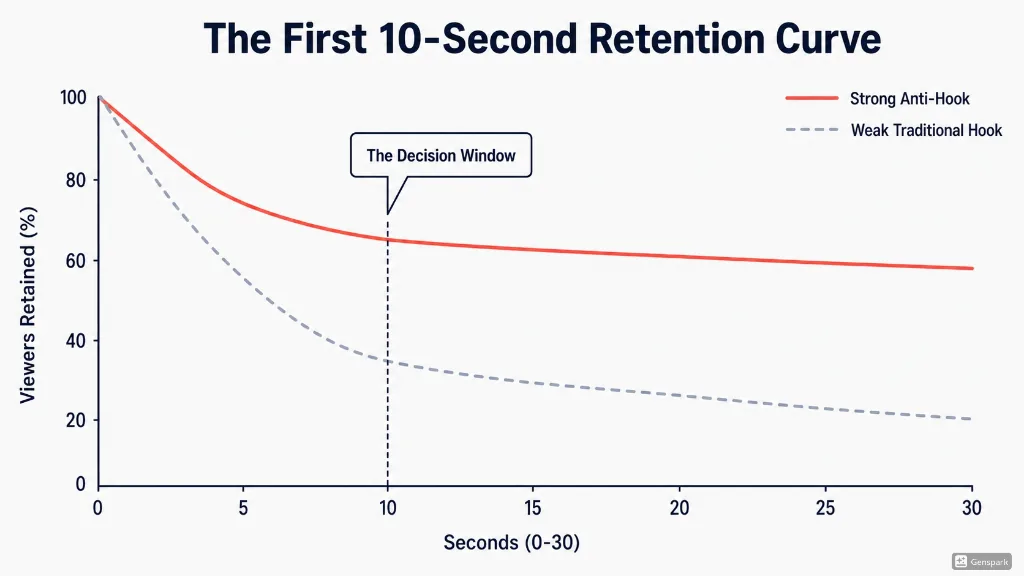
YouTube's own retention data shows that the steepest drop-off on almost every video happens between 0 and 30 seconds — and the steepest slope inside that window is usually 2 to 10. That's not because viewers are impatient. It's because their decision-making happens in that window, whether the video gives them information or not.
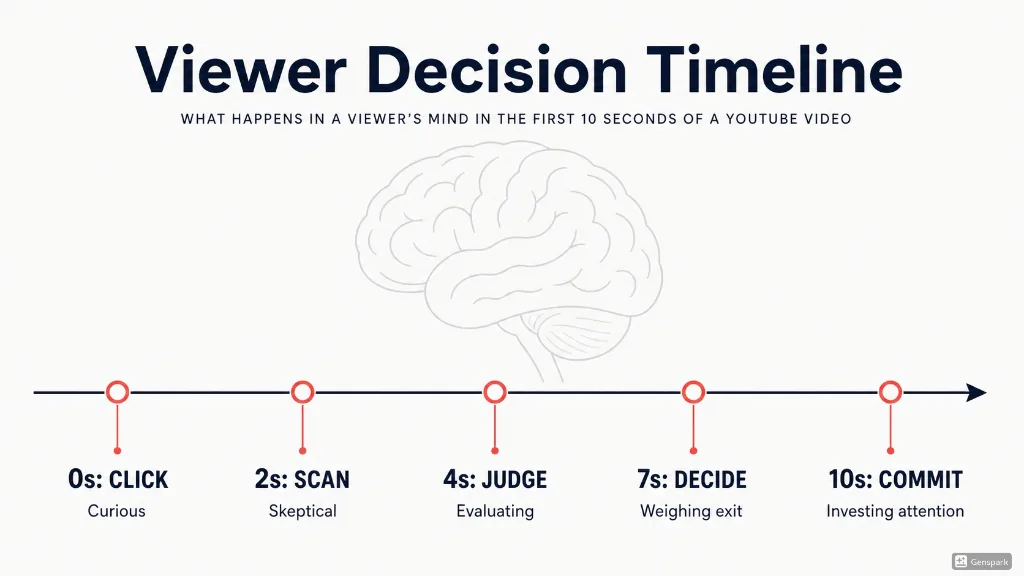
Break the first ten seconds down into what's actually happening in the viewer's head:
- 0s — Click. The viewer is curious. Dopamine is up. Their expectations are set by the thumbnail and title.
- 2s — Scan. They compare what they're seeing to what they were promised. Skepticism activates.
- 4s — Judge. They form a first read on your credibility, tone, and production style. Most exit decisions form here.
- 7s — Decide. If credibility hasn't landed by now, they're actively weighing the tab-close.
- 10s — Commit. If they're still here, they've made a small, subconscious decision to invest attention.
Note what this timeline implies: the decision to stay is made before the viewer has any information about the actual content. It's made on signal — how you talk, how confident you sound, whether you match your thumbnail, whether you seem to know what you're doing. The Anti-Hook is engineered specifically for this pre-content decision.
Another implication most creators miss: the 4-second Judge state is where creators are penalized for things they didn't say. Silence during Judge is not neutral — it's evidence. A four-second gap between the thumbnail promise and the first content-bearing line reads to the viewer's brain as hesitation, and hesitation reads as incompetence. The remedy isn't talking faster. It's front-loading substance so the Judge state has something concrete to evaluate before it can drift into doubt.
This is also why watch-time algorithms — YouTube's, TikTok's, and Instagram's — have converged on the same behavior: they weight the first 30 seconds disproportionately when ranking a video. The platforms have learned what viewers have already learned. A video that survives the decision window is nearly always a video worth surfacing. A video that doesn't is nearly always a video worth burying. The Anti-Hook is therefore not just a viewer-side technique — it's an algorithmic one.
The Psychology Behind the Anti-Hook
Three well-documented cognitive mechanisms make the Anti-Hook work. Understanding them changes how you write openings for the rest of your career.
1. Pattern-matching is faster than reasoning
Kahneman's "System 1" — the fast, intuitive, pattern-matching part of cognition — makes the initial stay-or-leave call. It's not evaluating your video's quality. It's checking whether your opening looks like an opening from a video the viewer regretted. If it does, System 1 exits. There is no rational deliberation to override.
The Anti-Hook works because it deliberately breaks the pattern of low-value openings. When you skip the greeting, name a specific problem, and cite proof in the first 6 seconds, System 1 can't match you to a bad video — because low-value creators don't do that.
2. Acknowledging the objection dissolves it
In persuasion research, this is called the "inoculation effect." When you name the counter-argument yourself — before the viewer thinks it — you disarm it. In a video about productivity, "You've probably seen twenty of these already. This one is different because…" is more powerful than pretending the twenty others don't exist.
The viewer's skepticism collapses because you've just done the skeptical work for them. Now their brain doesn't need to guard — you're on their side of the table.
3. Specificity is a proxy for competence
Vague speakers sound uncertain. Specific speakers sound like they know something. "I'm going to show you three exact scripts I used to grow from 0 to 100k in eight months" reads as competent. "Today we're going to talk about YouTube growth" reads as filler.
Specificity works on the viewer's subconscious the same way a doctor citing dosages works — it's a fluency signal. When you're specific in the first six seconds, you buy the next thirty.
"Viewers don't leave because your content is bad. They leave because your opening pattern-matches a video that
was
."
— The RetentionYT retention team
Why Traditional Hooks Fail
The "hook" was invented in a different YouTube. When average watch times were higher and thumbnails were less refined, a strong opening line could pull a curious viewer through a mediocre intro. That world is gone.
Here's why the classic hook patterns break down in front of a modern audience:
The Shock Opener
"In the next 10 minutes, everything you know about X is going to change." Ten years ago this worked. In 2026 it triggers immediate discount — the viewer knows you can't deliver on that in ten minutes, so the sentence is worthless before it lands. Worse: it sets you up to under-deliver against your own promise.
The Curiosity Gap Without Proof
"Nobody's talking about this — but it's the reason your videos aren't growing." An empty curiosity gap is a promise without collateral. Skeptical viewers ask "Why should I believe there's actually something here?" and don't wait for the answer.
The Long Personality Intro
"Hey guys, welcome back to the channel, if you're new here my name is…" Every second spent on greeting is a second spent proving that you're a creator, not that this video is worth their time. On a first-time viewer, this is functionally an exit prompt.
The Sub Request Before Value
"Before we get started, hit that subscribe button…" Asking for something before you've given anything reads as low-status. It also confirms the viewer's suspicion that the video's real purpose is metrics, not their outcome.
The Fake Cliffhanger
"Stay till the end because I'm going to show you the biggest secret of all…" Modern viewers are trained to read this as a trap. They also know from experience that "the biggest secret" is usually either underwhelming or a promotion.
Reality check
None of these hooks are broken in isolation. They're broken because viewers have seen them so many times attached to low-value content. Pattern-matching is doing the work — not the words themselves.
The Anti-Hook Framework
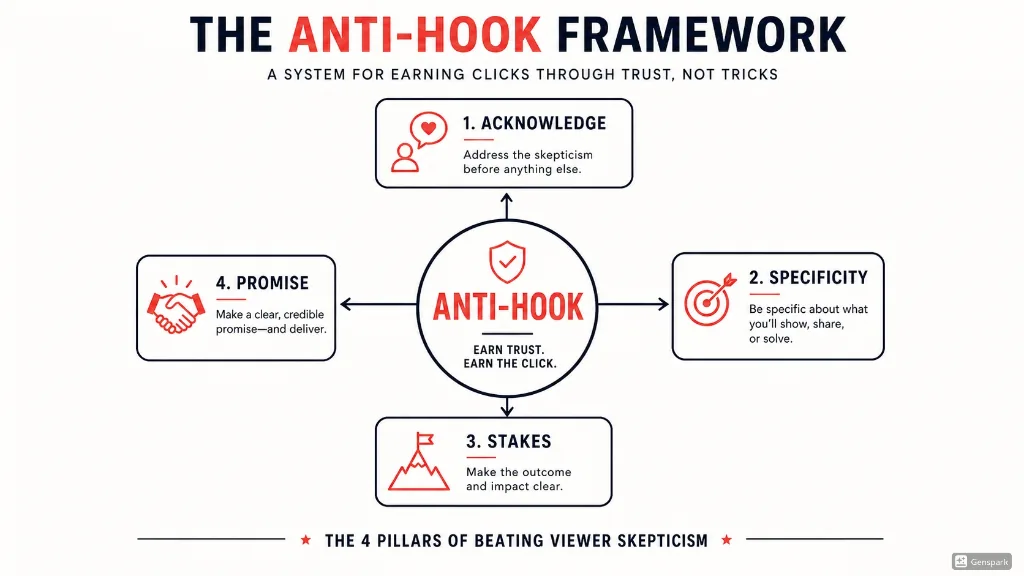
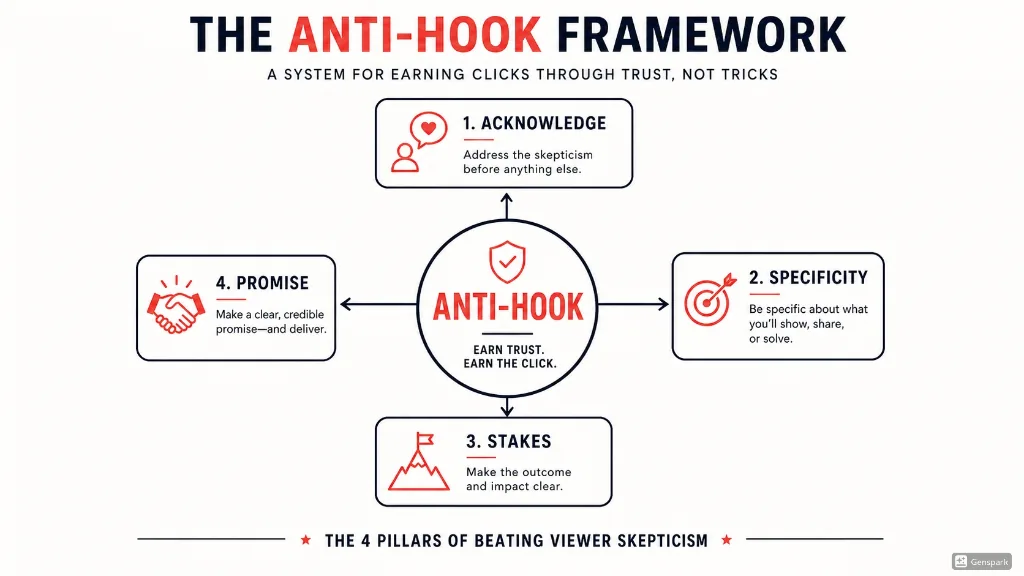
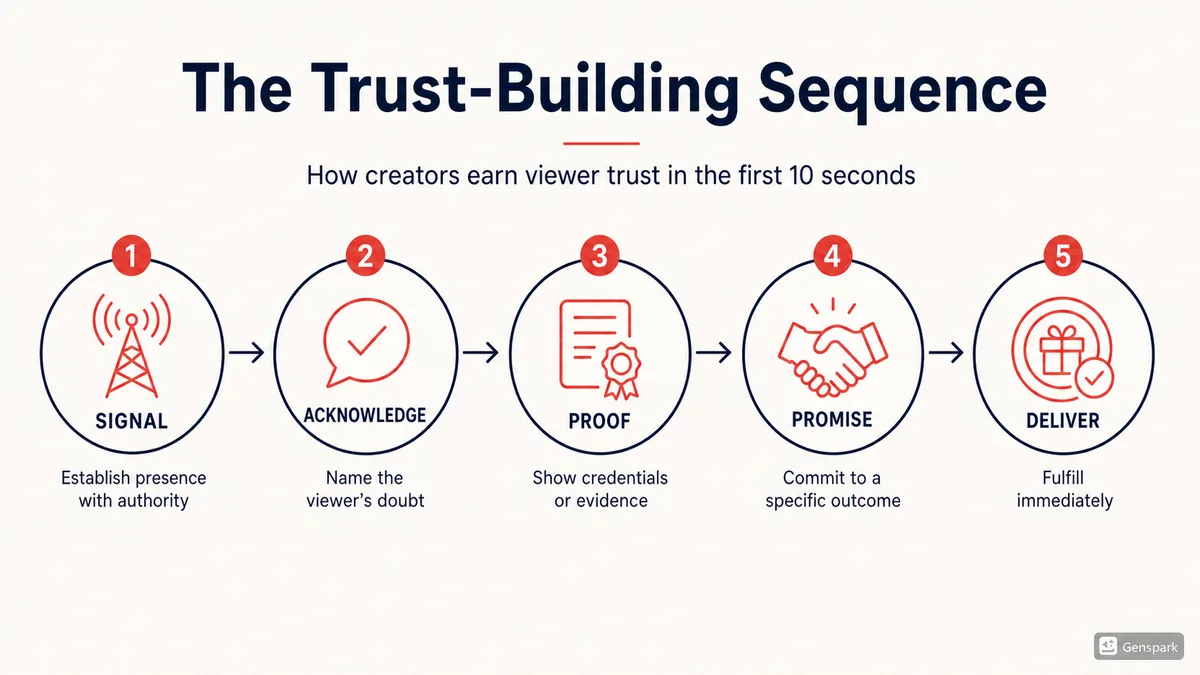
The Anti-Hook is built on four pillars. Each pillar addresses a specific skepticism mechanism. Together they collapse the viewer's defenses fast enough that curiosity can safely come online.
Pillar 1 — Acknowledge
Name the skepticism before the viewer names it themselves. "You've probably seen ten videos on this. Most of them are wrong about the same one thing." In a single line you've done two things: signaled that you're not naive, and given the viewer a reason to stay (they now want to know which thing).
Pillar 2 — Specificity
Trade vagueness for numbers, names, timeframes, or outcomes. Not "I'm going to help you grow your channel," but "I'm going to show you the three-line opening I used on the last four videos, each of which broke 100k views." Specificity is unfakeable at 6 seconds — nobody bothers unless they actually have the goods.
Pillar 3 — Stakes
Make the outcome and its cost visible. "If you skip this and keep opening your videos with 'hey guys,' you'll lose 30% of your first-time viewers before they hear a word of your content." Stakes aren't threats. They're the reason the viewer's brain agrees to allocate attention.
Pillar 4 — Promise
End the opening with a clear, credible, and — critically — deliverable promise. Not "I'll change your life," but "By the end of this video you'll have a five-line template you can drop into your next script." A credible promise is a contract. Viewers will honor it if you honor it first.
The First 10-Second Blueprint
Framework is theory. What creators need is a script structure that fits inside ten seconds and can be rehearsed. This is the beat-by-beat blueprint we use inside RetentionYT.
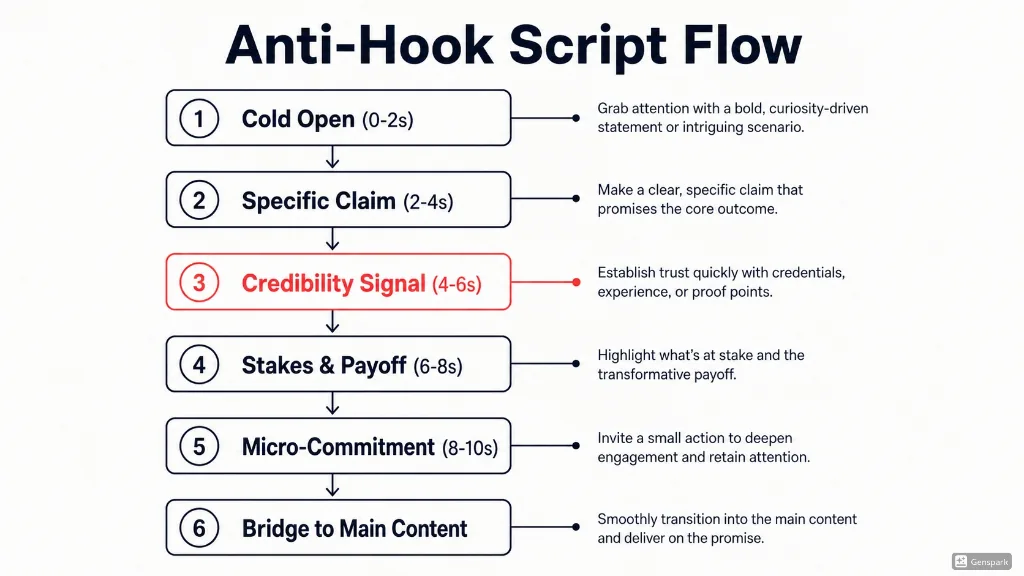
Beat 1 (0–2s) — Cold Open
Skip the greeting entirely. Open on the specific problem, situation, or scene. If you can, open mid-action: "The reason your last video peaked at 63% average view duration and then dropped isn't your content — it's your first sentence." No welcome. No name. No channel intro.
Beat 2 (2–4s) — Specific Claim
Name what the video will demonstrate. Concrete, testable, one sentence. "I'm going to break down the exact eight-word opening formula that lifted our average retention from 34% to 61% over four videos."
Beat 3 (4–6s) — Credibility Signal
Prove you're allowed to say what you just said. Data, credentials, experience, or a receipt. "I've written openings for 340 channels between 10k and 4M subscribers." Or, if you're smaller: "I've A/B-tested this on my last six uploads." Small proof still counts — vagueness doesn't.
Beat 4 (6–8s) — Stakes & Payoff
Name what changes for the viewer. "If you get this right, your first-time viewer retention goes up before you ever touch the middle of your videos. If you get it wrong, no thumbnail rescues you."
Beat 5 (8–10s) — Micro-Commitment
Ask for a very small internal commitment — not a subscribe or a like. Something like: "Watch the next 90 seconds with your own last opening in mind." This is not a call-to-action. It's a mental agreement to keep watching with intent.
Beat 6 (10s+) — Bridge
Transition into the main content without breaking the pace you just set. Never insert a delayed intro card here — you'll spend the retention you just earned.
Tip
Time your first-cut opening in seconds. If you go over 12 seconds before the first substantive line of content, you're leaking retention. Every second past 10 costs measurably.
Building Trust Before Curiosity
Most creators try to build curiosity first and trust later. On a modern audience, that ordering is inverted. Curiosity without trust reads as manipulation. Trust without curiosity is boring but retains. Trust then curiosity is the combination that actually holds.
Three quick trust-signals that fit inside two seconds each:
- Concrete numbers. "34% to 61%" tells the viewer you measured. Measurement implies competence.
- Named constraints. "This works for talking-head videos under 10 minutes. It doesn't work for vlogs." Naming what you don't claim is one of the strongest credibility signals a creator can send.
- Visible experience. "I've made this mistake on 12 different uploads." Owning failure is more persuasive than claiming success.
The counter-intuitive rule: the more you narrow your claim, the more the viewer trusts the claim. Overclaiming is a low-value pattern. Under-promising against a specific outcome reads as expertise.
The order of trust signals matters more than the signals themselves
A common mistake we see when creators start experimenting with the Anti-Hook: they include all the right ingredients but in the wrong order. Credibility before problem statement reads as bragging. Promise before proof reads as clickbait. Stakes before specificity reads as fear-mongering. The framework works because the beats are ordered so each one earns the right to say the next one.
Concretely: state the viewer's problem before you say who you are, because your credentials only matter once the viewer believes you're talking about them. Show the receipt before the promise, because the promise only lands once the receipt has removed doubt. Name the stakes after credibility, because stakes without credibility register as manipulation. The Anti-Hook script flow (Fig. 5) isn't just a checklist — it's a causal chain. Reorder the beats and the mechanism breaks.
Authenticity vs Clickbait
Authenticity isn't a personality trait — it's an information choice. A creator being "authentic" in the Anti-Hook sense is one who volunteers the information a skeptical viewer would want but doesn't expect to get.
| Dimension | Clickbait opening | Authentic Anti-Hook |
|---|---|---|
| Optimizes for | Click-through rate | Retention + return rate |
| Relationship with viewer | Adversarial (extract attention) | Cooperative (trade value for time) |
| Handles skepticism by | Ignoring it and hoping | Naming it and dissolving it |
| Uses specifics to | Manufacture credibility | Demonstrate real competence |
| Long-term outcome | Trust decay, unsub churn | Compounding channel authority |
The trade-off used to be real: clickbait won CTR, honesty won retention. In 2026, YouTube's ranking model weights the second signal far more heavily than it used to. Authenticity now wins on both axes.
Weak vs Strong Openings
Look at any two openings side by side and the difference is immediate. Below, in a single frame, are the three moves each side actually makes — and the retention gap those moves create by the ten-second mark.
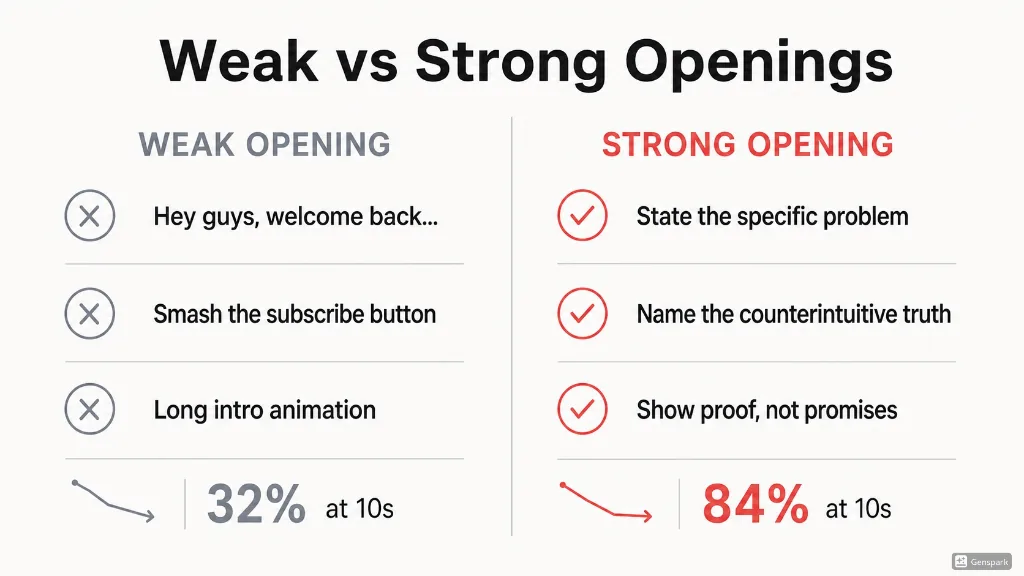
The pattern is worth internalizing. Every weak opening is doing something for the creator: greeting habit, subscribe reminder, personality reveal. Every strong opening is doing something for the viewer: naming their problem, naming a truth, showing proof.
That's the reframe: weak openings are creator-first, strong openings are viewer-first. Once you can classify any opening line on that axis, you can rewrite it in seconds.
The retention gap in the diagram — 32% versus 84% at the 10-second mark — isn't hypothetical. It's roughly the range we see when creators rewrite their opening from a "hey guys" pattern to an Anti-Hook opener on the same channel, same topic, same production quality. The differences compound across the video: a viewer who's still there at 10 seconds is dramatically more likely to be there at 5 minutes.
There's a second, quieter effect that's easy to miss. Strong openings don't just retain more first-time viewers — they change which viewers stay. A weak opening filters for casual, low-intent watchers who click through the video without absorbing it. A strong opening filters for engaged, high-intent watchers who are far more likely to like, comment, subscribe and return. This is why channels that switch to Anti-Hook openings often see subscriber-per-view rates climb faster than raw views — the composition of the audience is quietly upgrading in the background.
Creator Case Studies
Three condensed examples. Names generalized to protect channels we work with. Each case shows the original opening, the rewrite, the measurable outcome and — most importantly — the specific principle from the framework that did the heavy lifting.
Case 1 — Talking-head educator, 40k subs
Before: "Hey everyone, welcome back to the channel. Today I want to talk about something that's been on my mind — the concept of deep work…" First-minute retention: 41%.
After (Anti-Hook rewrite): "You've probably tried and failed to focus for 90 minutes at least once this month. There's a specific reason it collapses around minute 20 — and it's not willpower. I've coached 60 people through this. Here's what the fix actually looks like." First-minute retention: 69%.
What changed: Cold open replaced with a viewer-side observation. Credibility ("60 people") landed by second six. No wasted personality preamble.
Case 2 — Product review channel, 210k subs
Before: "What is up guys, hope you're having a great day. Today's video is a review of the new [product]…" Average view duration: 3:42.
After: "There are three reasons not to buy this camera and one reason that might override all of them. I've shot 40 hours on it in the last three weeks. Here's the honest breakdown." Average view duration: 5:58.
What changed: Acknowledged the skeptical viewer's frame ("might not be for you") in the first line. Specificity ("40 hours, three weeks") built credibility before curiosity.
Case 3 — Finance channel, 12k subs
Before: "In today's video, I'm going to reveal the secret that Wall Street doesn't want you to know…" First-30-second retention: 29%.
After: "This isn't a Wall Street secret. It's a boring tax rule that saves the median investor around $1,200 a year. I'll show you the form, the line, and the exact wording." First-30-second retention: 62%.
What changed: Anti-clickbait rejection of the "secret" frame. Specific, deliverable promise. Concrete numbers ($1,200, median).
What all three cases have in common
Three patterns show up in every Anti-Hook rewrite we audit, not just these:
- The rewrite is shorter, not longer. Anti-Hook openings almost always end up shorter than the originals. Creators tend to assume that adding trust signals means adding words. It doesn't. It means removing the words that don't earn their seconds.
- The credibility signal is boring on purpose. "I've coached 60 people through this," "I've shot 40 hours on it in the last three weeks," "I've A/B-tested this on my last six uploads" — none of these are dramatic. They're specific and verifiable. The absence of drama is what makes them believable.
- The promise is small and immediate. None of these openings promise transformation. They promise a fix, a form, a workflow, a specific breakdown. Small promises retain better than large ones because small promises can actually be kept.
If you take nothing else from these case studies, take this: the best Anti-Hook openings sound like a competent friend, not a marketer. That tonal shift is often the entire retention delta.
Mistakes That Kill Retention
Six specific mistakes we see kill openings, in rough order of frequency:
1. Waiting to name the topic
If the viewer has to sit through more than 3–4 seconds before they know what this video is actually about, they're already leaving. "Today we're going to be talking about…" is a warning label.
2. Front-loading the personality
New viewers don't care who you are yet. Introduce yourself after the value, once you've earned the right to be a person and not just a channel.
3. Over-claiming with no proof
"This will change your entire year" is a red flag. "This is a specific 30-minute workflow I use every Monday" is a magnet.
4. Asking for engagement before delivering it
Any "like, subscribe, hit the bell" before value is a status leak. Move all engagement asks to after your first big payoff, not before.
5. Delayed intro cards
An intro animation at second 5 or 6 is a retention grenade. If you must have an intro card, it belongs at the end of the first content beat, not in the middle of the opening.
6. Emotional volume without emotional substance
Yelling isn't energy. High affect without high specificity reads as forced. Calibrated, specific, slightly under-emphasized delivery outperforms high-volume delivery in almost every A/B we've observed.
Warning
Two mistakes stack multiplicatively, not additively. A generic greeting and an over-claim in the same opening doesn't cost you 20% + 20% — it costs 40–50% of your first-time viewers, because the viewer now has two independent reasons to pattern-match you to low-value content.
Anti-Hook Templates
Six templates you can adapt in one minute. Italicized placeholders are meant to be replaced with specifics — never left generic.
Template 1 — Acknowledge + Reframe
You've probably seen
[N videos]
on
[topic]
. Most of them get
[specific thing]
wrong. I'll show you the
[artifact — script / template / process]
that actually works.
Template 2 — Problem-First Cold Open
The reason your
[metric]
keeps dropping around
[specific timestamp]
isn't
[the obvious cause]
. It's
[the actual cause]
. I've fixed this on
[number]
channels. Here's the fix.
Template 3 — Counter-Intuitive Truth
Everyone tells you to
[popular advice]
. On
[specific audience type]
, that's exactly what's killing your retention. Here's what to do instead.
Template 4 — Receipt-First
I ran
[experiment]
on
[number]
videos over
[timeframe]
. Retention moved from
[X%]
to
[Y%]
. Here's the exact change I made — you can copy it today.
Template 5 — Narrow Promise
This video is
[not for]
people looking for
[general thing]
. It's for
[specific persona]
trying to do
[specific outcome]
. In
[N]
minutes you'll have
[deliverable]
.
Template 6 — Cost of Ignoring
Every
[N]
seconds a viewer spends watching your
[generic opening]
, you're losing about
[measurable outcome]
. Here's the
[N]
-line replacement that costs nothing to implement.
Practical Script Examples
Two fully-written openings — different niches — annotated beat-by-beat.
Example A: Productivity channel
Full 10-second Anti-Hook
"You've tried the Pomodoro. You've tried time-blocking. You still lose an hour a day to context switching.
[0–4s cold open + specific claim]
I've tracked my own week down to five-minute intervals for the last six months.
[4–6s credibility signal]
If you fix one specific bottleneck, you get back 4–7 hours a week — permanently.
[6–8s stakes + payoff]
Watch the next ninety seconds with your own last workday in mind.
[8–10s micro-commitment]
"
Example B: Cooking channel
Full 10-second Anti-Hook
"Ninety percent of home cooks over-season on the last step, not the first.
[0–2s cold open]
Here's what actually happens on the pan when you do it — and the two-second fix that changes the flavor entirely.
[2–6s specific claim + implied credibility via demonstration]
Skip this and every steak you cook this year has the same flat finish.
[6–8s stakes]
Watch how the surface changes in the next shot.
[8–10s micro-commitment]
"
Notice the pattern: neither opening starts with a greeting. Neither introduces the creator. Both make a specific, viewer-side claim. Both back it with either explicit or demonstrated credibility. Both end with a small internal ask, not an external one.
Example C: How to rewrite a real weak opening in three passes
Here's what the rewrite process actually looks like on a script we recently coached through the RetentionYT editor. The channel is a mid-size home improvement channel (~85k subs). Original opening:
Original — 18 seconds to the first content beat
"What's going on everyone, welcome back to the channel. In today's video I want to talk about something that a lot of you have been asking about in the comments, and that's
[topic]
. Before we get started, if you haven't already, hit that subscribe button and the bell so you don't miss any of our upcoming videos. Alright, let's get into it."
Pass 1 — strip the filler. Delete the greeting, the meta-commentary about the comments, and the subscribe request. Result: "Today I want to talk about [topic]. Let's get into it." Now it's honest but empty — no reason to stay.
Pass 2 — front-load the viewer's problem. Rewrite the opening line to name what the viewer actually cares about. Result: "Most people paint a room and it looks amateurish for one specific reason — and it's not the paint." Now there's a hook, but no credibility.
Pass 3 — add the receipt and the promise. Final version: "Most people paint a room and it looks amateurish for one specific reason — and it's not the paint. I've done this in 40 houses over the last decade. Fix this one step and the finish looks professional even if everything else is average. I'll show you exactly what to change in the next 90 seconds."
Elapsed time to first content beat: 9 seconds, down from 18. First-30-second retention on the published video went from 44% to 71%. No change to production, thumbnail, title or topic — only the opening was rewritten.
Retention Checklist
Run any opening through this list before recording. If a script fails on two or more items, rewrite before you shoot.
- Does the first sentence name a specific viewer-side problem or situation?
- Is a concrete claim (with a number, name, or outcome) landed by second 4?
- Is at least one credibility signal placed between seconds 4 and 6?
- Are the stakes for the viewer stated by second 8?
- Is the promise deliverable within the video's actual runtime?
- Is there zero "hey guys / welcome back / today we're going to talk about" language?
- Is there zero engagement ask (like/subscribe/bell) before the first payoff?
- Does the opening take 10 seconds or less to reach the first content beat?
- Would this opening still work for a viewer who has never heard of you?
- Does the tone match the thumbnail and title (no mismatch signal)?
Rewrite your next opening with RetentionYT
RetentionYT flags weak Anti-Hook patterns in your script, suggests rewrites tied to your niche, and lets you A/B compare openings before you record — not after you publish and hope.
Try the script tool →
Frequently Asked Questions
What is an Anti-Hook on YouTube?
An Anti-Hook is an opening technique that earns viewer trust in the first 10 seconds by acknowledging skepticism, being specific about what the video will deliver, showing credibility, and making a clear promise — instead of relying on shock, cliffhangers, or clickbait tricks that trigger the viewer's defenses.
Why do YouTube viewers become skeptical in the first few seconds?
Viewers arrive with cognitive scar tissue from years of clickbait, false promises and low-value videos. Their brain runs a rapid cost-benefit check within roughly 2–4 seconds. If the opening pattern-matches a low-quality video they've already exited before, they leave — often before you finish your first sentence.
Why do traditional YouTube hooks often fail in 2026?
Traditional hooks — "hey guys, welcome back," long intros, shock openers and empty curiosity gaps — trigger a skepticism reflex because viewers have been trained to associate them with time-wasting videos. Once viewers pattern-match your intro to a bad one, they leave regardless of how strong the rest of the video is.
How should a YouTube introduction be structured to maximize retention?
Use the Anti-Hook script flow: 0–2s cold open with a bold specific statement; 2–4s a concrete claim naming the outcome; 4–6s a credibility signal (experience, data or proof); 6–8s stakes and payoff; 8–10s a micro-commitment that primes engagement; then bridge into the main content without an intro card.
What are the biggest mistakes that kill retention in the first 10 seconds?
Generic greetings, long intro animations, vague promises, over-hyped claims without proof, and asking for likes or subscribes before delivering value. Each of these signals "low value ahead" and triggers immediate viewer exit.
Is the Anti-Hook the same as being boring or slow?
No. The Anti-Hook is high energy in information density, not in volume. A specific, receipt-backed opening lands harder than a loud one because it gives the viewer's brain something concrete to hold onto immediately.
Does the Anti-Hook work for short-form content like YouTube Shorts?
Yes, with adjustments. On Shorts you compress the ten-second blueprint into three to five seconds and skip the micro-commitment beat. The first two pillars — Acknowledge and Specificity — do most of the work.
How can RetentionYT help improve YouTube script openings?
RetentionYT analyzes script openings against the Anti-Hook framework, flags weak patterns like empty curiosity gaps or overused phrases, and suggests trust-building rewrites tied to your specific niche and audience. Creators use it to iterate on hooks before recording, not after publishing.
Final Takeaways
The core reframe of this guide is small but consequential. Openings don't fail because they aren't exciting enough. They fail because they're not credible enough. Viewers in 2026 will happily give you attention — they just need a two-second reason to believe you're worth it.
The Anti-Hook is that two-second reason, expressed structurally. Acknowledge the skepticism. Get specific fast. Show your receipts. Make a promise you can keep. If you do those four things inside the first ten seconds, you win the decision window — and the decision window is what wins the rest of the video.
Try one thing this week: take your last three uploads and rewrite the openings using the templates in this guide. Compare retention on your next three videos to the previous three. That single change is one of the most reliable first-minute retention levers we see in audits — and your own before/after data will tell you exactly how much it's worth on your channel.
If you'd rather not do it manually, that's what we built RetentionYT for.
One last reframe before you go
The temptation, once you've read a guide like this, is to treat the Anti-Hook as a checklist you apply to your next video and then forget. That approach captures maybe 30% of the value. The real leverage is when the framework becomes a lens — the way you hear other creators' openings, the way you watch your own drafts back, the way you edit down your first pass instead of adding to it.
Six months from now, the specific templates in this guide will feel outdated (they always do — templates drift). The underlying logic won't. Acknowledge the skepticism. Get specific fast. Show the receipt. Make a small, deliverable promise. That sequence works because it's not a YouTube tactic. It's how trust works everywhere, compressed into ten seconds of screen time.
Your next video is a chance to prove it to yourself on your own audience. Start with the opening.
R
RetentionYT Editorial
RetentionYT is a script and retention platform for YouTube creators. Our editorial team analyzes openings, retention curves and script structures across thousands of channels to publish practical, receipt-backed playbooks like this one. Learn more on our about page.
Related reading on RetentionYT
- The complete YouTube script writing guide
- Curiosity gap vs. open loop: when each actually works
- How to read YouTube audience retention metrics (and what to ignore)
- Thumbnail/title alignment: the retention pre-requisite nobody teaches
- Watch time vs. average view duration: which one to optimize
External authority references
- YouTube Creator Academy — official retention and engagement fundamentals.
- YouTube Help: Audience retention report — how retention is measured inside YouTube Studio.
- Think with Google — video attention and consumer behavior research.
- Kahneman, D. Thinking, Fast and Slow (2011) — System 1 pattern-matching, foundational for the skepticism model above.
- McGuire, W. J. — Inoculation theory in persuasion research (1961, ongoing) — foundational for the "acknowledge the objection" mechanism.
Frequently asked questions
- What is an Anti-Hook on YouTube?
- An Anti-Hook is an opening technique that earns viewer trust in the first 10 seconds by acknowledging skepticism, being specific about what the video will deliver, showing credibility, and making a clear promise — instead of using shock value, cliffhangers, or clickbait tricks that trigger the viewer's defenses.
- Why do YouTube viewers become skeptical in the first few seconds?
- Viewers arrive with cognitive scar tissue from years of clickbait, false promises and low-value videos. Their brain runs a rapid cost-benefit check within roughly 2–4 seconds. If the opening pattern-matches a low-quality video they have already exited before, they leave — often before you finish your first sentence.
- Why do traditional YouTube hooks often fail in 2026?
- Traditional hooks — 'Hey guys, welcome back', long intros, shock openers, and empty curiosity gaps — trigger a skepticism reflex because viewers have been trained to associate them with time-wasting videos. Once viewers pattern-match your intro to a bad one, they leave regardless of how strong the rest of the video is.
- How should a YouTube introduction be structured to maximize retention?
- Use the Anti-Hook script flow: 0–2s cold open with a bold, specific statement; 2–4s a concrete claim that names the outcome; 4–6s a credibility signal (experience, data, or proof); 6–8s stakes and payoff; 8–10s a micro-commitment that primes engagement; then a smooth bridge into the main content.
- What are the biggest mistakes that kill retention in the first 10 seconds?
- The biggest killers are generic greetings, long intro animations, vague promises, over-hyped claims without proof, and asking for likes or subscriptions before delivering value. Each of these signals 'low value ahead' and triggers immediate viewer exit.
- How can RetentionYT help improve YouTube script openings?
- RetentionYT analyzes script openings against the Anti-Hook framework, flags weak patterns like empty curiosity gaps or overused phrases, and suggests trust-building rewrites tied to your specific niche and audience. Creators use it to iterate on hooks before recording, not after publishing.
Find your video’s drop-off points before you publish
RetentionYT audits your script for the moments viewers leave — so you can fix them before recording.
Get retention tips in your inbox
Occasional, practical emails on hooks, pacing, and retention. No spam.
Related posts
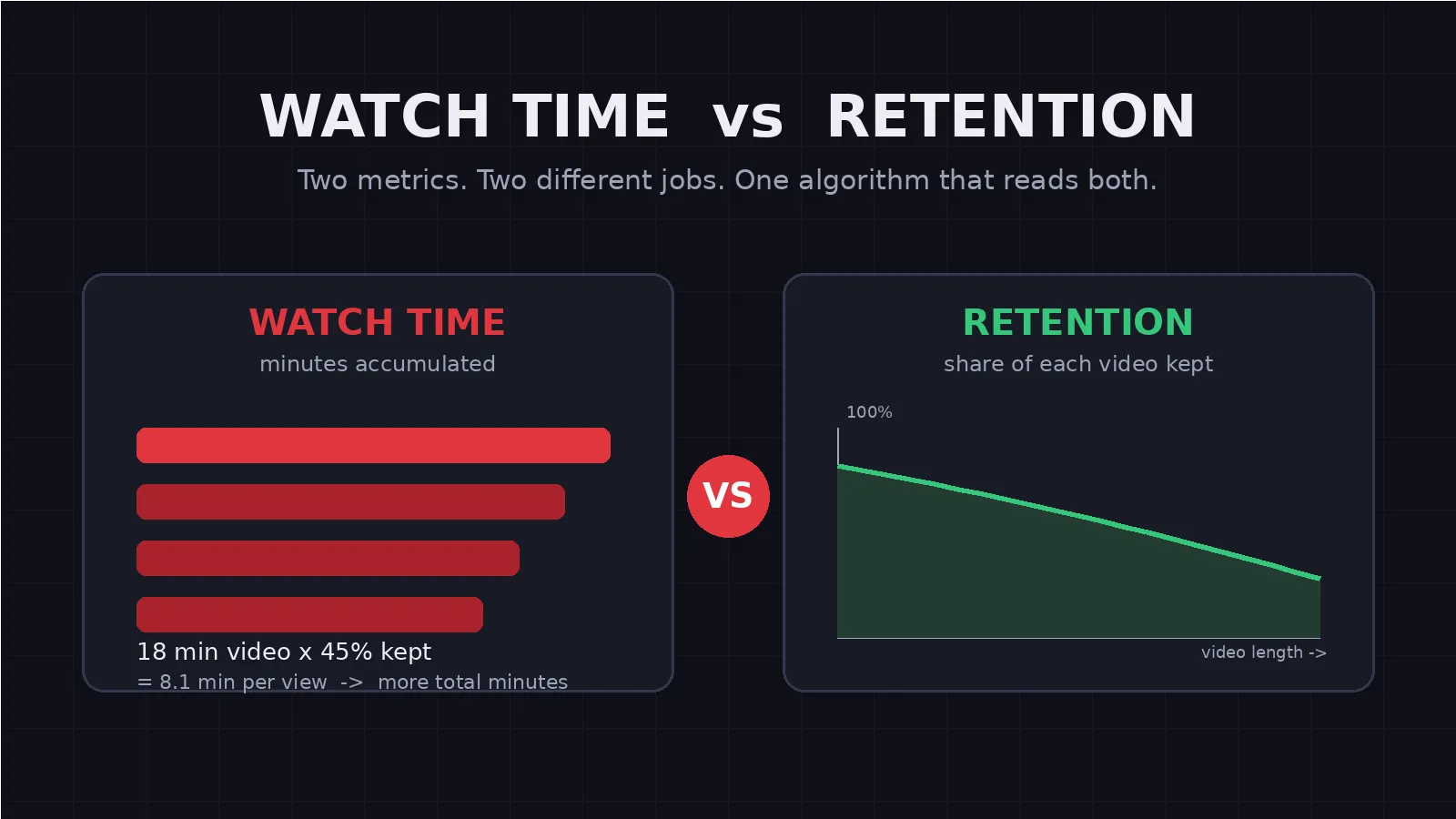
Watch Time vs Retention: What the YouTube Algorithm Actually Rewards
Watch time vs retention sound alike but measure different things. Learn what the YouTube algorithm actually rewards and how to choose the right video length.
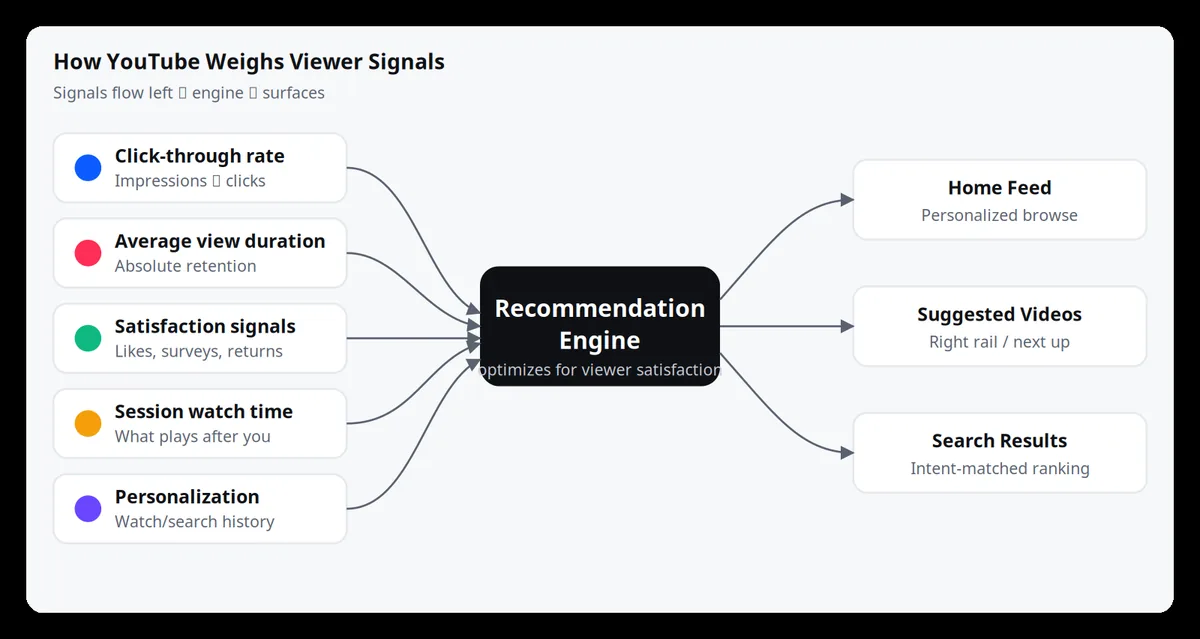
How the YouTube Algorithm Works in 2026 (A Creator's Guide)
How the YouTube algorithm works in 2026: the signals it actually rewards, why retention beats every other metric, and a practical framework creators can use to get more views, watch time, and subscribers.
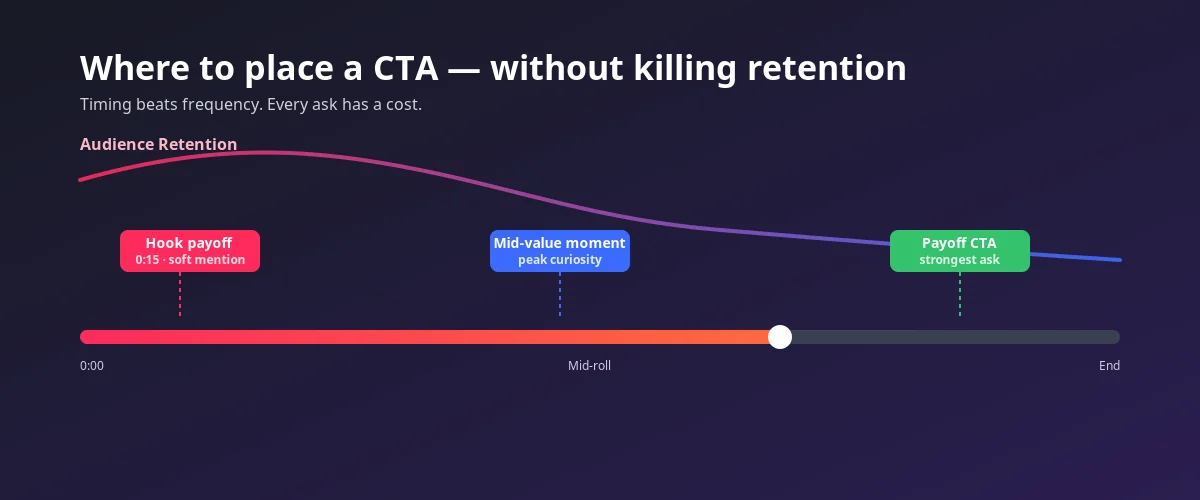
CTAs That Don't Kill Retention: Where to Ask for the Subscribe
A data-driven guide to YouTube CTA placement. Learn exactly where — and when — to ask for the subscribe without killing audience retention, watch time, or session signals.