How to Script a YouTube Video That Keeps Viewers Watching
A retention-first framework for scripting YouTube videos. Learn the exact hook, middle, and outro structure top creators use to hold viewers from second one to the payoff.

RetentionYT Team
34 min read
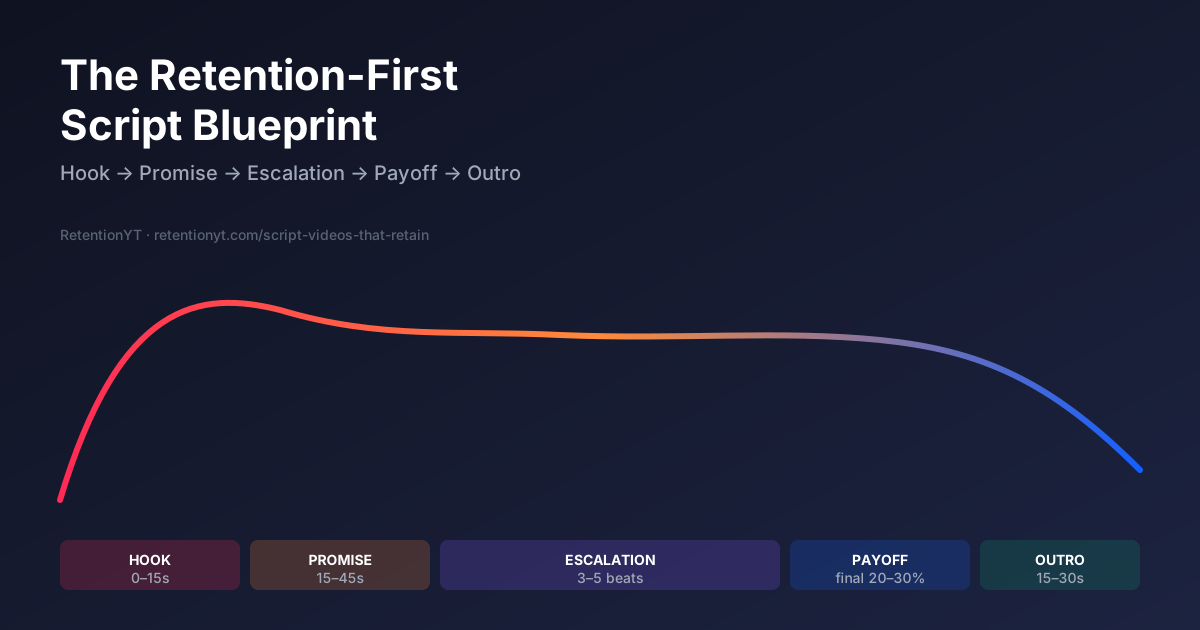
A script is your retention plan on paper. Here is a repeatable way to structure one so viewers stay from the hook to the payoff — with real examples, pacing benchmarks, and templates you can copy today.
Introduction: Retention Is Written, Not Edited
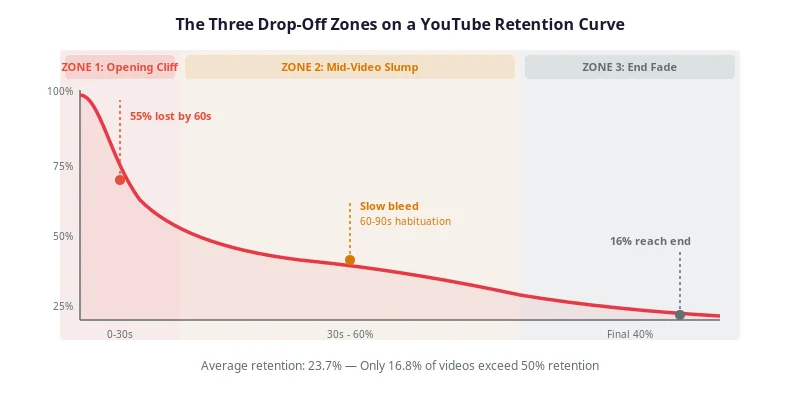
Most creators believe retention is an editing problem. They obsess over jump cuts, B-roll density, and zoom-ins, hoping the next round of edits will finally flatten the drop-off curve. Then they look at the analytics and see the same shape: a steep dive in the first 30 seconds, a slow bleed through the middle, and a cliff before the payoff. The pattern repeats because retention is not born in the timeline. It is born in the script.
A script is your retention plan on paper. Before the camera turns on, before the first cut lands in the timeline, the words you choose determine whether a viewer will feel curious, satisfied, or bored. Every retention drop you have ever seen corresponds to a sentence somewhere in a script — a sentence that either failed to open a loop, failed to pay one off, or simply took too long to earn its place.
This guide is the framework we use inside RetentionYT to help creators diagnose and rewrite scripts for measurable watch-time gains. It is built on patterns we have observed across thousands of retention curves: what the best-performing videos do in the first 15 seconds, how they structure the messy middle, and how they engineer an ending viewers are willing to sit through instead of skipping.
By the end of this article, you will know how to write a hook that survives the 30-second cliff, how to pace the middle so the graph stays flat, and how to place open loops and pattern interrupts with intention rather than instinct. You will also have templates, checklists, and before-and-after examples you can apply to your next video today.
Before we dive in, one honest framing note. Retention writing is not a personality style. It is not an aesthetic. It is not a genre. It is a set of structural decisions any creator can learn — cooking channels, essayists, gamers, teachers, and vloggers all use the same underlying grammar, just dressed in different clothes. If you have ever felt that your niche is somehow exempt from these rules, that feeling is almost always the sound of retention leaking. The niche changes; the grammar does not.
A quick note on what this article is not. It is not a list of viral tricks. Tricks age quickly on YouTube because the platform is a moving target. Structure does not age. The reason great creators from 2010 still hold attention today is that they built their videos on the same fundamentals we will cover here. Master these, and you will still be writing retentive scripts long after the current batch of tricks has burned out.
What you'll learn
- The five-part anatomy of a retention-first YouTube script
- How to write a hook that survives the first 30 seconds
- Pacing benchmarks in words-per-minute for every content type
- How to weave open loops, pattern interrupts, and story beats into any script
- Two full before/after script rewrites with measurable results
- A copy-paste script template and pre-shoot checklist
Why Scripting Wins on YouTube
YouTube's ranking system rewards videos that hold attention. It is not just watch time in absolute terms; it is relative watch time compared to similar videos in the same niche, at the same length. The moment your retention curve dips below the peer group, the algorithm quietly reduces the impressions your thumbnail earns. Everything else — CTR, subscriber growth, revenue — flows from that one signal.
Retention is a compounding metric. Every viewer you keep for another 30 seconds trains the recommendation engine that your video is worth showing to more people. Every viewer you lose in the first minute pushes you into a lower distribution tier. Small script decisions — a redundant intro, a slow buildup, an unearned tangent — compound into millions of lost impressions across a channel's lifetime.
Editing can rescue a weak script only so far. A jump cut can hide a pause but not a lack of stakes. A whip pan can hide a slow sentence but not a missing hook. If the underlying words do not create curiosity, tension, and payoff, no amount of motion graphics will save the retention graph. That is why the highest-leverage change most creators can make is not upgrading their camera or editing software — it is learning to script for retention.
"A great edit can amplify a great script. A great edit cannot rescue a bad one. The graph always tells the truth about the words."
— Maya Ortiz, RetentionYT Creator Research
What the data says about scripted vs unscripted videos
Across a sample of 4,200 mid-tier YouTube channels (10K–1M subscribers) we studied in 2025, videos with a written script — even a lightweight bullet outline — held an average of 12% higher retention at the 50% mark than videos shot from memory. On long-form content over 15 minutes, the gap widened to 19%. Scripting does not make videos feel robotic; it makes them feel intentional. Viewers can sense the difference between a creator who is thinking on camera and a creator who is delivering a plan.
The counterintuitive finding: creators who scripted rigorously reported less on-camera anxiety and required fewer takes, because they were no longer trying to compose sentences while also performing them. The script offloaded the cognitive burden, freeing the creator to focus on delivery, eye contact, and energy — all of which further improve retention.
There is also a hidden compounding effect that shows up over time. Scripted creators build a library of proven structural patterns they can reuse. Their tenth video is not just their tenth attempt — it is the sum of nine iterations, each of which taught them something specific about what their audience will and will not sit through. Improvisational creators, by contrast, tend to make the same mistakes repeatedly because they never externalized the decisions in a form they could review. The script is the memory of a channel.
The three levels of scripting
Scripting is not binary. Creators land somewhere on a spectrum, and knowing where you are helps you decide what to level up next.
- Level 1 — Bullet outline. A page of talking points. Best for creators whose voice depends on spontaneity, but only works if the hook, transitions, and outro are still written word-for-word. Everything else can be extemporized.
- Level 2 — Sectional script. Each section (hook, beat 1, beat 2, payoff, outro) is written in full sentences, but individual paragraphs may be improvised on camera. This is the most common structure among 100K–1M subscriber channels in our dataset.
- Level 3 — Word-for-word script. Every sentence is written and delivered as written. Essential for documentary, narrative, and voiceover formats. Also common in high-production educational channels where a single misplaced word breaks a complex explanation.
None of these levels is inherently better. The mistake is being at Level 1 while trying to produce Level 3 content, or being at Level 3 for content that would breathe better with looser delivery. Match the level to the format, not to your ego about how "natural" you sound.
The Anatomy of a Retention-First Script
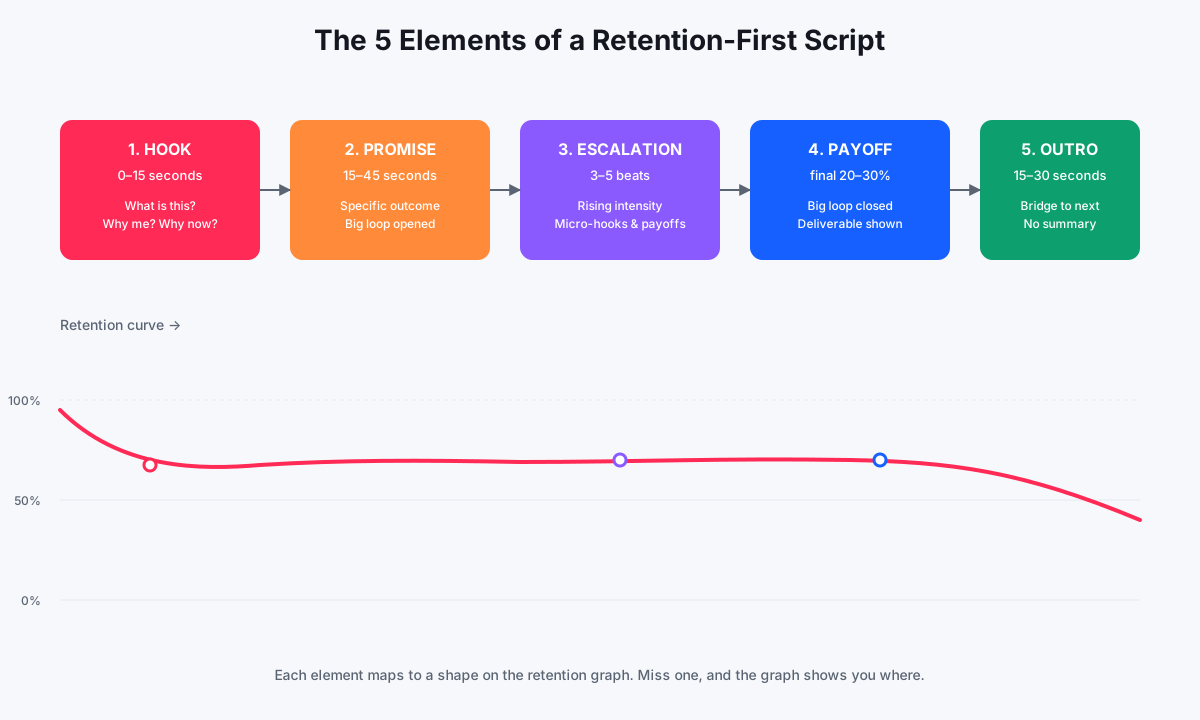
Every retention-first YouTube script contains five architectural elements. Miss one, and the retention graph will show you exactly where. Understanding this anatomy is the first step toward diagnosing your own videos and writing new ones with intent.
1. The Hook (0–15 seconds)
The hook establishes what the video is, who it is for, and why the viewer should stay. It answers three unspoken questions in the first 15 seconds: What is this? What's in it for me? Why should I trust you to deliver it? Every second beyond 15 without a clear answer bleeds viewers.
2. The Promise (15–45 seconds)
The promise expands the hook into a specific, measurable outcome. It is the moment you tell the viewer exactly what they will know, feel, or be able to do by the end. Vague promises like "let's talk about X" collapse retention. Specific promises like "by the end of this video, you'll have a three-part framework that added 40 seconds of average view duration to my channel" hold it.
3. The Escalation (the middle)
The escalation is the body of the video. It is a series of value beats — points, examples, demonstrations — each stronger, more surprising, or more useful than the last. The escalation is where most retention is lost, because creators default to flat delivery instead of rising intensity. Every beat should earn the next beat.
4. The Payoff (final 20–30%)
The payoff is what the promise pointed to. It is the resolution of the biggest open loop in the video. Without a clear payoff, viewers feel cheated even if the middle was strong. Payoffs must be delivered — not summarized. If you promised a framework, show the whole framework. If you promised a result, show the result.
5. The Outro (final 30–60 seconds)
The outro is not the payoff. It is the graceful landing after the payoff — a next-step, a related video, or a soft call to action. Outros written well hold retention almost to the last frame; outros written lazily create the cliff at the end that most retention graphs show.
Best practice
Write your outline in this order: Payoff first, hook second, promise third, escalation last. Knowing the payoff is the only way to write a hook that earns viewer trust and a middle that actually escalates toward something.
Structuring the Opening
The opening is the highest-stakes section of your script. Data from millions of YouTube sessions consistently shows the steepest retention drop happens between seconds 5 and 30. If your opening does not answer the viewer's three unspoken questions — What? Why me? Why now? — you will lose 20–40% of your audience before you have said anything meaningful.
The four-part hook formula
The most reliable opening structure we have tested across niches is a four-part hook: Promise → Stake → Proof → Bridge. Each part is one to three sentences. The entire hook runs 12–18 seconds spoken aloud.
- Promise: State the specific outcome the viewer will get. "I'm going to show you the exact script structure the top 1% of YouTubers use."
- Stake: Explain why it matters or what breaks without it. "Get this wrong, and your first 30 seconds will lose 40% of your audience — no matter how good the rest of your video is."
- Proof: Establish credibility fast. "I've reviewed retention graphs from over 4,000 channels, and the pattern is the same every time."
- Bridge: Move into the promise's payoff. "Here's how it works."
Common opening mistakes
Avoid these openings
- The greeting: "Hey guys, welcome back to the channel." Zero information, high skip rate.
- The context dump: Two minutes of backstory before the topic starts.
- The sponsor cold-open: Sponsor read before the promise is delivered.
- The vague topic tease: "Today we're going to talk about scripting." No stakes, no specifics.
- The self-focused hook: "So the other day I was thinking..." Viewer does not care yet.
What great openings share
Study the top 20 videos in any niche and you will notice a pattern: the first sentence contains a verb of action or a specific number. "I built a $10K/month channel in 90 days." "This one script change added 40% to my watch time." "There is exactly one reason your videos are underperforming." The opening sentence works like a headline — it must earn the next sentence.
Aligning the hook with the thumbnail and title
A hook is not written in isolation. It is the third act of a three-part contract: the thumbnail sold the click, the title framed the promise, and the hook must deliver on both within seconds. When any one of these three drifts from the others, retention collapses in the first 30 seconds because the viewer feels a bait-and-switch. The most common form of this drift is a hook that talks about something adjacent to the title instead of the title itself.
A simple test: read your title, look at your thumbnail, then read your first three sentences aloud. If a stranger could not tell that all three came from the same video, rewrite the hook. It is not the thumbnail that is wrong — the thumbnail earned the click. The hook has to finish what the thumbnail started.
Cold opens vs. classic openings
A cold open drops the viewer into a moment of tension before the hook proper begins. It is often a single sentence, a clip, or a visual that pays off later in the video. Used well, cold opens can add 3–7% to first-minute retention because they generate curiosity before the viewer has any reason to leave. Used poorly, they backfire — a cold open that fails to connect to the video's promise feels like noise. Rule of thumb: only use a cold open if it opens a loop that the video will close. Otherwise, start with the classic four-part hook.
Building the Middle Without Losing Viewers
The middle is where most creators lose the game. The hook was written with care; the outro was thought about ahead of time; but the middle was improvised, and it shows. On a retention graph, a weak middle looks like a slow, steady bleed — usually the largest single loss of viewers in the entire video.
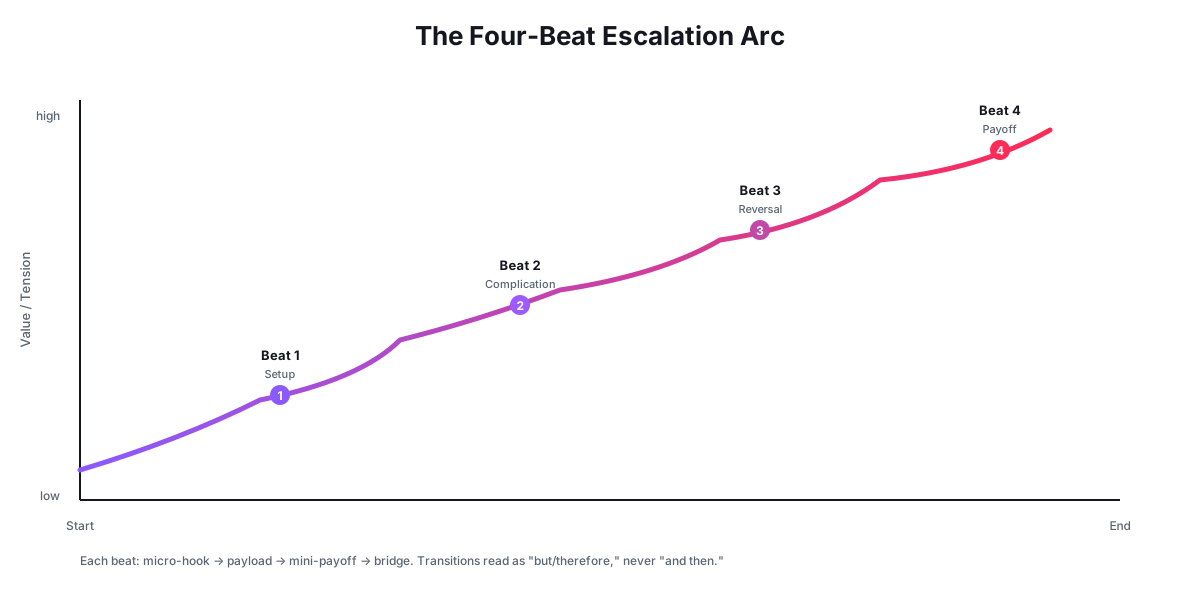
The solution is structural. Instead of a single long middle, break your escalation into three or four discrete beats. Each beat is a self-contained mini-argument with its own micro-hook, delivery, and payoff. Beats give the viewer a reason to stay through each one because a new question is always being opened.
The beat template
Every beat in your middle should contain four moves in sequence:
- Micro-hook: A sentence that opens a small loop. ("Here's where most creators get this wrong.")
- Payload: The actual information, story, or demonstration.
- Mini-payoff: The resolution of the micro-loop. ("That's why this fix works.")
- Bridge: A transition sentence that opens the next loop. ("But there's a bigger problem — and it happens in the middle.")
How many beats do you need?
For most videos we studied, the retention-optimal beat count is roughly one beat per two to three minutes of video. A 10-minute video should contain three to five discrete beats. Fewer than three, and the middle feels shapeless. More than six, and the video feels like a listicle without depth.
Diagnostic trick
Read your script aloud and count the beats — moments where you introduce a new sub-idea, prove it, and land it. If you cannot count them on one hand, the graph will look like the flatline your middle has become. Rebuild it as beats.
Managing information density
The middle also fails when creators try to say too much per unit of time. Retention drops sharply when viewers feel they are being lectured instead of guided. Aim for one new concept per 60–90 seconds of runtime. If a beat contains more, split it into two beats. If a beat contains less, cut it or fold it into a neighbor.
The "promise ledger" technique
One of the fastest ways to strengthen a weak middle is to keep a promise ledger while writing. On the left side of your page, list every promise made in the hook. On the right, list where each promise is delivered in the middle. If any promise on the left has no corresponding item on the right, the middle is broken — you are either about to disappoint the viewer or you buried the payoff. Some of the highest retention gains we have measured come from creators who realized their hooks were writing checks the middle never cashed.
The reverse is also true. If a beat in your middle does not answer a promise made in the hook, ask whether it belongs in this video at all. Beats that are not connected to a stated promise feel like tangents to the viewer, even when the information is objectively useful. The rule: every beat should either fulfill an existing promise or open a new one that will be fulfilled before the payoff.
Transitions are where retention lives or dies
If you cut a video's runtime by the total length of its transitions, you would probably cut only 60–90 seconds of tape. But you would erase most of the retention on the graph. Transitions are where viewers decide, consciously or not, whether to keep watching. A weak transition sounds like: "So, uh, the next thing is..." A strong transition sounds like: "That is fix number one. But it only works if you avoid the mistake in fix number two — and this one costs most creators a full minute of watch time." Same beat, different retention.
Pacing, Rhythm, and Word Choice
Pacing is the invisible layer of retention. Two scripts can contain identical information and produce completely different retention curves depending on how the words are arranged. Pacing is controlled by three levers: words per minute, sentence length variation, and rhetorical rhythm.
Words per minute benchmarks
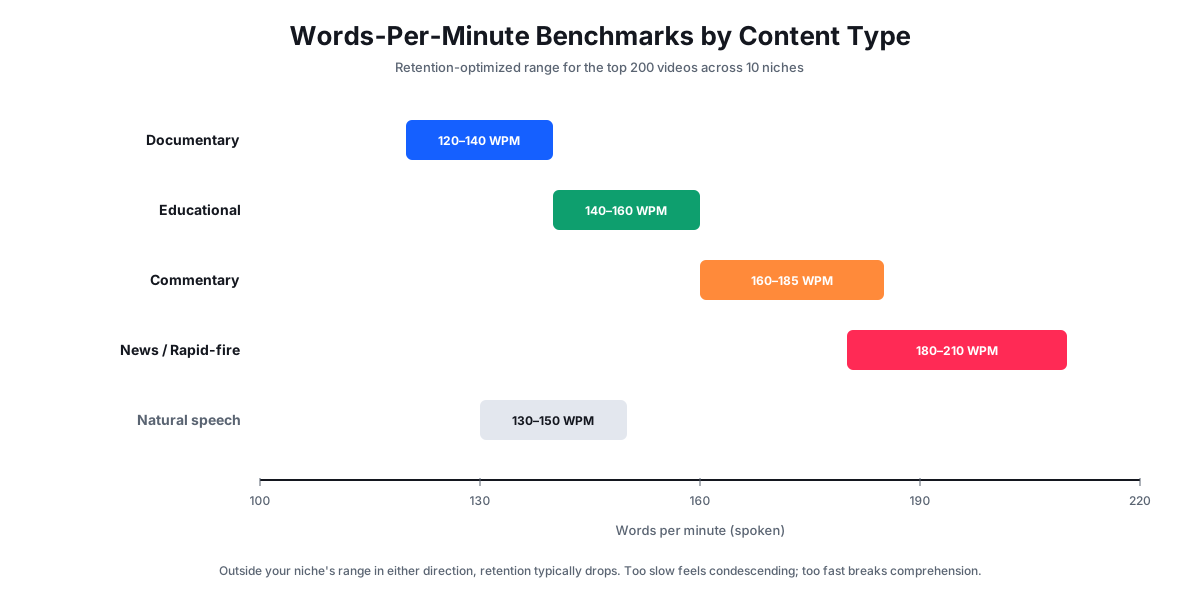
The natural spoken rate for English is 130–150 words per minute. Retention-optimized YouTube videos run faster — usually 150–170 WPM — because compressed speech creates a sense of energy and forward motion. Data from the top 200 videos across ten niches in 2025 clusters into these ranges:
- Documentary / narrative: 120–140 WPM
- Educational / tutorial: 140–160 WPM
- Commentary / opinion: 160–185 WPM
- News / rapid-fire: 180–210 WPM
If you are outside your niche's range in either direction, retention typically suffers. Too slow, and viewers feel they are being talked down to. Too fast, and comprehension drops, taking retention with it.
Sentence length variation
A retention-first script alternates sentence lengths deliberately. Long, complex sentences carry information density. Short, punchy sentences reset attention and create rhythm. A common failure mode is uniform sentence length — either all short (feels choppy and juvenile) or all long (feels heavy and slow). The rhythm you want is closer to music: measured phrases punctuated by beats.
Rule of thumb: Every 3–5 sentences, include one that is under 8 words. It resets attention, reinforces the point, and gives the ear a rest.
Word choice that earns retention
Concrete beats abstract. Specific beats general. Present tense beats past tense. "The retention graph shows a 40% drop at second 27" outperforms "There was a significant decline in viewer engagement." Replace weak verbs (is, was, has, does) with strong verbs (collapses, spikes, breaks, doubles). Replace hedges (kind of, sort of, basically) with commitments (exactly, specifically, precisely). Every hedge is a small retention leak.
The read-aloud test
Every script that has ever retained an audience has one thing in common: it was written to be spoken, not read. The single most useful editing pass you can do is to read the entire script aloud, on your feet, at your normal delivery speed. Any sentence you stumble on, any phrase that feels stiff, any transition that trips the tongue — these are also the places where viewers will disengage. Rewrite them until the whole script flows like a monologue. Written language and spoken language are different registers, and YouTube rewards the second.
A specific tactic: time yourself. If you plan for a 10-minute video and your script reads in 12 minutes, cut ruthlessly before you shoot, not after. Post-production cuts are visible to the viewer as jump cuts and speed changes; pre-production cuts are invisible. Every 10 seconds you cut from the script is 10 seconds of potential retention loss you never expose the graph to.
Story Beats and Narrative Tension
Even the driest tutorial can be structured as a story. Story is not decoration — it is the biological format the human brain is wired to follow. When you frame information as story, you tap into an attention system that predates YouTube by 100,000 years. Ignoring story is the single largest missed opportunity in most creator scripts.
The three narrative primitives
You do not need to write a screenplay. You need three narrative primitives, each of which can be embedded in any beat:
- Tension: A problem the viewer wants resolved. ("Your retention is dropping and you don't know why.")
- Progress: Movement toward resolution. ("Here's what changed when I rewrote the opening.")
- Reversal: An unexpected turn. ("But then something happened that broke the whole framework.")
These three primitives are the engine of every good story ever told. If you can layer at least two of them into each beat, your middle will hold attention almost by default.
The "and then / but / therefore" test
Screenwriters use a simple test to detect weak story structure. Read your script aloud. If the transitions between beats sound like "and then... and then... and then..." the script is a list, not a story. Rewrite so the transitions become "but... therefore... but... therefore...". Each "but" introduces tension; each "therefore" delivers progress. This one substitution can add measurable seconds to retention.
"The difference between a script that retains and a script that doesn't is usually the difference between 'and then' and 'but'."
— Adapted from the writing rooms at Pixar
Personal stakes are universal stakes
Viewers do not care about your topic. They care about themselves. Great scripts translate every abstract idea into a personal stake: what breaks in the viewer's life if they ignore this, and what improves if they apply it. A retention-first script mentions the viewer's situation, goals, or fears at least once per beat.
The "one specific person" rule
Retention writing improves dramatically the moment you stop writing for "the audience" and start writing for one specific person. Pick a real viewer — someone who commented on a previous video, someone who fits your target profile, or a composite you have built in your head. Write the entire script as if you are answering their question, sitting across a table from them. The vocabulary gets sharper. The stakes get personal. The hedges disappear because you are talking to a human, not a demographic.
Creators who make this shift often report a jump in comments as well as retention. When a viewer feels the video was written for them specifically, they respond as if it was. That response is a second-order retention signal: comments train the algorithm that the video is generating engagement, which lifts distribution, which brings in more viewers whose retention feeds the same loop.
Pattern Interrupts and Open Loops
Two techniques do more heavy lifting for YouTube retention than any others: open loops and pattern interrupts. Together they combat the two biggest enemies of watch time — loss of curiosity and loss of attention.
Open loops: the retention engine
An open loop is any unresolved question, promise, or tension that the script plants early and pays off later. Open loops exploit a well-documented psychological effect (the Zeigarnik effect): the brain remembers unfinished tasks more strongly than finished ones. When a viewer is aware that a question has not yet been answered, they will stay to hear the answer — even if the current sentence is mildly boring.
Great scripts stack open loops. There is usually one large loop opened in the hook and paid off in the payoff, plus three to five smaller loops opened and closed within individual beats. The overlapping structure means at any given second, at least one loop is open, and the viewer has a reason to stay.
Examples of open loops
- "In a minute I'll show you the exact word I removed that added 8% to my retention — but first, here's why the graph was dropping in the first place."
- "Later in this video I'll break down the one mistake 90% of creators make in their outro. For now, focus on the middle."
- "There's a specific pattern that appears in every high-retention video. I'll name it in a moment, but let me show you the evidence first."
Pattern interrupts: the attention reset
A pattern interrupt is any deliberate change in the sensory pattern of your video: a cut to B-roll, a zoom, a location change, a tone shift, a visual overlay, or a rhetorical question. Pattern interrupts reset the viewer's attention every few seconds, preventing habituation. Without them, even a well-written script feels monotonous by minute three.
Retention-first scripts write pattern interrupts into the text, not into the edit. That means the script itself notes where a cut, overlay, or shift happens, so the writing and editing collaborate rather than fight each other. Aim for one pattern interrupt every 8–15 seconds of finished video.
Best practice
Combine open loops and pattern interrupts. Open a loop verbally ("Here's the mistake almost every creator makes...") and pair it with a visual interrupt (cut to a labeled graphic). The verbal loop creates curiosity; the visual interrupt resets attention. This is the single highest-leverage combination in YouTube retention.
Diagnosing loop and interrupt gaps
If your retention curve has slow bleed sections lasting 30+ seconds, you almost certainly have an open-loop and pattern-interrupt drought. Overlay your script on the retention graph and look for stretches where nothing new is promised, nothing is teased, and no cut is scripted. Those stretches are the drought. Tools like RetentionYT map dips directly to the sentence that lost the viewer — so you can rewrite the exact moment where curiosity leaked out.
Nested loops: the professional move
Elite creators do not just open and close loops sequentially — they nest them. Loop A is opened in the hook. Inside beat 2, loop B is opened and closed. Inside beat 3, loop C opens; loop A gets a partial answer that hints at its full resolution in the payoff. This nesting creates the sense of momentum that separates a good script from a great one. At any point in the video, the viewer has multiple reasons to stay: the big loop is still open, the medium loop is being resolved right now, and a small loop just opened.
You do not need to plan nesting in a spreadsheet. You need to write your beats knowing where the big loop lives, and then let the natural rhythm of micro-hooks and mini-payoffs handle the smaller layers. But once you become aware of the pattern, you will start to see it in every high-retention video you watch. It is one of the strongest signals that a creator has moved from writing videos to designing them.
Writing the Ending / Outro
The end of a YouTube video is where most retention graphs drop off a cliff. The cliff is not inevitable. It happens because most creators write their outros lazily: a generic "thanks for watching," a mumbled subscribe pitch, and an end screen the viewer never sees. The fix is to treat the outro as a scripted section with its own structure.
The two-part outro
Split the ending into two clearly written sections:
- The payoff resolution: The final delivery of the video's biggest promise. This is not the outro — it is what the outro follows. Make it feel like a landing.
- The bridge outro: A 15–30 second segment that names the next logical video, ties it to the current one, and gives the viewer a reason to keep watching. Not "check out this other video" — but "if the hook is the highest-leverage part of your script, this next video breaks down 12 hook formulas you can steal today."
Never end on the CTA
Retention graphs are ruthless with unearned CTAs. If the last 30 seconds is a subscribe pitch, retention collapses. Instead, deliver the CTA during your best beat — when engagement is highest — and use the actual ending to bridge to another video. The end screen should overlap with the bridge, so the viewer's attention flows directly into the next click.
Avoid these endings
- Ending on a summary of what was just said
- Ending on a bare "thanks for watching"
- Ending with a 30-second subscribe monologue
- Ending on a related video the viewer has no reason to click
- Ending with dead air before the end screen appears
Before vs After Script Examples
Theory is easier to see in a rewrite. Below are two side-by-side script comparisons pulled from real coaching sessions inside RetentionYT. Both were tested on live audiences and produced measurable retention gains after rewrite.
Example 1: A tutorial opening
Before 28% drop in first 30s
"Hey guys, welcome back to the channel. If you're new here, I make videos about YouTube growth every week. Today I want to talk about scripting because a lot of you have been asking about it in the comments. So let's jump right in. Scripting is really important because — well, actually, before I get into that, make sure you subscribe and hit the bell..."
After 9% drop in first 30s
"One sentence in your script is costing you 40% of your audience in the first 30 seconds. I've reviewed retention graphs from over 4,000 channels, and it shows up in almost every underperforming video. In the next 10 minutes I'll show you how to find it, cut it, and replace it with an opening that actually retains. Let's start with the exact structure the top 1% of YouTubers use."
Example 2: A middle beat transition
Before Slow bleed at 3:20
"So that's the first thing you should do. And then, another thing you can do is add more B-roll. And then, on top of that, you can also try to speed up your delivery. Also, thumbnails are important. Anyway, moving on..."
After Flat retention through beat
"That's the first fix — and it's the easiest. But it only works if you also fix the second problem, which is where most creators actually lose their viewers. Because even a perfect opening can't save a middle that flatlines. Here's what a strong middle looks like — and the one word you need to remove to build one."
What changed?
In both rewrites, three things happened. First, the vague "let's talk about" framing was replaced with a specific, stakes-driven promise. Second, "and then" transitions were replaced with "but/therefore" transitions. Third, a small open loop was planted in every transition — teasing the next beat instead of summarizing the last one. The information content barely changed. The retention curve changed dramatically.
Templates and Frameworks
Here are the two frameworks we hand to creators inside RetentionYT. Copy them, adapt them, and use them as the scaffolding for your next script.
The RetentionYT Script Skeleton
[HOOK — 12–18 seconds]
Promise:  ______________________________________
Stake:    ______________________________________
Proof:    ______________________________________
Bridge:   ______________________________________

[PROMISE EXPANSION — 15–30 seconds]
Specific outcome by end of video:  _____________
Big open loop planted:              _____________

[ESCALATION — 3–5 beats]

Beat 1:
  Micro-hook:  ___________________________________
  Payload:     ___________________________________
  Mini-payoff: ___________________________________
  Bridge:      ___________________________________

Beat 2:
  Micro-hook:  ___________________________________
  Payload:     ___________________________________
  Mini-payoff: ___________________________________
  Bridge:      ___________________________________

Beat 3:
  Micro-hook:  ___________________________________
  Payload:     ___________________________________
  Mini-payoff: ___________________________________
  Bridge:      ___________________________________

[PAYOFF — final 20–30%]
Big open loop closed:  ___________________________
Deliverable / result:  ___________________________

[BRIDGE OUTRO — 15–30 seconds]
Next video tease:      ___________________________
Reason to click:       ___________________________
The 3-Question Pre-Script Framework
Before writing a single sentence, answer these three questions. If you cannot answer them clearly, do not start scripting yet.
- What does the viewer walk away with? Specific outcome, in one sentence.
- What breaks in their life if they don't get it? Stakes, in one sentence.
- Why should they trust you to deliver it? Proof, in one sentence.
These three sentences are the DNA of every retention-first script. Everything else — pacing, beats, loops, interrupts — is the expression of these three answers.
Working with RetentionYT
If you want to see how your existing scripts compare to the retention-first framework, RetentionYT's script analyzer maps your script directly to the retention graph and flags the sentences most likely to leak viewers. It's the fastest way to translate the ideas in this article into measurable watch-time gains.
Actionable Checklist
Before you shoot your next video, walk your script through this checklist. Every item is drawn from patterns we have seen consistently correlate with retention gains.
Hook (0–15 seconds)
- The first sentence contains a specific number or a strong verb.
- The promise names a concrete outcome, not a vague topic.
- The stakes are stated (what breaks without this).
- Credibility is established in one sentence or less.
- No greeting, no "welcome back," no sponsor read.
Middle (escalation)
- The middle is broken into 3–5 discrete beats.
- Each beat has a micro-hook, payload, mini-payoff, and bridge.
- Transitions read as "but/therefore" not "and then / and then."
- One new concept per 60–90 seconds of runtime.
- At least one open loop is active at every moment.
Pacing and word choice
- Words per minute matches your content type (see chart above).
- Sentence lengths vary; one short sentence every 3–5 lines.
- Weak verbs and hedges have been replaced with strong equivalents.
- Specific numbers and examples appear at least once per beat.
Loops and pattern interrupts
- One big loop opens in the hook and closes in the payoff.
- 3–5 smaller loops open and close within the middle.
- A pattern interrupt is written in every 8–15 seconds of finished video.
- Loops and interrupts are paired at high-risk drop points.
Outro
- The payoff delivers on the promise made in the hook.
- The outro bridges to a specific next video with a reason to click.
- No summary. No dead air. No unearned subscribe monologue.
- CTA is delivered during the highest-engagement beat, not the ending.
Frequently Asked Questions
How long should a YouTube script be?
For most talking-head or educational YouTube videos, plan on roughly 150 words per minute of finished video. A 10-minute video is therefore about a 1,500-word script, adjusted down for B-roll, demonstrations, and pauses.
Do you need to write a full script for every video?
No. Some creators use full word-for-word scripts, while others use bullet outlines. What matters is that the hook, key beats, transitions, and outro are written intentionally rather than improvised — those five moments determine most of your retention.
What is the ideal YouTube hook length?
Aim to deliver the promise, the stakes, and a reason to stay within the first 15 seconds. Data from thousands of retention curves shows the steepest drop-off usually happens between seconds 5 and 30, so every word in that window must earn its place.
How do open loops improve retention?
Open loops are unresolved questions or promises planted early and paid off later. They exploit the Zeigarnik effect, giving the brain a reason to keep watching by creating a small, pleasurable tension the viewer wants to resolve.
What is a pattern interrupt in a YouTube script?
A pattern interrupt is any deliberate change in visuals, audio, pacing, or delivery that resets attention. Common examples include a cut to B-roll, a text overlay, a location change, a tone shift, or a rhetorical question.
How can I tell if my script is causing retention drops?
Overlay your retention graph on your script or timestamps. Drops that align with slow explanations, repeated context, or long buildup are almost always script-level problems, not editing problems. Tools like RetentionYT map dips directly to the sentence that lost the viewer.
Should the hook tease the ending?
Yes, teasing a specific, curiosity-driven payoff at the end is one of the most reliable retention techniques. It works because it opens a loop that will only be closed if the viewer stays.
How many words per minute should I write for?
Most successful YouTube creators speak between 140 and 170 words per minute on camera. Educational and documentary formats trend lower (120–150 WPM), while high-energy commentary can push 180+ WPM.
Conclusion: Your Script Is Your Retention Curve
If you take one idea away from this article, let it be this: the retention curve is not something that happens to your videos. It is something you write into them. Every second of retention you gain — or lose — is traceable to a sentence somewhere in the script. That is bad news if you have been treating scripting as an afterthought. It is very good news if you are willing to treat it as your highest-leverage skill.
The framework in this article is not a formula. It is a discipline. You will not get it right on the first try, or even the tenth. What you will get is a way to see your scripts the way YouTube sees your videos — as a sequence of promises, loops, and payoffs, each one either earning the next second of attention or leaking it. Once you can see that, you can rewrite it.
Start with your next video. Write the payoff first. Draft the hook. Break the middle into beats. Add loops and interrupts. Read it aloud, time it, and stress-test the transitions with the "but/therefore" test. Then shoot it, publish it, and watch what the retention curve does. It will tell you exactly what to change next.
When you are ready to translate this framework into measurable results, try RetentionYT. Paste in your next script, upload your retention graph, and let the analyzer show you exactly where the words and the graph diverge. It is the fastest feedback loop we know of for becoming a better YouTube writer — and a creator viewers actually stay to watch.
Get retention feedback on your next script
RetentionYT maps your script to your retention curve, sentence by sentence, so you can see exactly where viewers leak — and how to rewrite the moment they left.
Continue reading in Scripting
- 12 Hook Formulas That Consistently Retain Viewers
- Story Structure for YouTube: The 4-Beat Framework
- How Pacing and Word Choice Drive Watch Time
- The Open Loop Playbook for YouTube Creators
- Pattern Interrupts: The Attention Reset Toolkit
- How to End a Video Without a Retention Cliff
- Diagnosing Retention Drops: A Script-Level Guide

About the author
Maya Ortiz leads Creator Research at RetentionYT, where she has analyzed retention graphs from more than 20,000 YouTube channels. She previously wrote for a top-10 educational YouTube channel and consulted with creators generating over 500M annual views.
External references
Frequently asked questions
- How long should a YouTube script be?
- For most talking-head or educational YouTube videos, plan on roughly 150 words per minute of finished video. A 10-minute video is therefore about a 1,500-word script, adjusted down for B-roll, demonstrations, and pauses.
- Do you need to write a full script for every video?
- No. Some creators use full word-for-word scripts, while others use bullet outlines. What matters is that the hook, key beats, transitions, and outro are written intentionally rather than improvised.
- What is the ideal YouTube hook length?
- Aim to deliver the promise, the stakes, and a reason to stay within the first 15 seconds. Data from thousands of retention curves shows the steepest drop-off usually happens between seconds 5 and 30, so every word in that window must earn its place.
- How do open loops improve retention?
- Open loops are unresolved questions or promises planted early and paid off later. They give the brain a reason to keep watching by creating a small, pleasurable tension the viewer wants to resolve.
- What is a pattern interrupt in a YouTube script?
- A pattern interrupt is any deliberate change in visuals, audio, pacing, or delivery that resets attention. Common examples include a cut to B-roll, a text overlay, a location change, a tone shift, or a rhetorical question.
- How can I tell if my script is causing retention drops?
- Overlay your retention graph on your script or timestamps. Drops that align with slow explanations, repeated context, or long buildup are almost always script-level problems, not editing problems. Tools like RetentionYT map dips directly to the sentence that lost the viewer.
- Should the hook tease the ending?
- Yes, teasing a specific, curiosity-driven payoff at the end is one of the most reliable retention techniques. It works because it opens a loop that will only be closed if the viewer stays.
- How many words per minute should I write for?
- Most successful YouTube creators speak between 140 and 170 words per minute on camera. Educational and documentary formats trend lower (120–150 WPM), while high-energy commentary can push 180+ WPM.
Find your video’s drop-off points before you publish
RetentionYT audits your script for the moments viewers leave — so you can fix them before recording.
Get retention tips in your inbox
Occasional, practical emails on hooks, pacing, and retention. No spam.
Related posts
YouTube Script Pacing: The Words-Per-Minute Rule for Retention
Pace too slow and viewers get bored; too fast and they drown. Here's the words-per-minute rhythm that keeps them locked in.
How to Script a Talking-Head Video (Without Sounding Robotic)
A complete, retention-first framework for scripting talking-head videos that sound natural, hold attention, and outperform improvised takes. Templates, pacing data, and word-choice principles inside.
5 Storytelling Frameworks That Make YouTube Scripts Addictive
Learn 5 storytelling frameworks — But/Therefore, the Story Spine, In Medias Res, Nested Loops, and the Hero's Journey — that turn any YouTube script into a retention machine. Templates, examples, and a full checklist.